
Funerals Done Right: Presence, Dress, and the Call Afterward
Funeral etiquette begins with what to wear and whether to send flowers or donations — but it is finished weeks later, by the people still calling when everyone else has gone home.
Of all the questions funeral etiquette asks — what to wear, whether to send flowers or make donations, what on earth to say at the casket — the one that matters most is the one nobody puts on the programme: will you still be there next month?
A funeral done right is not a single morning executed correctly, though the morning matters. It is a season of presence, correctly dressed at the start and still standing at the end, when the casseroles have stopped and the house has gone quiet.
This guide covers the whole arc: the homegoing itself, the dress, the words, the flowers, the repast — and the call afterward, which is where character is actually measured.
Start with the simplest truth in this entire series: your presence is the gift. Funeral-home guidance says it without ornament: sometimes the most powerful gift you can bring is simply your presence — a hug, a listening ear, a kind word, remembered long after the service ends. Families count the room.
They may never say so, and they will certainly never say who was missing, but they know. Arrive early enough to be settled before the family processes in, take a seat behind the rows reserved for family, silence the phone entirely — not vibrate, off — and be fully, quietly there.
That is eighty percent of funeral etiquette, and it requires nothing but showing up on purpose.
The Homegoing: Why Our Funerals Rejoice
To attend a Black funeral well, you must first understand what it is.
The tradition carried by the National Funeral Directors Association’s Remembering a Life programme traces the African American funeral to traditions reaching back to Egypt and West Africa, reshaped during and after enslavement — when collective mourning was at first forbidden, funerals became one of the rare occasions Black families could gather freely, drawing loved ones from far and wide.
From that history comes the homegoing: the conviction, sung as much as spoken, that the deceased has gone home — leaving behind earthly suffering for a heavenly one — so that grief and jubilation stand in the same room, unembarrassed by each other.
This is why a homegoing can hold a shout and a sob in the same pew, why the music lifts, why the eulogy tells the funny story too.
If you are a guest from outside the tradition, follow the family’s temperature: stand when they stand, sing when the hymn is one everyone knows, and do not mistake the joy for shallowness. The joy is theology. The celebration is the doctrine that death did not win.
Dress for it, behave for it, and let the family set every note of it.
Dress: What Black Is Correct
The rule for dress is conservative, formal, and subordinate to the family’s stated wishes — in that order of importance, with the last one winning.
Funeral etiquette guidance is consistent: dress formally, conservatively, and in subdued colours, with accessories and jewellery understated — a funeral is no time to display your fashion prowess, and the last thing you want is to call attention to yourself.
Black remains the correct default: a black suit, pressed; a black dress or tailored suit for women; dark shoes; jewellery quiet enough not to catch the light during prayer. Navy and charcoal are acceptable when black is unavailable.
Bright colour belongs at a funeral only when the family has asked for it — some homegoings request white, or the deceased’s favourite colour, or celebration dress — and then wearing it is not a lapse but obedience, and black would be the mistake.
Two refinements. First, dress for the whole day, not the photograph: the service, the graveside in weather, the repast in a fellowship hall — practical shoes and a layer you can manage are part of respect.
Second, children follow the same standard in miniature, dark and neat, because the homegoing is one of the places our children learn, by watching us, that some occasions are not about us. A child holding a grandfather’s hand in a proper black coat is receiving an education no classroom sells.
What to Say — and What Never to Say
At the casket and in the receiving line, brevity is mercy. The family is receiving hundreds of sentiments through a fog of exhaustion; your job is one true sentence and your hand in theirs.
The Emily Post Institute’s guidance on what to say when someone dies offers the sentences that never fail: “I am sorry for your loss,” and “I am here for you” — and adds that a hug, an embrace, or a hand on the shoulder are all fitting gestures, and that a positive story about the deceased, offered at the right moment, is a genuine comfort.
I am sorry for your loss. I am here for you.— The Emily Post Institute, “What to Say When Someone Dies”
What never to say is equally learnable.
Do not explain the death (“God needed another angel”), do not grade it (“at least she didn’t suffer”), do not compete with it (your own loss, your own illness, your own near miss), and do not air a single grievance about the deceased, the family, or the arrangements within a mile of the building.
Funeral guidance is blunt about that last one: avoid airing grievances, and avoid telling the bereaved the deceased is in a better place — the family’s theology is theirs to pronounce, not yours to assign.
If you knew the departed, one specific memory — a kindness, a laugh, a sentence of theirs you still quote — is worth more than every platitude ever printed on a sympathy card. Then move along the line. Somebody behind you is waiting to say their one sentence too.
A word on children, because every family argues it in the car.
Funeral-home guidance treats the question as a judgement call rather than a rule: whether a child attends depends on the situation, the relationship, and the child’s age and ability to behave appropriately — and if you bring them, explain beforehand what will happen and how they should act during it.
Prepared children do beautifully at homegoings; they absorb the singing, they hold the programme, they learn that their people do not hide death from them but carry them through it. Unprepared children struggle, through no fault of their own. The preparation is the etiquette.
Flowers, Donations, and the Obituary’s Instructions
Flowers or donations is not a taste question; it is an instructions question, and the instructions are printed in the obituary. Funeral guidance across the profession agrees: check the obituary or funeral announcement first — some families request donations instead of flowers, directing memorial contributions to a charity, church, or organisation meaningful to the deceased.
When that request appears, honour it exactly, and let the family know, in your card, that the gift was made in their loved one’s name. Sending a lavish arrangement anyway is not generosity; it is ignoring the family’s one stated wish at the moment they can least afford to be ignored.
When flowers are welcome, send them to the service or, more thoughtfully still, to the home, where they will be seen in the quiet days rather than only in the crowded ones.
Traditional choices carry traditional meanings — lilies for purity and restored innocence, roses for love and respect, orchids for enduring love — and white and soft colours suit the occasion. And remember the card itself: a handwritten sympathy note, specific and unhurried, outlasts every bouquet.
It is the same discipline as the thank-you note that anchors this series, turned to its saddest and most necessary use — which is why Proper Form, Part IV: The Thank-You Note is this article’s closest companion.
The Repast: The Table After the Tears
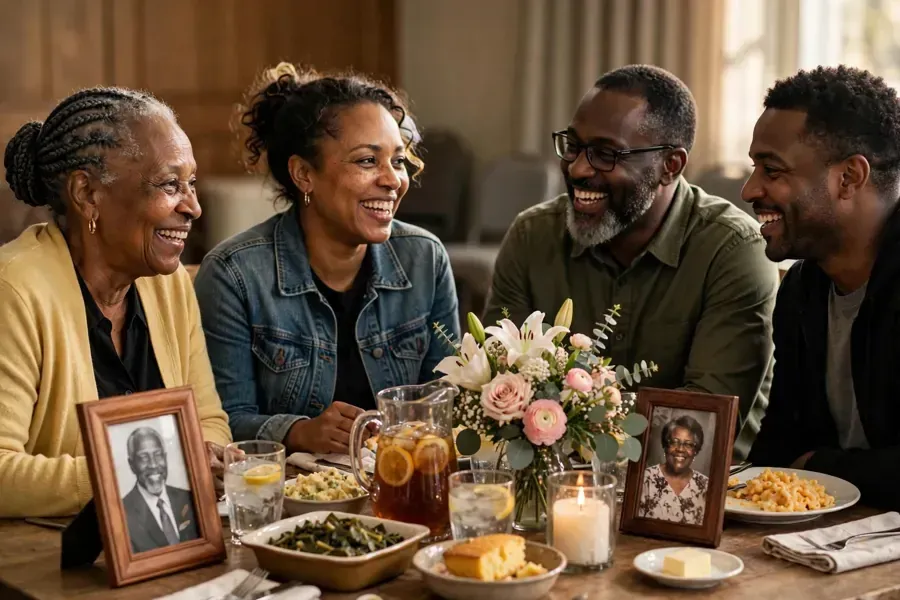
After the service and the burial comes the repast, and a guest who leaves before it has missed the homegoing’s second half. The repast is, as its cultural history records, an African-American cultural rite — a meal after the funeral where family, friends, and mourners share food, offer condolences, and provide mutual support.
Its roots run to West African mourning practice and to the travelling mourners of the slavery and Jim Crow eras who had journeyed far and had to be fed; through those years the church family and the neighbours became the safety net, and the fellowship-hall table — the fried fish, the stews, the greens, the cakes baked by hands that have baked them for fifty funerals — became mutual aid you could eat.
Guest craft at the repast is simple and warm. Go. Sit with people you do not know; the mixing is the point.
Eat what is offered with gratitude — the cooks are performing love in its most fluent language, and refusing the plate refuses the sentence. Tell the stories here that the sanctuary had no room for: this is where the laughter belongs, where the deceased is reassembled out of a hundred memories into somebody whole.
And if you are close enough to the family to be useful, be useful in the old way — serve, clear, drive an elder home — because at a repast, rank dissolves and everybody works for the family.
The Call Afterward
Now the part that separates the correct from the kind. Everyone is wonderful the week of the funeral. The test arrives in week three, when the family returns to a house full of their person’s absence and the world has resumed its noise.
Post-funeral guidance from funeral homes that watch families through this valley is practical: the days and weeks following a funeral can be particularly difficult, and ongoing support means checking in regularly, sending a thoughtful, personal condolence note with a specific memory, offering practical help with meals, errands, and children, respecting privacy without disappearing, and remembering the dates that will ambush the bereaved — the birthday, the anniversary — with a call placed before the day, not after.
Make your offers specific, because grief cannot delegate. “Let me know if you need anything” is a sentence that asks the drowning to assign tasks.
The Emily Post guidance makes the same point with an example worth copying exactly: offer the concrete thing — the grocery shopping, the house cleaning, the children for an afternoon — and close with “if you’d like,” so the offer carries no obligation to accept.
Then put the follow-ups in your calendar like appointments with the living, because they are: a call at two weeks, a note at a month, a standing invitation that survives being declined.
The pastors and funeral directors who walk our families through this — the men and women honoured in our Society Profiles — Pastors collection — will tell you the same thing: grief does not run on the funeral’s schedule, and neither should comfort.
A funeral done right, then, is a portrait of the guest as much as of the departed. Show up early and stay through the repast. Dress like the day matters, because it does.
Say the one true sentence. Send what the family asked for, in the name they gave you. And then — the whole standard in a single act — make the call afterward, and keep making it, until the family no longer needs it and only enjoys it.
Presence at the start is etiquette. Presence at the end is love, and everyone in that quiet house can tell the difference.
Proper Form, Part IV: The Thank-You Note — Stationery, Timing, and the Words That Land
Society Profiles — Pastors
The Emily Post Institute — “Etiquette Today: What to Say When Someone Dies”
Remembering a Life (National Funeral Directors Association) — “A Rich History: African American Funeral Traditions”
Wikipedia — “Repast (Funeral)”
Montgomery & Steward Funeral Home — “Post-Funeral Etiquette: Supporting Loved Ones After the Service”
Echovita — “Funeral Etiquette: What to Wear, Do and Say at a Funeral”
Roupp Funeral Home — “What to Bring (and What Not to Bring) to a Funeral”
Westminster Funeral Home & Cemetery — “Funeral Etiquette” (children, seating, and condolences)
Questions & Answers
What is the first thing to do when you enter a room or sit down to a meal?
Funeral etiquette begins with what to wear and whether to send flowers or donations — but it is finished weeks later, by the people still calling when everyone else has gone home.
What should you know about the Call Afterward?
Now the part that separates the correct from the kind. Everyone is wonderful the week of the funeral.
What does this article say about the Homegoing: Why Our Funerals Rejoice?
To attend a Black funeral well, you must first understand what it is.