
Titles and Names: Getting People Right
Forms of address pastor bishop judge etiquette — it is the smallest courtesy there is, and the one people remember longest: being called, correctly, by the name and title they have earned.
There is a moment, early in every important room, when a person is introduced — and in that moment the room learns two things at once: who they are, and whether the person introducing them did the homework. Forms of address pastor bishop judge etiquette is not a parlour game for the anxious. It is a record-keeping of achievement.
A title, in the institutions that shape Black life — the church, the court, the university, the professions — is rarely decoration. It is a summary: years of study, an election, an ordination, an appointment, a family’s sacrifices carried across a threshold and set, at last, in front of a name.
To get it right is to read that summary aloud, accurately, in public. To get it wrong — to demote a judge to Mrs., a doctor to Mr., a bishop to Pastor — is to announce that you did not think the summary was worth reading. This guide will make sure you never announce that.
Begin with the master rule, from which every specific form in this article descends: use the title a person uses, in the context you are in, until they invite you to do otherwise. Emily Post’s guidance on professional titles makes the practical version of the rule reassuringly simple for the most common case of all:
“If, when meeting people with doctorates, you’re unsure how to address them, ‘Dr.’ is always correct.”— The Emily Post Institute, “Professional Title Etiquette”
Notice the generosity inside that sentence. The correct instinct, when you are unsure, is upward — toward the fuller form of respect — and then to let the person relax it if they wish. That instinct will carry you through almost every situation in this article: the spoken introduction, the place card, the envelope, the podium announcement.
When in doubt, honour in full, and accept correction with a smile and no apology speech. People forgive an excess of respect instantly. They file a deficit away.
Spoken, Written, and Printed: Three Forms, One Person
The first confusion to clear is that a title has three lives. There is the written form, used on envelopes, programmes and invitations — the fullest and most formal version, where “The Reverend” and “The Honorable” belong. There is the spoken form, used in conversation and introductions — shorter, warmer: Pastor, Bishop, Judge, Doctor, followed by the surname.
And there is the printed form at the table — the place card — which has its own rules, covered below. Most errors happen when one life is used in another’s place: “Reverend Smith” written where “The Reverend Dr. Smith” was required, or a bare first name announced from a podium where a title was owed.
Emily Post’s correspondence guidance shows how carefully the written form is built for couples, including the principle that a woman who outranks her husband is listed by her title and name first — Dr. Jane Kelly before Mr. John Kelly — and that two doctors sharing a surname may be addressed together as The Doctors Kelly.
Rank, not habit, sets the order. That single principle, honestly applied, resolves most of the panicked questions hosts ask in the week before a dinner.
A second written rule saves endless awkwardness: courtesy titles and professional designations do not stack carelessly.
Emily Post’s correspondence guide notes that Ms. is the default form of address for a woman unless you know positively she wishes to be addressed as Mrs., that a professional designation used after a name replaces the courtesy title before it, and that “Esquire” for attorneys is used without Mr. or Ms. at all.
The pattern underneath is elegant: a name carries one marker of respect at a time, chosen correctly. Piling markers on — the Honorable Dr. Judge — does not multiply respect. It advertises uncertainty.
Doctor: The Title That Travels
Of all titles, Doctor travels furthest between professional and social life, and Emily Post’s professional-titles guidance draws the map clearly: medical doctors, dentists and other professionals are addressed by, and introduced with, their titles socially as well as professionally, while holders of a Ph.D. or another academic doctorate have the choice of using “Dr.” socially as well as professionally.
In rooms where education was hard-won — which is to say, in most of the rooms this magazine covers — that choice is usually exercised, and honoured.
Introduce the university president, the surgeon and the scholar alike as Doctor, with the surname, and let each of them be the one to say “please, call me by my first name,” if that is their pleasure. Never make the decision for them in the other direction.
Two refinements complete the Doctor file.
First, when a title sticks, it sticks: Emily Post notes that some titles outlast the office itself, observing that a local judge who has been called by his title for a number of years is usually addressed as “Judge” even after retirement — and the same courtesy extends, in practice, to retired professors, pastors emeriti and senior physicians in the communities they served.
Second, degrees belong after the name in writing, not in speech. Nobody is introduced aloud with their letters; the programme and the place card carry the record. Keep speech to Doctor and the surname, and you will sound like someone who has done this before.
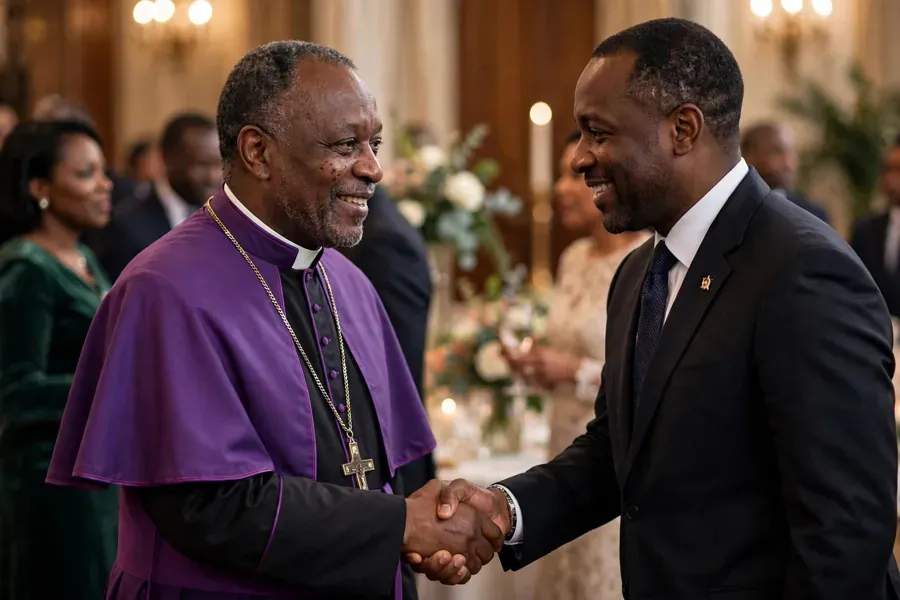
Pastor, Bishop, and the Church’s Own Order
At Black institutions — the anniversary banquet, the pastor’s ball, the scholarship dinner held in the fellowship hall that seats four hundred — titles carry history, and the church’s own order deserves the same precision as the court’s.
Here is the working map, kept cultural rather than doctrinal, because forms vary by tradition and the house always governs.
In writing, many Protestant clergy are addressed as “The Reverend” plus the full name; Emily Post’s guidance confirms that in introductions and correspondence, many Protestant clergy are referred to as “The Reverend”, and that in conversation the same person is addressed as Dr., Pastor, or Reverend plus the surname, as their tradition and preference dictate.
Where a doctorate is held, the written form becomes The Reverend Dr. — the pattern Emily Post illustrates with clergy couples, where the spouse holding the doctorate is listed first.
A bishop, in speech, is Bishop plus the surname — never a bare first name from a podium, and never reduced to Pastor, which names a different office in most traditions that use both words.
When a tradition uses additional offices or honorifics — and some do, with real meaning inside their own fellowship — the loving and accurate rule is the master rule again: use the form the person is introduced by in their own house, confirm it with the church administrator or event planner in advance, and write it exactly as confirmed.
The so-called suffix question — the letters and styles that follow or precede a name in a particular tradition — is settled the same way: not by debate at the reception desk, but by the person’s own usage, checked beforehand and honoured in full.
Introductions of clergy follow the order of the occasion. At a church-led event, the presiding clergy are presented before lay guests of honour; at a civic event where clergy are guests, they are introduced by the same rank logic as any other honoured guest.
The introducer’s craft is covered in our companion guide to introductions that open doors; the titles-specific point is simply to rehearse the full spoken form once, aloud, before the room fills. A stumbled title is forgiven; an unrehearsed one is a choice. And receive correction the way the well-bred always do — with thanks, immediately applied.
If a pastor says, warmly, “Pastor is fine,” then Pastor it is, for the rest of the evening and in your notes for next time. Our Pastors collection gathers the profiles of men and women whose names fill these programmes — read them with this guide open and you will see the forms at work.
Judge, the Honorable, and the Civic Forms
The civic titles run on a parallel track, and the key is knowing which word lives where. “The Honorable” is a written style, not a spoken one: it appears on the envelope, the invitation and the programme before the full name of a judge or elected official, and it is never used in conversation — nobody at a dinner says “Good evening, Honorable.” In speech, a judge is “Judge” plus the surname, or “Your Honor” in the courtroom setting itself.
Emily Post’s correspondence guidance shows the written machinery in action for couples, styling the judge “The Honorable Jane Kelly” on the envelope while her husband is Mr. John Kelly — her public office sets her line, and his courtesy title keeps its own.
Forms-of-address scholarship adds the stacking rule for people who hold more than one distinction: in the USA the honorific “Dr.” is used alone — not in combination with a courtesy title such as “the Honorable” — so a judge with a doctorate is The Honorable in writing and Judge in speech, with the degree recorded in the biography, not welded onto the name.
Choose the form that matches the setting — office for civic occasions, professional title for professional ones — and the name will sit correctly in any room.
For elected officials and appointees below the bench, the same architecture holds: The Honorable in writing for those entitled to it, the office in speech — Senator, Mayor, Councilwoman — plus the surname.
Retired officials generally keep The Honorable in writing for life where the office conferred it, and in speech the office often softens, by their own invitation, to the name.
When a serving official and a spouse with a professional title arrive together, list each by their own marker, higher public or professional rank first, exactly as the couples’ examples above demonstrate. It takes ninety seconds to check and it is visible all evening.
Place Cards: Where Titles Become Visible
Everything in this article becomes physical at the place card, which is why the image at the top of this page — gloved hands setting cards while the events director works the seating plan — is the truest picture of the subject.
Robert Hickey’s forms-of-address guidance on place cards states the founding principle: a formal place card simply identifies a person’s seat, and you write the name as the person is addressed in conversation — Mr. Hickey, Mayor Darr, Senator Feinstein, in his examples.
At official events, he adds, a very high office may appear alone — The President, The Chief Justice — because the office itself is the identification.
Banquet guidance from the stationery trade agrees on consistency as the governing virtue: formality should stay consistent throughout the table, using a title and full name for guests, applied at the same level of formality across all cards. That consistency rule is the one most often broken, and the break is always read as a ranking.
The table where one guest is “Dr. Amara Osei” and another, equally titled, is “James” has made a statement no host intended.
Decide the table’s level — full title and surname for formal and official dinners is the safe summit — apply it to every card including the hosts’ own family, and proof the cards against the confirmed list, name by name, before a single one is set down.
Clergy cards follow the spoken form: Bishop plus surname, Pastor plus surname, The Reverend reserved for the programme and the envelope.
And keep a few blank cards and a proper pen at the reception table, as the banquet guides advise, because the guest list of a living event always changes at the last hour — and a handwritten card in the same style beats a printed absence every time.
Families who gather for the milestones in our Jack and Jill and Links story will recognise the scene: the names are the heritage, and getting them right is the point.
Get people right and a quiet thing happens: rooms relax around you. Hosts trust you with introductions. Institutions trust you with their programmes.
Elders, whose titles encode the longest journeys in the room, register that the record is safe in your hands.
It costs nothing but attention — a checked spelling, a confirmed form, a rehearsed line — and it pays, for a lifetime, in the currency this magazine values most: being known as a person who honours what others have built, starting with their name.
Introductions That Open Doors
Jack and Jill, the Links, and the World They Built
Society Profiles: The Pastors Collection
Pastors: Profiles in Leadership
The Emily Post Institute — “Professional Title Etiquette: When to Use Your Dr. Title”
The Emily Post Institute — “How to Address an Envelope or Letter”
Forms of Address (Robert Hickey) — “How to Write a Name on a Place Card”
Forms of Address (Robert Hickey) — “How to Address a Person with Two Titles”
PaperDirect — “Banquet Place Card Etiquette & Tips”
Questions & Answers
What is the first thing to do when you enter a room or sit down to a meal?
Forms of address pastor bishop judge etiquette — it is the smallest courtesy there is, and the one people remember longest: being called, correctly, by the name and title they have earned. It links to 4 stories and articles — open any card to read the full piece.
How should a guest answer an invitation?
Forms of address pastor bishop judge etiquette — it is the smallest courtesy there is, and the one people remember longest: being called, correctly, by the name and title they have earned.
How do I read the full stories on Titles and Names: Getting People Right?
Choose any card on this page. Each one opens a full page of its own — the complete story or article, with its sources linked.