
The Vault, Part I: Watches — Buying the Piece Your Grandson Will Fight Over
The best watches to buy as investment are rarely the loudest ones in the room. They are the Patek Philippe pieces bought slowly and correctly — on condition, on originality, and on papers — by a collector who intends to be a chapter in the watch's story, not the end of it.
Ask a room of serious collectors to name the best watches to buy as investment, and the conversation settles quickly on Patek Philippe — not because the name is magic, but because the discipline around the name is. Condition and papers decide what a watch is worth long after fashion has had its say.
A fine watch is one of the few objects a family can buy once, enjoy for a lifetime, and hand down with its value — financial and otherwise — intact. But that outcome is not automatic.
It is earned at the moment of purchase, in the unglamorous details most buyers rush past: the sharpness of a case edge, the originality of a dial, the completeness of the file that travels with the piece.
This first instalment of The Vault is about buying at that level — the level where a watch stops being a purchase and becomes an inheritance.
Condition Is the First Price
Every experienced dealer will tell you the same thing in different words: you do not buy the reference, you buy the example. Two watches carrying the same reference number can be separated by a fortune, and the difference is almost always condition.
An unpolished case keeps the crisp lines the factory cut into it; each aggressive polishing softens those lines forever, and the market prices that softness without mercy. An original dial — never refinished, never "improved" — is worth more than a prettier replacement, because originality cannot be bought back once it is gone.
Hands, crown, and pushers should be correct for the period. Lume should age the way lume ages, evenly and honestly.
This is why the loupe matters more than the logo. Under magnification, a watch confesses everything: the service marks scratched inside the caseback, the hairlines on a bezel, the subtle difference between honest wear and hard living.
Collectors who buy at the serious level either develop that eye themselves or pay for the counsel of someone who has it — an independent watchmaker or a specialist dealer whose reputation rides on every piece that passes through their hands.
Either way, the rule stands: the cheapest example of a great reference is usually the most expensive mistake in the room.
Box and Papers: The Paper Trail Is Part of the Watch
In the trade, a "full set" means the watch arrives with its original box, its certificate of origin, its hang tags, and its service history — the complete documentary life of the piece. Seasoned buying guides make the point bluntly: completeness is what you are really buying.
Mio Jewelry's collector guidance argues that the premium a complete set commands at purchase is, in its words, "almost always recovered (and exceeded) at resale" — the full-set guidance is worth reading in full.
The resale specialists at myGemma put a figure on the other side of the same habit: keeping the box and papers can add up to 20% to a watch's value, while neglecting service can take a comparable slice away.
For older pieces, the paper trail takes a particular form. Patek Philippe maintains archives reaching back across its history, and an Extract from the Archives confirms when a watch was made and when it was first sold — the closest thing horology has to a birth certificate.
When a vintage piece comes to auction accompanied by that extract, with its manufacture and sale dates confirmed by the house itself, bidders are not only buying steel and gears; they are buying certainty. In a market where certainty is scarce, it commands a price of its own. Keep everything.
The outer box, the inner box, the swing tags, the receipt from the day you bought it, every service invoice that follows. Your grandson will thank you — and so will his auctioneer, should it ever come to that.
You never actually own a Patek Philippe. You merely look after it for the next generation.— Patek Philippe, the "Generations" campaign, via Wikipedia
That line, carried in the record of the house, is the most famous sentence in watchmaking, and it happens to be a precise description of how the finest collections are actually built. The Stern family has owned Patek Philippe since 1932 and runs it the way the slogan suggests — as stewards.
Collectors who thrive over decades tend to adopt the same posture toward their own boxes.
What the Summit Looks Like
It helps to know where the ceiling sits. The most expensive Patek Philippe ever sold is the one-of-one Grandmaster Chime ref. 6300A-010, which sold for $31.19 million at the Only Watch auction in Geneva in 2019, according to Global Boutique's market history.
Nobody builds a family collection at that altitude, but the result matters to everyone below it: it proves the depth of demand waiting for the very finest examples of the marque.
Closer to earth, consider the reference 2499, the perpetual-calendar chronograph Phillips has called a holy grail of the hobby.
Produced across thirty-five years in just 349 examples, a first-series yellow-gold 2499 from 1953 — held in private hands for a quarter-century and accompanied by the maker's own paperwork confirming its dates — was expected by Phillips to bring between US$1 million and US$2 million, as Robb Report recorded.
Thomas Perazzi, Phillips' head of watches for Asia, put the reference's standing plainly:
Praised by many and yet rarely seen by most, the Patek Philippe reference 2499 is with no doubt an absolute treasure in the rich heritage of the firm.— Thomas Perazzi, Head of Watches, Phillips Asia, via Robb Report
Notice what drives those numbers. Not novelty — rarity, condition, documentation, and time. The 2499 was not built as an investment product; it became one because few were made, fewer survived beautifully, and the ones that did can prove what they are.
That is the whole lesson of The Vault in a single reference: value at this level is manufactured slowly, by scarcity and care, and it is documented or it is doubted.
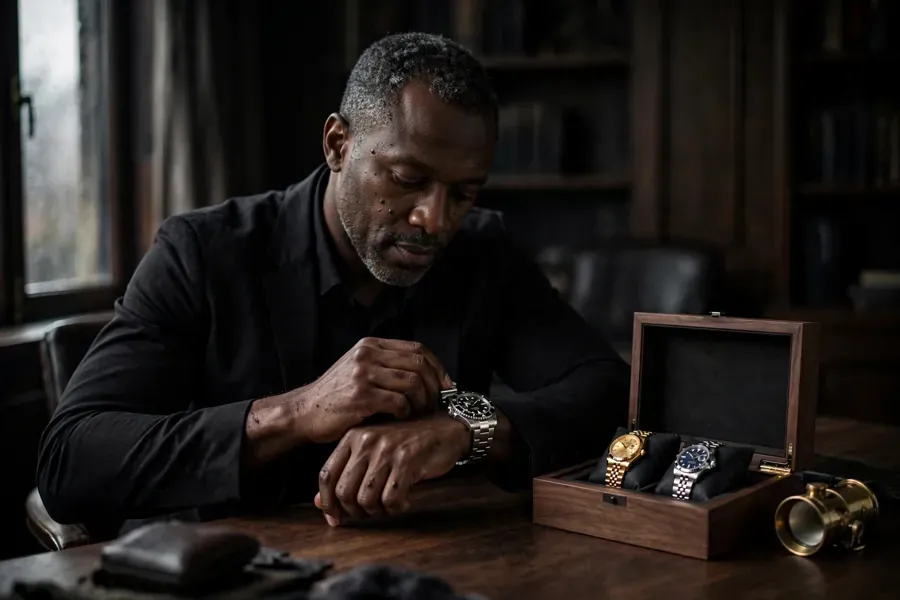
The Waitlist Game, Played Honestly
Now for the part nobody puts in the brochure. There is, for practical purposes, no public queue for the most wanted references.
As the dealer Wrist Aficionado explains in its account of how Patek Philippe allocations actually work, the manufacture does not run open waitlists; authorised retailers allocate scarce pieces privately, and the currency they trade in is relationship — above all, a genuine purchase history with that house.
Boutiques keep interest lists rather than first-come queues, favouring clients who have collected with them before. A new buyer asking for a steel Nautilus as a first piece is, in most cities, asking politely to be disappointed.
Played honestly, the game has rules worth respecting rather than resenting. Buy the pieces you actually want from the authorised dealer — the Calatrava you will wear to dinner, the annual calendar you have admired for years — and let the relationship accumulate naturally.
Register interest in writing, be specific about the reference, and be patient in a way that reads as serious rather than acquisitive. Never buy a watch you dislike as a toll payment; the market for unwanted pieces is unforgiving, and a collection built on tolls is a portfolio of regrets.
And understand the legitimate alternative: the pre-owned market, where established dealers sell the same references today at market price, with authentication, warranty, and no courtship required. Many fine collections are built entirely that way, and there is no shame in it — only arithmetic.
Servicing Is Stewardship
A mechanical watch is a machine that wears itself out politely, over years, in silence. Lubricants dry, gaskets harden, and friction begins its slow vandalism of the movement.
The consensus among watchmakers is unglamorous and consistent: specialists put the service interval for a luxury mechanical watch at roughly three to five years, depending on use and conditions, with a full service covering disassembly, cleaning, replacement of worn parts with original components, lubrication, regulation, and water-resistance testing.
Guidance for owners puts the common interval for most mechanical and automatic pieces in the same neighbourhood — roughly every four to six years — and warns that a watch left until it stops will cost its owner far more than the services that were skipped.
Two refinements separate the steward from the mere owner. First, documentation: every service should generate paperwork, and that paperwork joins the watch's file, because a documented service history is itself an asset the next buyer — or the next generation — can price. Second, restraint: polishing is the one service decision that can subtract value while intending to add it.
Heavy polishing rounds the edges that make a case desirable, and specialists counsel keeping refinishing careful and minimal. The factory service centres of the great houses understand this balance; so do the best independent watchmakers, who will often charge meaningfully less while working to preservation standards.
Choose deliberately, keep the invoices, and treat each service the way you would treat maintenance on a house you intend to leave to your children — because that is precisely what it is.
Three Doors Into the Collection
Serious collections are assembled through three doors, and the wise collector uses all of them knowingly. The first is the authorised dealer, where retail price rewards patience and relationship, as described above. The second is the auction room.
Geneva's seasonal sales — Phillips in association with Bacs & Russo, Christie's, Sotheby's — are where the hobby's centre of gravity sits, and where vintage pieces with genuine stories surface from families and estates. Auction buying demands its own arithmetic: the hammer price is not the price.
The Hour Markers' guide to the Geneva sales notes that bids at Phillips exclude a buyer's premium running to 27% on lots up to CHF 1.6 million — a fifth to a quarter added to every winning bid before the watch is yours.
Condition reports, in-person inspection during the viewing days, and a ceiling set before the sale begins are the auction buyer's equivalent of box and papers: non-negotiable, and cheaper than regret.
The third door is the established pre-owned market, already mentioned and worth stating plainly: for discontinued references — the steel Nautilus 5711 above all — it is not the alternative channel but, as the dealers themselves concede, the main one.
At the very top of the new market sits a fourth, narrower door: for limited and anniversary releases, the manufacture works through what Bob's Watches describes as the "Application Piece" process, in which a demonstrated collecting history is part of the application itself. None of these doors is the "right" one.
Each prices a different mixture of money, time, and certainty — and the collector who understands all four prices is the one the market cannot hurry.
Buying the Piece Your Grandson Will Fight Over
So the Vault's first rule of watches writes itself. Buy the great houses, buy the best example you can find, and buy its whole story — box, papers, archive extract, service file — or do not buy it at all. Play the allocation game with patience and self-respect, or step around it through dealers whose names are their bond.
Service on schedule, polish almost never, and keep every scrap of paper in one place. A watch bought this way does two jobs at once: it marks your time beautifully, and it waits, appreciating in every sense, for the wrist that comes after yours. The grandson who fights over it will not be fighting over a thing.
He will be fighting over proof that his family bought well, kept well, and understood the difference between owning and looking after. That is the only kind of wealth that reliably survives the journey down the generations — and it begins, unglamorously, with condition and papers.
A final practical word: a collection of this value belongs on the schedule of a proper valuables policy, appraised and photographed — the subject of our companion piece on insuring the life you've built. And for the watch as it is worn rather than vaulted, see our style desk's companion, The Watch on the Wrist.
The Watch on the Wrist
Insuring the Life You've Built: Valuables, Liability, and the Umbrella Mindset
Empire Makers — Society Profiles
Global Boutique — "Are Patek Philippe Watches A Good Investment?"
Robb Report Hong Kong — "This Ultra-Rare Gold Patek Philippe Watch Could Fetch US$2 Million at Auction This Fall"
Mio Jewelry — "Best Patek Philippe Watches To Own In 2026"
Wikipedia — "Patek Philippe"
Wrist Aficionado — "Patek Philippe Watches: How Allocations Work"
myGemma — "Watch Damage: How Will It Affect The Resale Value?"
EIN Presswire — "Watch Collectors Urged to Consider Servicing as Key to Preserving Value"
The Hour Markers — "The Fall Geneva Watch Auctions: Where History, Independents and Icons Converge"
Bob's Watches — "Patek Philippe Nautilus 50th Anniversary: What Collectors Need to Know"
Questions & Answers
What is generational wealth?
The best watches to buy as investment are rarely the loudest ones in the room. They are the Patek Philippe pieces bought slowly and correctly — on condition, on originality, and on papers — by a collector who intends to be a chapter in the watch's story, not the end of it. It links to 3 stories and articles — open any card to read the full piece.
How do families start building generational wealth from zero?
The best watches to buy as investment are rarely the loudest ones in the room. They are the Patek Philippe pieces bought slowly and correctly — on condition, on originality, and on papers — by a collector who intends to be a chapter in the watch's story, not the end of it.
How do I read the full stories on The Vault, Part I: Watches — Buying the Piece Your Grandson Will Fight Over?
Choose any card on this page. Each one opens a full page of its own — the complete story or article, with its sources linked.