
The Vault, Part IV: Art — Building a Collection That Starts With Black Masters
How to start collecting art — Black artists, auctions, guideposts and all — begins with conviction: know the masters, educate your eye, and buy work your grandchildren will be proud to inherit.
Every serious collection in our houses starts the same way: one painting that would not leave you alone. You saw it in a gallery, or across a fair aisle, or on a friend's wall, and it followed you home in your head.
Learning how to start collecting art — Black artists at the centre, auctions as one tool among several, this guide as your map — is really about turning that first pull of the heart into a discipline: an educated eye, a paper trail kept like a vault record, and the patience to build slowly.
The good news is that the tradition you are joining is deep and distinguished. Black collectors have been patrons, tastemakers and keepers of the culture's image bank for generations. What has changed is the market's temperature — and the need, therefore, to collect with both love and method.
The First Rule Has Never Changed: Buy What You Love
If you do not love the artwork and your investment flops, you are left with a piece of resentment hanging on your wall.— Chubb, "Nine Tips for the Emerging Art Collector"
The line, from Chubb's nine tips for the emerging collector, is the whole philosophy in one sentence. Chubb's advisers put it first for a reason: cultivate your taste, then buy what you love. Taste is trained, not born — in museums, in galleries, in artists' studios, looking until looking becomes judgement.
The same guide warns against the beginner's hurry: even with plenty of wall space, slow down, set a defined goal for the collection, and treat collecting as a lifelong endeavour rather than a decorating sprint. A collection assembled in a season looks like it.
A collection assembled over twenty years, piece by considered piece, becomes a portrait of the family itself — which is precisely why it belongs in the Vault, alongside the watches, the jewellery and the wine: it is an asset you live inside.
Know the Masters Before You Chase the Market
A collection that starts with Black masters starts, first, with homework — and the syllabus is glorious.
The Princeton University Art Museum's history of collecting African American art reaches back to its 1976 exhibition Fragments of American Life, which showed Romare Bearden, Joseph Delaney, Rex Goreleigh, Lois Mailou Jones, Jacob Lawrence and Hale Woodruff — artists championed decades earlier by the philosopher Alain Locke in The Negro in Art.
That lineage runs forward through Charles White to Kerry James Marshall, whose large-scale paintings place Black figures at the centre of the Western canon he mastered form by form, and on to the generation he opened the door for. Why does the canon matter to a buyer?
Because it teaches your eye what ambition looks like on canvas — the flattened planes of Lawrence, the layered symbolism of Marshall — and an eye that knows the masters recognises quality in a young painter's second show, years before the auction houses do. Collecting with conviction means buying from knowledge, not from heat.
The Market Is Real — Read It Soberly
None of this is to pretend the market is quiet, because it is not.
Artscapy's survey of collecting Black contemporary art notes the ongoing rise of Black artists in the global market, with strong gallery representation, notable auction performances and growing institutional acquisitions — pointing, for example, to Otis Kwame Kye Quaicoe's psychologically rich portraits achieving six-figure auction results, significantly exceeding estimates at Phillips and Christie's.
Culture Type's Christie's coverage records the house's inaugural 21st Century Evening Sale in New York, where ten leading Black contemporary artists were featured, six set new artist records, and Nina Chanel Abney's 2015 painting of two Black officers arresting a white man sold for $990,000.
And when an Amy Sherald painting reached a record-setting $4.2 million at Phillips, with works by four more Black artists setting benchmarks in the same sale, the message was not "buy anything" — it was that the museums, the scholarship and the saleroom have finally arrived at the same conclusion our families reached long ago.
The sober collector takes records as information, not instructions: they confirm that quality and importance are being recognised, and they raise the cost of dithering on the primary market, where the same artists' work is still priced by galleries rather than by bidding wars.
Galleries and Fairs: Where Collections Actually Begin
For all the auction headlines, most great collections are built the unglamorous way: gallery by gallery, relationship by relationship. Artsy's collector's guide to attending an art fair opens with the discipline that separates collectors from shoppers: going to an art fair is about educating your eye.
Work the fair with a shortlist — ten to twenty booths, revisited slowly — ask questions, request the artist's biography and CV, and ask what else the gallery holds beyond the booth walls, because the visible display is only the tip of the inventory.
The guide's deeper point deserves framing: when you commit to an artwork you are, to no small extent, committing to that gallery, and a gallery worth its salt will spend time with you, explain, and be open to discourse. Buy from people who teach you.
The seasoned voices in the same guide counsel patience at fairs — go to learn before you go to buy — and, when the moment comes, to do the research and the due diligence, then follow your heart to the work you will live with.
That is the rhythm of the primary market: previews offered to known collectors, prices that reward loyalty, and studios visited before the world arrives.
The Paper Trail: Provenance, Condition, and the File You Keep
A Vault piece is only as strong as its file.
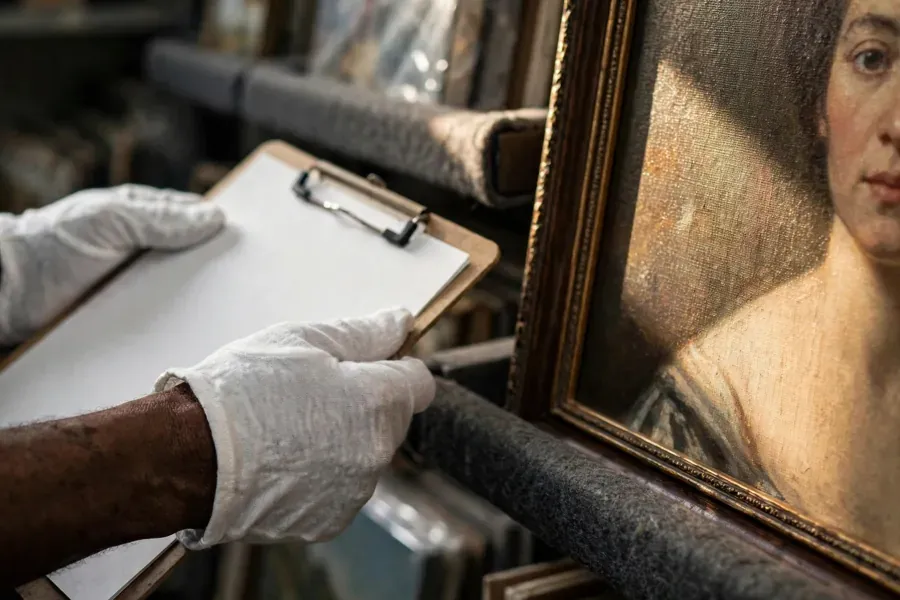
The standard documentation set for serious collections runs to ten records, and a disciplined collector keeps them all: the artwork inventory record (title, date, medium, dimensions, images, location, price); the certificate of authenticity; the bill of sale or invoice proving the transaction; the provenance record — the chain of ownership with its supporting documents; the condition report, with photographs, noting existing damage and frame and installation concerns; consignment and loan agreements when work leaves your walls; copyright and rights records; the exhibition and publication history; and the conservation record of any treatment, with before-and-after images.
Two of these deserve emphasis. Provenance is the work's biography — who owned it, where it hung, which exhibitions carried it — and it is the first thing appraisers, museums and future buyers examine when value is argued.
The condition report is its medical chart: a dated, photographed statement of the work's physical state that protects you at purchase, in transit, on loan and at claim time. Keep the file with the same seriousness as the art: scanned, backed up, and updated every time the work moves, is treated, or is shown.
Protect It Like the Asset It Is
The final discipline is protection, and it is where new collectors most often under-build. Brown & Brown's fine-art insurance guidance starts from a fact worth underlining: standard homeowners policies may not provide adequate coverage for high-value fine art, so collectors commonly carry a standalone fine-art policy against fire, theft, accidental breakage and other perils.
Value is established by a qualified appraiser, who documents each piece's condition and market value — and the appraisal is a living document: the same guidance advises updating appraisals every three to five years to keep coverage accurate, with more frequent reviews for some items.
Strong policies travel with the work — "wall-to-wall" coverage that follows pieces in transit and on loan — and when a museum borrows a piece, the usual counsel is to layer the museum's insurance with your own rather than surrendering protection entirely.
One household habit ties the whole section together: the moment a work's value moves materially — a record at auction for the artist, a museum retrospective announced — call the broker before you call the framer. Insurance bought at yesterday's value is a story families tell with regret.
Starting Positions: Prints, Paper, and Buying Direct
Not every Vault begins at evening-sale altitude, and the masters themselves would tell you the eye matters more than the entry price.
This Is African Art's collecting guide for beginners and enthusiasts lays out the sensible first rungs: set a budget that lets you explore without financial strain, and start small — smaller pieces and limited-edition prints that resonate with you, found at lower price points while your taste develops.
The same guide's authenticity discipline belongs in every starter file: research the artist's background, techniques and cultural context; consult reputable galleries or auction houses for expert opinion; always ask for a certificate of authenticity and provenance information; and examine the piece itself, its materials and craftsmanship, before money moves.
Its final counsel is the one that turns buyers into patrons: collecting is also about supporting a living artistic ecosystem — buy directly from artists or through their representing galleries where you can, and show up, at exhibitions and fairs, for the community your walls will come from.
A first shelf of prints and works on paper by artists you have met, whose certificates and invoices sit in your file, is a more honourable beginning than one expensive guess — and history is full of collections whose modest first rungs became their most valuable, because the eye that chose them had been trained early and honestly.
Auction Strategy, and the Long Game
When you do buy at auction, buy like a collector, not a contestant. Study the condition report the house provides and ask for more photographs; set your ceiling before the sale — hammer plus premium — and let lots pass when the room runs past it, because another work always comes.
Favour, early on, the drawings, prints and works on paper of artists you admire: the Artscapy and Culture Type record shows how quickly evening-sale prices climb, and the secondary market's entry rungs are where an educated eye still finds value. Then hold.
The collectors our Empire Makers profiles celebrate built their walls the same way this Vault was built — one loved, documented, protected piece at a time — and thought about the endgame from the beginning: which works the children will keep, which the museum will one day be offered, and how the giving itself should be structured, a question our companion piece on philanthropy with structure takes up in full.
Begin with the masters in your sights, your eye in training, and your files in order — and the collection will do what the best Black collections have always done: hold value, hold memory, and hold the family story on the wall where everyone can see it.
Philanthropy With Structure: Foundations, Donor-Advised Funds, and Giving That Lasts
Estate Planning Is Love, Written Down: The Plan Every Wealthy Family Owes Its Children
Empire Makers — Black Excellence Profiles
Chubb — "Nine Tips for the Emerging Art Collector"
Artsy — "The New Collector's Guide to Attending an Art Fair Like an Art-World Insider"
Artscapy — "Collecting Black Contemporary Art: A Timely Investment Beyond Black History Month"
Culture Type — Christie's coverage, incl. the inaugural 21st Century Evening Sale
Culture Type — "Amy Sherald Painting Skyrockets to Record-Setting $4.2 Million at Phillips"
Princeton University Art Museum — "Collecting African American Art"
Lisa Stavinoha Art — "Essential Art Documentation Every Artist, Collector and Gallery Needs"
This Is African Art — "Collecting African Art: A Guide for Beginners and Enthusiasts"
Brown & Brown — "Fine Art Insurance for Private Art Collections"
Questions & Answers
What is generational wealth?
How to start collecting art — Black artists, auctions, guideposts and all — begins with conviction: know the masters, educate your eye, and buy work your grandchildren will be proud to inherit. It links to 3 stories and articles — open any card to read the full piece.
How do families start building generational wealth from zero?
How to start collecting art — Black artists, auctions, guideposts and all — begins with conviction: know the masters, educate your eye, and buy work your grandchildren will be proud to inherit.
How do I read the full stories on The Vault, Part IV: Art — Building a Collection That Starts With Black Masters?
Choose any card on this page. Each one opens a full page of its own — the complete story or article, with its sources linked.