The Benefit Concert and the Museum Night: Culture as Philanthropy
Museum patron circles, their benefits, and the art of joining young patrons: how the culture calendar funds itself — and how a family builds its patron identity, one beautiful evening at a time.
There is a moment, about twenty minutes into a museum benefit, when the evening quietly explains itself.
The quartet is playing on the landing, the galleries are open after hours, your glass is full — and somewhere behind the marble and the music, an exhibition is being paid for, a school programme is being underwritten, an artist's next year is being made possible.
That is the bargain at the heart of museum patron circles and their benefits: joining young patrons and senior circles alike is how the culture calendar funds itself, converting pleasure into patronage so gracefully that the guests can forget, for an evening, that they are the funding model.
This piece is a map of that machinery — the benefit formats, the circles and their ladders, the naming gifts handled tastefully, and the long game by which a family becomes, over years, part of the furniture of the institutions it loves.
How the Culture Calendar Funds Itself
Start with the benefit itself, because its economics are widely misunderstood. A benefit concert or museum night is not a party with a ticket price; it is a fundraising instrument wearing evening dress.
The ticket carries a charitable portion above the fair value of the dinner and the music, the sponsorship tiers stack recognition on top of seats, and the room is gathered precisely because its members have demonstrated they will give.
The scale this machinery can reach, in the right institution, is considerable: the Studio Museum in Harlem's annual gala — a single evening — drew more than 700 artists, trustees, philanthropists and civic leaders and raised more than $3.7 million, on a night that also carried a $10 million Ford Foundation endowment grant and the presentation of the $50,000 Joyce Alexander Wein Artist Prize.
Announcing the Ford gift, its president Darren Walker called the museum "one of America's cultural treasures" — and the setting was the point. Foundations announce transformational gifts at benefits because the room itself is evidence: a constituency that shows up, dressed, giving, year after year.
Below the gala's summit, the same machinery runs at every scale.
Orchestras and ensembles structure it as sponsorship: one Gulf Coast symphony's published ladder, typical of regional houses, runs from musician sponsorships in the low thousands through guest-artist and concert sponsorships to a season sponsorship at $75,000 and above, with the orchestra stating plainly what the money does — keeps concerts affordable, brings in high-calibre guest artists, and funds education and outreach across the community.
Hold that sentence in mind, because it is the entire case for cultural philanthropy in one line: the benefit is not decoration on the art. The benefit is how the art survives its own box office.
The Young Patron Circles: Where a Patron Life Begins
Every great institution now keeps a door built for the under-forty patron, and the design is remarkably consistent: a meaningful but reachable annual gift, a calendar dense enough to build friendships on, and access that makes a young professional feel — accurately — like an insider in formation.
The Metropolitan Museum's Apollo Circle is the archetype: $1,500 a year for members aged 21 to 39, of which $899 is tax-deductible, with a Patron tier at $3,500 that adds behind-the-scenes tours of conservation labs and libraries, private collection tours, artist studio visits and passes to select global art fairs.
The Met describes the circle's purpose without embarrassment: members' giving gives curators, educators and conservators a reliable source of funding — which is to say, the institution tells its young patrons the truth, that they are needed, and rewards them with the run of the house.
MoMA built the template a generation ago: its Young Patrons Council, founded in 1990 for art enthusiasts between 21 and 40, with dues MoMA lists at $1,200 for an individual and $2,000 for two, trades in exactly the currency young patrons value — galleries after hours, artist studios, private collections, curatorial tours — and in the relationships that form across a decade of such evenings.
MoMA's wider architecture shows where the ladder leads: a Patron Program in Contributor, Benefactor and Leader tiers at $1,500, $5,000 and $10,000, and affiliate groups gathered around shared affinities, among them a Black Arts Council — a reminder that the circles are also where collectors of African descent organise their patronage deliberately, together.
Houston's Museum of Fine Arts makes the same point in its own accent: its patron groups include the African American Art Advisory Association, known as 5A, founded in 1993 to support the museum's collections, education programmes and community outreach — three decades of proof that an affinity circle, faithfully kept, becomes an institution inside the institution.
The advice for the young patron is therefore simple and sequenced. Choose one house — the museum or orchestra whose work you actually love — and join its young circle properly: pay the dues, then work the calendar. The benefit of these circles compounds through attendance; the curator-led tour you skip is the relationship you did not build.
Bring your partner, bring friends who should be patrons, and let the institution watch you be reliable.
Reliability, noticed over seasons, is what turns a young patron into a committee member, a committee member into a benefit chair, and a benefit chair into the kind of name a development director calls first — the natural graduation our guide to the art season assumes when it talks about moving through art week like a collector-citizen.
The Formats of the Night — and the First Rung
New patrons are sometimes surprised by how many distinct evenings hide under the single word "benefit," and learning the formats is part of learning the world.
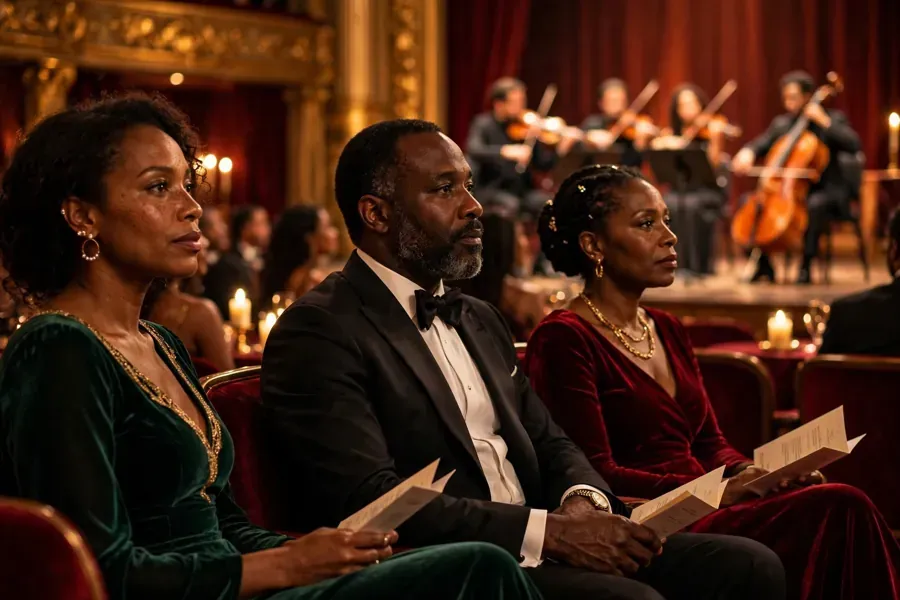
The museum night is the flagship: galleries open after hours, a quartet or a celebrated soloist in the great hall, dinner among the collection or cocktails beneath the staircase — pleasure engineered so that the institution surrounds you with the very work your ticket sustains.
The benefit concert reverses the polarity: the music is the main event, the giving is woven into sponsorships and programme recognition, and the reception before or after is where the institution thanks its underwriters in person.
Around those two poles orbit the working formats — curator-led previews, artist dinners, studio visits, the young patrons' ball — each calibrated to a rung of the ladder, each giving the development office a reason to put the right twenty people in a room together.
When an invitation arrives, read it for its format before its glamour: the small curator's dinner will teach you more, and bind you closer, than the ball ten times its size.
Nor does the ladder begin at four figures. The Bronx Museum's published membership opens its Emerging Patron rung at $250 a year for an individual and $400 for two, carrying invitations to artist studios, curator-led tours of art fairs and reciprocal admission to hundreds of institutions nationwide — the whole young-patron experience, honestly priced for a first step.
Fotografiska New York similarly prices its Young Patron membership at $1,000 a year for patrons of 27 and under, built around artist dinners and a community of emerging culture-makers. The lesson is encouraging and worth stating plainly: patronage is a habit before it is a fortune.
The couple who begin at the emerging rung of a museum they love, attend faithfully and rise as their means rise, will be known and welcomed in that house for decades — which is the entire object of the exercise.
The Patron Ladder and the Tasteful Name
Above the young circles, the ladder formalises.
Boston's Museum of Fine Arts publishes a representative structure: Patron Member at $3,000 to $5,999 a year, Patron Fellow at $6,000 to $11,999, and Patron Sponsor at $12,000 to $29,999 — each rung adding what patrons actually cherish: a dedicated concierge line, early access to exhibition tickets, travel with curators, invitations that get smaller and better, and, at the Sponsor level, the ability to rent the museum's own spaces for a private evening at a steep discount.
Read the ladder as a curriculum. The lower rungs buy access; the middle rungs buy proximity to the people who make the work; the upper rungs buy a voice in the room where the institution's future is discussed.
A family climbing deliberately — one institution, rising a rung as means allow, never scattering small gifts across a dozen letterheads — arrives at the top of that curriculum with something money alone cannot purchase quickly: a reputation inside a house that matters to them.
At the ladder's top sit the naming opportunities, and they are where taste is tested. A named gallery, a named concert series, an endowed chair, a prize that carries a family name into every programme: these are the permanent furniture of a patron identity, and the institutions offer them because endowment is culture's only true pension.
The Studio Museum's Wein Prize evening shows the graceful version — a named, juried honour for an artist, presented by the director as part of the institution's own story. Thelma Golden's words for the recipient that night capture what a well-placed naming gift actually buys — not signage, but association with excellence at the moment it is recognised:
Toyin's intricately depicted works in pen, pencil, charcoal, and pastel are active inquiries into the possibilities of world building and visual storytelling.— Thelma Golden, Director and Chief Curator, the Studio Museum in Harlem, via Culture Type
The rules of taste follow from that example. Name things that live — prizes, programmes, fellowships, a concert series — rather than things that merely stand. Let the institution propose the wording and accept its typography without negotiation; a name handled by the house's own designers will still be elegant in fifty years.
And time the gift to the institution's campaign rather than your own announcement calendar: the family whose name arrives inside a great collective effort is remembered as a builder, while the name that arrives with a press release of its own is remembered as a billboard.
The architecture that holds all of this — how cultural giving sits inside a family's total philanthropy — is the subject of our guide to philanthropy with structure, and the profiles of the arts board members in our Empire Makers collection show the end state: patrons whose names and institutions have grown up together.
Building a Family's Patron Identity
Patronage, done over years, becomes identity — and identity is built the way collections are: deliberately, in the open, with the next generation watching. Bring your children to the member previews; let them learn that the museum has a door that opens for your family because your family helps hold the building up.
Keep one signature evening a year — the benefit your household never misses — and let it anchor your social season the way the gala circuit's great nights anchor their cities. When you travel, use the reciprocal courtesies your membership carries and visit sister institutions as a patron, not a tourist.
And keep your giving as steady in a lean year as in a fat one, at whatever rung you can honour: institutions forgive a smaller cheque far more readily than a vanished one, because what they are really banking is your continuity.
That is the quiet truth the benefit concert teaches, somewhere between the quartet on the landing and the last glass of the night. Culture does not fund itself by accident, and it does not fund itself by strangers.
It funds itself by families who decide that certain rooms — a museum's galleries, an orchestra's hall, a theatre's stage — are part of their own household's inheritance, and who then show up for those rooms the way they show up for their own: dressed, generous, and there every year. Join the circle. Climb the ladder kindly.
Put your name, when the time comes, on something that lives. The music will do the rest.
The Art Season: Fairs, Auctions, and Opening Nights
Philanthropy with Structure
Empire Makers — Society Profiles
Culture Type — "Studio Museum in Harlem Annual Gala Celebrates Wein Artist Prize Recipient Toyin Ojih Odutola and New $10 Million Endowment Grant From Ford Foundation"
Hyperallergic — "Studio Museum in Harlem Receives $10M From Ford Foundation"
The Metropolitan Museum of Art — "The Apollo Circle"
MoMA — "Patron Program and Affiliate Groups"
Museum of Fine Arts, Boston — "Patron Program"
The Museum of Fine Arts, Houston — "Patron Groups"
Gulf Coast Symphony — "Sponsorship"
The Bronx Museum — "Become a Member"
Fotografiska New York — "Young Patron Insider Membership"
Questions & Answers
Who will you meet on this page?
Museum patron circles, their benefits, and the art of joining young patrons: how the culture calendar funds itself — and how a family builds its patron identity, one beautiful evening at a time. It links to 3 stories and articles — open any card to read the full piece.
What makes these stories worth reading?
Museum patron circles, their benefits, and the art of joining young patrons: how the culture calendar funds itself — and how a family builds its patron identity, one beautiful evening at a time.
How do I read the full stories on The Benefit Concert and the Museum Night: Culture as Philanthropy?
Choose any card on this page. Each one opens a full page of its own — the complete story or article, with its sources linked.