
Brothers in This: The Quiet Fraternity of Men Who Have Been There
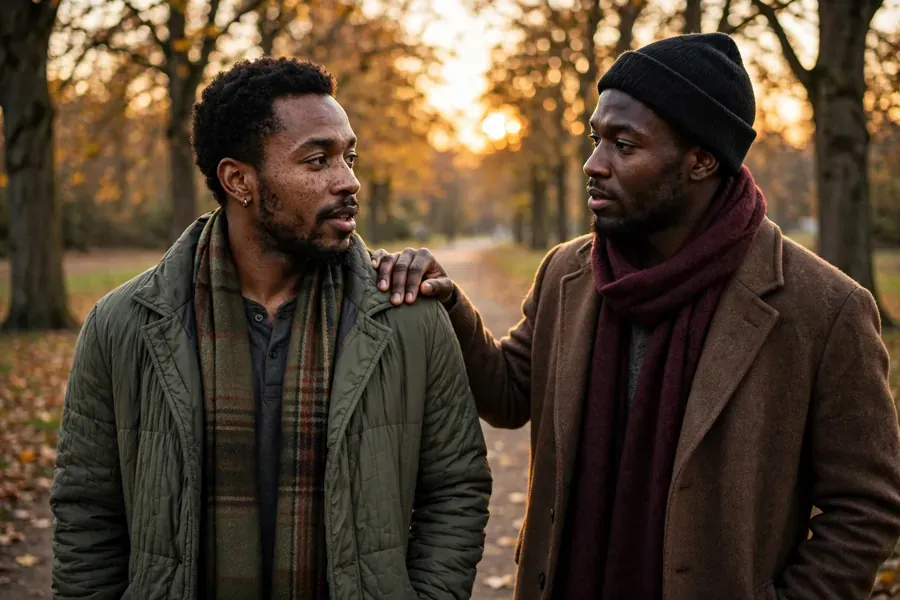
Black men peer support groups rarely call themselves that. They are the breakfast circle, the walking pair, the brothers who have been there — and the quiet fraternity may be the strongest medicine a proud man will ever take.
Ask a man who has carried a great deal — a business, a family, a name — what finally helped him through the hardest season, and he will rarely name a technique. He will name a man. The friend who called on the bad Tuesday without being asked.
The older brother, not by blood, who listened all the way to the end of the story before offering a word.
This is a piece about that fraternity: Black men peer support groups in their many forms, formal and gloriously informal, and the quiet brotherhood of men who have been there — through grief, divorce, illness, a father's death, a son's trouble, a business on the edge — and who make themselves available to the next man coming through the same door.
It helps to know this is not merely sentiment; it is a model with a serious evidence base behind it.
Peer support, in the definition used by the Substance Abuse and Mental Health Services Administration and summarised in SAMHSA's guide to incorporating peer support into treatment services, rests on help offered from shared understanding — people in similar situations supporting one another, with recovery understood as a process of change through which a person improves their health and wellness and strives to reach their full potential.
Strip away the professional vocabulary and you have something our grandfathers would recognise instantly: a man who has been where you are, sitting with you until the ground feels solid again.
Peer-to-peer support and shoulder-to-shoulder collaboration have the power to support mental wellbeing and build resilience.— Movember, on its Making Connections initiative
Shoulder to Shoulder: How This Brotherhood Actually Works
Notice the geometry in that Movember line. Not face to face, under interrogation lights — shoulder to shoulder.
The Making Connections initiative, which Movember built to improve mental health and wellbeing among men and boys of colour, works exactly that way: it connects men in the places where they already spend their time, through activities they already enjoy, building on community strengths to address isolation and create lasting connection — in some communities, literally around bicycle shops and basketball courts.
The lesson travels well beyond any one programme. Men open up while doing something: walking, driving, working with their hands, watching a game badly. The wise circle builds the conversation into the activity, and lets the honesty arrive sideways, at its own pace.
Movember's wider work in social connection, described in its account of the programmes it supports, includes the Young Black Men project — YBmen — originally developed in the United States to give young Black college men social and educational support through a private group of their peers.
The pattern repeats at every age: privacy, peers, and a door that is easy to walk through. What changes across the decades is only the furniture — a dorm room becomes a barbershop becomes a Saturday breakfast table — while the medicine stays the same.
The Rooms That Already Exist
For the man who wants a room with a name and a meeting time, the infrastructure is better than it has ever been — and much of it was built specifically with Black men in mind.
The National Alliance on Mental Illness keeps a considered list in its NAMI HelpLine guide to resources for the Black community: Black Men Heal, which provides access to mental-health treatment, education and community resources to men of colour; the Black Emotional and Mental Health Collective — BEAM — with its education, community and support groups; the Black Mental Health Alliance and its locator for culturally competent professionals; and Brother You're on My Mind, the initiative of Omega Psi Phi Fraternity and the National Institute on Minority Health and Health Disparities, which equips fraternity brothers and community members with a toolkit on depression and stress in Black men.
NAMI's own Sharing Hope series, and its Black and African Ancestry Male Mental Health conversations, create facilitated spaces where men can set the performance down for an evening.
Alongside the national names runs a quieter layer: therapist-led groups for Black men, meeting online and in person, with the protection and structure of a professional in the room.
Empowered Transitions Counseling's Healing for Black Men group describes its offer in language any man in this fraternity will understand: a space to talk openly about what you are carrying, to connect with men who truly get it, and to build steadier ways of managing anxiety, stress and the pressures of daily life — together, in brotherhood.
And the professional conversation around all of this is maturing: Patient.info's Movember spotlight on Black men's mental health documents programmes from school-based counselling to community peer-support forums, and the growing insistence that services meet Black men with genuine cultural understanding rather than a generic welcome.
The Informal Fraternity: Building Yours on Purpose
And yet — most of the brotherhood that saves men will never have a website. It is the four friends who have breakfast on the first Saturday of the month and have done for twenty years. It is the walking pair who cover three miles and everything that matters before the coffee.
It is the group chat that knows the difference between a joke and a flare. If you are fortunate, you already belong to such a circle without ever having named it. If you are not, build one the way you would build anything meant to last: small, regular, and honest about its purpose.
A few working rules, gathered from how the durable circles actually run. Keep it small enough for trust — four to eight men is a room; thirty is an audience. Meet on a rhythm that survives busy seasons, attached to something pleasant: a walk, a meal, a drive.
Let age mix freely; the man of seventy who has buried a wife and the man of forty in the middle of a divorce are not at different tables, they are at different chapters of the same book, and each is the other's best reader. Protect confidence absolutely — what is said in the circle is the circle's.
And make room, explicitly, for the hard subjects alongside the easy ones: money trouble, a frightening diagnosis, a marriage under strain, a child you are worried about. A fraternity that can only do sports scores is a fan club. The brothers who have been there can do the scores too — after the real thing has been said.
Two boundaries keep the fraternity healthy, and a gentleman honours both. The first: peers are not clinicians. A brother's listening is powerful medicine for loneliness, grief and the ordinary weight of a life, and the circle should be the first to say — warmly, without drama — when a man's season calls for professional help alongside fraternal help.
Our companion piece on elite mental-health care and total discretion exists precisely so that step can be taken with dignity. The second boundary runs the other way: do not let pride dress itself up as privacy. The men in these rooms are, almost to a one, men who once believed they should carry it alone.
Every one of them can tell you what that belief cost, and what it paid to set it down.
Where This Fraternity Has Always Lived
None of this is new, and it is worth saying so.
Long before peer support had a professional name, it had addresses: the barbershop chair where a man's week got talked through while the clippers hummed; the fraternity line that became, decades later, a phone tree of brothers who check on one another as a matter of honour — the same impulse NAMI's list records in the Brother You're on My Mind partnership between Omega Psi Phi and the National Institute on Minority Health and Health Disparities; the church men's breakfast, the lodge, the veterans' table at the diner, the uncles on the porch who made a young man's troubles their agenda without ever calling it that.
The modern groups, the facilitated rooms and the online circles, are not replacements for those institutions. They are their continuation, by other means, for men whose lives have scattered them far from the porch. If your life still has a barbershop or a breakfast table where the real conversation happens, you are richer than your balance sheet says.
Protect those rooms. Show up to them. They are infrastructure.
And if distance, success or circumstance has quietly thinned your circle — a common, unspoken tax on the very lives this magazine celebrates — treat rebuilding it as seriously as you would any other part of the well-kept self.
The formal doors stand open, from NAMI's Sharing Hope conversations to the groups named above, and the informal one is simpler still: one honest invitation, to one man you respect, for a walk that repeats. Fraternities, like families, are mostly just people who kept showing up.
Being the Brother Who Has Been There
There is a final turn in this story, and it is the one that completes the well-kept self. At some point — sooner than you expect — you stop being only the man who was carried, and become one of the carriers. The divorce you survived becomes the map you quietly hand to a friend at the start of his.
The year you sat with your father's illness becomes the reason you know exactly what to say, and what not to say, in a hospital corridor. Nothing about this requires a title or a programme.
It requires a phone call returned, a visit made, a confidence kept, and the willingness to say the four most useful words in the fraternity: I have been there.
That, in the end, is the quiet genius of peer support as SAMHSA describes it — help based on shared understanding, respect and mutual empowerment between people in similar situations. Mutual is the word to keep.
In this brotherhood nobody is only the strong one, and nobody is only the one in need; the roles rotate with the seasons of life, and the dignity is never spent.
Keep your body in the same kind of honest company — the annual physical, done right, and a trainer who respects you — and keep your inner life in company too.
A man surrounded by brothers who have been there is a man very hard to knock down, and rarer still: a man who knows he does not have to stand back up alone.
So here is the invitation this piece has been walking toward, and it is a small one on purpose. Think of the man — you already have — who carried you once, in a season you do not discuss at dinner parties.
Call him this week, not to repay anything, but to say so plainly while it can still be heard. Then think of the second man, the one whose season it is now, whose jokes have gone a half-tone flat. Call him too.
That is the whole ceremony of this fraternity: two phone calls, honestly made. Everything else — the groups, the programmes, the breakfasts that run for decades — is built out of repetitions of exactly that.
The Annual Physical, Done Right: The Well-Kept Man's (and Woman's) Health Ritual
The Trainer Who Respects You: Strength, Mobility, and the Long Game
The Therapist to the Stars: Elite Mental-Health Care, Total Discretion
Black Excellence — Black Men Profiles
NAMI HelpLine — “Mental Health Resources for the African American/Black Community”
Movember — “Supporting Mental Wellbeing in Diverse Communities Across the U.S.”
Movember — About Us / Social Connections Programmes
NCBI Bookshelf / SAMHSA — “Incorporating Peer Support Into Substance Use Disorder Treatment Services”
Empowered Transitions Counseling — “Healing for Black Men Online Support Group”
Patient.info — “Movember Spotlight: Black Men's Mental Health”
Questions & Answers
Who will you meet on this page?
Black men peer support groups rarely call themselves that. They are the breakfast circle, the walking pair, the brothers who have been there — and the quiet fraternity may be the strongest medicine a proud man will ever take. It links to 4 stories and articles — open any card to read the full piece.
What makes these stories worth reading?
Black men peer support groups rarely call themselves that. They are the breakfast circle, the walking pair, the brothers who have been there — and the quiet fraternity may be the strongest medicine a proud man will ever take.
How do I read the full stories on Brothers in This: The Quiet Fraternity of Men Who Have Been There?
Choose any card on this page. Each one opens a full page of its own — the complete story or article, with its sources linked.