
Drivers and the Cars They Keep: Chauffeurs, Security Driving, and the Garage Standard
How to hire a private chauffeur, what the driver costs, and why the best ones are judged as much by the state of the garage as by the smoothness of the ride.
Ask a family that has had the same chauffeur for a decade what they are actually paying for, and nobody mentions driving. They mention the car that is always there, at the right door, at the right temperature, with the right water in the back and the day's route already thought through.
They mention never — not once — having to think about traffic, petrol, parking or the school-run timing, because somebody else thinks about all of it, superbly, before they have finished their coffee.
That is the real subject of this piece: how to hire a private chauffeur, what a driver of this calibre costs, and the standard — at the wheel, on the road and in the garage — that turns a driver into the person the whole household quietly revolves around. Get this hire right and your family's days run on rails.
Get it wrong and you will feel it every single morning.
A Driver Transports. A Chauffeur Anticipates.
The role is broader than driving: it includes vehicle care, anticipation of the principal's preferences, and coordination with the wider household.— Oplu, private chauffeur hiring guide for UHNW families
Hold that definition and the market sorts itself. Oplu's hiring guide for families describes the private chauffeur as the professional who drives the principal and family, manages the principal's vehicle, coordinates routes and schedules with the executive assistant or chief of staff, maintains situational awareness, and operates with absolute discretion.
Note what is missing from that list: nothing about speed, nothing about showing off a car's performance. The job is judgement wearing a suit. A talented amateur can steer a flagship sedan beautifully on an empty Sunday road.
The professional earns his salary on the wet Tuesday when the motorway closes, the meeting moves, your daughter's recital starts early, and three of those facts arrive in the same ten minutes — and the family in the back notices none of it.
This is also a household role, not a transport contract, and the distinction shapes everything from the interview to the pay.
The placement specialists at My Household Managed put it plainly: a driver provides transportation as a transaction, while a personal chauffeur provides it as a private service professional embedded within a household — knowing the principal's preferences, operating inside the rhythm of the house, presenting himself and the vehicle to the household's standard, and keeping absolute discretion about everything encountered in the work.
Hire for the second description, even if the first is all you think you need today. Households grow into their chauffeur's competence; they never grow out of his discretion.
Where the Best Chauffeurs Actually Come From
Serious chauffeurs reach serious houses through a small number of doors. The established route is the specialist staffing agency, whose best lists are built from years of placements and whose vetting — licence, record, references from previous principals — is done before you ever meet a candidate.
The second door is the adjacent uniformed professions: former police and military drivers, close-protection officers who prefer the wheel to the doorway, and corporate executive drivers ready to trade the boardroom circuit for one family's service.
The third, and often the finest, is referral from another principal's household — the chauffeur whose family is relocating, whose principal has died, or who is simply ready for a new house after a long and honourable tenure. Those candidates rarely reach the open market, which is why your network and your agency both matter.
Wherever the candidate comes from, the paper comes first. A clean driving licence is the baseline, not the achievement. Beyond it, look for advanced driving qualifications: Irving Scott's chauffeur guide names RoSPA and IAM advanced credentials and police-level training as the markers its recruiters seek, with many top chauffeurs also holding close-protection licences and current first-aid certificates.
Pull the driving record yourself or through your investigator — never take it on trust — and check it for pattern, not just points: the occasional old speeding fine is a conversation; a history of carelessness is a conclusion. If children will be driven, enhanced background screening is non-negotiable, and so is a temperament your children will actually relax around.
Then do what too many families skip: a paid driving trial, on your real routes, in your real car, with a school run and an evening pickup in the mix.
You are watching smoothness — braking you cannot feel, gaps chosen early, a car positioned for the exit before the exit matters — and you are listening for the quality that cannot be taught: calm.
Route Craft: The Invisible Half of the Job
Amateurs know the way. Professionals know three ways, the state of each by the hour, and which one your wife prefers because it passes the place she likes to stop.
Route craft is the chauffeur's scholarship: the school run timed against three different traffic patterns, the airport run with its buffer honestly calculated rather than optimistically assumed, the restaurant whose entrance is on the side street, the client's office where the car waits in the second bay because the first floods when it rains.
Eden Private Staff's profile of the private chauffeur's duties lists route planning — using navigation and local knowledge to choose the best routes against traffic and delays — alongside luggage assistance, passenger assistance and communication with the family office as core responsibilities.
That is the right framing: the route is planned the way a good chef plans a menu, in advance, with the ingredients checked.
Expect, too, a professional's relationship with time. The great chauffeur is early without ever making the family feel rushed: the car positioned before it is needed, the principal collected without a horn, a text or a flustered arrival.
When plans change — and in a busy house they change hourly — the adjustment happens silently, through the house manager or assistant, so the back seat experiences continuity while the front seat does the improvising.
Build the communication rhythm in the first week: how the day's schedule reaches him, who may change it, how delays are reported, and what he should do with the dead time between runs. A chauffeur with clear instructions uses waiting time on the car, the routes and the next task.
A chauffeur left guessing uses it on his phone, and the standard quietly rots.
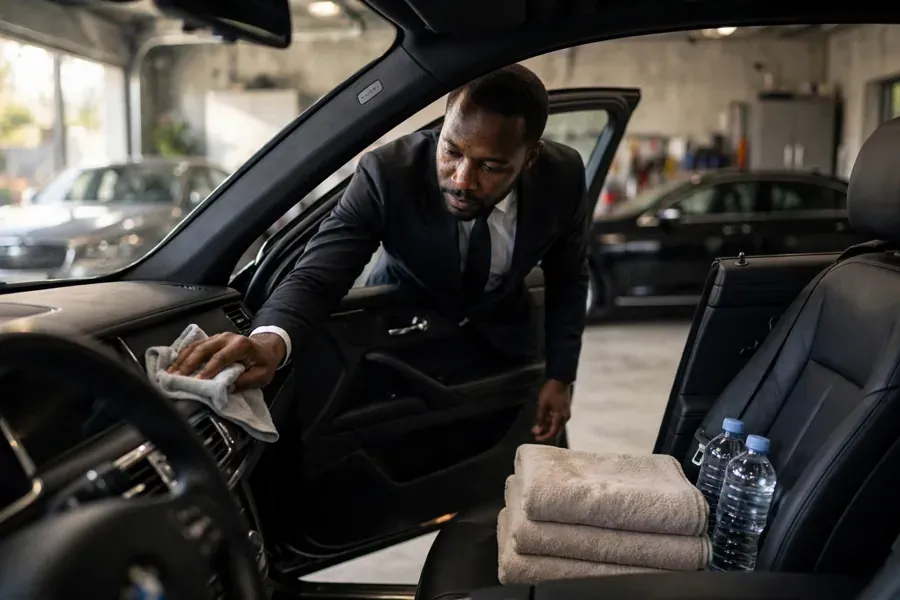
The Garage Standard: The Car Kept Like a Hotel Room
Here is the test that predicts everything else: walk out to the car, unannounced, on an ordinary morning, and open the rear door. In a house with the garage standard, you will find a cabin that reads like a good hotel room — immaculate, scentless or faintly of leather, stocked and silent. Water at the temperature the principal likes.
The right charger cable. Tissues, mints, a folded throw in season, the day's newspapers if that is the house's custom, and nothing — no cups, no wrappers, no yesterday — that does not belong. The exterior carries the same discipline: washed, waxed in its turn, glass perfect, wheels clean.
This is not vanity. It is the chauffeur's daily written exam, sat in public, and a man who keeps the car this way when nobody is checking will keep his standards when everything is going wrong at once.
The standard is mechanical as well as cosmetic. Keeping the vehicle in immaculate condition is, as My Household Managed notes, a core part of the role — daily cleaning and presentation, fuelling, and managing service appointments.
In houses with a property manager, fleet care is shared between the two roles; without one, the chauffeur takes the broader brief: service scheduling, registration, tyres, inspections, and the small repairs that must never be allowed to become big ones.
Eden's duty profile says the same from the agency side — the vehicle kept clean and valeted inside and out, fuelled and in optimal working condition.
Set the system in writing in the household manual: daily checks (fuel, tyres by eye, fluids weekly, warning lights never ignored), a cleaning rhythm (interior daily, full valet on a schedule), a service diary kept in the car and reviewed by the house manager monthly, and a rule that defects are reported the day they are found, with a photograph.
The families who do this keep cars for years that feel new. The families who don't discover the cost of neglect all at once, usually at the kerb, usually in the rain.
One more garage rule, and it is about respect in both directions: give the chauffeur what the standard requires.
A proper place to wash and keep the car, the right products rather than the cheapest, time in the schedule for the work, and a fuel and expenses float that never makes him fund the house's motoring out of his own pocket. Standards demanded without resources are theatre.
Standards resourced, inspected lightly and praised when met become culture — and culture is what keeps a flagship car, and a flagship driver, at their best for years.
Confidentiality: What Is Heard in the Car Stays in the Car
No member of your staff hears more of your life than your chauffeur. Deals are closed on the phone in the back seat. Marriages have their difficult conversations between the office and home.
Children say unguarded things; friends, collected after dinner, say more. The professional's rule is total: none of it exists once the door closes. Put confidentiality in the written agreement, discuss it plainly at hiring — not as an accusation but as the honour code of the profession — and then protect it from your side as well.
Do not ask your chauffeur about other families he has served; the man who tells you about them will tell them about you. Do not retail his predecessor's failings or invite commentary on your guests.
The houses that keep great chauffeurs for decades treat discretion as a two-way inheritance, and it is remarkable how completely a professional rises to the level of discretion a house practises toward him.
When a Security-Trained Driver Is Worth the Premium
For some families the question is not whether the chauffeur can drive beautifully, but whether he can drive protectively — and the market prices that difference honestly.
Eden Private Staff's analysis of hybrid chauffeur roles explains why security-aware chauffeurs command higher salaries: they are paid for trust, access, flexibility, judgement, experience and additional capability — with close-protection licensing, defensive and advanced driving training, and experience with high-profile principals the factors that move pay upward.
Oplu puts the premium in numbers: chauffeurs with formal security qualifications command roughly 15 to 30 percent over civilian roles. Irving Scott takes the practical view — many chauffeurs hold close-protection backgrounds and can combine driving with security awareness, which suits most principals well, while higher-threat situations call for dedicated security alongside the driver.
That calibration belongs with your protection plan, not your anxieties. If your household already works with executive protection — the subject of our companion piece on hiring the bodyguard — the chauffeur should be hired inside that plan: trained to the detail's protocols, rehearsed in its routes and rendezvous, and clear about who commands in an incident.
If your family's profile is ordinary visibility — a known business, a photographed social life, children at known schools — a security-aware chauffeur with defensive-driving training is usually the proportionate answer: one professional who drives superbly, watches the surroundings as a matter of habit, varies routes when a routine becomes too predictable, and knows how to leave a situation rather than star in one.
Pay the premium where the risk is real, and spend the saving on the thing that protects families every ordinary day: a superb driver, fully rested, in a perfectly maintained car.
What It Costs, Stated Plainly
Chauffeur pay follows hours, duties and security content, and published ranges vary by city — treat these as the market's shape, not a quote. Irving Scott places full-time chauffeur salaries typically between £35,000 and £65,000 a year, with London at the higher end and live-in roles carrying accommodation on top.
Oplu's banding for private service is finer-grained: junior to mid-level chauffeurs at £42,000 to £62,000 base, senior chauffeurs £60,000 to £85,000, head chauffeurs £75,000 to £105,000, with international and travelling roles reaching higher — and United States equivalents, Oplu notes, running roughly 30 to 50 percent above comparable British levels.
American career guides tell the same story in dollars: full-time household chauffeurs commonly in the region of $60,000 to $100,000 in total compensation, with security-trained private drivers reported in the $80,000 to $120,000 range.
On top of salary sit the employer's real costs — payroll and insurance handled under the discipline of household employment done legally, the car itself, fuel, tolls, parking and valeting.
A family comparing an employed chauffeur with an hourly car service should compare like with like: the service sells you hours; the employee gives you a standard, a memory and a man who knows your family's life by heart.
However you structure it, structure it in writing before the first drive: hours and the honest treatment of the split shifts and late evenings this work involves, overtime, rest days, the standby question, travel with the family, and who pays for what when the car is away from home.
The chauffeur's week in a busy house is long and irregular by nature; the agreement that respects that — with rest protected as firmly as availability — is the agreement that keeps a professional for years instead of seasons.
The Trial, the Rhythm, and Keeping Him
Hire slowly, then settle the rhythm quickly. After the driving trial and the checks, a probationary season inside the real life of the house tells you the rest: how he is with the children at 7 a.m., with your mother on Sundays, with a flustered guest, with a changed plan at midnight.
Debrief it with your house manager, correct the small things early and kindly — the preferred door, the conversation level your family likes, which in many houses is a courteous minimum — and write what you learn into the household manual so the standard survives holidays and sick days through a relief driver.
And then, keep him. The chauffeur who becomes indispensable does so because the house made the job worth keeping: pay reviewed before he has to ask, rest genuinely protected, birthdays remembered, mastery noticed.
He will repay it in the currency that matters — a family that moves through its days unhurried and unworried, children who think the car simply appears, and a garage that gleams like a promise. Of all the standards in a great house, the front seat is the one your family experiences first every morning and last every night.
Staff it like it matters, because it does.
Hiring the Bodyguard: Executive Protection and Home Security, Handled Quietly
The Best Chauffeured Cars
Household Employment, Done Legally: Payroll, Taxes, Contracts, and NDAs
Black Excellence Profiles — The Men
Oplu — "Private Chauffeur for UHNW Families: Hiring Guide"
Irving Scott — "Private Chauffeur Hire"
Eden Private Staff — "More Than Just a 'Driver': Hybrid Chauffeurs"
Eden Private Staff — "Spotlight on a Private Chauffeur"
My Household Managed — "Personal Chauffeur Placement"
Questions & Answers
Who will you meet on this page?
How to hire a private chauffeur, what the driver costs, and why the best ones are judged as much by the state of the garage as by the smoothness of the ride. It links to 4 stories and articles — open any card to read the full piece.
What makes these stories worth reading?
How to hire a private chauffeur, what the driver costs, and why the best ones are judged as much by the state of the garage as by the smoothness of the ride.
How do I read the full stories on Drivers and the Cars They Keep: Chauffeurs, Security Driving, and the Garage Standard?
Choose any card on this page. Each one opens a full page of its own — the complete story or article, with its sources linked.