
The Grand Tour, Our Way: Oak Bluffs to Accra — Heritage Travel at the Highest Level
Luxury Black heritage travel, from Ghana to Martha's Vineyard — tours, homecomings and summer seasons arranged with the rigour of a royal progress and the warmth of a family reunion.
Once, the grand tour meant young aristocrats finishing their education among the ruins and galleries of Europe. Our version is better.
Luxury Black heritage travel — from Ghana to Martha's Vineyard, on tours led by historians rather than hurried past monuments — is a journey through the places where our story was scattered and where, generation by generation, it has been gloriously gathered back: a beach in Oak Bluffs where our families have summered for a century, a doorway in Ghana that our ancestors left through and we return through, a hillside in Bahia where African hands built a church of their own.
This is travel as inheritance. Done at the highest level, it is not a checklist but a progress — planned with care, paced with respect, and shared, whenever possible, across three generations at once.
Oak Bluffs: Where the Tour Begins at Home
Start where the season starts: Oak Bluffs, on Martha's Vineyard, the town that became — against considerable odds — the classic Black American summer.
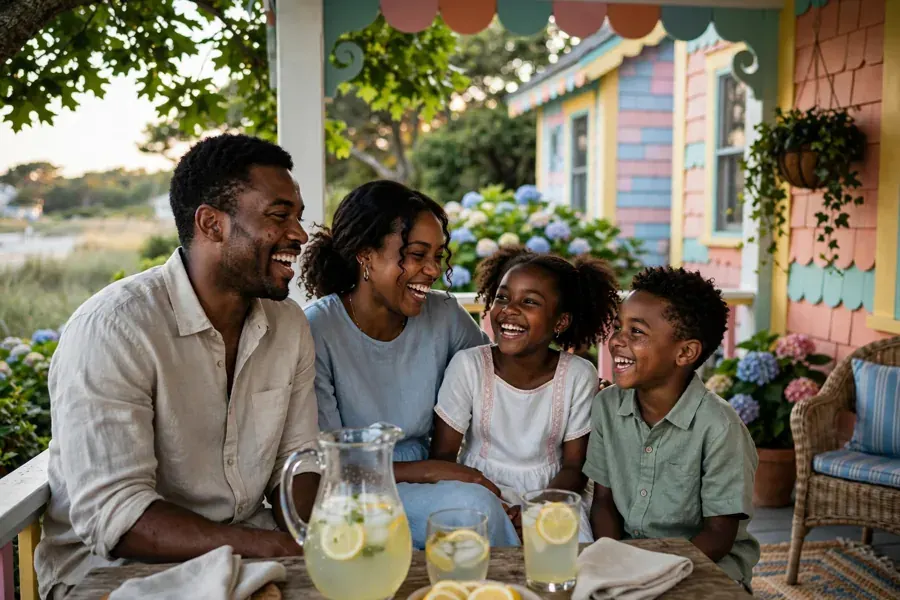
Narratively's history of Black Martha's Vineyard describes a town of colourful gingerbread cottages, pristine beaches and an old-time harbour whose summertime population swells from under five thousand to around twenty thousand — a season regulars call Black August.
Its most famous shore carries its history in its name: Inkwell Beach, as the same account explains, pays homage to beachgoers' Black skin, said to glisten like ink in the hot sun — a name first meant as an insult and long since reclaimed as a point of pride, watched over each morning by the Polar Bears, the swimming club that has splashed into the Atlantic just after sunrise for generations.
Collider's account of the town's Black history traces the pattern to the 1920s, when colourful summer cottages were built by Black citizens who worked for white families elsewhere on the island, in a place that became truly safe for Black vacationers.
You can forget all those other characterizations. You don't need that armor here on Martha's Vineyard.— Skip Finley, author, quoted in Collider's history of Black Martha's Vineyard
Do Oak Bluffs properly and you do it slowly: a morning swim with the Polar Bears if they will have you, a guided walk on the African American Heritage Trail — its bronze markers tell the island's Black story site by site — and long porch evenings in the gingerbread lanes.
Shearer Cottage, opened in 1912 as one of the first seasonal inns catering to African American tourists, anchors the history; the writers, judges, artists and presidents who have summered here since are simply its continuation.
On the mainland side of the tour, add Sag Harbor, where the Preservation League of New York State's account of the SANS community describes how Sag Harbor Hills, Azurest and Ninevah were founded between 1947 and 1952 by African Americans creating a place for themselves — self-financed in an era when mortgages were hard for Black families to get, and preserved today as a historic district of mid-century summer homes.
Our fuller guide to the season, The Summer House Season, takes up Oak Bluffs and Sag Harbor house by house.
Accra: The Capital of the Return
Then cross the Atlantic the way the tour now demands: to Ghana, which has made itself, deliberately, the capital of the homecoming.
Vialis Travel's Ghana heritage guide explains the founding gesture: the Year of Return, launched by President Nana Akufo-Addo in 2019, marked 400 years since the first documented arrival of enslaved Africans in colonial Virginia, formally invited the global African diaspora to return to Ghana as an ancestral homeland, and drew over a million diaspora visitors in a single year — a welcome now kept open indefinitely by its successor programme, Beyond the Return.
Begin in Accra, and begin properly: Black Star Square and the Independence Arch, the Kwame Nkrumah Memorial Park, and the W.E.B. Du Bois Centre, where the great scholar spent his final years.
The Travel Divas' Ghana guide sketches the capital's pleasures at ground level — the colour and noise of Makola Market, the old fishing community of Jamestown, a day ending at Labadi Beach — and the practical frame around them: English is the official language, the comfortable season is the dry stretch from November through March, and December is the homecoming high season, electric with festivals and returning family, and priced like it.
Choose your December knowingly, or choose the quieter months and have the monuments more nearly to yourselves.
Timing shapes the Ghanaian leg more than travellers expect. The Travel Divas' guide notes that Ghana is warm all year, generally in the upper seventies to upper eighties, and that from December into February the Harmattan blows in — a dry, hazy wind off the Sahara that cools the nights and softens the light, and makes for beautiful, forgiving photography.
December itself is the homecoming at full volume: festivals, family, and the famous Detty December energy bringing the diaspora to Accra all at once.
Choose it if you want the reunion; choose the quieter dry months if you want the castles and the capital at a gentler pace, and leave the rainy stretch, roughly April through June, to travellers who do not mind their grandeur damp.
Either way, book the season deliberately — on a journey of this meaning, the calendar is part of the craft.
Cape Coast and Elmina: The Heavy, Necessary Heart
Every grand tour has a room where the talking stops. In Ghana it is on the coast, where more than forty European-built forts and castles line the shore.
At Cape Coast Castle, the itinerary reaches the Door of No Return — Vialis Travel describes it as a doorway in the castle's outer wall at sea level, through which enslaved Africans were transferred directly onto waiting ships, the final point of contact between millions of enslaved people and the continent before the Middle Passage.
In 1998 the door was symbolically rededicated as the Door of Return, acknowledging the diaspora's right to come back — and diaspora visitors now walk back through it, as free people who chose the journey, in ceremonies of remembrance that many describe as the most powerful moment of their lives.
Go with a historian-guide, go in a small group, and go unhurried. Nearby Elmina Castle, raised by the Portuguese in 1482 and preserved as a national museum and World Heritage site, carries the same weight in an older building.
And complete the pilgrimage inland at Assin Manso, where the Ancestral Slave River — Donkor Nsuo — was the site of the captives' last bath in continental waters, and where a memorial cemetery now holds repatriated ancestors. The luxury in this part of the tour is not thread count.
It is privacy, pacing, and a guide who knows when to speak and when to let the place speak.
Kumasi: The Kingdom That Endures
Do not let the coast be the whole of Ghana. Inland lies Kumasi, the Ashanti heartland, and a grand tour that skips it has read only half the book.
The Travel Divas' guide calls Kumasi and the Ashanti region the cultural heartland, where you can watch kente cloth being woven by hand in the village of Bonwire and feel the depth of a kingdom that shaped the region.
Go to Bonwire and stand at the looms: the cloth your family wears at graduations and weddings is not printed there but built, strip by strip, on wooden frames, in patterns whose names carry proverbs. Commission a cloth, meet the weavers, and have it finished and sent on — a souvenir with a genealogy.
On the road between Kumasi and the coast, the same guide recommends the great green interlude of Kakum National Park, where a canopy walkway strung high above the rainforest gives the tour a morning of pure wonder between its days of memory.
Sequence matters on a journey like this: castles, then kingdom, then canopy — grief, pride, and joy, in the order a wise guide arranges them, so that no traveller carries the heavy days without the restorative ones beside them.
The best heritage operators build exactly this rhythm into the route, and it is one more reason to put the whole arc in one trusted pair of hands rather than assembling it from day tours.
West to Gorée, Across to Bahia and Havana
The tour's wider arc follows the diaspora's own map.
In Senegal, twenty minutes by ferry from Dakar, lies Gorée Island: African World Heritage Sites records it as a UNESCO World Heritage Site since 1978, possibly Africa's biggest slave-trading centre from the fifteenth to the nineteenth century, and today a place of pilgrimage for the African diaspora — a car-free island of ochre and pink houses whose House of Slaves, dating from the 1780s, holds its own Door of No Return above the sea.
In Brazil, the tour lands in Salvador, Bahia — founded in 1549 and Brazil's colonial capital until 1763 — where Audiala's Salvador guide finds Afro-Brazilian culture lived in the streets: in the Pelourinho's pastel lanes, once a site of public punishment and slave auctions and now a centre of drumming, capoeira and celebration; in the percussion of Olodum; and at the acarajé stands, where the black-eyed pea fritters come crisp and golden from bubbling dendê oil.
Seek out, especially, the church of Nossa Senhora do Rosário dos Pretos — built by enslaved and freed Afro-Brazilians themselves — the living counterweight to the gilded splendour around it.
And in Havana, the tour closes its circle with music. “In Cuba, African influences can be found everywhere,” Alberto Granado, director of Casa de Africa, told Essence's exploration of Afro-Cuban culture — from religion to art and food, he said, these elements are part of Cuban identity.
The Casa de Africa museum in Old Havana, housed in a seventeenth-century mansion, holds that inheritance in objects: ritual masks, carvings, textiles.
Beyond it, National Geographic's Havana guide points travellers to the rumba traditions kept by the national folklore ensemble and to a city where, in its words and in the judgement of the musicians it quotes, Cuba's African heritage sits at the core of its music — above all at Callejón de Hamel, the mural-filled alley where Sunday rumba has gathered the neighbourhood for decades.
Take these places as Cuba asks to be taken: respectfully, with local guides, and with your attention — and your spending — directed to the communities who keep the culture.
How to Build It at the Highest Level
A tour of this weight deserves royal-progress logistics.
Work with an operator who builds with historians, not just drivers: LABUSA Travel's Ghana programme, to take one model, describes journeys crafted through deep relationships across the country, connecting travellers with historians, local artisans, community leaders and cultural storytellers, and curating the ceremonies that turn a visit into a homecoming — traditional naming ceremonies among them, where a traveller receives a Ghanaian day-name in the community's own rite.
Build the party across generations if you possibly can; these are journeys grandparents and grandchildren should make in each other's company, and the operators who specialise in heritage travel know how to pace them — a heavy morning at the castles followed by a long, kind lunch and an evening of music; rest days written in, not apologised for.
Book the best rooms in each city, the private guide for the whole arc rather than a stranger per stop, and the photographer for one golden afternoon, so the family portrait from Accra can take its place beside the ones from Oak Bluffs.
The families whose own returns fill our Came From Nothing collection will recognise the pattern: go back in strength, bring everybody, and let the journey itself become part of what the family hands down.
That is the grand tour, our way. Not a finishing school for looking at other people's past, but a homecoming route through our own — the Inkwell's morning swimmers, Accra's markets, a doorway walked back through in freedom, drums in Bahia and Havana answering drums in Dakar.
Travel it slowly, travel it together, and travel it at the level the story deserves.
The Summer House Season: Oak Bluffs, Sag Harbor, and the Art of the August House
Came From Nothing — Black Excellence Profiles
Vialis Travel — “Ghana Heritage Travel Guide: Slave Castles, Cape Coast”
Travel Divas — “Ghana, the Front Door of the Return: What to Know Before You Go”
Narratively — “The Real Story of Black Martha's Vineyard”
Collider — “The Rich Black History Behind 'Summer House Martha's Vineyard'”
Preservation League of New York State — “Further Reading on Sag Harbor's SANS Community”
African World Heritage Sites — “Island of Goree (Senegal)”
Audiala — “Salvador, Brazil: Travel Guide”
Essence — “Discovering the African Heartbeat in Cuba”
National Geographic — “Get Off the Tourist Track in Havana”
LABUSA Travel — “Accra & Cape Coast Ghana Tours: Heritage Travel Experience”
Questions & Answers
How do seasoned travelers plan a trip that feels effortless?
Luxury Black heritage travel, from Ghana to Martha's Vineyard — tours, homecomings and summer seasons arranged with the rigour of a royal progress and the warmth of a family reunion.
What should you know about accra: The Capital of the Return?
Then cross the Atlantic the way the tour now demands: to Ghana, which has made itself, deliberately, the capital of the homecoming.
What does this article say about cape Coast and Elmina: The Heavy, Necessary Heart?
Every grand tour has a room where the talking stops. In Ghana it is on the coast, where more than forty European-built forts and castles line the shore.