
The Golden Age Canon: The Films Every Well-Dressed Life Should Know
The best classic films golden age Hollywood must watch list — Gable and Monroe, Casablanca and the Falcon — curated as a permanent shelf, with notes on the tailoring, the manners and the rooms.
Every well-dressed life deserves a shelf of certainties, and this is ours: the best classic films golden age Hollywood must watch list, built the way a good wardrobe is built — a few perfect pieces, chosen once and kept forever.
These are the films our parents quoted, our grandparents dressed for, and every serious student of style still studies, because the golden age did not only invent modern movie stardom. It invented a way of carrying yourself: the entrance, the pause, the perfectly timed line delivered without raising your voice.
A canon is not a trivia contest. The American Film Institute's 100 Years…100 Movies list remains the most useful starting map, and you will notice how much of our list lives near its summit: Casablanca (1942) at number two, Gone with the Wind (1939) at number four, Sunset Blvd.
(1950) at number twelve, Some Like It Hot (1959) at number fourteen, The Maltese Falcon (1941) at number twenty-three, and It Happened One Night (1934) at number thirty-five. Lists will argue with each other forever. What matters is that these films reward an evening the way a great novel rewards a quiet weekend — completely.
Start With the King: Clark Gable
If the golden age had a posture, it was Clark Gable's. Often called the “King of Hollywood,” Gable appeared in more than 60 motion pictures across a 37-year career, and the American Film Institute ranked him the seventh-greatest male screen legend of classical Hollywood cinema.
Begin with It Happened One Night (1934), Frank Capra's road comedy with Claudette Colbert, for which Gable won the Academy Award for Best Actor.
A fuller account of that production notes it became the first film to sweep the five major Oscars — Best Actor, Best Actress, Director, Writer and Picture — a feat so rare it still functions as a piece of Hollywood shorthand.
Watch what Gable does with almost nothing: a raised eyebrow, a hitchhiking thumb, a shirt removed to reveal no undershirt at all — a moment show-business legend says emptied undershirt counters across America. Whether or not the legend is literally true, the lesson is. Ease is the luxury.
Then take Mutiny on the Bounty (1935), where his Fletcher Christian earned him a second Oscar nomination, and notice the tailoring under pressure: the naval coat, the open collar, authority worn like it was cut for him personally.
Save Gone with the Wind (1939) for a proper occasion — a long evening, good company, no phones. Gable's Rhett Butler brought his third Best Actor nomination, and the performance remains the era's definitive study in charm used as armour.
Rhett enters late, dressed better than every man in the room, and spends the film being the only person who sees Scarlett O'Hara clearly. Watch the manners as much as the romance: who stands, who waits, who pours, who leaves first. The golden age ran on that choreography, and this film is its grand ball.
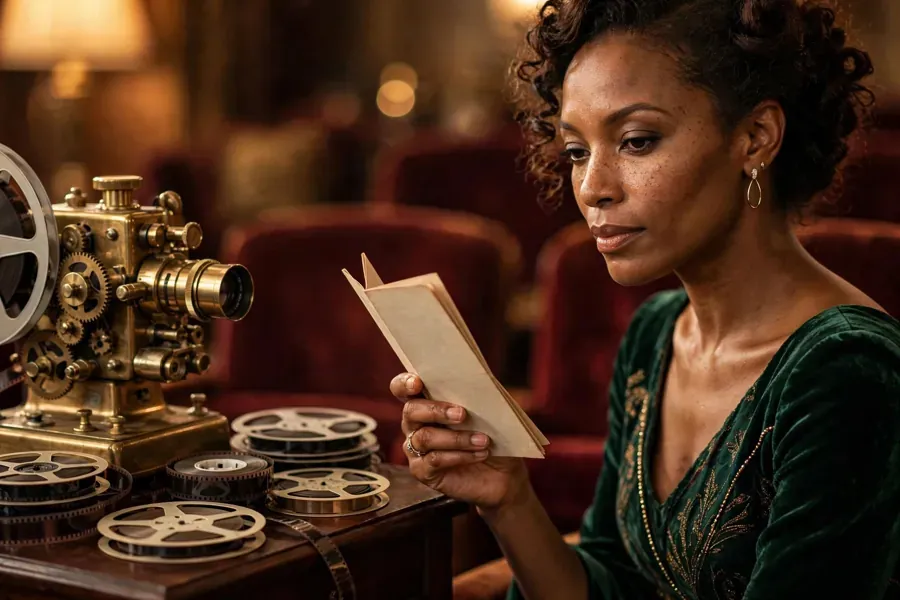
Casablanca and the Perfection of the Well-Made Film
If you may only know one golden-age film by heart, make it Casablanca (1942). It sits at number two on the AFI list, behind only Citizen Kane (1941) — itself essential viewing, and the obvious next step once this shelf is built; its director, Orson Welles, was twenty-five and rearranging the grammar of cinema as he went.
Casablanca is the opposite miracle: not a revolution but a perfection. Every line lands, every exit hurts, and Humphrey Bogart's white dinner jacket in Rick's Café remains, decade after decade, the single most imitated piece of menswear in film history. The lesson for a well-dressed life is direct: fit, restraint, and one immaculate signature.
Pair it with The Maltese Falcon (1941), John Huston's directorial debut and the foundation stone of film noir. Critics surveying the noir tradition call it a foundational and signature entry in noir history, a film that introduced and refined an abundance of the genre's elements.
Bogart's Sam Spade is Gable's charm turned cold: the same economy of gesture, the same hat, but the romance drained out and replaced with suspicion. Watch the two films on consecutive nights and you have watched Hollywood learn both of its great moods — the toast and the interrogation.
Marilyn Monroe, Taken Seriously
No golden-age shelf is complete without Marilyn Monroe, and the respectful way to watch her is in sequence. A standard biography of her career lists the run plainly: Gentlemen Prefer Blondes (1953), How to Marry a Millionaire (1953), The Seven Year Itch (1955) and Some Like It Hot (1959), with Niagara (1953) as her first great leading showcase.
Start with Gentlemen Prefer Blondes, directed by Howard Hawks, and watch the famous pink-dress number with fresh eyes: Monroe is not playing a fool. She is playing a woman who has read the room's economics more accurately than any man in it, and the comedy comes from everyone else catching up.
The Seven Year Itch (1955) gives you the icon — the white dress over the subway grate — but stay for the timing, which is metronome-perfect.
Then finish with Some Like It Hot (1959), Billy Wilder's farce with Tony Curtis and Jack Lemmon, which the AFI places at number fourteen of all American films and which Monroe herself crowns with a performance of genuine musical melancholy.
She won a Golden Globe for it, and the film makes the strongest possible case that the golden age's greatest comic actress has been hiding in plain sight inside its most famous silhouette.
Sunset Boulevard: The Era Looks in the Mirror
Every canon needs its conscience, and ours is Sunset Boulevard (1950). Wilder again: a struggling screenwriter, Joe Gillis, played by William Holden, drifts into the mansion of Norma Desmond, a former silent-film star played by Gloria Swanson — who actually had been one.
The film earned eleven Academy Award nominations and won for its screenplay, art direction and score, and later assessments have gone further, calling it the greatest classic film noir of all time. Hollywood did not entirely enjoy the portrait. After a private screening, MGM chief Louis B. Mayer confronted Wilder directly:
“You have disgraced the industry that made and fed you! You should be tarred and feathered and run out of Hollywood!”— Louis B. Mayer to Billy Wilder, as reported by Men's Journal
That outburst, recounted in the coverage of the film's long afterlife, is precisely why the film belongs on a prestige shelf: the golden age was self-aware enough to produce its own elegy, and honest enough to let it be a masterpiece. Watch the rooms in this one — the decaying grandeur of Desmond's mansion is production design as biography.
The Second Shelf: Kane, the Musical and the Drawing Room
Once the pillars stand, a second shelf completes the education. Citizen Kane (1941) sits at number one on the AFI list itself, and it is the golden age's great lesson in ambition: a newspaper magnate's life told in flashbacks, photographed with a depth and shadow nobody had attempted at that scale.
Watch it after Casablanca, not before — contrast is the teacher. Where Casablanca perfects the well-made film, Kane invents the modern one, and a viewer who holds both understands the whole era's range.
Then lighten the room. Singin' in the Rain (1952), tenth on the AFI list, is the definitive Hollywood musical and, not coincidentally, a comedy about the very transition — silent pictures to talkies — that haunts Sunset Boulevard. Gene Kelly's joy is athletic scholarship; every young performer in your family should see what discipline looks like when it is smiling.
Beside it place All About Eve (1950), sixteenth on the list, for Bette Davis and the sharpest dialogue the era produced — theatre people scheming in evening dress, every line a small, polished weapon. A household that can quote All About Eve at dinner is a household properly educated.
Round the shelf out with shadow and sentiment in equal measure. Double Indemnity (1944), Wilder again and thirty-eighth on the AFI list, is noir at its most precise: an insurance man, a femme fatale, a plan that works perfectly except for the people in it.
And It's a Wonderful Life (1946), eleventh on the list, earns its sentiment honestly — a good man shown, on the worst night of his life, the exact weight of his own decency. Programmed across a season, these four turn a viewing list into a liberal education: ambition, joy, wit, darkness and grace, each in its definitive golden-age form.
A word on order, because order is half the pleasure. Begin with It Happened One Night for charm, Casablanca for perfection, The Maltese Falcon for shadow, Gentlemen Prefer Blondes for wit, Sunset Boulevard for conscience, and Gone with the Wind as the grand occasion that closes the first season.
The second season — Kane, the musicals, Eve, Indemnity — will then land on prepared eyes. This is how canons are actually built in real houses: not in a weekend of bingeing, but in a year of evenings that the family comes to expect, dress for, and remember.
Two closing notes complete the shelf's story. The first is a year: 1939, still argued as Hollywood's greatest.
The AFI list alone carries Gone with the Wind at number four and The Wizard of Oz at number six from that single year, alongside Mr. Smith Goes to Washington at number twenty-nine — epics, fantasies and civic fables arriving in one season, from one industry, at one standard. The second note is an ending.
Gable's final onscreen role was the aging cowboy of The Misfits (1961), opposite Marilyn Monroe, in what proved to be her last completed film as well.
The King and the era's defining blonde, closing the age together in a modern western written for her by Arthur Miller: programme it last in your canon, and the golden age will seem to bow as it leaves the room.
And do not close the era without its master of suspense. Alfred Hitchcock's golden-age run stands on the AFI list in force — North by Northwest (1959) at number forty and Rear Window (1954) at number forty-two — and either film teaches the same lesson as the whole canon in miniature: control.
Cary Grant fleeing across a cornfield in a grey suit that became a menswear landmark; James Stewart watching a courtyard become a theatre of other people's lives. Hitchcock dressed his thrillers the way this magazine's readers dress themselves: nothing accidental, everything considered, the effect apparently effortless because the work underneath is not.
How to Watch Them Well
A few house rules elevate the whole canon. Choose restored editions whenever a choice exists; these films were lit by masters, and a good restoration returns the blacks, the silver and the skin tones that made the lighting famous.
Watch on the largest screen your home offers, in one sitting, with the lights low — the golden age was composed for a darkened room and an unbroken spell. Keep a small notebook if you are so inclined: one line per film, the performance, the room, the suit. And programme the shelf socially.
A canon watched alone is homework; a canon watched with family, across generations, becomes inheritance — which is, in the end, what this magazine believes a film collection is for.
From here, the shelf widens naturally. Our companion guide to the essential foreign canon takes the same discipline abroad, and our history of Black cinema across the eras tells the parallel American story Hollywood's main line left out. But start here, with the King, the falcon, the café and the blonde who outsmarted them all.
That is the golden age. That is the standard.
The Essential Foreign Canon: The World Cinema Shelf
Black Cinema Across the Eras: From Race Films to the Blaxploitation Years and Beyond
The Quiet Flex
American Film Institute — “AFI's 100 Years…100 Movies”
Wikipedia — “Clark Gable”
Hollywood's Golden Age — “Clark Gable”
Collider — “These Are the Most Important Film Noir Movies Ever Made”
Men's Journal — “William Holden Classic Named the Best Film Noir of All Time”
Classic Movie Hub — “Marilyn Monroe”
Questions & Answers
Why does Black cultural history matter today?
The best classic films golden age Hollywood must watch list — Gable and Monroe, Casablanca and the Falcon — curated as a permanent shelf, with notes on the tailoring, the manners and the rooms. It links to 4 stories and articles — open any card to read the full piece.
What should every house know about this history?
The best classic films golden age Hollywood must watch list — Gable and Monroe, Casablanca and the Falcon — curated as a permanent shelf, with notes on the tailoring, the manners and the rooms.
How do I read the full stories on The Golden Age Canon: The Films Every Well-Dressed Life Should Know?
Choose any card on this page. Each one opens a full page of its own — the complete story or article, with its sources linked.