Dressing Well, Part VIII: The Quiet Flex — Logos, Signals, and Dressing for the Room That Knows
Quiet luxury style for men is, at bottom, how to dress understated wealth: no logos, no announcement — just cloth, cut and care, legible at a glance to the room that knows how to read them.
Type the search yourself — quiet luxury style men how to dress understated wealth — and you will find a thousand explainers, but the thing itself is older than the phrase and simpler than the discourse.
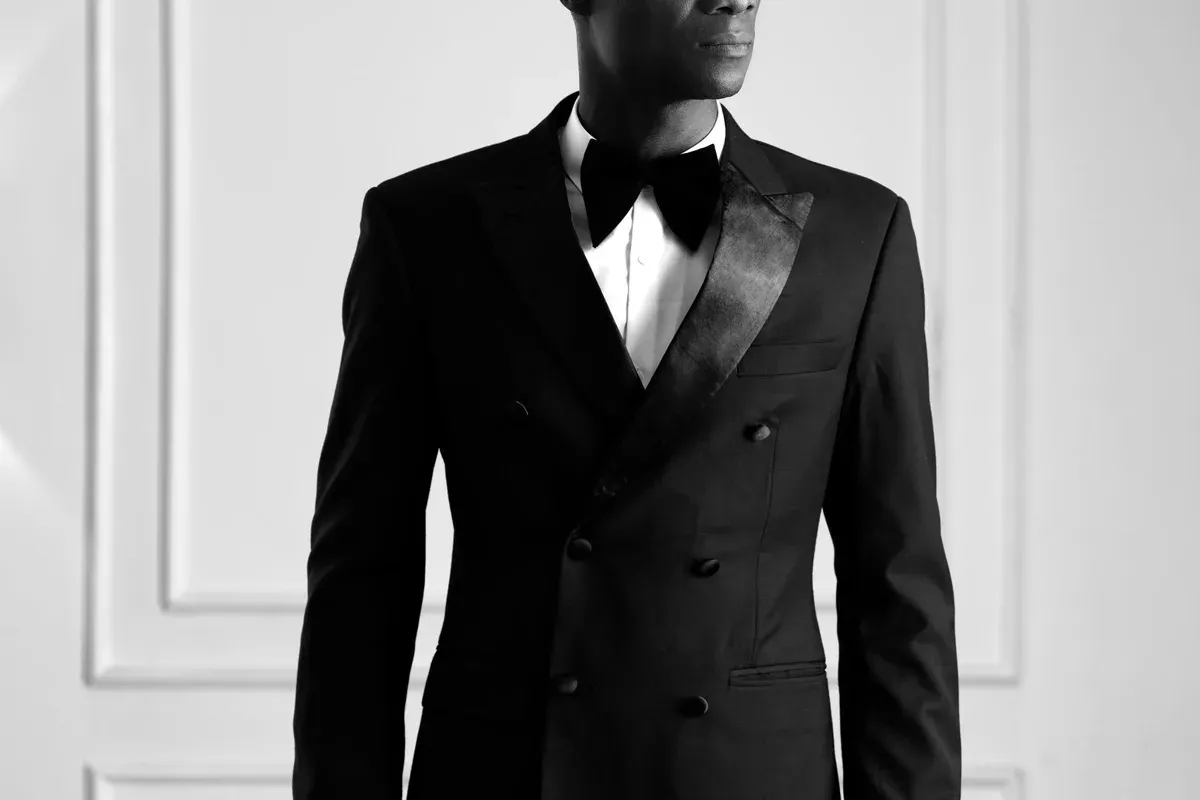
It is the man in our photograph: an unmarked navy crewneck, tailored trousers, good shoes, crossing a gallery as if the room were his natural weather. Nothing on him names itself. Nothing needs to.
The guides that define the school agree on its first principle: quiet luxury relies on good cloth and plain design without decoration — instead of large logos, heavy jewellery or very bright colours, it uses soft tailoring, texture and muted colours. That is the quiet flex. It is not the absence of luxury; it is luxury that has stopped auditioning.
This instalment decodes how the signal actually works — what the knowing room reads, in what order — and how to buy the real thing, at every level, without buying the costume version of it.
The Semiotics — What the Room Actually Reads
Established money dresses in a language with a small vocabulary and perfect grammar.
A luxury editor's formulation is the clearest we found: silent luxury is fashion that communicates through material and construction and not branding — the coat fits like it was cut for its wearer, the bag has no hardware spelling out a house name, there is no monogram anywhere, and yet the whole thing looks more expensive than anything in the room covered in logos.
That is the point, the same source adds — and the mechanism is worth naming precisely, because it explains everything that follows. A logo is a signal broadcast to strangers: it spends itself on everyone in sight, including everyone who cannot read it and everyone who can read it and discounts it.
Material and construction are signals addressed to initiates: they are invisible at a distance and unmistakable at a handshake. The quiet flex chooses the second audience deliberately.
It dresses for the room that knows — the partner across the table, the host at the private view, the tailor on the other side of the room — and lets everyone else simply register that the man looks, somehow, completely right.
The culture caught up to the code through a television wardrobe.
The plain cashmere baseball cap worn by Kendall Roy in Succession became the school's most discussed garment, and its sourcing is now a matter of record: the show's costume designer Michelle Matland sourced the unbranded cap from Loro Piana, as she told W Magazine — and in that interview she describes the hunt for one plain cap in one particular colour as a saga of sold-out stores and customs delays, all for a baseball cap.
Matland's research method is the deeper lesson: she and her team followed genuinely wealthy shoppers into stores like Brunello Cucinelli and Loro Piana and watched what they touched, concluding that the appeal of clothing to this kind of person is in the fabrication of the garment. Touch first, label never.
That is why the quiet wardrobe is built from the hand outward — a man who shops by feel cannot be sold a logo, and a wardrobe bought by feel ages into a uniform rather than a costume rack.
The Tells — Fit, Fibre, and the Hand-Finished Detail
If the signal is construction, the tells are specific, and learning to read them is most of learning to buy. The stealth-wealth guides list the inspection points in order: the weight of the fabric, the regularity of the stitching, the quality of the buttons, the softness of the lining.
Add the tailor's tells this series has taught from the beginning — a collar that sits on the neck without a gap, a sleeve that ends where the wrist breaks, a trouser that falls clean to the shoe — and you have the full grammar.
The fit rule from the quiet-luxury guides is absolute in its simplicity: clothes should not pull, sag or leave trousers too short; get the fit right and plain cloth becomes presence. Notice what is absent from every serious list: no mention of names.
The houses most associated with the school — Loro Piana, founded in 1924 and built on a century of sourcing fibres most brands cannot or will not source; Brunello Cucinelli, working from the Umbrian village of Solomeo since 1978; The Row — are recognised, as one guide puts it, by touch: the particular softness of a rare fibre, recognised by those who own it, not by anyone else's eyes.
The interior label is the only branding you will find. Everything else is handwriting only initiates can read.
Fibre literacy is where the flex becomes genuinely quiet, because it cannot be faked at a glance and it compounds over years. Take cashmere, the school's signature cloth.
A cashmere buyer's guide explains the grading in numbers a shopper can use: luxury-grade cashmere runs 14 to 16 microns in fibre diameter with long staple length, which resists pilling — while shorter, coarser fibres pill quickly and age a sweater in a single season.
The same guide prices the honest article accordingly: houses controlling every phase from sourcing to finishing, Loro Piana and Brunello Cucinelli among them, sell sweaters from around $800 to over $2,000, while mid-market cashmere runs $100 to $300 with more variable transparency.
And at the school's outermost edge sits vicuña, the wild Andean fibre finer than the finest cashmere, which one report prices at $4,950 for a crewneck and $25,000 for a jacket — figures we cite not as shopping advice but as cartography: this is how far the territory extends, and the men who buy there have never once needed a logo to find it.
The discipline generalises. Learn one fibre properly — its grades, its tells, its honest price — and you can read a whole rail the way you read a balance sheet.
Buying the Look Without Buying the Costume
Here is the good news the discourse often buries: because quiet luxury is a set of principles rather than a set of brands, it can be practised at almost any budget — and the guides say so plainly. The method is the audit, then the foundation.
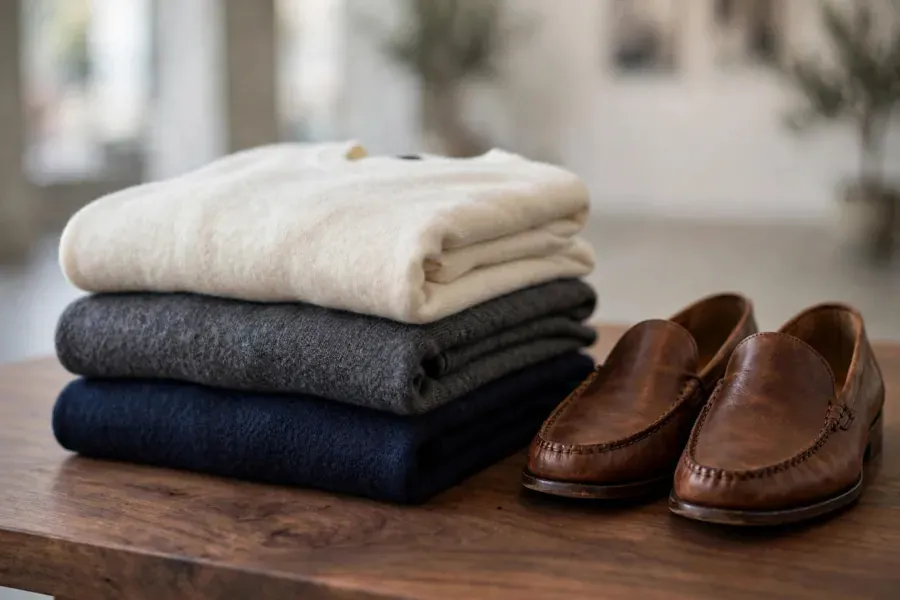
A stealth-wealth wardrobe guide prescribes the sequence: audit the closet and remove loud, logo-heavy pieces you rarely wear; invest in foundation pieces — a crisp white shirt, perfect dark denim, a tailored navy blazer, versatile leather shoes — in a rotation of core neutrals: navy, charcoal, cream, olive, tan. Then let tailoring do the spending for you.
Another guide makes the arithmetic explicit: a mid-tier blazer taken to a professional tailor — nipped at the waist, trousers hemmed to break perfectly over the loafers — will read as a garment many times its price, because fit is the loudest of the quiet signals.
A men's style magazine's checklist reduces the whole practice to five habits: focus on fabric in natural materials, keep the palette neutral, make tailoring impeccable, skip the logos, and invest in footwear.
Where the budget does stretch, stretch it in the order the room reads: shoes and knitwear first, outerwear next, tailoring always — and let our own series carry you deeper, from Dressing the Generations, where the family wardrobe is considered whole, to the composure under pressure taught in Grace Under Needles, which is the quiet flex practised as manners.
“With luxury labels you pay partly for the brand and partly for materials and making, so compare the garment itself rather than the name.”— The Vou, “Quiet Luxury for Men”
That sentence deserves to hang in every dressing room in this magazine's world, because it converts taste into method: compare the garment itself. Turn it inside out. Read the seams, the lining, the buttons, the fibre content; weigh it in your hands; try it against your tailor's eye before your mirror's.
The costume version of quiet luxury — the beige haul, the logo-free but lifeless rail bought to imitate a television still — fails precisely here: it copies the palette and skips the inspection. The real practice is slower and, in the end, cheaper per year of wear: fewer, better garments, bought one at a time, each one interrogated.
A quiet-luxury wardrobe guide states the school's economics without romance: it favours garments that stay in use for many seasons rather than fast-changing trends — clothes that do not need to announce themselves. Buy once, buy by hand and eye, keep it for a decade, and the flex takes care of itself.
It was never the logo, and it was never the price tag. It is simply a man whose clothes have nothing to prove, in a room that can tell.
The Paradox — When Quiet Becomes Recognisable, and What Remains
Success brings a problem the school's founders never had to solve: everyone now knows.
A commentary on the stealth-wealth houses observes the turn honestly — the ethos of if-you-know-you-know held while the brands were anonymous, but as public awareness of these brands has grown, their discreet designs have themselves become recognisable indicators of affluence, so that informed observers can now discern the value of an unadorned accessory at sight. Does that kill the flex?
Only the lazy version of it. The man who bought the cap because a television character wore it was always wearing a costume, and his signal degrades exactly as fast as the costume circulates.
The man who bought by hand and eye loses nothing when the crowd learns the brand's name, because his signal was never the name — it was the fibre's hand, the seam's regularity, the decade of wear the garment is visibly settling into. Recognition can be copied in a season; condition cannot.
A ten-year-old cashmere crewneck in perfect order says something about its owner that no new purchase can say at any price: that he buys well, keeps well, and is in no hurry. Time is the one logo that cannot be counterfeited, and the quiet wardrobe is the only wardrobe that appreciates in it.
Which is why the last layer of the flex is not cloth at all. The stealth-wealth guides close their checklists where every serious dresser eventually arrives: grooming and presence — clean shoes, neat hair, good posture and a calm demeanour doing as much work as fabric can.
Read the full signal stack in the order a knowing room reads it and the hierarchy is humbling: carriage before coat, grooming before garment, garment before brand, and brand — the thing the costume buyer starts with — last and least.
This series has a whole instalment on the grooming standard behind that stack, and the principle transfers whole: the appointments kept, the shoes cleaned and treed, the hands and hair tended, are not vanity items on the quiet flex's ledger. They are the ledger. A man can rent the palette for a weekend.
He cannot rent ten years of being looked-after, and the room that knows is, in the end, simply the room that can tell the difference between a purchase and a practice.
Dressing the Generations
Grace Under Needles
Black Excellence Profiles: Black Men
The Vou — “Quiet Luxury for Men, How to Wear It and Brands to Know”
W Magazine — “Succession Costume Designer on Quiet Luxury”
Robb Report India — “Silent Luxury Explained: Loro Piana, Brunello Cucinelli and The Row”
Gentleman Within — “Stealth Wealth Style Guide for Men”
Swagger Magazine — “What Is Quiet Luxury?”
LDN Fashion — “Quiet Luxury Brands: 12 Labels to Shop Now”
Blue Hare Magazine — “Not All Cashmere Is Created Equal: A Shopper's Guide”
Offbeat — “Brands Like Loro Piana: The Guide to Succession Fashion Alternatives”
Questions & Answers
What makes a gentleman in the modern world?
Quiet luxury style for men is, at bottom, how to dress understated wealth: no logos, no announcement — just cloth, cut and care, legible at a glance to the room that knows how to read them. It links to 3 stories and articles — open any card to read the full piece.
How should a gentleman dress and carry himself?
Quiet luxury style for men is, at bottom, how to dress understated wealth: no logos, no announcement — just cloth, cut and care, legible at a glance to the room that knows how to read them.
How do I read the full stories on Dressing Well, Part VIII: The Quiet Flex — Logos, Signals, and Dressing for the Room That…?
Choose any card on this page. Each one opens a full page of its own — the complete story or article, with its sources linked.