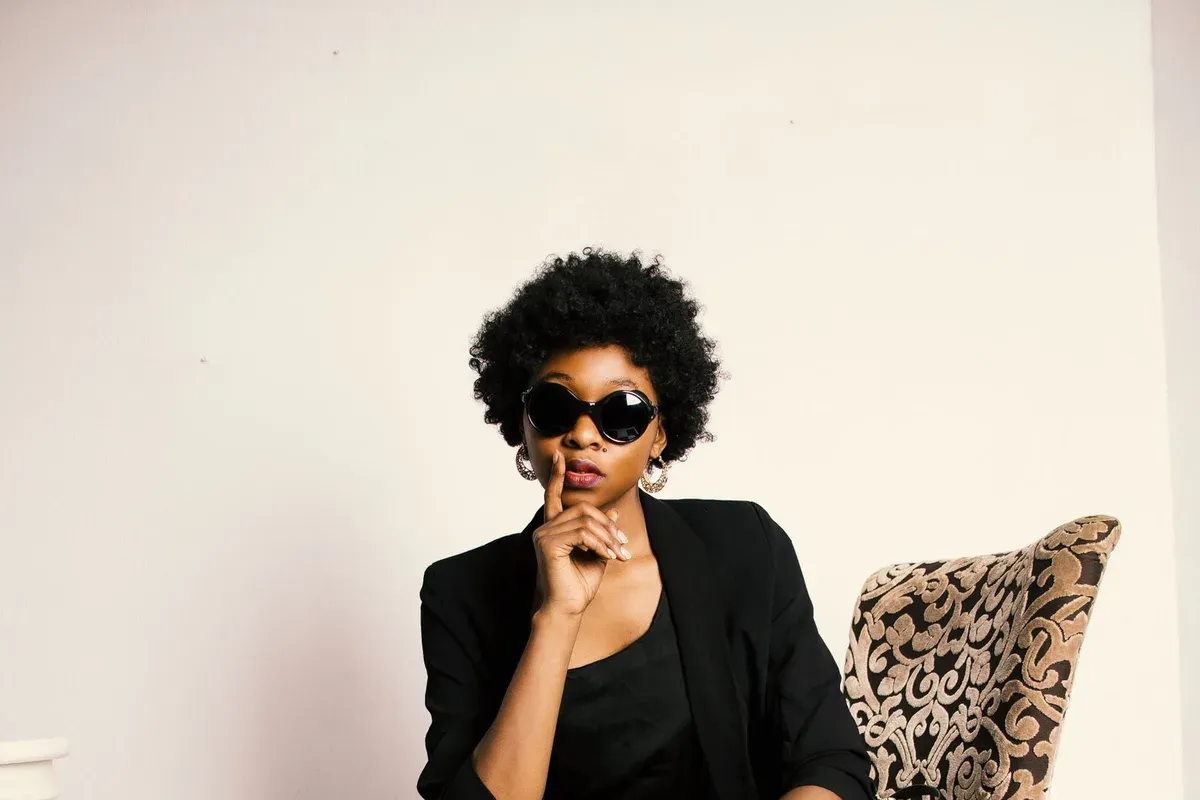
Dressing Well Through the Decades: Her Wardrobe at 30, 45, 60, and Beyond
What to wear for family portraits — coordinated outfits, yes, but first a wardrobe that honours every decade she has earned: the tailoring, the fabrics, and the quiet rules that carry a woman beautifully from 30 to 45 to 60 and beyond.
Ask a room of well-dressed women what to wear for family portraits and you will hear about palettes and patterns.
Ask the woman in the portrait that has hung in the hall for fifty years — the grandmother in pearls, still flawless — and she will tell you the photograph was decided years before the sitting, in the wardrobe she built decade by decade.
Dressing well through the decades is not a different skill at 60 than it was at 30. It is the same skill, deepened: know your silhouettes, buy honest fabric, tailor without mercy, and let each decade edit rather than replace.
Coordinated outfits for the family portrait matter — we will come to them — but they are the last ten minutes of a much longer discipline. This is that discipline, decade by decade, built on the pieces that style editors return to at every age and the standards our mothers actually lived by.
The encouraging news, confirmed by every serious wardrobe guide, is how much stays constant.
The core of the elegant closet barely moves between 30 and 60: a modest, well-cut black dress that adapts to business meetings, dinners, and social evenings; a crisp white shirt in cotton or a silk blend, pressed and properly fitted; tailored trousers or a classic midi skirt; and a neutral coat in camel, beige, grey, or black, cut cleanly in wool or a cashmere blend.
What changes across the decades is not the list. It is the emphasis — where the money goes, where the ease lives, and what she refuses to apologise for.
At 30: Build the Bones
Thirty is the decade of acquisition, and its great temptation is volume — the sale rail, the trend piece, the fifth version of a thing she does not yet own in its proper form. The women who arrive at 45 looking inevitable did the opposite at 30: they bought the bones.
A foundation wardrobe assembled young — the white button-down, the black blazer, straight-leg jeans in dark indigo, a cashmere sweater in camel, navy, grey, or ivory, a trench coat, a midi wrap dress, and the little black dress — is the same foundation stylists prescribe for the 40s and 50s, which is precisely the point.
Buy it once, in the best fabric the budget allows, and the next two decades become styling rather than shopping.
Two habits separate the builders from the accumulators. The first is tailoring from the very first good purchase: a blazer nipped to her actual waist and trousers hemmed to her actual shoe teach her eye what fit is, and she will never unlearn it. The second is colour discipline.
The thirty-year-old who chooses her neutrals deliberately — black or navy, camel or grey, ivory rather than stark white if her skin prefers it — and then lets colour arrive as silk, as a wrap dress in burgundy or olive, as one glorious coat, is building the palette the cameras will learn to associate with her.
Our companion piece on the silhouette wardrobe lays out the twelve-piece architecture in full; think of the thirties as the years she lays that foundation in real cloth, one excellent piece at a time, and learns the tailor's name before the trend's.
At 45: Edit Like You Mean It
If 30 builds, 45 edits — and editing, done well, is the most glamorous act in dressing. The mid-forties wardrobe is where quality stops being a preference and becomes the whole strategy: fewer pieces, each one unmistakably right.
The staples do not change — the same guides that dress a woman at 35 prescribe the blazer, the white shirt, the wrap dress, and the trench at 50 — but the standard for each rises. The blazer is softer in construction and better in cloth. The white shirt is silk-blend and opaque.
The denim is dark, straight, and unadorned. What leaves the closet is everything that was almost right: the trouser that needed a tug, the shoe that punished by evening, the colour that photographed tired.
This is also the decade of the signature. At 30 she experimented; at 45 the room should know her before she speaks — the pearl stud or the gold hoop, the scarf knotted the same sure way, the silhouette she returns to because it has never once failed her in a photograph.
There is a practical dividend, too: a wardrobe built on pieces that all answer to one palette dresses itself. Mornings shorten. Packing becomes a pleasure.
And when the invitation that matters arrives — the gala, the anniversary, the portrait sitting — she is not shopping in a panic. She is choosing, which is an entirely different posture, and it shows in every picture.
For the evenings that call for more, our guide to the world of women's made-to-order shows what happens when that same discipline is handed to an atelier.
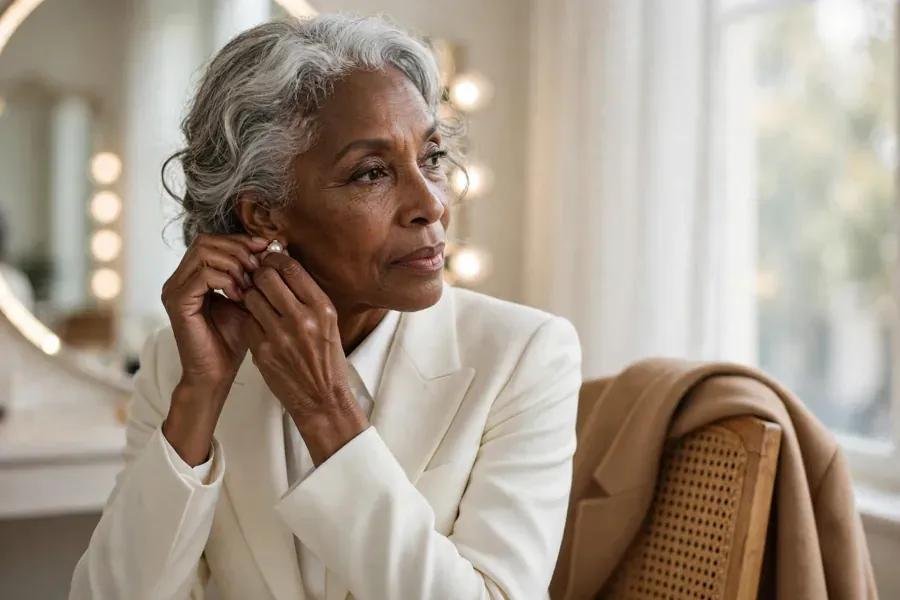
At 60 and Beyond: Ease, Polished
Sixty is where the wardrobe stops performing and starts serving — and the women who understand this look more elegant, not less. The capsule logic that began at 30 comes fully into its own.
Wardrobe coaches who specialise in dressing after 60 start with an audit any of our readers will recognise: most of us wear 20 percent of our clothes 80 percent of the time, so the honest capsule begins by pulling out what was actually reached for over the last three months and asking of each piece whether it fits the body as it is today, whether the fabric is kind against the skin, and whether it styles at least three ways.
Then comes the anchor: one dark neutral — navy, charcoal, espresso, or black — carries the investment pieces, the trousers, the good coat, the primary shoes, so that everything in the closet is already in conversation with everything else. A dozen well-chosen pieces, on that logic, yield more than thirty outfits. Liberation, not limitation.
Fit and fabric now share the throne. The mature-style guides are unanimous that investing in durable natural materials — cotton, silk, wool — and tailoring pieces to a perfect fit matters more at this stage than any new silhouette, with proportion kept elegant by letting the top take one-third and the bottom two-thirds of the line.
Even the denim earns its place on merit. As stylist Linda Peavy puts it:
Bootcut jeans are great for mature women because they provide more room through the thighs and flare gently at the knee, creating a flattering silhouette.— Stylist Linda Peavy, via the linked source
And then there is the scarf — the accessory Peavy credits with taking an outfit from boring to blazing, brightening the face and lending graceful coverage, alongside the structured handbag that anchors a look with intention. Jewellery, too, changes its job: at 60 the pearl strand and the gold she has worn for decades are no longer accessories.
They are heraldry. The debutante training many of our grandmothers absorbed — revisited in the debutante standard — always said poise was preparation made visible. At 60 and beyond, the wardrobe is simply that preparation, completed.
Care: The Skill Every Decade Shares
One more discipline runs underneath all three decades, and it is the least photographed: keeping what she buys.
A wardrobe built on quality only pays its dividend if the quality is maintained — the coat brushed and rested between wearings, the knit folded rather than hung, the good shoes rotated and treed, the blazer sent for its small repairs while they are still small.
The capsule guides make the underlying arithmetic plain: a wardrobe that works across the 30s, 40s, and 50s comes down to choosing quality over quantity — pieces that fit well and feel good, worn on rotation for years, rather than a closet rebuilt every season.
That is cost-per-wear thinking, and it is why the 60-year-old's camel coat still looks like money: it was money, spent once, and then defended by habit.
Budget for the defence. A standing relationship with a tailor and a good cleaner is worth more than one more dress; alterations are how a beloved piece crosses from one decade's body to the next without apology — a waist eased here, a hem modernised there, a sleeve brought to the length the current silhouette wants.
And keep the record the way the portrait families keep theirs: note what was bought well, what was altered, what is promised to a daughter. A wardrobe maintained like an archive becomes one — the rail a granddaughter will one day be invited to choose from, in the happy knowledge that everything on it still deserves her.
The Family Portrait Standard
Which brings us back to the portrait — the three-generation photograph that will hang for fifty years, and the reason this wardrobe discipline matters beyond any single morning.
The photographers' rule is coordination without matching: choose three or four colours and let each person wear a different combination of them — one neutral such as cream, tan, grey, navy, or soft black, one or two colours that suit the season and the setting, and a small accent if the family wants personality — spreading the colours through the group so nobody disappears into a uniform.
Patterns follow the same courtesy: one main pattern, chosen first, with everyone else's colours pulled from it, and no competing prints, logos, or neon to pull the eye away from faces.
Now dress that rule in three decades of good wardrobes and watch what happens. Grandmother anchors the palette in her pearls and the ivory or camel she has perfected. Mother carries the silk and the family's accent colour.
The daughter brings the modern line — the sculpted suit, the clean trouser — in a tone pulled from the same palette. Nobody matches; everybody belongs. That is the whole philosophy of dressing through the decades in a single frame: each woman entirely herself, all of them unmistakably one family.
It is also, not incidentally, how the conversation at the sitting should feel — the same unhurried standard we keep for the family meeting, where what is handed down is discussed with love and worn with pride.
So build at 30, edit at 45, and polish ease at 60 and beyond — and keep the portrait in mind from the very first blazer. The wardrobe that serves a woman for a lifetime is never an accident and never a costume.
It is a record, in cloth, of a woman who knew herself early and kept faith with what she knew. Her daughters will borrow from it. Her granddaughters will study the photographs.
Begin accordingly.
Couture for Her: The World of Women's Made-to-Order
The Silhouette Wardrobe
The Debutante Standard
The Family Meeting
Women — Society Profiles Collection
Soy Carmín — "How to Dress With Elegance in Your 30s, 40s, and 50s"
StyleCheer — "Closet Staples That Work in Your 30s, 40s, and 50s"
Living Well for Seniors — "The Ultimate Guide to Building a Simple Capsule Wardrobe After 60"
Yonder — "Classic Wardrobe Staples for Women Over 60"
Alison's Notebook — "6 Things to Wear Over 60 (Timeless Capsule Wardrobe)"
Ice Cream n Sticky Fingers — "Family Photo Outfits That Look Good Together"
Questions & Answers
How should a lady carry herself in public?
What to wear for family portraits — coordinated outfits, yes, but first a wardrobe that honours every decade she has earned: the tailoring, the fabrics, and the quiet rules that carry a woman beautifully from 30 to 45 to 60 and beyond. It links to 5 stories and articles — open any card to read the full piece.
What should a lady wear on the street?
What to wear for family portraits — coordinated outfits, yes, but first a wardrobe that honours every decade she has earned: the tailoring, the fabrics, and the quiet rules that carry a woman beautifully from 30 to 45 to 60 and beyond.
How do I read the full stories on Dressing Well Through the Decades: Her Wardrobe at 30, 45, 60, and Beyond?
Choose any card on this page. Each one opens a full page of its own — the complete story or article, with its sources linked.