
Dress Like a Lady, Part I: The Silhouette Wardrobe — Twelve Pieces, Endless Rooms
Classic wardrobe essentials, elegant women, capsule thinking: the twelve silhouettes that carry a photographed life without a repeat anyone can name.
Here is the thing nobody tells you about women who are photographed constantly: they are not wearing more clothes than you. They are wearing fewer, better ones, on a system.
Ask any stylist who dresses executives, first ladies and women whose Sundays, board meetings and benefit photographs all end up in public, and the answer comes back the same — classic wardrobe essentials, elegant women, capsule discipline. Not a closet the size of a boutique.
A short rail of silhouettes, each one cut so well and chosen so deliberately that it can walk into a boardroom in the morning, a church pew at noon, a gala that evening and a lawn on the Vineyard the following weekend, and no one in any of those rooms could swear they had seen it before.
That is the silhouette wardrobe. It is not minimalism for its own sake, and it is certainly not about deprivation.
It is about owning exactly the shapes your life actually requires — tailored, fluid, covered, celebratory — in fabrics that hold up under a camera flash and colours that agree with one another, so that getting dressed stops being a negotiation and becomes a signature.
The guides agree on the mechanics: a capsule works because most of the pieces can be worn together, and because quality is asked to do the work that quantity used to do.
What follows is the lady's version of that system: twelve silhouettes, the rooms each one commands, and the rules that keep the whole rail invisible as a system and unforgettable as a presence.
Why Silhouettes, Not Trends
Trends announce their date. A silhouette announces its wearer. The distinction matters for a woman whose image travels: a novelty sleeve or a of-the-moment hem is recognisable the second time it appears, and recognisable is the enemy.
A clean shoulder line, a waist placed where your waist actually is, a skirt that moves when you move — those read as you, every time, and nobody files them away as a repeat.
Styling guides for timeless dressing return to this point again and again: a well-cut blazer in a neutral colour can be easily mixed and matched across an entire wardrobe, while the little black dress earns its place precisely because it bridges day and night without changing its character.
There is a second, quieter reason. Silhouette is where fit lives, and fit is the whole game. A capsule stylist's blunt rule — that a perfectly tailored modest piece will always out-dress an expensive one that was not made for your body — is the open secret of every well-photographed woman.
The twelve pieces below are not a shopping list to be bought in an afternoon. They are shapes to be fitted, one at a time, until each one looks less purchased than inherited.
The Twelve Silhouettes
1. The sculpted suit. One suit, cut close and immaculate, in cream, navy or black — jacket and trousers, with a matching skirt if your life asks for both.
This is the boardroom anchor and, separated, half the wardrobe. Tailored suiting lists place the structured wool blazer at the foundation for a reason: in camel or navy, paired with wool trousers or a pencil skirt, it creates the silhouette everything else borrows authority from.
2. The sheath dress. Sleeveless or short-sleeved, knee-length or just below, in a fabric with enough body to hold a line through a long lunch.
The sheath is the hardest-working shape in a photographed life: alone for a luncheon, under the suit jacket for a presentation, with jewellery and a heel for an evening reception.
Luxury capsule guides count the sheath among the simple dresses that can be dressed up or down, and in a deep jewel tone it photographs like a decision, not a default.
3. The silk blouse. Ivory first, then a colour that loves your skin.
Tucked into trousers it is business; loose over a skirt it is Sunday; under the suit it softens the authority just enough. Silk is the fabric the capsule guides keep returning to — blouses in silk are listed as ideal for both formal and casual settings, tucked into trousers or skirts alike.
4. The tailored trouser. Straight or gently wide, high enough to hold a tucked blouse cleanly, hemmed for the shoe you actually wear.
Black tailored trousers are described by classic-capsule stylists as nothing less than classic and polished — styled casually with flats, or dressed up with a blazer and accessories without missing a beat.
5. The pencil or midi skirt. The skirt carries the rooms the trouser cannot: church, christenings, the luncheon where a trouser would read as a statement you did not intend to make.
A midi length in a fluid fabric pairs, as the luxury guides note, with everything from flats to boots — which is another way of saying it pairs with every version of your day.
6. The crisp white shirt. Cotton poplin, cut with intention, collar that stands.
It is the great equaliser of the rail: with the suit it is counsel; with the midi skirt it is the Vineyard; open over a camisole it is the weekend, still unmistakably you. Timeless-wardrobe guides call the white button-down a forever classic that works for every season and almost every occasion.
7. The fine knit. A cashmere crewneck or cardigan in ivory, taupe or soft grey.
The knit is the silhouette's diplomat — it takes the edge off tailoring for a school visit or a morning meeting, and layered under a coat it carries the whole rail through cold weather without bulk.
Capsule guides treat cashmere cardigans and fine merino sweaters as indispensable layering pieces, chosen in muted tones precisely so they complement the broadest range of outfits.
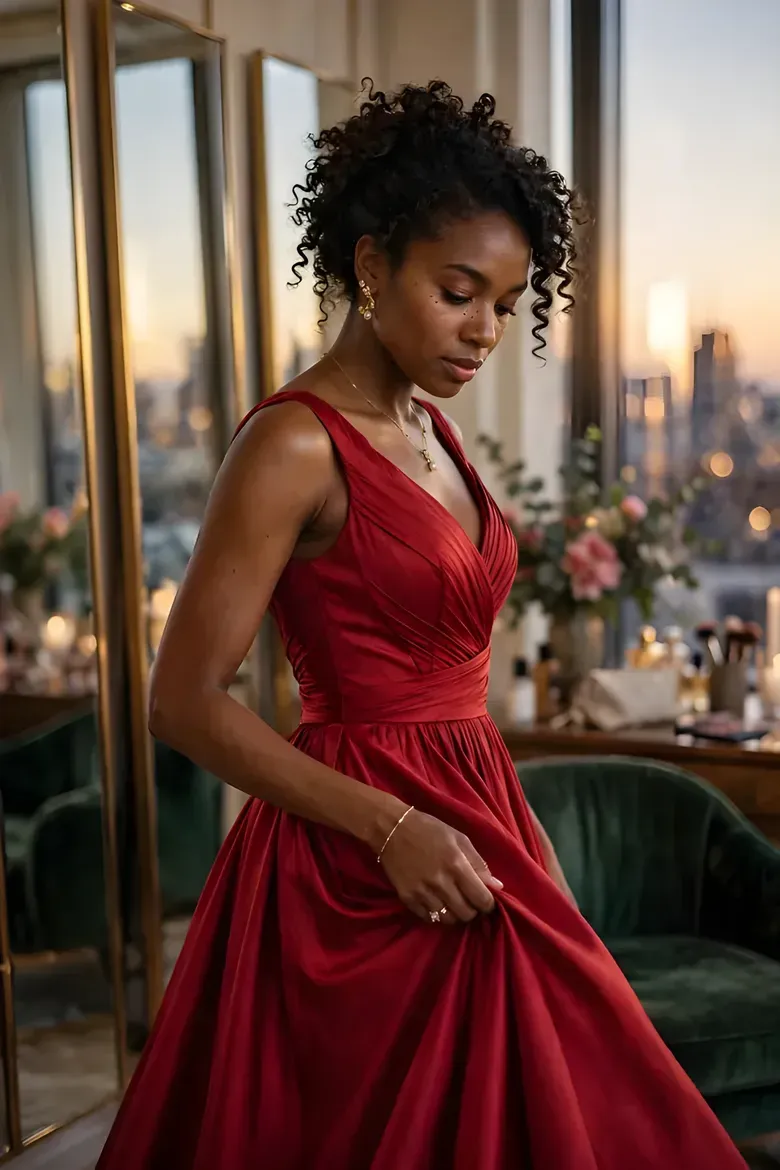
8. The evening gown, in colour. One true gown — floor-length, in scarlet, emerald, royal or gold — bought for your skin and your silhouette, not for a theme.
The gown is the piece women most often rent, borrow or panic-buy, and it shows. A gown that is yours, fitted to you and kept ready, turns every gala from an emergency into an entrance.
Choose drama in the cut rather than in ornament: a clean neckline and a skirt with movement photograph beautifully for decades, while heavy embellishment dates in a single frame.
9. The cocktail dress. The gown's younger sister: knee or midi length, in black or a saturated colour, for the reception, the benefit dinner and the evening that is formal but not black-tie.
This is the little black dress, properly understood — celebrated in the styling literature as the epitome of elegance, dressed up with statement jewellery and heels or toned down until it nearly disappears into the day.
10. The great coat. A tailored wool coat, camel or navy, long enough to cover the gown and the suit alike.
In cold-weather photographs the coat is the outfit — the arrival, the steps, the doorway — and capsule guides consistently advise investing heaviest exactly here, in outerwear and tailoring, where craftsmanship and fabric decide how long and how well a piece serves.
11. The trench. The coat's fair-weather counterpart and the traveller of the rail.
A classic trench works over almost any outfit and across three seasons, which makes it the silhouette that carries the airport photograph, the rainy-morning arrival and the shoulder-season luncheon with the same unhurried polish.
12. The occasion separates. One fluid skirt or palazzo trouser and one beautiful top — beaded, silk or lace — that combine into an evening look and separate into two others.
This is the system's insurance policy: the pieces that let you accept the unexpected invitation, the second event in one evening, the photograph you did not know was coming, without repeating a full look or buying in haste.
“My lane is definitely the woman who is a traditional woman, but she walks to the beat of her own drum in a certain way. A lot of CEOs, a lot of lawyers, a lot of newscasters. Powerful women who have to be seen, but they don't want to be seen just for what they have on.” — Designer Sergio Hudson, in The Zoe Report
The Designers Who Cut for the Room
A silhouette wardrobe is only as good as its cutting, and it is worth knowing whose cutting to study. Sergio Hudson has built his name on exactly this woman: his collections are described as designed for the woman in charge — sharp silhouettes, bold colours, draping fabrics and cinched waistlines.
His tailoring is praised for recalling power dressing at its best, with flared pants and strong shoulders set against cinched bodices and hems that fall below the knee. Note the lesson inside the praise: the power is in the architecture of the garment, not in novelty.
A strong shoulder and a defined waist will still be right when every trend on either side of them has been retired.
Study, too, the most instructive public wardrobe of the modern era — the one built for Michelle Obama by her stylist Meredith Koop, who is credited with subtly defining that style and breaking the pastel-skirts-and-suits mould expected of a first lady.
The signatures that emerged — matching sets, monochromatic tailored suiting, statement belts, pearls, and colourful sheath dresses worn with cardigans and brooches — are a masterclass in the silhouette principle: a small set of recognisable shapes, varied by colour, fabric and accessory, so the woman reads as consistent rather than repetitive. Consistency is what a signature is.
Repetition is only what happens when the pieces, not the woman, are doing the talking.
And take the church lesson seriously, because Hudson himself names it as his foundation. Raised in the South, he has said that the Southern church experience shaped how he sees women and how they dress — that getting dressed up there is a way of showing respect for yourself, for a higher power and for each other.
That is the silhouette wardrobe's moral centre: dressing well is not vanity. It is a form of regard — for the room, for the occasion, and for the people who will remember you in it.
Colour, Fabric and the Camera
Build the rail on three or four neutrals that agree with each other — cream, camel, navy, black, chocolate — then add your colours as citizens, not tourists: the scarlet of the gown, the emerald of a sheath, the gold of an evening separate, each one chosen because it loves your skin in daylight and under flash.
When everything shares a palette, almost everything matches, and the combinations multiply faster than the pieces do. That arithmetic is the capsule's quiet promise: a dozen silhouettes in a disciplined palette yield more distinct, photographable looks than a closet three times the size assembled at random.
Fabric does the other half of the camera work. Natural fibres — silk, wool, cashmere, fine cotton — are what the luxury guides keep specifying, because they drape instead of cling, hold a pressed line through a long event, and take light softly rather than shining under it.
Minimal gold or pearl jewellery completes the system the same way: a finishing note, repeated often enough to become part of the signature. The structured handbag in black or tan, the classic pump, the leather loafer or ballet flat for the daytime rooms — these are not accessories to the wardrobe.
They are its punctuation, and punctuation is what makes a sentence readable in a photograph.
The Fitting Rules
First, fit before labels. Every silhouette on the rail earns its place only after a tailor has had a say — hems, waist placement, sleeve length, the break of the trouser.
Second, buy the room, not the fantasy: count the rooms your life actually contains — boardroom, gala, church, school, luncheon, Vineyard, courtroom, christening — and let that census, not a magazine's, set the proportions of the rail. Third, protect the system's invisibility: vary the combinations, rotate the jewellery, change the hair before you change the dress.
The goal is that people remember how you looked, never what you wore last time.
Fourth, maintain like you mean it. The capsule math only works if each piece lasts, and longevity is a discipline: proper hangers, rest days between wearings, prompt repairs, shoes resoled before they plead.
Stylists who teach the capsule method frame it plainly as an eighty-twenty wardrobe — the great majority staples, the remainder occasion pieces and joy — with the foundation treated not as a cage but, in one stylist's words, as a launchpad. When the foundation is sound, the occasional glorious extravagance costs you nothing in coherence.
It simply lands on a rail that can absorb it.
A Lady's Rail, Kept Ready
Keep the twelve pressed, paired and photographed — a simple record on your phone of the combinations that work is the photographed woman's true secret weapon, because it turns a morning of decisions into a minute of selection. Keep one complete look, shoes and jewellery included, ready for the invitation that arrives with no warning.
And keep the standard where it belongs: not on the newness of the clothes, but on the certainty of the woman inside them. Twelve silhouettes, endlessly recombined, carried with poise — that is not a small wardrobe. That is a signature, and a signature is the one thing no one ever mistakes for a repeat.
Dress Codes Decoded
Dress Like a Gentleman, Part I
Women of Distinction — Profile Collection
The Best Tables in America
Jack and Jill, The Links, and the Architecture of Black Belonging
Lovau — “Timeless Capsule Wardrobe Checklist for Everyday Wear”
The Zhush — “Classic Capsule Wardrobe For Women Over 50”
Anastacia Styling — “How to Create a Capsule Wardrobe That Is Versatile and Timeless”
Corporette — “How to Build a Capsule Wardrobe for Work”
Luxury Life Journal — “Capsule Wardrobe Essentials: The Luxury Guide”
The Zoe Report — “Sergio Hudson On Met Gala, Suit Overload & Brand's 10-Year Anniversary”
V Magazine — “Sergio Hudson Merges Modernity and Power Dressing For FW26”
Fashionista — “Must Read: Meet the Woman Behind Michelle Obama's Wardrobe”
Linda Paige — “How Many Pieces Should a Capsule Wardrobe Have?”
Black Fashion Week — “NYFW Black Designer Spotlight”