Dress Like a Gentleman, Part I: The Suit Is a System — How Should a Suit Fit Men? A Guide to Fit Before Fabric Before Flash
Wealthy men do not shop for a label. They run an order of operations — silhouette first, cloth second, everything else last. Here is that system.
Ask how should a suit fit men — guide yourself by that question before you ask anything about brands, prices, or cloth — and you have already taken the first step that separates the men who look commissioned from the men who look costumed. Here is the thing nobody tells you in the store: a suit is not a purchase.
It is a system, with an order of operations, and the men who always look right run that order without exception. Fit first, because no cloth on earth can rescue a wrong silhouette. Fabric second, because once the shape is right, the cloth decides how the suit drapes, breathes, and ages.
Flash last — the label, the lining, the flourish — because those things are only ever noticed on a suit that already fits. Reverse the order, as most men do, and you get the familiar result: an expensive suit that looks borrowed. Follow it, and a modest suit, properly altered, will be mistaken for bespoke across any room you enter.
First: The Silhouette — What Fit Actually Means
Fit is not a feeling, and it is not a size. It is a short list of fixed points that either align or do not, and every serious guide to the subject starts at the same place: the shoulders.
The jacket’s shoulder seam should sit exactly where your own shoulder ends — aligned with the edge of the shoulder bone, with no overhang beyond it and no divot or wrinkle where the sleeve begins.
One buying guide states the rule plainly: the shoulder seam should align with the edge of your shoulder bone, the chest should feel snug but not tight, and the sleeve should end above the wrist so the shirt cuff shows.
This matters more than any other point on the garment, for a practical reason we will return to: shoulders are the one thing a tailor essentially cannot fix. Buy the shoulders right, and almost everything else can be made right. Buy them wrong, and nothing else matters.
From the shoulders, work down in order. The collar should sit snugly against your neck and your shirt collar, with no gap standing away at the back — a collar gap is visible to everyone behind you even when you cannot see it yourself.
The chest should close without strain: button the jacket and there should be no X of pulling creases across the front, no lapels bowing away from your chest, and room enough to slip a flat hand, or a finger or two, between jacket and chest.
A detailed fit guide gives the same allowance in its own terms — the jacket shoulders must align exactly with the natural shoulder line, the sleeve must reveal a sliver of shirt cuff, and the chest needs breathing room when buttoned. The jacket’s length should cover your seat, ending roughly at your knuckles when your arms hang naturally.
The waist of the jacket should taper gently to your body — that quiet indentation is what shaves off the boxy, rented look — and the vents at the back should lie flat, never splaying open.
Then the trousers, which men treat as an afterthought and rooms read as half the outfit. Trousers should sit at your natural waist and stay there without depending on a belt to hold them up. The seat should be clean, with no sagging and no strain.
The leg should drape in one unbroken line to the shoe, where the break — the small fold where cloth meets leather — is a deliberate choice: a slight break is the classic, polished standard; no break is the most contemporary reading; pooling fabric over the shoe is never a choice at all, only an unfinished hem.
Sit down in the trousers before you buy them. A suit is worn sitting, standing, walking, and reaching, and a fit that only works in the mirror, standing still, is not a fit.
“A suit can be made from the finest materials, but if it doesn’t fit your body correctly, it will never look its best.” — LeStyleParfait, “Men’s Suit Buying Guide: Fit, Fabric & Style”
Second: The Cloth — Fabric After Fit, Before Everything Else
Only when the silhouette is settled does cloth enter the conversation, and here the gentleman’s rule is restraint.
Wool remains the premier suiting fabric for sound reasons — natural stretch, breathability, durability, and a drape no synthetic has matched — and within wool, the choice that matters most is not the famous number but the balance between fineness and service. The “Super” number measures the fineness of the wool fibre, nothing more; it is not a quality rank.
A clear explainer of the scale warns that finer cloth is softer and more luxurious, but beyond a point it turns delicate, creases more easily, and wears out faster.
For a suit in regular rotation, guides converge on the same practical territory — roughly Super 100s to 130s — where the hand feels refined and the cloth still forgives a working life. Reserve the very fine cloths for garments worn occasionally and handled gently.
Weight is the cloth decision men most often skip, and it decides comfort as surely as colour decides appearance. A medium-weight cloth serves across most of the year and most rooms; lighter, open weaves — tropical wool, fresco — breathe in heat, while flannel and heavier cloths carry cold weather with authority.
Construction is the third consideration, and it is the hidden half of fabric: a half-canvassed or fully canvassed chest, where a layer of canvas is worked into the jacket, holds its shape and moulds to the wearer over time, while a fully fused jacket, glued rather than built, is more prone to stiffen and, over time, to bubble.
You can feel the difference by pinching the chest and sensing whether there are distinct layers. None of this requires expertise to use. It requires only the order: choose cloth for how and how often the suit will actually be worn, not for the number printed on the bolt.
Third: Flash Last — Labels, Linings, and the Discipline of Restraint
The label belongs at the end of the system because it contributes the least to how a suit looks on a man.
A Savile Row guide makes the point in its own ordering, listing fit first among the marks of a quality suit — “Fit is King” — shoulders hugging without overhang, the jacket covering the seat, and half an inch of shirt cuff showing — before it ever reaches fabric, lining, or stitching.
That is the correct hierarchy, and it is worth adopting as a personal rule: never pay for a name to compensate for a silhouette you have not fixed.
The visible signals of a well-dressed man are almost embarrassingly quiet — a lapel that rolls rather than creases flat, stitching that is neat and even, a lining that moves freely, buttons that feel substantial in the hand.
Learn to read those, and the sleeve tag becomes what it should have been all along: the least interesting thing about the suit.
The Bespoke Benchmark — And Why You Do Not Need It Yet
It helps to know what the top of the craft actually does, because bespoke tailoring is simply this same system carried to its limit.
At a house such as Henry Poole, the process begins with consultation and cloth — thousands of samples, a cutter who advises on what will work — before measurements are taken and a personal paper pattern is cut for one man alone.
As the house describes it, the cutter takes your measurements, cuts your own personal paper pattern, chalks it onto the cloth, and leaves extra cloth at the seams so the suit can be altered later; after the first fitting the garment is taken apart, re-cut, and the pattern itself corrected, so every future order starts from a truer version of you.
A survey of Savile Row practice adds what that buys over time: bespoke work accounts for your shoulder angle, the curvature of your spine, and even a difference in leg length, across multiple fittings, and the inlays left in the seams let the suit follow your body as it changes across years of wear.
Hold that benchmark in mind, then set it aside.
You do not need a bespoke commission to look like a gentleman, and the men who dress best on ordinary means understand why: bespoke’s advantage is fit, pursued without compromise — and a large share of that advantage can be captured, on a ready-made suit, by a skilled alterations tailor working on the right points.
A made-to-measure guide makes the same observation from the other direction, noting that bespoke houses eliminate common fit faults by cutting a unique pattern for the body — which is another way of saying the faults themselves are known, named, and, in a ready-made suit that starts close, largely correctable.
That correction is the heart of this article, and it has a name in every good tailor’s shop: the five alterations.
The Five Alterations That Make a Modest Suit Look Commissioned
Budget for alterations when you budget for the suit. Treat them not as repairs but as the second half of the purchase, and bring the shoes and the shirt you will actually wear to the fitting. These five, in this order, deliver nearly all of the transformation.
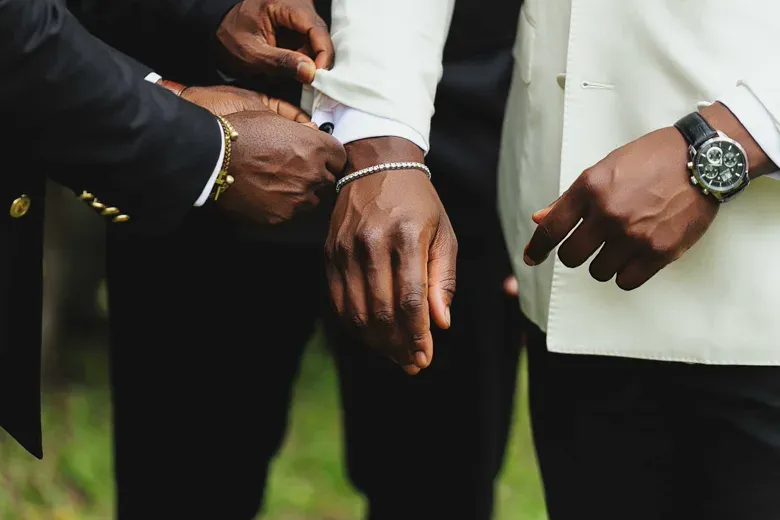
One — shorten the jacket sleeves to show the cuff. The jacket sleeve should end just above the wrist bone, revealing roughly a quarter to half an inch of shirt cuff.
Sleeves that swallow the cuff — or worse, reach the knuckles — are the single most common tell of an unaltered suit, and the fix is among the simplest a tailor performs.
Alterations guides rate sleeve shortening as high value for exactly that reason: a modest alteration with an outsized visual effect, because the sliver of linen at the wrist is what makes the whole arm look considered.
Two — take in the jacket waist. Most ready-made jackets are cut generously through the middle to fit the widest range of bodies, which leaves the average man swimming in a column of cloth.
Waist suppression — taking the jacket in at the sides to create a gentle taper — is the alteration that removes the box and creates the silhouette. A national tailor’s guide lists jacket waist suppression among its highest-value alterations, because it creates the tailored look and eliminates the boxy appearance.
The discipline is moderation: taken in until the front lies clean and you can still move and breathe, never until the button strains.
Three — hem the trousers to a deliberate break. Unhemmed or over-long trousers pool over the shoe and shorten the leg more effectively than any other fault. Hemming sets the break on purpose — a slight break for the classic line — and instantly cleans the entire lower half of the outfit.
It is inexpensive, it is always available, and no suit should be worn in public before it is done.
Four — taper the trouser leg. Where the jacket waist removes the box from the top half, tapering removes it from the bottom: narrowing the leg from knee to hem so the trouser follows the line of the leg instead of flapping around it.
A suit alterations guide describes tapering plainly as adjusting the trousers to be more slim-fitting, alongside taking in the waist and setting the hem or break — and paired with the hem, it is what gives a modest suit its modern, intentional line. Taper to clean, not to tight: the cloth should skim, never grip.
Five — settle the trouser waist and seat. Trousers should sit at the natural waist and stay there on their own. Taking in a loose waist ends the constant hitching and bunching under a belt that quietly ruins an otherwise good outfit, and cleaning up excess cloth in the seat completes the unbroken drape from jacket to shoe.
Together with the hem and the taper, this is the full lower-half system: waist, seat, leg, break — each one small, the sum of them unmistakable.
Know, too, what not to ask for. Shoulders that are significantly too wide or too tight, a chest that is far off, a jacket that is far too long or too short — these are not alterations but reconstructions, and good tailors, including the guide above, advise against them: the work is complex, costly, and rarely returns its value.
That is not a limitation of the system. It is the system. Shoulders and chest are bought right in the store; sleeves, waist, hem, taper, and seat are made right at the tailor.
A Men’s Wearhouse fit guide sums up the store half in a checklist worth memorising — shoulders lying flat without divots or overhang, the jacket closing without pulling, the cuff landing beyond the jacket sleeve, and trousers draping cleanly to the top of the shoe.
In the store: shoulders exact, collar close, chest closing clean, jacket covering the seat, trousers sitting at the waist — and sit down before you decide. At the tailor: sleeves to show the cuff, jacket waist taken in, trousers hemmed to a slight break, legs tapered, waist and seat settled.
In the cloth: wool first, a sensible Super range for a suit you will wear often, weight matched to the weather, canvas where you can. In everything else — label, lining, flourish — restraint. Run in that order, every time, and the price of the suit becomes the least visible thing about it.
A System, Kept for Life
The real reward of dressing this way is that it compounds. A man who buys by the system builds a wardrobe of suits that all fit the same correct way, cloth chosen for the life he actually lives, each one altered to him and therefore interchangeable, repairable, and durable in a way trend purchases never are.
Bespoke tailors build their whole practice on that continuity — the corrected pattern kept on file, the inlays waiting in the seams, the relationship that keeps a garment right for years. You can adopt the same posture at any level of means: one good tailor, one honest mirror, one unchanging order of operations. Fit before fabric before flash.
It is a small discipline, and it is the whole difference between a man who bought a suit and a gentleman who wears one.
Proper Form, Part III: Dress Codes, Decoded Once and for All
Dress Like a Lady, Part I
Black Excellence — Profiles of Black Men
The Best Tables in America
Estate Planning: Protecting What You Build
LeStyleParfait — “Men’s Suit Buying Guide: Fit, Fabric & Style”
Modern Gentleman Magazine — “How Should a Suit Fit: Measurements, Styles, Fabrics, and Occasions”
Made to Measure Suit Guide — “The Ultimate Guide to Buying a Suit”
Men’s Wearhouse — “How to Know If a Suit Is Too Small: Jacket Fit, Sleeve & Length Guide”
Savile Row Company — “The Ultimate Men’s Suit Guide”
Men’s Wearhouse — “Suit Tailoring: Pant & Jacket Fixes, Cost & Time”
Generation Tux — “Suit Alterations Guide: Cost, Timeline & What’s Possible”
Henry Poole & Co — “Bespoke Process”
Sartoro — “Suit Fabric Types, Weaves and Weights”
Tellar — “The Ultimate Guide to Savile Row”