
The Library Every House Should Hold: Black Classics, Beautifully Bound
Essential black literature books every home library should hold — Baldwin to Bennett, the memoirs, the art books and the children's shelf — chosen with booksellers, bound beautifully, and placed like furniture.
Walk into a serious house and you learn it before the tour begins: the shelves speak first. A library every house should hold is not decoration and it is not homework — it is the family's memory, bound.
The essential black literature books every home library needs are the ones a grandfather can hand to a granddaughter without a speech, because the speech is already inside them.
This is that shelf, chosen the way the keepers of our bookstores and the editors of our classics choose: Baldwin to Bennett, the memoirs, the art books, and the children's corner where the next reader is made.
The Foundation Shelf: The Witnesses
Begin where the record begins — in the witnesses' own voices.
The classic treasury that booksellers keep in print binds the foundation in a single run: Frederick Douglass's Narrative of 1845, Harriet Jacobs's Incidents in the Life of a Slave Girl, Solomon Northup's Twelve Years a Slave, Booker T. Washington's Up From Slavery, and W. E. B. Du Bois's The Souls of Black Folk of 1903 — a set one long-standing catalogue describes as the foundational works, in their own voices.
Douglass taught himself to read against the law and then wrote the book that helped end the system that forbade it; Du Bois, the first African American to earn a Harvard doctorate, named the century in a single sentence.
The problem of the twentieth century is the problem of the color line.— W. E. B. Du Bois, The Souls of Black Folk (1903)
Shelve these in the editions that honour them — cloth, sewn, with paper that will outlast us — because these are the volumes the house will be judged by when we are not in the room to explain them.
The Novelists' Wall
Above the foundation stands the wall every guest drifts toward. Toni Morrison anchors it: Song of Solomon, which brought her the National Book Critics Circle Award; Beloved, which won the Pulitzer Prize in 1988; and the 1993 Nobel Prize in Literature, which made her the first Black woman to receive it.
Beside her, James Baldwin entire — the Collected Essays and the fiction, from Go Tell It on the Mountain to If Beale Street Could Talk, a love story Penguin's classics editors describe as evoking the blues.
The curated sets that serious collectors buy bind exactly these names together: Hurston, Wright, Morrison, Angelou, Baldwin and Douglass, in Library of America and Everyman's Library editions.
Fill the wall honestly: Ralph Ellison's Invisible Man; Richard Wright's Native Son, which, as one library catalogue notes, has acquired classic status without losing its power to shock; Zora Neale Hurston's novels and stories; Alice Walker's The Color Purple; Ann Petry's The Street; Octavia Butler's Kindred and Parable of the Sower.
The keepers of the canon at AALBC maintain a hundred-title essential fiction list that runs from these pillars to Yaa Gyasi's Homegoing and James McBride — use it as the wall's expansion plan, a shelf a year.
History, Told by Us
Every house in this magazine's world keeps one historian within arm's reach, and for two generations that historian was Lerone Bennett Jr. His Before the Mayflower: A History of Black America grew out of his history articles at Ebony — where he rose to senior editor under John H. Johnson — and appeared in 1963 as the book that taught Black America its own timeline in a single volume.
Bennett spent almost forty years as Ebony's senior editor — the magazine's intellectual engine inside the largest Black-owned publishing company in the world — and Before the Mayflower carries that authority onto the home shelf: journalism's reach, history's patience. BlackPast's biography records what the book insisted on: that Black roots in this soil predate the Puritans' landing in 1620.
Keep Bennett beside the art books, and keep the model behind him in mind: Arturo Alfonso Schomburg, the collector whose private library — bought by the New York Public Library in 1926 for the 135th Street branch — grew from 10,000 items into the Schomburg Center, today holding more than ten million items across five divisions.
The centre began in 1925 as the Division of Negro Literature, History and Prints of the 135th Street branch library; Schomburg himself served as its curator from 1932 to 1938, which is to say the greatest Black book collection in the country was built the way yours will be — one deliberate acquisition at a time, by a man who treated other people's discards as his inheritance.
A home library is a small Schomburg with better chairs: collect on purpose, and the collection becomes an institution.
Memoir, Art, and the Children's Shelf
Maya Angelou's Collected Autobiographies, beginning with I Know Why the Caged Bird Sings in 1969, belong on the memoir shelf where daughters find them at exactly the right age.
The art books earn their size: the finest curated set of African American literature published today wears, as its jacket, Jacob Lawrence's painting The Library — thought to depict that same 135th Street Library, now the Schomburg Center — a celebration of Black intellectual life and of the book itself as an instrument of freedom.
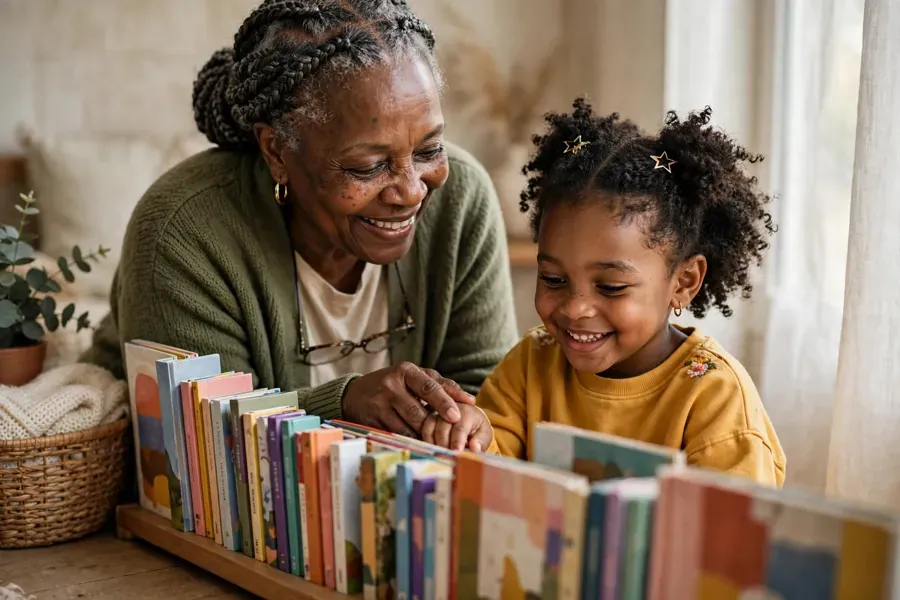
And the children's shelf is not an afterthought: it is the low shelf, at a small reader's eye level, stocked first, because a child who grows up seeing herself in books becomes the adult who builds rooms like this one.
If there is a book that you want to read, but it hasn't been written yet, then you must write it.— Toni Morrison, via Education Week
The Guest Test
There is a simple audit for all of it, and every host in this magazine's world has run it without naming it: the guest test.
A visitor with twenty unobserved minutes in the room should be able to reconstruct the household from the shelves alone — its faith in witnesses, its novelists, its historian, its art, its children, and at least one shelf that reveals the family's own eccentricity, the racing histories or the hymnals or the Harlem Renaissance first printings that no listicle would have prescribed.
If the shelves could belong to anyone, they belong to no one. The canon is the floor of the room, never its ceiling: Baldwin and Bennett get you to serious; the idiosyncratic shelf — kept current, argued over, lent from and replenished — is what makes the library this house's, and no other's.
The Living Shelf: The Books Still Being Written Into the Canon
A library that stops at the classics becomes a museum of other people's reading.
The living shelf keeps the house current: the same AALBC essential list that anchors the pillars also carries Yaa Gyasi's Homegoing, Brit Bennett's The Vanishing Half, Paul Beatty's The Sellout, James McBride's The Heaven & Earth Grocery Store and Octavia Butler's Parable of the Sower — the contemporary run a well-read host is expected to have an opinion about.
Add to it the household's own trades: the business memoirs, the cookbooks your kitchen actually uses, the local history of your own city. And keep one shelf deliberately unfinished.
Morrison herself wrote children's books with her son Slade, and her Remember: The Journey to School Integration won the Coretta Scott King Award — proof, on the children's shelf, that the canon has a door at child height and it is meant to be walked through.
Editions and Bindings: Buying Once, Buying Well
The standard is simple: buy the edition you will hand down, the first time.
The two publishers the collectors' sets rely on — Library of America and Everyman's Library — exist precisely for this: cloth bindings, sewn signatures, ribbon markers, and texts edited to a scholarly standard, so that Baldwin's essays or Douglass's autobiographies sit on the shelf as permanent furniture rather than as paperbacks on their third spine-crack.
Where a title matters to the family — a grandmother's Baldwin, a father's Bennett — a fine or custom binding earns its cost the way a frame earns its painting. Keep the working paperbacks in the kitchen and the study; the library wall itself is built, deliberately, to be inherited.
Where the Keepers Buy, and How the Books Live
Buy from the houses that kept these books alive when no one else stocked them. Marcus Books — founded in San Francisco in 1960 by Drs. Julian and Raye Richardson, named for Marcus Garvey, and still family-run in Oakland by their daughter — is counted among the oldest Black-owned bookstores in the country.
In Washington, MahoganyBooks, founded online in 2007 by Derrick and Ramunda Young, built its store inside the Anacostia Arts Center on story times, readings and depth of inventory. Atlanta's For Keeps, on historic Auburn Avenue, specialises in the rare and the signed — Lorde, Angelou, Walker, Brooks — with some treasures kept for in-store reading, like a community library.
AFAR's roll of Black-owned bookstores is the travel list; your own shelf is the home game.
The Reading Life of the House
A library is kept the way a table is kept — by use. The houses that do this well share a few quiet rules. Every gift book is inscribed: giver, occasion, year, one line of why — because in thirty years the inscription is the provenance, and provenance is what turns a book into an heirloom.
One book is always being read aloud somewhere in the house, even if it is only a poem after dinner on Sundays. Children may take any book down themselves; a book a child has to ask permission to touch is a book that child will never love.
Lending is generous to family and firm with acquaintances: the irreplaceable volumes — the signed For Keeps treasures, the inscribed first printings — do not leave the house, and nobody who loves you will ask twice.
And once a year, the shelf is edited the way a wardrobe is edited: duplicates and disappointments go, with thanks, to a school, a church library or a young cousin's first apartment, where they will be read harder than they ever were here.
Then place the books like furniture, because they are: the foundation shelf at the reading chair, the novelists at eye level in the room guests enter, the art books flat and heavy on the low table, the children's shelf where small hands actually reach. Bound beautifully, kept dusted, lent reluctantly and inscribed always — that is the whole standard.
A house that holds these books is telling its children, every day and without a word, exactly who they are.
Start this month, then, the way the institution-builders started: the foundation five, Morrison and Baldwin entire, Bennett for the history shelf, Angelou for the memoirs, one art book heavy enough to need two hands, and a children's shelf low enough for small ones. Six purchases, honestly bound, and the room already introduces the family before anyone sits down.
The Sound of the House: Jazz, Vinyl, and the Music Room Standard
The Decorated House: Great Furniture, Serious Interiors
Raising the Whole Child
Women of Black Excellence — Profiles
Song of Solomon — Toni Morrison
The Souls of Black Folk — W. E. B. Du Bois
Invisible Man — Ralph Ellison
Kindred — Octavia Butler
I Know Why the Caged Bird Sings — Maya Angelou
Before the Mayflower — Lerone Bennett Jr.
Affiliate Disclosure: Bourgeois Society Magazine may earn a commission when readers buy through links on this page, at no additional cost to the reader.
Juniper Custom — “African American Literature Set”
Penguin Random House — “Classic Novels by Black Authors”
AALBC — “100 Essential Adult Fiction Books by Black Writers”
BlackPast — “Lerone Bennett (1928–2018)”
Princeton University — “Toni Morrison, Nobel-winning author, dies at 88”
Slavery and Remembrance — “Schomburg Center for Research in Black Culture”
AFAR — “13 Black-Owned Bookstores to Visit Across the U.S.”
Oakland Public Library — “The Souls of Black Folk”
Questions & Answers
Why does Black cultural history matter today?
Essential black literature books every home library should hold — Baldwin to Bennett, the memoirs, the art books and the children's shelf — chosen with booksellers, bound beautifully, and placed like furniture. It links to 4 stories and articles — open any card to read the full piece.
What should every house know about this history?
Essential black literature books every home library should hold — Baldwin to Bennett, the memoirs, the art books and the children's shelf — chosen with booksellers, bound beautifully, and placed like furniture.
How do I read the full stories on The Library Every House Should Hold: Black Classics, Beautifully Bound?
Choose any card on this page. Each one opens a full page of its own — the complete story or article, with its sources linked.