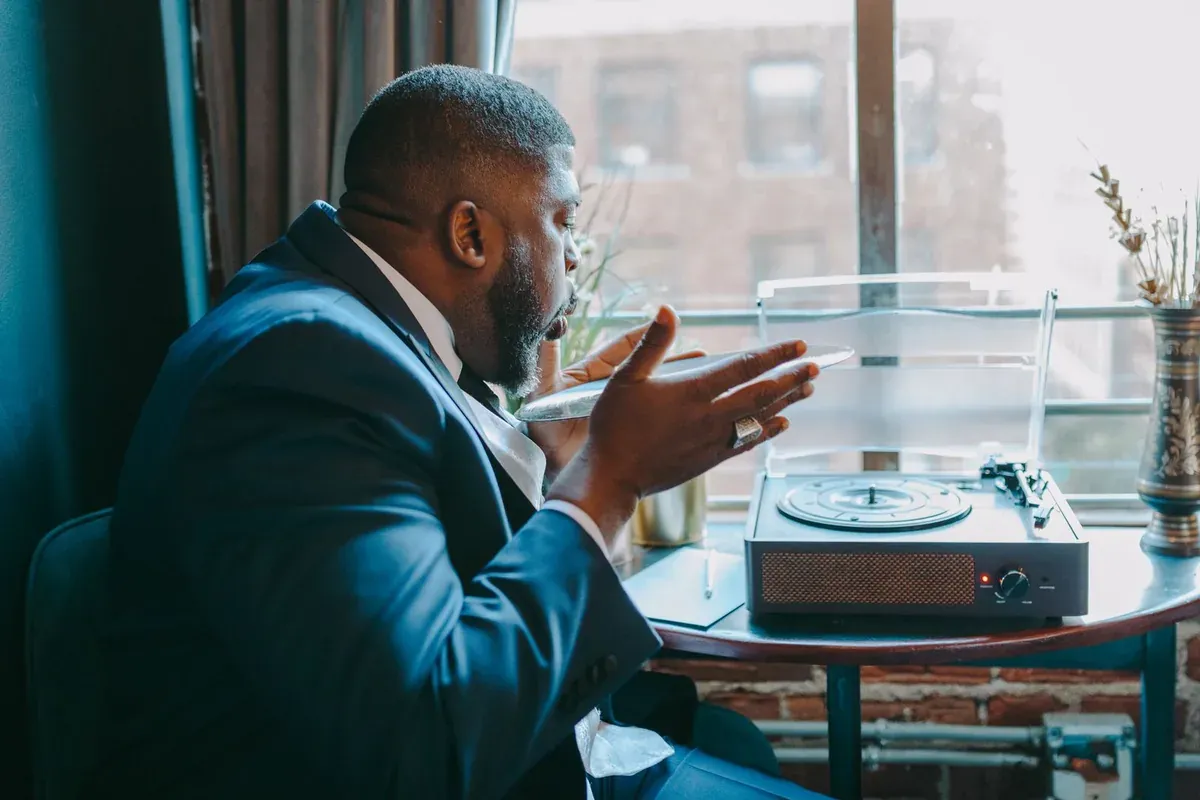
The Sound of the House: Jazz, Vinyl, and the Music Room Standard
Building a vinyl record collection around the jazz essentials and a turntable that respects them — the pressings that anchor the house collection, the listening room standard, and listening evenings as a social art.
Every serious house has a sound, and in ours it is not a playlist — it is a record, chosen, carried to the turntable, and played all the way through.
Building a vinyl record collection is how a house takes its music seriously again: the jazz essentials on the shelf, a turntable set up to respect them, and listening restored to what it was in our parents' houses — an event, not a background.
Here is the standard: the anchor records, the labels that made them, the soul shelf beside them, the machine, the room, and the evening.
The Anchor Shelf: Five Records That Start Everything
Start where every serious collection starts.
Miles Davis's Kind of Blue, released in August 1959, is the best-selling jazz record of all time — recorded in two sessions at Columbia's 30th Street Studio in New York, with John Coltrane and Cannonball Adderley on saxophones, Bill Evans and Wynton Kelly at the piano, Paul Chambers on bass and Jimmy Cobb on drums: seven musicians, as one audiophile house puts it, who made a masterpiece out of sketches, space and first takes.
Beside it, Coltrane twice: Blue Train, his Blue Note session of 1957, and A Love Supreme of 1965, the spiritual suite that collector guides describe as his quartet at its peak — the cornerstone pairing around which a jazz shelf organises itself.
Then the working anchors: Dave Brubeck's Time Out, the 1959 record that taught a generation to count in five; a hard-bop cornerstone from the Prestige and Blue Note runs — the Miles quintet sessions that produced Cookin', Relaxin', Workin' and Steamin' with Coltrane in the band; and one vocal record, because a house collection serves evenings as well as study.
Buy these five in the finest pressings you can justify, and the shelf already sounds like it knows where it is going.
Play Kind of Blue first on any new system and in any new room, and use it as the house reference: the audiophile literature returns to it for a reason beyond its sales.
Its virtues are architectural — modal sketches instead of dense chord changes, air around every instrument, a tempo that refuses to hurry — which makes its faults, on a badly set-up deck, just as audible: a smeared piano, a bass that arrives late to its own notes.
When Coltrane's entrance on "So What" sounds like a man stepping into a lit room, the setup is right. Collectors have treated the record this way for decades, and the best modern writing on it says the quiet part plainly: its power is in its stillness and its space, the sound of musicians trusting one another completely.
The Blue Note Standard: Why the Label Matters
Half the anchor shelf carries one logo, and it is worth knowing why. Blue Note Records was founded on January 6, 1939, by Alfred Lion and Francis Wolff, German immigrants whose passion for jazz built, as one label history puts it, a home for the most revered players in jazz.
Lion's genius was trust — long, unhurried sessions, musicians paid to rehearse — and his engineer was the other half of the sound: Rudy Van Gelder, who built his first studio in his parents' living room in Hackensack, New Jersey, and from 1959 worked from Englewood Cliffs.
The National Endowment for the Arts tells how Lion found him: he took a Van Gelder recording to his own engineer, who listened and gave the only honest answer in the business.
Alfred, I can't get that sound. You better take it to the guy who made it.— A New York engineer to Alfred Lion, via the National Endowment for the Arts
Van Gelder engineered nearly every Blue Note session from 1953 into the late sixties, and his stamp in a record's dead wax is a mark collectors still hunt.
Add the third signature — Reid Miles's cover designs, as distinctive as the music — and a Blue Note shelf is a design collection and a listening library in the same twelve inches.
The modern reissue programmes honour the standard: Blue Note's Tone Poet editions of Blue Train, for instance, were mastered from the original analog tapes and pressed on 180-gram vinyl in deluxe gatefold jackets, with session photographs by Francis Wolff himself in the booklet.
The Soul Shelf: The Other Half of the House
Jazz anchors the room; soul runs the evening.
Aretha Franklin's I Never Loved a Man the Way I Love You of 1967 is the soul shelf's foundation stone — the Atlantic record on which, as one history of the genre's classic albums puts it, she was dubbed the Queen of Soul, with "Respect" — Otis Redding's song, recomposed at her piano — spending fourteen weeks at the top.
Shelve Redding's own Otis Blue beside it; collectors never tire of noting that he recorded the whole album in twenty-four hours.
Then Nina Simone, whose essential starting trio the vinyl guides name plainly: I Put a Spell on You and Pastel Blues of 1965, and Wild Is the Wind of 1966 — original Philips pressings of Simone are the one indulgence this magazine will defend without blushing, since collector guides price them at $150–400 and up, depending on condition.
Marvin Gaye, Donny Hathaway and Al Green complete the shelf's first rank — and give Curtis Mayfield his own sentence, because Superfly belongs here too: rooted in realism where the film flirted with glamour, it is the rare soundtrack that out-argued its movie.
The Turntable Standard: A Setup That Respects the Records
A fine collection on a careless setup is a library in a damp room.
The discipline, as the setup guides lay it out, is unglamorous and absolute: the turntable sits level — checked with a small bubble level on the platter — on a stable surface away from the speakers, whose bass vibrations travel through floors and furniture into the stylus.
Tracking force is set to the cartridge maker's specification with a gauge, anti-skate matched to it, the cartridge aligned with a protractor; records are handled by their edges and labels, stored vertically, cool and dry, out of direct sun.
The signal chain can be simple or grand — a turntable with a built-in phono stage into powered speakers, or separates with an external preamp and passive speakers — but every link in it is chosen, not accidental.
One practical rule from the listening-room designers: keep three to four feet between turntable and speakers, and never, ever set the deck on top of one.
Buying Well: Originals, Reissues, and the Long Game
Two honest roads build the shelf. The first is the fine reissue: programmes like Blue Note's Tone Poet series and the Van Gelder remaster runs put the canonical recordings back on heavyweight vinyl, mastered from the original analog tapes, at prices a working collector can plan around — and for daily listening they are, frankly, the sensible glory.
The second road is the original pressing, bought slowly and knowingly: the identifiers are part of the education.
Collector guides teach the marks by heart — Columbia's "Six Eye" label on a 1959 Kind of Blue, the "Van Gelder" stamp in the run-out groove of a first A Love Supreme — because the stamp and the label are the record's papers, and papers are what separate an heirloom from a purchase.
Whichever road a given title takes, buy the best copy you can find once, keep the receipt and the story with the sleeve, and let the shelf grow at the pace of conviction: five records a year, chosen like furniture, will outplay five hundred chosen like groceries.
The Second Shelf: Where the Collection Goes Next
Once the anchors hold, the shelf deepens along the lines the collector guides themselves draw.
Coltrane's Giant Steps and My Favorite Things stand beside A Love Supreme in the standard top-five lists — the hard-bop landmark and the soprano record that made a Broadway tune into a standard — and Miles's electric turn, Bitches Brew and On the Corner, opens the fusion door for the household that wants it.
The care of the growing shelf is its own small liturgy, and the setup guides are blunt about it: dust is the enemy, met with a carbon-fibre brush before and after play; a record's weight is no guarantee of its virtue — a well-kept standard pressing of a great performance will always outplay a heavyweight pressing of a poor one; and the stylus, the smallest and most sacrificial part of the whole apparatus, is inspected and replaced on schedule rather than on failure.
Collections kept this way do not merely survive; they appreciate — in value sometimes, in meaning always.
The Listening Evening, and What the Records Become
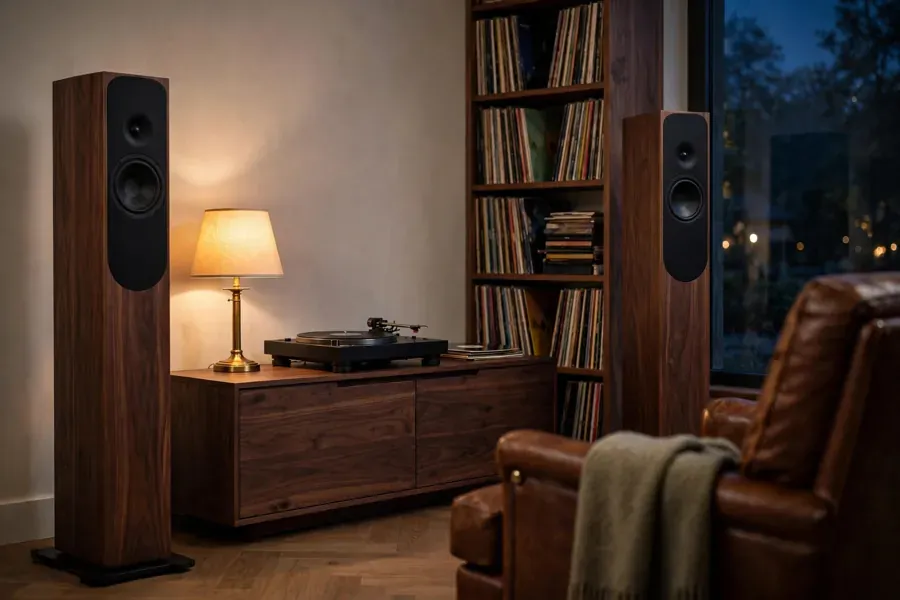
The room finishes what the equipment starts. Seat the listening chair where the geometry works — the point of an equilateral triangle with the two speakers — lamplight low, phones in another room, and play whole sides.
A listening evening at this level has a host's manners: one record chosen by the host, one by the guest of honour, a story attached to each, and silence while the music plays — conversation is for the side breaks, and it is better conversation for the wait.
This is how the collection becomes an inheritance rather than a hobby: the records carry the stories with them. A father writes the date and the room on the inner sleeve; a daughter inherits not just A Love Supreme but the evening it was first played for her.
Vinyl asks slowness of a house, and pays it back in the only currency that compounds — memory, at thirty-three and a third revolutions per minute.
House Rules for a Collection That Outlives Its Shelves
Three small laws keep a great collection great. First, the host plays the records: guests browse and request, but the stylus is lifted and lowered by the hands that own the machine — not from ceremony but because a tonearm is a precision instrument and hospitality does not extend to other people's technique.
Second, every record returns to its sleeve the night it is played; a collection's condition is decided in the small hours, not at the shop. Third, the catalogue is written down — a simple notebook or card file beside the shelves, title, pressing, date acquired, and one line of memory when the record earns one.
It takes a minute a record. It is the difference, forty years on, between a stack of vinyl and an archive — and this house deals in archives.
The Cookout, Elevated
The Long Marriage Playbook
The Library Every House Should Hold: Black Classics, Beautifully Bound
Hosting the Salon
Benefit Concert and Museum Night
Burl Audio — “Featured Vinyl: Kind of Blue”
VMG Vinyl — “Building Your Jazz Collection”
National Endowment for the Arts — “Rudy Van Gelder on Being Discovered by Alfred Lion”
Fresh Sound Records — “Rudy Van Gelder Albums”
Grunge — “5 Classic Albums That Define Soul”
Keep Them Spinning — “Nina Simone on Vinyl: A Collector's Guide”
All For Turntables — “Setting Up a Record Player”
Elevated Magazines — “The Vinyl Revival: Setting Up the Perfect Listening Space”
Questions & Answers
Why does Black cultural history matter today?
Building a vinyl record collection around the jazz essentials and a turntable that respects them — the pressings that anchor the house collection, the listening room standard, and listening evenings as a social art. It links to 6 stories and articles — open any card to read the full piece.
What should every house know about this history?
Building a vinyl record collection around the jazz essentials and a turntable that respects them — the pressings that anchor the house collection, the listening room standard, and listening evenings as a social art.
How do I read the full stories on The Sound of the House: Jazz, Vinyl, and the Music Room Standard?
Choose any card on this page. Each one opens a full page of its own — the complete story or article, with its sources linked.