The House That Jazz Built: Black Jazz History — the Best Musicians Past and Present and the Essential Albums
A Black jazz history of the best musicians past and present: the eras, the innovators who built the house room by room, and the essential albums that form the canon — with the masters carrying the music now.
Jazz is the one art form America invented out of whole cloth, and Black musicians invented it.
This Black jazz history — the best musicians past and present, and the essential albums that carry their work — begins where the music begins: in New Orleans, in the late 19th and early 20th centuries, where, as Far Out Magazine's history puts it, jazz emerged from African American communities in New Orleans, drawing upon blues, ragtime and other musical traditions, with improvisation, rhythmic interplay and individual expression as its defining characteristics.
From that one city it travelled up the river and across the country, changing its clothes in every era — swing, bebop, cool, modal, free, fusion — without ever changing its soul. This article is the story of that house and its builders.
For the music's other great line — gospel, blues, soul and funk — see our companion canon, The Sound Before Everything; for where to hear this music live and dressed up, our venue roll, The Listening Rooms, follows this one.
New Orleans: The First Rooms
Early jazz was a collective music — trumpet, clarinet and trombone improvising together over a rhythm section, a street parade folded into a dance band. The genius who reorganised it around the soloist was Louis Armstrong.
In the account of one evolution history, Armstrong revolutionised jazz with virtuosic trumpet solos and scat singing in the 1920s Hot Five recordings, shifting the focus from ensembles to individual stars.
That shift is the founding event of modern music: the band became a frame, and inside the frame a single personality could now speak, at length, in a voice nobody else had. Armstrong's contemporary Sidney Bechet took the music to Europe; Jelly Roll Morton claimed, with more truth than modesty usually allows, to have invented the whole thing in 1902.
What is certain is that by the time the music reached Chicago and New York, it had its grammar: blues changes, swing rhythm, call and response, and the solo as a form of testimony.
The Swing Era: Ellington, Basie, and the Big Band as Orchestra
The 1930s and 1940s made jazz America's dance music, and its two presiding geniuses ran opposite kinds of orchestras.
Duke Ellington, in the same history's count, led big bands through the swing era with over 3,000 compositions, blending orchestral depth and blues — writing not for instruments but for the individual men in his band, so that a solo by Johnny Hodges or Cootie Williams sounds like a portrait, because it is one.
His ambitions ran past the dance hall: "Black, Brown and Beige," his 50-minute classical-style suite introduced at Carnegie Hall in 1943, stands as the era's monument — Ellington called "perhaps the single most important creative talent in American popular music history" by the same account.
Count Basie built the opposite miracle: a Kansas City band of minimalist piano, a rhythm section that floated like a yacht, and soloists like Lester Young, whose tenor seemed to lean back against the beat and smile — Basie's "One O'Clock Jump" powered dance floors nationwide, and his orchestra defined swing with Kansas City grooves.
Between Ellington's architecture and Basie's ease, the big band became a complete civilisation — and Billie Holiday, singing with both worlds, redefined what a jazz vocal could carry, infusing the form with an emotional directness nobody has improved on since.
Bebop: The Musicians' Music
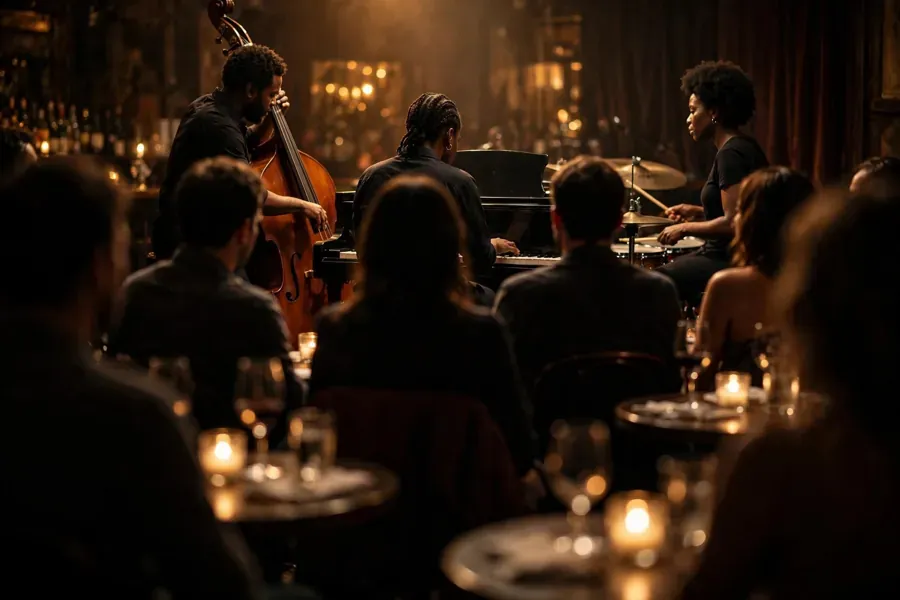
In the early 1940s, in after-hours rooms like Minton's Playhouse in Harlem, a generation of young virtuosos rebuilt jazz as an art music — music for listening, at tempos dancers could not follow. Charlie Parker co-founded bebop with lightning-fast alto saxophone and complex harmonies, demanding a new level of musical virtuosity, while Dizzy Gillespie innovated alongside him at Minton's.
Thelonious Monk brought angles and dissonance to the piano that still sound like the future; Bud Powell translated Parker's language to the keyboard.
Bebop's children — cool jazz, hard bop, modal jazz — filled the 1950s: hard bop, as the standard histories summarise, emerged in the 1950s incorporating influences from rhythm and blues, gospel music, and blues, especially in the saxophone and piano playing — Art Blakey's Jazz Messengers becoming, in the process, the music's great finishing school for young players, a line that runs unbroken to the present day.
1959 and After: Modal, Spiritual, Free
One year holds the centre of the canon. In 1959 Miles Davis — who had already shaped cool jazz — recorded Kind of Blue in two sessions with a band that included John Coltrane and Bill Evans, improvising from modes rather than chord changes.
The verdict of the record books, as a University Musical Society history states it: the certified lifetime sales tell the story — more than five million copies for Kind of Blue (1959) and one million for A Love Supreme (1964), placing both among the best-selling jazz records ever made.
James Kaplan's account of the three men calls Kind of Blue, plainly, the best-selling jazz album ever.
Coltrane took the modal idea and made it a spiritual practice: his "sheets of sound," as critic Ira Gitler named them in 1958, resolved into the four-part suite A Love Supreme, recorded in December 1964 — a prayer in album form that remains the music's most beloved devotional work.
Around them, Ornette Coleman loosened the music's last structures into free jazz, Charles Mingus composed like an Ellington with a grievance and a grin, and Herbie Hancock would soon pioneer fusion, bridging jazz to funk and electronics. The house now had more rooms than anyone could visit in a lifetime — which is precisely the point of a canon.
The Singers: Holiday, Fitzgerald, and the Art of the Wait
No history of this house is complete without its singers, because jazz singing is where the music's two gifts — improvisation and testimony — meet in a single throat. Billie Holiday bent phrasing the way Parker bent harmony, lagging behind the beat until a lyric confessed things its writer never wrote.
Ella Fitzgerald answered with the opposite miracle: perfect time, perfect pitch, and a scat vocabulary that let her improvise like a horn.
Hear them together on Ella & Louis (1956), the duet album with Armstrong, which one appreciative survey describes as a masterclass in making the listener wait — when Fitzgerald is singing her part in a duet, you miss Armstrong; when Armstrong is singing, you miss Fitzgerald; and the balance, held by musicianship of the highest order, is perfect.
Sarah Vaughan carried the bebop generation's harmonic knowledge into a voice of operatic range; Betty Carter turned the bandstand into a masterclass of her own, training young players the way Blakey did. The singers were never decoration on this music.
They were among its architects — and the present generation of jazz vocalists, raised on all three women at once, is the proof.
Fusion: The House Gets Wired
Davis, characteristically, refused to stay in any room he had built. Having shaped cool and modal jazz, he turned to fusion with Bitches Brew, plugging the band into rock's electricity; and Herbie Hancock — a Davis alumnus — pioneered jazz fusion with funk and synthesisers on "Chameleon," bridging the music to modern electronic hybrids.
Critics argued about fusion for a generation, but the argument missed what the musicians knew: the house had always absorbed whatever the street was playing, from ragtime to rhythm and blues. Fusion simply proved the walls were load-bearing.
It also built the bridge the present generation walks daily — the jazz-R&B-hip-hop fusions of contemporary Los Angeles and London are fusion's grandchildren, and they know it.
The Keepers: Marsalis and the House Made Official
Every inheritance needs a keeper, and jazz found its most consequential one in Wynton Marsalis — trumpeter, composer, and the artist whose 1997 oratorio Blood on the Fields was, as his departure coverage notes, the first jazz work to receive the Pulitzer Prize for Music.
His institutional work began modestly: in the mid-1980s, Lincoln Center's Alina Bloomgarden, determined to remedy jazz's lack of representation in the fine-arts world, presented the "Classical Jazz at Lincoln Center" summer concert series in 1987 with Marsalis as artistic director.
The series grew into a department, and by 1996 Jazz at Lincoln Center stood as a full constituent of Lincoln Center alongside the New York Philharmonic and the Metropolitan Opera — the music's address made official at last. Its education programmes, including the Essentially Ellington high-school competition, have put the canon into the hands of generations of students.
It's the perfect time to identify the next generation of leadership.— Wynton Marsalis, via the linked source
That sentence is the whole tradition in miniature: the house is not a museum. It is a trust, and it is meant to be handed on.
The Present Masters
The handover is already audible. The contemporary field, as current surveys describe it, is led by artists raised inside this history and fluent in everything after it.
Kamasi Washington, the tenor saxophone titan, unleashes epic suites like The Epic (2015), a three-hour odyssey with orchestral swells and spiritual undertones whose work echoes John Coltrane while inviting hip-hop fans through massive live ensembles. Robert Glasper crosses between jazz piano, soul and rap — his Black Radio albums earned Grammys by making contemporary jazz accessible without diluting its depth.
And the map is now global: Kamasi Washington, Shabaka Hutchings, Nubya Garcia, Ezra Collective and Esperanza Spalding regularly anchor the international conversation, with London's scene answering Los Angeles and New York room for room.
The rooms themselves testify: when a new Blue Note club opened in Los Angeles, its calendar read like this article's present tense — residencies and stands by Robert Glasper, Kamasi Washington, Branford Marsalis, Esperanza Spalding, Ravi Coltrane and Kenny Garrett, one after another. A music whose masters fill a season without repeating themselves is not surviving.
It is thriving, on schedule, in public. Jazz's present, in other words, looks exactly like its past: Black musicians, in dialogue with their moment, making rooms the rest of us get to live in for a while.
The Listening Map: The Essential Albums
Build the shelf in this order and you will have the house. Louis Armstrong's Hot Five and Hot Seven recordings — the foundation. Duke Ellington at his orchestral peak, and Ella & Louis (1956), the Fitzgerald–Armstrong masterclass in making a listener wait.
Charlie Parker's Savoy and Dial sessions — bebop being invented in real time. Thelonious Monk's Straight, No Chaser (1967) — mid-tempo swing and a tendency to stay in one key that first sounds like coffee-house ease, until the angles in Monk's playing reveal it as bebop of the most personal kind.
Then the twin pillars: Kind of Blue and A Love Supreme, the two records the histories above place at the top of the sales lists and the top of the art. Herbie Hancock's fusion landmarks.
And the present: Kamasi Washington's The Epic and Robert Glasper's Black Radio — proof, on your own shelf, that the newest rooms in the house are built of the same timber as the first.
And the house's influence long ago outgrew its own walls: as the standard histories close the account, the genre has subsequently influenced rock, funk, hip-hop, electronic music and countless other styles — which is another way of saying that a very large share of the music the world now makes is, whether it knows it or not, made in rooms Black jazz musicians built first.
A house this well built does not empty. It fills — with students in Ellington competitions, with trios in candlelit clubs, with a child hearing "So What" for the first time and going quiet in the way that means a life has just changed direction. Keep the records in the home.
Keep the rooms full. That is how the house stands.
The Sound Before Everything: Classic Black Music and Its Makers
The Listening Rooms: The Best Jazz Clubs in America
Black Men — Profile Collection
Far Out Magazine — "Jazz: Artists, Albums, History and Music"
Classicalite — "How Jazz Music Evolved Throughout History: New Orleans Roots to Modern Fusion"
University Musical Society — "Miles Davis and John Coltrane at 100"
Classicalite — "Top Modern Jazz Artists and Contemporary Jazz Musicians Keeping the Genre Thriving"
Wynton Marsalis — Official Biography
The Box Houston — "The Evolution of Jazz Music"
Culturizm — "15 Contemporary Jazz Artists: Shaping Today's Music Scene"
Wikipedia — "Wynton Marsalis"
Spectrum FM — "Wynton Marsalis to Step Down from Jazz at Lincoln Center After More Than Three Decades"
Manual RedEye — "Six Black Jazz Albums"
Relix — "Blue Note LA Unveils Opening Calendar"
Questions & Answers
Why does Black cultural history matter today?
A Black jazz history of the best musicians past and present: the eras, the innovators who built the house room by room, and the essential albums that form the canon — with the masters carrying the music now. It links to 3 stories and articles — open any card to read the full piece.
What should every house know about this history?
A Black jazz history of the best musicians past and present: the eras, the innovators who built the house room by room, and the essential albums that form the canon — with the masters carrying the music now.
How do I read the full stories on The House That Jazz Built: Black Jazz History — the Best Musicians Past and Present and…?
Choose any card on this page. Each one opens a full page of its own — the complete story or article, with its sources linked.