The Listening Rooms: The Best Jazz Clubs in America
A live jazz venues guide to the best jazz clubs in America — the historic houses and the modern listening rooms, city by city, with where to sit, what to order, and how each room expects its guests to behave.
There are really two kinds of rooms on any honest list of the best jazz clubs in America, and knowing which kind you are entering is the whole of the etiquette.
The first is the historic house — a room where the music has been played so long that the walls themselves are part of the instrument, where you go to sit inside history and listen the way congregations listen.
The second is the modern listening room or supper club, built for comfort: a proper dinner, a deep chair, a sound system tuned like a recording studio, and a headliner close enough to read. Both kinds ask the same thing of you — dress like the evening matters, arrive before the set, and give the music your attention.
In return, they give you the last great dress-up night in American life that is not about being seen. It is about hearing. This guide walks the rooms city by city, the way you might plan a year of them.
A word on the word "oldest," because the rooms argue about it. Detroit's Baker's Keyboard Lounge is billed as the world's oldest continuously operating jazz club; New York's Village Vanguard is documented as the oldest operating jazz club in New York City, and a leading candidate for the world's title in its own right.
Both claims appear in this guide, each attached to the room that makes it — at this level, we let the houses state their own cases and we simply enjoy the rivalry.
What is not in dispute is the standard the survivors share, one that New Music USA's survey of America's most fascinating jazz clubs puts plainly: the rooms that lasted did it on the integrity of their bookings. Names change on the marquee every week. The standard does not.
New York: The Vanguard, the Blue Note, Birdland, Smoke
Begin where the music keeps its capital. The Village Vanguard, at 178 Seventh Avenue South in Greenwich Village, opened on February 22, 1935, under Max Gordon, presented folk music and poetry first, and turned primarily to jazz in 1957 — the year its live-album era began.
It is today the oldest operating jazz club in New York City, a wedge-shaped basement seating just 123 people, with the bandstand at the point of the triangle and some of the most praised acoustics in the world: more than one hundred albums have been recorded live in that room, including the defining 1961 engagements of Bill Evans and John Coltrane.
The Vanguard Jazz Orchestra holds the Monday-night residency, a tradition running back decades, and a working band plays a full week at a stretch — which is why musicians grow inside a Vanguard engagement the way they grow inside a residency nowhere else. Book ahead; there are no bad seats, but there are only 123 of them.
After Max Gordon's death in 1989, his widow Lorraine ran the room for nearly three more decades with a manager's iron and a fan's heart. Asked how she decided things, she joked:
When I have to make a decision, I ask, 'What would Max do?' Then I do the opposite.— Lorraine Gordon, via Jazz Promo Services
Three blocks and one generation later, the Blue Note at 131 West 3rd Street has been Greenwich Village's polished showroom since 1981 — the club guides describe as one of the most famous in the world, where Herbie Hancock, Chick Corea and Wynton Marsalis headline and the late-night sets introduce the next names.
Where the Vanguard is a chapel, the Blue Note is a theatre with dinner: fuller production, a complete kitchen, and the easiest first jazz-club evening in America for a guest you are introducing to the music.
Uptown in the Theater District, Birdland at 315 West 44th Street carries the most famous nickname in the music — the Jazz Corner of the World, after its namesake, Charlie "Bird" Parker, for whom the original club was named in 1949.
The present room is its third home and its longest-lived: a genuine supper club with a full menu, big-band nights, and music charges the club lists from $20 to $50 with a $10 food or drink minimum — arrive for dinner, stay for the set, and you are doing Birdland the way it was designed.
Finally, the Upper West Side's Smoke Jazz & Supper Club at 2751 Broadway is the connoisseur's New York room: candle-lit tables, red velvet banquettes, double headlining sets and contemporary artist residencies, with serious dining attached. Smoke is where New Yorkers in the know take other New Yorkers — the room you graduate to.
New Orleans: Preservation Hall
Every other room in this guide is a club. Preservation Hall in the French Quarter is a mission.
Founded in 1961 by Allan and Sandra Jaffe, it was created, in the words of its chroniclers, as a sanctuary for New Orleans jazz musicians at the moment modern jazz and rock and roll were pushing the traditional music aside — a bare room, no frills, the music played the way its inventors played it, by musicians who in the early years had learned it firsthand.
The building had lived several lives before the music — residence, tavern, inn, photo studio, art gallery — and the gallery years are where the sessions began.
Allan Jaffe played tuba; his son Ben grew up inside the hall, took its leadership, and plays in the Preservation Hall Jazz Band, formed in 1963, which carries the music around the world while the hall's collective of master musicians plays on at home, night after night. Ben Jaffe's test for an evening is the simplest in this entire guide:
If people don't walk out of here with a smile on their face, then we haven't done our job.— Ben Jaffe, via National Geographic
Practical counsel: the hall is small, the seating is benches, there is no dinner and no cocktail theatre — and none is wanted. Go early, sit close, and understand that you are not attending a concert so much as being received in a living room where the family happens to be the custodians of an American art form.
Pair it with dinner before in the Quarter — our guide to New Orleans, lived well knows the tables — and let the hall be the whole of the night's music. Dress with respect. The musicians do.
Chicago and Detroit: The Green Mill and Baker's
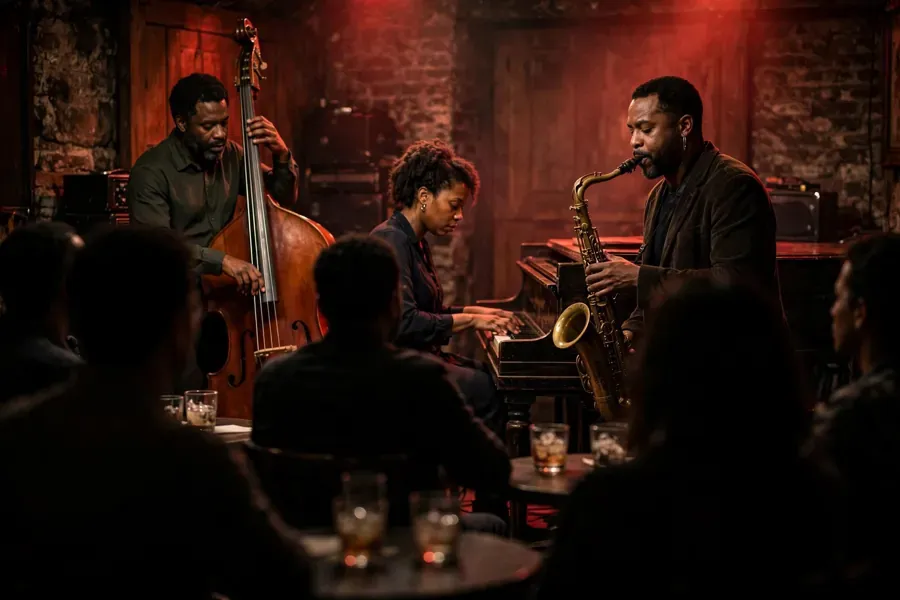
Chicago's Green Mill Cocktail Lounge, at 4802 North Broadway in Uptown, is the great survivor of the Prohibition room.
The business opened in 1907 as a beer garden and took the Green Mill name in 1910 — a nod to Paris's Moulin Rouge — before its famous years as a speakeasy favored by Al Capone, whose favorite booth, placed to watch both entrances, is still in the room.
The Art Deco interior is largely original, the jazz runs seven nights a week, and on Sundays the room hosts the Uptown Poetry Slam, the longest-running poetry slam in the world, born at the Green Mill in 1986.
Go for the late set, sit in a booth, order a classic cocktail, and let the room do what it has done for a century: make the present feel pleasantly outnumbered by the past.
Gear Patrol's national survey keeps the Green Mill on its list of America's best clubs for live jazz, and Chicagoans will tell you the listing is the least the room deserves.
Detroit answers with Baker's Keyboard Lounge, at 20510 Livernois Avenue on the Avenue of Fashion — founded in May 1933 as a lunchtime sandwich restaurant, booking jazz pianists from 1934 and national acts from 1939, and the oldest continuously operated jazz club in Detroit. Ninety-nine seats. Art Deco furnishings kept from the 1952 remodel.
A piano-shaped bar painted with a keyboard motif — the bar that, local history delights in noting, inspired Liberace's piano-shaped swimming pool.
The roll of musicians who played this small room is not small at all: Ella Fitzgerald, Miles Davis, Oscar Peterson, Sarah Vaughan, Cab Calloway, Nat King Cole, and Art Tatum, who chose its Steinway and played the last performance of his life here in 1956. Michigan designated Baker's a historic site in 1986.
This is the dress-up room of the Midwest's Black musical capital, and a table at Baker's remains what it has been for ninety years: a seat inside the story.
The West: Jazz Alley, Yoshi's, SFJAZZ
Seattle's Dimitriou's Jazz Alley, at 2033 Sixth Avenue, is the supper-club form perfected for the Pacific Northwest — family-owned since 1979, presenting music nearly every night of the week, with a full dinner service and the warm, upscale polish that made it a frequent answer when Jazz24 asked its listeners for the world's best jazz clubs.
Across the bay in Oakland's Jack London Square, Yoshi's at 510 Embarcadero West seats 310 around a stage that has hosted generations of headliners, pairing world-class jazz with a serious Japanese kitchen — the rare room where the dinner is a co-headliner and nobody minds.
And in San Francisco, SFJAZZ at 201 Franklin Street is the modern listening room at civic scale: opened in 2013 as the first stand-alone hall in the United States built entirely for jazz, its 700-seat Robert N. Miner Auditorium and intimate Joe Henderson Lab present hundreds of concerts a season in acoustics designed from the ground up.
SFJAZZ is what the twenty-first century built when it finally took the music as seriously as the music's own rooms always had — dress for it the way you would for the symphony, because the building does.
How Each Room Treats Its Guests — and How to Be One
The rooms differ; the covenant is the same. Reserve ahead — the Vanguard's 123 seats and Baker's 99 do not forgive spontaneity on a weekend. Arrive before the set begins and expect to stay for all of it; a set is a composition, not a playlist.
Order properly: the historic rooms run on a cover plus a drink minimum, the supper clubs on dinner — either way, your table's spending is part of how the music survives, and New Music USA's history of the form is honest that drink and dinner sales were always the lifeblood of these rooms.
Dress one notch above the room's minimum and you will never be wrong; these are the last rooms in America where a jacket and a dress are simply correct. Talk is for the interval, applause is for the solo's end, and the telephone stays in the pocket it arrived in.
Do that, and every room in this guide will treat you the way they have treated three generations of our families: as a listener, which in a jazz club is the highest title there is.
The music's own story — from the inventors to the masters carrying it now — is told in our companion history, Black Jazz, Past and Present, and the rooms where society hears everything else are gathered in The Most Exclusive Rooms.
The House That Jazz Built: Black Jazz, Past and Present
The Sound Before Everything: Classic Black Music and Its Makers
The Most Exclusive Rooms
Profiles: The Men of Black Excellence
Gear Patrol — "The Best Clubs Across America for Enjoying Live Jazz"
Wikipedia — "Village Vanguard"
Jazz Promo Services — "Lorraine Gordon, Keeper of the Village Vanguard Flame"
Path Culture — "Top Ten Legendary Jazz Clubs in New York City"
Birdland Jazz Club — the club's own pages
National Geographic — "Preservation Hall: My New Orleans Fairytale"
Academy of American Poets — "Green Mill Cocktail Lounge"
When It Was — "The Green Mill Cocktail Lounge"
Wikipedia — "Baker's Keyboard Lounge"
Jazz24 — "The World's Best Jazz Clubs, According to Jazz24 Listeners"
KLM Travel Guide — "Swinging in the Best Jazz Clubs" (San Francisco)
New Music USA — "America's Most Fascinating Jazz Clubs"
Questions & Answers
Who will you meet on this page?
A live jazz venues guide to the best jazz clubs in America — the historic houses and the modern listening rooms, city by city, with where to sit, what to order, and how each room expects its guests to behave. It links to 5 stories and articles — open any card to read the full piece.
What makes these stories worth reading?
A live jazz venues guide to the best jazz clubs in America — the historic houses and the modern listening rooms, city by city, with where to sit, what to order, and how each room expects its guests to behave.
How do I read the full stories on The Listening Rooms: The Best Jazz Clubs in America?
Choose any card on this page. Each one opens a full page of its own — the complete story or article, with its sources linked.