
New Orleans, Lived Well: The Bourgeois Guide to the Crescent City
This black New Orleans guide to neighbourhoods, restaurants and culture is drawn the way our readers actually live the city — by inheritance, table and Sunday parade.
Every city has a visitor's version of itself, and then it has the version its own people live.
This black New Orleans guide is about the second one — the neighbourhoods, tables, churches and Sunday streets where the city's Black bourgeoisie has built its life for generations, and where a reader who comes to the Crescent City with love and a little money can live it well.
New Orleans rewards the traveller who goes deeper than the famous quarter: into Tremé's living history, the Seventh Ward's Creole houses, Gentilly's broad lawns and Pontchartrain Park's ranch homes around the golf course. Bring your appetite and your respect, in that order and in equal measure. The city will do the rest.
A word on how to use this guide. New Orleans is an inheritance before it is a destination — Creole culture, carried in families, in recipes, in the names of streets and the membership rolls of clubs.
We will point you to where to stay, where to eat, where to worship and where to buy, but the through-line is the geography itself: a map drawn by free people of color before the Civil War, by builders and attorneys in the Seventh Ward, by doctors and teachers who raised a suburb of their own in the 1950s, and by the Social Aid & Pleasure Clubs that still turn ordinary Sundays into parades.
Walk it slowly.
Tremé: Where the Music — and the Neighbourhood — Begins
Start where the city itself starts.
Tremé, just across Rampart Street from the French Quarter, is considered the oldest African American neighborhood in the country and an important part of the Civil Rights Trail — recognised as one of the oldest African American neighbourhoods in the country, its ground bought and built by free people of color in the early nineteenth century.
Its streets are lined with colourful Creole cottages and shotgun houses, and its front parlours raised generations of musicians, artisans and undertakers, caterers and clubmen — the professional class of Black New Orleans in its first great flowering.
The neighbourhood's sacred ground is Congo Square, inside what is now Armstrong Park: the 32-acre park named for Louis Armstrong, where, as the city's own walking-tour account records, enslaved and free people of color gathered on Sundays centuries ago, and where drumming circles still form on Sunday afternoons.
A few blocks away stands St. Augustine Catholic Church — founded in 1841, described in neighbourhood guides as the oldest African American Catholic parish in the United States, built by free people of color and still the spiritual heart of Tremé, its October Tremé Fall Fest raising funds for the church's restoration.
Worship here, respectfully and properly dressed, is not tourism; it is participation in the oldest continuous story in Black American Catholic life — and it pairs naturally with our coverage of faith's own social season.
Give the Backstreet Cultural Museum its hour. The museum houses one of the world's largest collections of Mardi Gras Indian suits, jazz funeral and second line memorabilia — the regalia of a culture that files its history in beadwork and feathers rather than in books.
Then eat, because Tremé insists on it: Lil Dizzy's Cafe for the neighbourhood table, and above all the restaurant the next section cannot do without.
The Table: Dooky Chase's and the Creole Standard
Dooky Chase's Restaurant, on Orleans Avenue in Tremé, opened in 1941 as a sandwich shop and lottery-ticket outlet founded by Emily and Dooky Chase Sr. — and became, under Leah Chase, who married into the family in 1946, one of the country's first African American fine dining rooms.
The record, as the restaurant's own histories tell it, is extraordinary: a central meeting place for music, entertainment and civil rights organising, its upstairs room a strategy table for the movement, its dining room wrapped in African American art and Creole cooking.
Leah Chase — the Queen of Creole Cuisine — received the James Beard Foundation's Lifetime Achievement Award in 2016, and the restaurant, designated a James Beard American Classic, remains family owned and operated, a true New Orleans landmark.
Order the gumbo. Order the fried chicken. Understand, as you eat, that you are sitting in a room where the good life and the serious life were never separate — where a family built a business, fed a movement, collected its people's art and set a standard of Creole hospitality that the whole country eventually came to honour.
That is the bourgeois story in its purest New Orleans form, and it is why this guide begins its table talk here rather than at any fashionable new room. The new rooms are fine. This one is foundational.
The Seventh Ward: The Creole Houses and the Builders Who Raised Them
East of Tremé lies the Seventh Ward, the city's great Creole corridor.
The Preservation Resource Center's account of the A.P. Tureaud–7th Ward district describes a community long associated with Creoles of color in the building trades — the artisans and craftspeople credited with constructing buildings in the French Quarter, Esplanade Ridge and Uptown, who on evenings and weekends constructed or added to their own homes in the 7th Ward, often bartering skilled labor with their neighbors.
Walk these streets with that knowledge and the architecture changes meaning: the double-gallery houses, the ornate cornices, the ironwork are not decoration. They are signatures — the portfolio of a class of free craftsmen who built the city's beauty and then built their own.
The ward's names carry the same weight. A.P. Tureaud Avenue honours the civil rights attorney Alexander Pierre Tureaud, whose home here is listed on the National Register of Historic Places. Dillard University, the HBCU rooted in the nineteenth century, anchors the ward's northern reach in Gentilly.
And the ward's tables and storefronts — the Circle Food Store tradition of Black-owned provision, the barrooms and bakeries along St. Bernard Avenue — formed the commercial spine of Creole New Orleans.
To buy in the Seventh Ward today, as some of our readers do when they come home or come for the season, is to buy into that lineage: a Creole house is not merely purchased, it is succeeded to, and the neighbours will expect it to be kept accordingly.
Gentilly and Pontchartrain Park: The Suburb Our Grandparents Built
Now drive east and north, toward the lake, into Gentilly — and prepare for the most quietly moving stop on this itinerary.
Pontchartrain Park, constructed beginning in 1955, is recognised by The Cultural Landscape Foundation as one of the earliest African American suburbs in the United States — a one-square-mile development of single-family homes, mostly in the California Ranch style, designed for and marketed to middle- and upper-class Black families at a time when the lakefront around it served white residents only.
Black Creoles left the older downtown neighbourhoods for its curving streets, its lawns, and the roughly 183-acre park and golf course at its centre. Southern University at New Orleans opened its campus at the neighbourhood's northwest corner in 1959.
Growing up here was like being in Mayberry.— Dwight Richards, early Pontchartrain Park resident, via the Preservation Resource Center of New Orleans
The Preservation Resource Center records that the neighbourhood — its ranch-style homes set around the Joseph M. Bartholomew Sr. Golf Course — was added to the National Register of Historic Places in 2020 thanks to the efforts of its dedicated residents, and that after the catastrophic flooding that followed Hurricane Katrina, residents' own efforts restored many of its homes.
Its roll of prominent residents runs from mayors Ernest and Marc Morial to actor Wendell Pierce and musician Terence Blanchard. This is the New Orleans good life in its domestic form: the cookout on the patio, the grandchildren on the golf course's edge, the house paid for and kept with pride for sixty years.
If you are house-hunting in the city — and readers write to us that they are — Pontchartrain Park and the wider Gentilly terraces are where the bourgeois map and the property map coincide. Our guide to the storied enclaves places this ground in its national company.
The Season: Social Aid & Pleasure Clubs and the Second Line
No guide to living well in New Orleans is complete without its calendar, and the city's true social season belongs to the Social Aid & Pleasure Clubs.
Their history is mutual aid made beautiful: Black residents, refused coverage by insurance companies, formed benevolent societies whose benefits included care in illness, a proper funeral — and an annual parade behind a brass band.
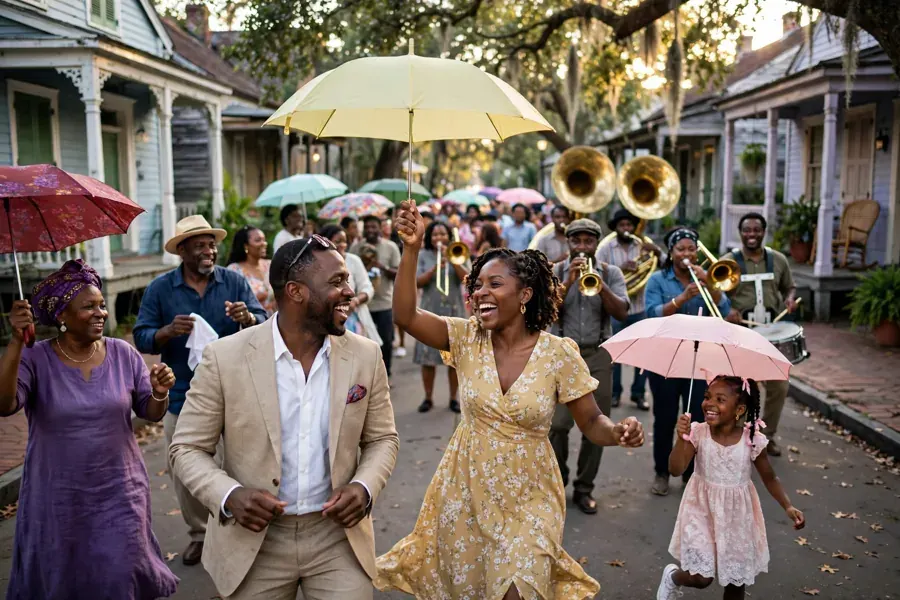
Out of those funerals and parades came the second line: the first line of band and club, the second line of everyone dancing behind, handkerchiefs and umbrellas aloft, grief turned by tempo into celebration.
Histories of the tradition credit the clubs with sustaining the brass band renaissance itself — steady work for musicians, a stage for the Dirty Dozen Brass Band's experiments, and a Sunday institution that now runs, in some corner of the city, practically every week of the year.
The visitor's etiquette is simple and non-negotiable.
A second line is a neighbourhood's celebration, not a show staged for you: fall in behind, dance if your feet know how, buy from the vendors who walk the route, dress like the day matters — the club members in their coordinated suits and dresses certainly have — and never step in front of the band or the club for a photograph.
Do that, and you will experience the most joyful public culture in America exactly as it is meant to be experienced: from inside the second line, where everybody is welcome and nobody is a spectator.
The Zulu Social Aid and Pleasure Club, whose krewe rolls on Mardi Gras morning with a membership drawn from the city's business, government and community leadership, is the tradition at its most majestic — the same club world, wearing crowns.
Where to Stay, and How to Come Home
For the stay itself, divide your nights by intention.
The grand hotels of the French Quarter and the Central Business District suit a first visit and a formal calendar; a guesthouse or a well-kept Creole cottage rental in Tremé or the Marigny suits the traveller who wants the neighbourhood at the door — coffee on the gallery at dusk, the streetcar's light below, exactly the hour our hero photograph catches.
Worship on Sunday — St. Augustine in Tremé, or the great Black Baptist and Catholic congregations across the city, several of whose pastors appear in our Pastors profiles collection.
Eat one foundational meal at Dooky Chase's, one neighbourhood meal in Tremé, and one long lunch wherever a local friend insists — in New Orleans, the friend's insistence is the finest restaurant guide ever compiled.
And if the city gets into you, as it has gotten into generations of our readers?
Then do what New Orleanians themselves do: come back for a season rather than a weekend, learn one neighbourhood the way you would learn a family, and consider the Gentilly and Seventh Ward streets in this guide not as scenery but as an address of your own. New Orleans, lived well, is not a trip.
It is an inheritance with an open door — Creole houses, a golf course ringed with ranch homes our grandparents built from cypress swamp and sheer determination, a table where the gumbo carries history, and a band, somewhere, tuning up for Sunday. All you have to do is fall in line. The second one.
The Storied Enclaves: Oak Bluffs, Sag Harbor, Prince George's County, Cascade Heights
The Church Anniversary and the Pastor's Ball
The Prestige Addresses: Upper East Side, Beverly Hills, and the Streets Where Money Lives
Pastors — Profiles Collection
AFAR — "Best New Orleans Neighborhoods for Visitors"
NewOrleans.com — "Self-Guided Tremé Walking Tour"
Preservation Resource Center of New Orleans — "Pontchartrain Park"
The Cultural Landscape Foundation — "Pontchartrain Park Neighborhood"
Goldbelly — "Dooky Chase"
Preservation Resource Center of New Orleans — "A.P. Tureaud-7th Ward Cultural District"
A Closer Walk NOLA — "Benevolent Societies / Social Aid and Pleasure Clubs"
Questions & Answers
What makes an address prestigious?
This black New Orleans guide to neighbourhoods, restaurants and culture is drawn the way our readers actually live the city — by inheritance, table and Sunday parade. It links to 4 stories and articles — open any card to read the full piece.
How do you choose a high-end realtor?
This black New Orleans guide to neighbourhoods, restaurants and culture is drawn the way our readers actually live the city — by inheritance, table and Sunday parade.
How do I read the full stories on New Orleans, Lived Well: The Bourgeois Guide to the Crescent City?
Choose any card on this page. Each one opens a full page of its own — the complete story or article, with its sources linked.