
The Storied Enclaves: Oak Bluffs, Sag Harbor, Prince George's County, Cascade Heights
The historic Black wealthy neighbourhoods of the East — Oak Bluffs, Sag Harbor, Prince George's County, and Cascade Heights — were not discovered. They were built, bought, and handed down, porch by porch and deed by deed.
Every family that summers in the same cottage for fifty years is making an argument about what wealth is for. The historic Black wealthy neighbourhoods of the East Coast — Oak Bluffs on Martha's Vineyard, the SANS communities of Sag Harbor, Prince George's County outside Washington, and Atlanta's Cascade Heights — make that argument in four different accents.
One is an island of gingerbread porches. One is a self-financed beachfront drawn up by a Black woman architect. One is an entire county that grew richer as it grew Blacker.
One is a canopy of Atlanta hardwoods that mayors call home. This is the map, and the meaning, of the storied enclaves.
Oak Bluffs: A Century of Summers
Oak Bluffs is where the map begins, because Oak Bluffs is where Black Americans first built a summer world of their own.
BlackPast's history of the town records that the community took shape in the 1890s around the beach now called the Inkwell — a name first thrown as an insult at the swimmers' skin and long since transformed into an emblem of pride, among the most famous such transformations in the country.
The early arrivals came to the island as servants to summering white families; the remarkable turn is what they did next.
Despite restrictive covenants elsewhere on the island, some of those workers became property owners, year-round residents, and small business owners — and, as BlackPast notes, much of the property purchased by these early African American islanders continues to be owned by their descendants.
The institution that anchored it all still stands. Shearer Cottage, founded by Charles and Henrietta Shearer in 1912 out of a laundry business begun in 1903, became a cornerstone of African American tourism on the island and remains family-run into the twenty-first century.
In the 1920s, Black islanders began offering rooms in their cottages to visitors from Boston, New York, and Philadelphia; the colourful gingerbread cottages became a byword for a particular kind of summer — educated, unhurried, and entirely self-possessed.
Writers of the Harlem Renaissance walked the Inkwell's sand; generations of HBCU alumni have returned to it since, including the morning swimmers of the Polar Bears club and the sisters who gather down the shore.
The economics quietly compounded: the same island history notes that cottages bought for under $30,000 between the 1950s and early 1970s had appreciated fifteen to twenty times by 2010, solidifying Oak Bluffs as one of the wealthiest Black resort communities — wealth created not by speculation but by staying.
The ritual heart of the Oak Bluffs summer still beats at the water's edge each morning.
Island guides record that the Polar Bears swim club has gathered at the Inkwell at half past seven every summer morning since 1946 — a daily circle in the calm bay water, open to all, now in its eightieth season — and that the African American Heritage Trail of Martha's Vineyard, founded to mark this history in place, now counts some thirty sites across the island, its first marker placed at the Inkwell in 1998.
To summer in Oak Bluffs is to live inside a curated memory: the trail signs, the Shearer porch, the cottages whose deeds read like family Bibles. Few resort towns in America can show you their history on a morning walk. Oak Bluffs insists on it.
You can forget all those other characterizations. You don’t need that armor here on Martha’s Vineyard.— Skip Finley, author, whose family has holidayed on the Vineyard for five generations, via Collider
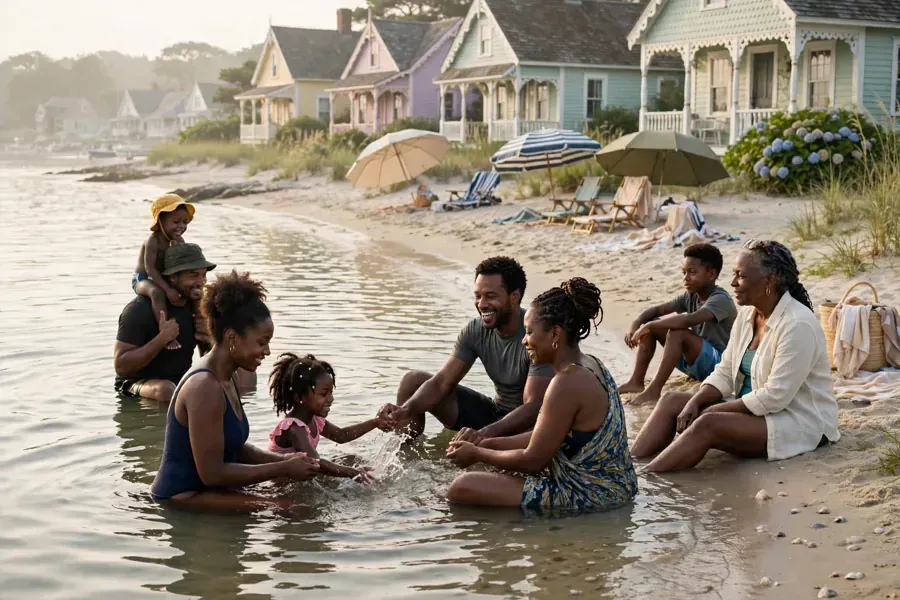
Sag Harbor: The SANS Communities
Ninety miles east, on Long Island's South Fork, stands the enclave that was quite literally drawn by its own people.
The Sag Harbor Hills, Azurest, and Ninevah Beach subdivisions — SANS — were founded between 1947 and 1952, and the Preservation League of New York State records the essential fact: the founders self-financed at a time when policies made it incredibly difficult for Black people to get mortgages, building a place of rest when few such places were open to them.
Azurest came first, planned by Maude Terry and her sister Amaza Lee Meredith — one of the first professional African American women architects — who laid out the lots in 1947 and sold them to friends and acquaintances; several of the modest mid-century houses were Meredith's own designs.
The Cultural Landscape Foundation's record gives the community its dimensions: a 154-acre district of three contiguous communities, its ranch, Cape Cod, and mid-century modern houses set on generous, densely canopied lots, with sandy paths leading to a private stretch of Havens Beach.
Sag Harbor Hills and Ninevah Beach followed between 1949 and 1952, and more than three hundred Black families ultimately bought in — Lena Horne and Harry Belafonte among the famous names the neighbourhood's histories record.
In 2019 the district was listed on the National Register of Historic Places, and its most telling statistic is not architectural at all: many of its homes are still owned by their original occupants and their descendants.
Buying into SANS today means joining a going concern — a community association, a beach, a memory — as much as purchasing a house.
Sag Harbor's Black story runs deeper than the postwar subdivisions, and the depth explains SANS.
Untapped Cities' survey of free Black communities in New York State traces the ground back to Eastville, the village's historic free Black settlement, where St. David AME Zion Church, built in 1839, served a community of free Black families, Native Americans, and immigrants — many of them whalers, in an era when wives often held the property so the home survived if a ship did not.
A century later, when Maude Terry and Amaza Lee Meredith laid out Azurest a short walk east, they were not inventing a community from nothing.
They were extending one of the oldest free Black settlements on Long Island into the age of the summer house — which is why SANS feels less like a development and more like a homecoming with deeds.
Prince George's County: A County, Not a Neighbourhood
Prince George's County, Maryland, operates at a different scale entirely: not a street or a shoreline but a whole suburban county east of Washington, D.C. Its rise was powered by the federal city — generations of Black professionals who built careers in government and bought, in wave after wave, into the county's subdivisions and golf-course communities.
The county became majority Black in 1990, and reference histories record that from 2000 to 2020 Prince George's ranked as the wealthiest African American-majority county in the United States — a standing that neighbouring Charles County, also in Maryland, took in the 2020 census, which tells its own story about how thoroughly the model spread.
Washington Post reporting on the county's federal workforce, summarising regional council analysis, counts more than 65,000 federal workers living in the county — over seventeen percent of its workforce — with a median salary well into six figures; stability, compounded over decades, is the county's founding fortune.
What Prince George's proved, against every assumption of the era that produced it, is that a jurisdiction could grow wealthier as its Black population grew — more than sixty percent Black today — because the newcomers were not a burden on the place but its professional class entire: doctors, lawyers, executives, and entrepreneurs who chose critical mass over dispersal.
Residents have long called it "the promised land," and its most exclusive pockets, like the gated golf community of Woodmore, carry the full apparatus of American luxury — country club, manicured fairways, seven-figure houses — with a membership that is overwhelmingly Black. It is the enclave as a polity: schools, churches, county government, and capital, all in the same hands.
Cascade Heights: Atlanta's Southwest Crown
Atlanta's answer sits under the trees of the city's southwest side. Cascade Heights is known for its rolling hills, large homes, and spacious lots beneath one of the densest tree canopies in Atlanta, bisected by Cascade Road — the old Sandtown Road, following a trail far older than the city.
Its modern story turned in the early 1960s, when Black professionals began buying into the area. In December 1962, the city erected a barricade across Peyton Road to discourage Black homebuyers — an episode remembered as Atlanta's "Berlin Wall" — and the following March the barrier was ruled unconstitutional and removed.
The attempted wall is a footnote now; the neighbourhood is the text. Cascade Heights became one of Atlanta's most affluent African American neighbourhoods, home over the years to Mayor Andrew Young, the family of Mayor Maynard Jackson, Mayor Shirley Franklin's family, and Hank Aaron, alongside the doctors, lawyers, and executives who give the southwest side its standing.
The texture of the place is its argument: sprawling mid-century houses on quiet side streets, newer luxury subdivisions along Cascade Road, the Cascade Springs Nature Preserve in its heart, and downtown minutes away.
Where Oak Bluffs is a summer inheritance and SANS a self-built retreat, Cascade Heights is a year-round seat of power — the neighbourhood a city's Black leadership actually lives in, which is why its porches and living rooms have hosted so much of Atlanta's consequential conversation.
What Buying In Means Now
Four enclaves, one lesson: in each of these places, the property and the community are the same asset.
Buying in means buying into a historic district's preservation discipline in View Park's western cousins and in SANS, into a cottage colony where houses pass quietly between families who have known each other for decades, into a county whose institutions your neighbours run, into an Atlanta streetscape where the mayor might be two doors down.
Supply is structurally thin — descendants hold, founders' families stay, and the listings that reach the open market are the exception — which is why the search for these addresses runs through relationships and through the brokers who specialise in them, the subject of our guide to the best high-end realtors.
The western map completes the picture in Baldwin Hills and the Los Angeles Enclaves, and the summer rhythm that Oak Bluffs perfected is honoured every year across the calendar in the social season and in our guide to the summer house season.
Come to these places as a buyer if fortune allows. Come to them first as a student. They are the proof, kept in brick and shingle and county record, that Black wealth in America was never only earned — it was housed, held, and handed down on purpose.
Baldwin Hills and the Los Angeles Enclaves: The Black Beverly Hills and Its Peers
The Best High-End Realtors: The Brokers Who Sell Mansions and Penthouses
The Summer House Season
Empire Makers — Profiles Collection
BlackPast — "The Inkwell, Martha's Vineyard (1890s– )"
This Week on Martha's Vineyard — "The Inkwell: An Emblem of Pride in Oak Bluffs"
Preservation League of New York State — "Further Reading on Sag Harbor's SANS Community"
The Cultural Landscape Foundation — "Sag Harbor Hills, Azurest, and Ninevah Beach Subdivisions Historic District"
Wikipedia — "Prince George's County, Maryland"
Wikipedia — "Atlanta's Berlin Wall" (the Peyton Road affair)
Collider — "The Rich Black History Behind 'Summer House Martha's Vineyard'"
Untapped Cities — "Free Black Communities in and Around New York State"
MV Vacation — "Inkwell Beach, Oak Bluffs: History, the Polar Bears and How to Visit"
Questions & Answers
What makes an address prestigious?
The historic Black wealthy neighbourhoods of the East — Oak Bluffs, Sag Harbor, Prince George's County, and Cascade Heights — were not discovered. They were built, bought, and handed down, porch by porch and deed by deed. It links to 5 stories and articles — open any card to read the full piece.
How do you choose a high-end realtor?
The historic Black wealthy neighbourhoods of the East — Oak Bluffs, Sag Harbor, Prince George's County, and Cascade Heights — were not discovered. They were built, bought, and handed down, porch by porch and deed by deed.
How do I read the full stories on The Storied Enclaves: Oak Bluffs, Sag Harbor, Prince George's County, Cascade Heights?
Choose any card on this page. Each one opens a full page of its own — the complete story or article, with its sources linked.