
Baldwin Hills and the Los Angeles Enclaves: The Black Beverly Hills and Its Peers
Baldwin Hills — the Black Beverly Hills — together with View Park–Windsor Hills and Ladera Heights forms the most storied map of Black Los Angeles: three hillside enclaves, three generations deep, still holding their views.
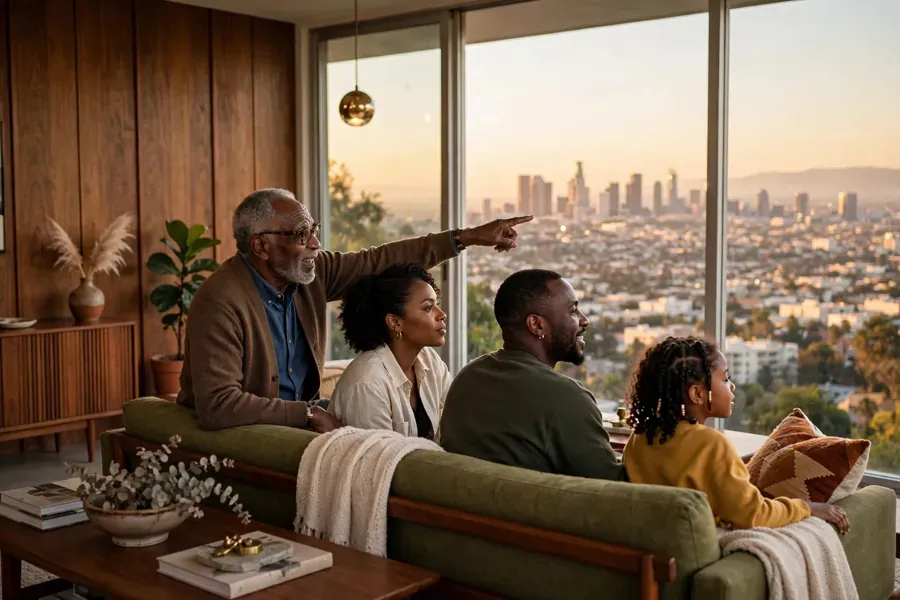
Drive up into Baldwin Hills at golden hour and the nickname explains itself before anyone has to say it. The Black Beverly Hills — a name the Los Angeles Times was already printing decades ago — sits above the city in a sweep of curving streets, palm-lined drives, and mid-century houses angled toward the light.
Below you, the whole basin glitters. Around you, the quiet of a neighbourhood where the doctor, the judge, the entertainer, and the school principal have lived on the same streets for three generations.
Baldwin Hills is where this story starts, but it does not end there: the same hills hold View Park–Windsor Hills, the largest historic Black affluent district in the country, and Ladera Heights, the polished, private third sister. Together they are the Los Angeles enclaves — and this is their map.
How the Hills Were Built
The hills were valuable before they were Black, and that is precisely the point of the story.
View Park was subdivided in the 1920s by the Los Angeles Investment Company as a fully improved, upper-class subdivision — wide lot frontages of sixty to a hundred feet, minimum home prices, underground utilities, and an architectural review board to keep the character cohesive.
Spanish and Mission Revival houses rose with stucco walls, clay tile roofs, and names like "The Barcelona." The developers wrote racial restrictions into the deeds, as developers did across Los Angeles; the courts struck enforceable covenants down in the 1940s, and by the 1960s Black Angelenos were finally able to exercise the right to live where they chose.
What they chose was the best-built housing stock in the city — and they chose it together.
As the Los Angeles Conservancy's history records, after the Supreme Court ruled racially restrictive covenants unconstitutional in 1948, Black families began moving into View Park by the late 1950s, and by the 1960s it had become a predominantly Black neighbourhood retaining its prestige as home to the elite.
Families moved from the Crenshaw District up into the homes built atop Baldwin Hills in the 1950s — the ranch houses and moderns of Baldwin Hills Estates, on streets named for Spanish dons, where so many physicians settled that locals called it Pill Hill. This was not flight or accident.
It was inheritance claimed in real time: a generation that had built professional lives under constraint bought, deliberately, the finest streets available to it, and then stayed.
Baldwin Hills Proper: The Dons and the View
The neighbourhood's fame rests on its residents as much as its architecture.
Local reporting on the hills notes that the affluence, combined with the star power of residents such as Tina Turner, Mayor Tom Bradley, Ice Cube, and architect Paul Williams, led to the Black Beverly Hills name — and adds, with local pride, that the views beat the other Beverly Hills, hands down.
The houses match the billing: elegant mid-century moderns with walls of glass, post-and-beam contemporaries, and gracious ranch houses on deep lots, many held by the same families since the first generation arrived.
The hills have known sorrow as well as splendour. In December 1963 the Baldwin Hills Dam failed catastrophically, flooding the neighbourhoods below; the reservoir was never rebuilt — the site was filled, landscaped, and converted into Kenneth Hahn Regional Park, the green crown the community uses today.
That instinct — absorb the blow, keep the land, make it beautiful — is the neighbourhood's character in one sentence. The name endured through it all: by 1985 the Los Angeles Times was noting that Baldwin Hills is "now often called the Black Beverly Hills," and the title has never been surrendered since.
View Park–Windsor Hills: The Register's Largest
If Baldwin Hills is the famous sister, View Park is the documented one. The View Park Historic District comprises nearly 1,800 properties, and the Conservancy describes it as one of the largest National Register historic districts in California, and the largest district in the United States designated for its association with African American history.
The listing, achieved on July 12, 2016, was no bureaucratic accident: the grassroots View Park Conservancy, founded by residents, raised over $100,000 to fund the complex nomination themselves. That is what ownership looks like when a neighbourhood decides its own history is worth federal ink.
Walk its streets and the designation makes sense room by room. Revival-style houses with large front yards, servants' quarters, and swimming pools — built in the 1920s and 1930s for businessmen, lawyers, professors, and physicians — passed into the hands of a Black professional class that maintained them to the stud.
The landmarks carry the culture with them: the Ray Charles residence on Southridge Avenue, built in 1965; the library named for the novelist Bebe Moore Campbell, a community resident; homes associated with Ike and Tina Turner and Nancy Wilson. Preservation here is not nostalgia. It is a family's balance sheet and a people's archive, kept in the same deed.
Ladera Heights: The Quiet Third
West of the hills, Ladera Heights tells a slightly later version of the same story.
It began in the late 1940s with the development known as Old Ladera; in the 1960s, custom homes rose in New Ladera, many designed by architect Robert Earl for builders Valentine and Gallant — large ranch-style and split-level houses on spacious lots, tucked behind the oil fields in a pocket the rest of the Westside overlooked.
Baseball great Frank Robinson and other athletes began moving in during the early 1970s, and entertainers, players, and executives followed — Vanessa Williams, Lisa Leslie, and Chris Darden among the names local records attach to its streets.
The numbers certify the reputation. Reference sources report Ladera Heights' average household income at $132,824, ranking it third among the ten wealthiest majority-Black communities in the United States — and its integration was notably gradual, producing the stable, diverse, upper-middle-class calm residents describe as an oasis.
Divided into Upper, Lower, and Old Ladera, it remains the enclave Angelenos recommend to each other in a lowered voice, as if speaking the name too loudly might raise the prices. The prices need no help: local broker reporting has put Ladera properties generally between one and two million dollars, with renovated houses easily topping the upper figure.
The Streets Themselves: An Architectural Walk
Read the hills at walking pace and the architecture tells the generational story in sequence.
View Park's oldest streets are a catalogue of 1920s and 1930s revival styles — Spanish Colonial and Mediterranean houses with tile roofs and tower entries, Colonial Revival neighbours beside them — while Baldwin Hills Estates and Ladera Heights answer with the postwar decades: ranch houses stretched wide on their lots, split-levels stepping down the slopes, and mid-century moderns whose glass walls were aimed at the view like instruments.
Travel and preservation writing on View Park notes that many of its residences were designed by Paul R. Williams, the first African American certified architect of his stature, whose formally inventive houses shaped the district's character — a fitting authorship for streets that Black excellence would soon make its own.
The everyday landmarks hold the community together between the grand houses. Baldwin Hills Crenshaw Plaza serves as the neighbourhood's central hub, and neighbourhood guides note that every Saturday the plaza hosts a farmers' market, while the Baldwin Hills Community Garden gives residents a shared ground of a more literal kind.
Down at Slauson and Overhill stands the Googie-style Wich Stand, now Simply Wholesome — the kind of joyful roadside architecture Los Angeles invented and the enclaves absorbed.
Add Rueben Ingold Park in View Park–Windsor Hills, named for the developer who first subdivided View Park, and Kenneth Hahn State Recreation Area above it all, and the pattern is clear: this is not a collection of expensive houses that happen to share a hillside.
It is a complete civic world — market, garden, park, library, landmark — built once by developers for one population and claimed, kept, and continuously furnished by another.
At the foot of the hills sits the enclaves' other architectural treasure, and it is not a mansion at all. Baldwin Hills Village — today Village Green — was a groundbreaking garden-apartment complex of more than 620 units in two-story buildings scattered across a park-like 68-acre site, built in the 1940s when the surrounding fields were still empty.
Its landscaped courts and garden-city planning made it a landmark of American residential design, and its community became part of the same Crenshaw-and-hills world the mansion streets crown. The enclaves were never only about the houses on top.
They were a whole civilisation of Black Los Angeles, from the garden apartments below to the view houses above — one continuous fabric of ambition, held together street by street.
What the Houses Cost Now
A word of honesty about figures, because the hills deserve better than a single confident number. Housing trackers measure different slices of these neighbourhoods over different windows, and their medians move.
Homes.com's Baldwin Hills data puts the median sale price at about $1.05 million across the most recent twelve months it reports, with single-family medians considerably higher, around $1.43 to $1.45 million; another major listing tracker puts the Baldwin Hills median nearer $1.19 million.
Read together, the honest sentence is this: the median house in the hills trades in the low-to-mid one-millions, view properties and renovated moderns command substantially more, and the true premium is scarcity — houses here pass between families who already know each other, which is why the brokers who run these streets matter as much as the listings.
Our companion guide to choosing a top-tier broker is the right next read before you buy or sell on these hills.
Why Families Stay
Ask residents why three generations have held the same streets and the answers are practical before they are sentimental: the views, the quiet, the central position — convenient to Culver City and USC, with the basin spread out below like a family portrait. But the deeper answer is continuity.
The farmers' market at Baldwin Hills Crenshaw Plaza on Saturdays, the community garden, the block parties, the library named for a neighbour — these are the furnishings of a place that was built, bought, and defended by the people who live in it.
It’s mostly an older community. But we’re seeing a lot of young families moving in, particularly young families with kids.— Katrina Manning, real estate agent and owner of Homes by Katrina, on Baldwin Hills–Crenshaw
That is the enclaves' present tense: the founding generation's grandchildren are coming home, raising children in houses their grandparents bought when buying them was an act of faith. The East has its own version of this map — Oak Bluffs, Sag Harbor, Prince George's County, Cascade Heights — and we trace it in The Storied Enclaves.
And for the families thinking three generations ahead, our guide to raising heirs, not dependents begins where these front doors open.
The Best High-End Realtors: The Brokers Who Sell Mansions and Penthouses
The Storied Enclaves: Oak Bluffs, Sag Harbor, Prince George's County, Cascade Heights
Raising Heirs, Not Dependents
Empire Makers — Profiles Collection
PBS SoCal, Lost LA — "View Park: The Black Beverly Hills"
Los Angeles Conservancy — "View Park Historic District National Register Nomination"
Wikipedia — "Baldwin Hills, Los Angeles"
Wikipedia — "Ladera Heights, California"
Homes.com — "Baldwin Hills, Los Angeles Real Estate & Homes for Sale"
Los Angeles Times real estate coverage (syndicated) — Baldwin Hills and Ladera Heights neighbourhood reporting
Islands — "California's Hilltop Hideaway: View Park's Jazz-Age Mansions"
Coletti Estates — "Baldwin Hills Neighbourhood Guide"
Questions & Answers
What makes an address prestigious?
Baldwin Hills — the Black Beverly Hills — together with View Park–Windsor Hills and Ladera Heights forms the most storied map of Black Los Angeles: three hillside enclaves, three generations deep, still holding their views. It links to 4 stories and articles — open any card to read the full piece.
How do you choose a high-end realtor?
Baldwin Hills — the Black Beverly Hills — together with View Park–Windsor Hills and Ladera Heights forms the most storied map of Black Los Angeles: three hillside enclaves, three generations deep, still holding their views.
How do I read the full stories on Baldwin Hills and the Los Angeles Enclaves: The Black Beverly Hills and Its Peers?
Choose any card on this page. Each one opens a full page of its own — the complete story or article, with its sources linked.