
Building the Cellar, Part I: What to Drink Now, What to Lay Down
How to start a wine cellar collection that is built for hospitality, not hoarding: the three tiers — drink now, lay down, prestige — the temperature rules that are not negotiable, and how to buy en primeur without paying the romance tax.
If you want to know how to start a wine cellar collection, begin by deciding what a cellar is for. In the houses that do this well, a cellar is not a vault and it is certainly not a trophy case.
It is hospitality with a longer memory: a room — or a cabinet, or a quiet corner done properly — that lets you open the right bottle on a Tuesday because it is there, and the great bottle on the night that deserves it because you had the patience to wait. Everything in this guide follows from that definition.
A cellar built to be opened behaves differently from a cellar built to be admired, and it gives its owner a great deal more pleasure per dollar.
The good news is that the craft is learnable and the entry ticket is modest.
The collector’s guide at Pursuitist — “How to Start a Fine Wine Collection: Expert Guide” advises tasting widely before allocating capital — you should always genuinely enjoy what you own, even if market valuations fluctuate — and notes that exceptional, age-worthy bottles from rising producers begin around $50 to $100 each, so a focused case or two is a perfect starting point.
Blue-chip Bordeaux and Burgundy are by no means required to build an authentic, rewarding collection. Hold onto that. The cellar is a practice before it is a portfolio.
The Three Tiers: Drink Now, Lay Down, Prestige
Every working cellar is really three cellars wearing one coat. The first tier is the drinking cellar: bottles bought to be opened within the year, the wines your household actually reaches for — a grower Champagne for Friday, a village white Burgundy or a good Chablis for the fish course, a Rioja reserva for Sunday’s roast.
The second tier is the laying-down cellar: wines bought young and held three, five, ten years, so that structure softens into complexity — classed-growth Bordeaux from a strong year, premier cru Burgundy, serious Barolo and Barbaresco, the Northern Rhône.
The third tier is prestige: the handful of bottles that mark the architecture of a life — the birth-year bottle, the anniversary case, the wine you open when the deal closes or the grandchild arrives. Prestige bottles are few by definition.
If everything in your cellar is prestige, you own a museum, and you will find yourself buying wine at retail for dinner anyway.
The most useful articulation of the tiers we know comes from Worth Opening — “Your First Twelve Bottles: A Cellar Built to Be Opened”, which sorts a starter cellar into wines for now — all food-friendly, all rewarding immediately, none of them requiring an occasion; wines for three to five years, which it calls the teaching wines; and wines for ten and beyond, including Sauternes, which it describes as both the most undervalued category in fine wine and the one that survives longest.
And it offers the single most useful habit in all of cellaring:
“Buy two of a wine you intend to age, never one.”— Worth Opening, “Your First Twelve Bottles”
The reasoning is exact. A single bottle can only be opened once, and therefore always too early or too late — one guess, made blind. With two, you open the first at what you judge to be the early end of the window, learn something concrete, and hold the second with real information rather than a critic’s estimate.
With six — which is what most serious collectors do with wines they love — you can open one every eighteen months and watch the entire arc. That is the education, and no amount of reading substitutes for it. Build your tiers in twos and sixes, and your cellar starts teaching you from the first year.
Know What Ages — and What Never Will
The beginner’s costliest error is laying down wines that were never built to travel.
The cellaring primer at BetterTastingWine — “Starting a Wine Collection” states the three foundational facts plainly: not all wines are created to be aged, and most are best enjoyed within one to five years of release; improper storage can easily ruin a wine; and a wine’s value — in the glass above all — decreases after its prime.
Ageing improves only what structure built: a wine that lacks fruit concentration and structure will not be made better by time, merely older. The same guide sorts the field usefully. Capable of long ageing, eight years and beyond: premium Bordeaux, California Cabernet Sauvignon, Barolo, Barbaresco, Rioja Gran Reserva, Hermitage, Grand Cru Burgundy, Amarone, Vintage Port.
Best enjoyed between three and five years: everyday Bordeaux and Cabernet, village Burgundy and Pinot Noir, Chianti, Brunello, Rioja. Meant for early enjoyment: Gamay and Beaujolais, Valpolicella, and the light table wines.
Its rule of thumb on price is worth taping inside the cellar door: wines under $25 are best drunk within three to five years; for a collection held five years and more, look to wines above $40 from good vintages.
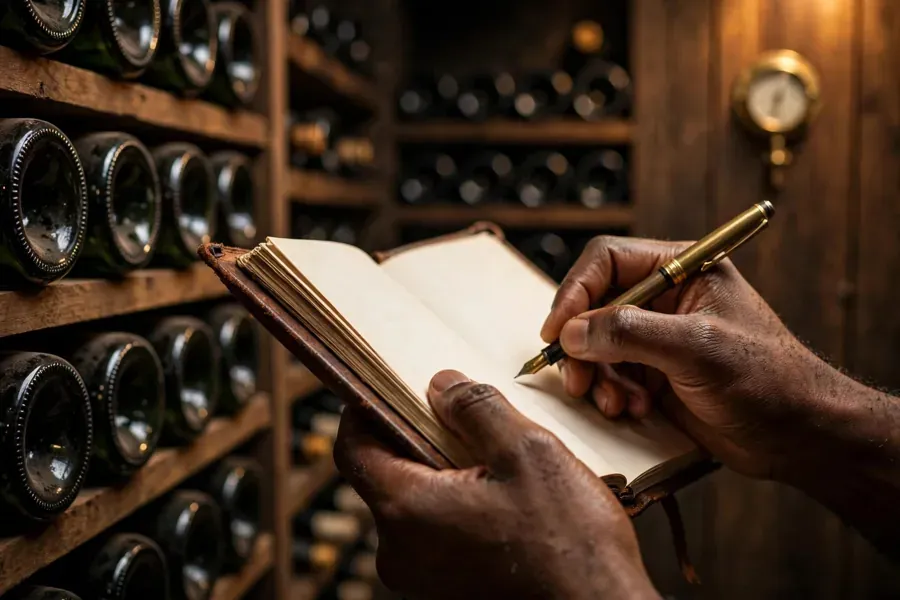
The Non-Negotiables: Temperature, Humidity, Darkness, Stillness
Before the second case arrives, settle the conditions — because storage is where novice collectors quietly lose everything. The baselines agree across every serious authority.
Pursuitist’s guide sets them strictly: temperature consistently maintained around 55°F (13°C); humidity kept steady between 60 and 70 percent, to keep corks resilient and prevent them drying or shrinking; bottles resting horizontally on their sides, so the wine stays in constant contact with the cork; and complete darkness, shielded from UV light and structural vibration.
The cellaring guides at Wine Gifts — “The Joy of Cellaring” give the same prescription — an ideal of 12–14°C (55–58°F), humidity of 60–70 percent to keep corks moist and prevent oxidation, protection from direct sunlight, and a place with minimal vibration to protect the sediment — and Dirty Laundry — “How to Start Your Own Wine Cellar” adds the practical instruments: a thermometer and a hygrometer, so you are measuring rather than hoping.
Above all, understand that consistency outranks perfection. Pursuitist’s guide carries the sentence every cellar owner should know by heart:
“Consistency in a wine cellar matters far more than hitting an exact, flawless number. A cellar that maintains a stable 58°F year-round will safeguard a wine beautifully, whereas a space that swings wildly between 50°F and 68°F will rapidly degrade it.”— Pursuitist, “How to Start a Fine Wine Collection: Expert Guide”
That one insight sorts the whole storage question. A below-stairs room with thick walls may serve beautifully; a glass showcase over the kitchen range will cook a fortune.
If your home cannot guarantee the conditions, the guides converge on the same two answers: a commercial-grade, temperature-controlled wine cabinet for the house, or professional climate-controlled storage for the laying-down tier — bonded warehouses having the further virtue of an official paper trail, which is what provenance is made of.
Provenance — the documented custody history of a bottle, its origin, past ownership, and storage lineage — is, for rare vintages, the entire difference between a sound bottle and an expensive disappointment. Buy from established merchants, winery allocations, and auction houses with inspection teams, and keep every receipt.
Your future self, pouring for people you love, will thank your present self for the paperwork.
Keep the Book
A cellar without a record is a rumor. The tracking discipline is simple and every guide repeats it: log each bottle’s producer, vintage, and region; the purchase date and price; the optimal drinking window; and, as you open bottles, your own tasting notes.
Wine Gifts recommends exactly that ledger — by app or by simple spreadsheet — and Dirty Laundry adds the cellar-keeper’s corollary on capacity: start with more space than you think you will need, because collections grow quickly. They do. Racking is cheap; regret is not.
Build the racks for the cellar you will have in five years, keep the book from the first case, and review the drinking windows twice a year — the saddest bottle in any cellar is a great wine opened five years past its prime by an owner who simply forgot it was there.
Buying En Primeur Without the Romance Tax
Sooner or later a merchant will offer you wine that does not yet exist in bottle — en primeur, the futures market of fine wine. Understand it coldly and it can serve you; buy it romantically and it will tax you for the privilege.
The mechanics, as the reference at Wikipedia — “En primeur” sets out, are these: you purchase a vintage while the wine is still in barrel, paying a year or eighteen months before its official release. The wines most commonly offered this way come from Bordeaux, Burgundy, the Rhône Valley, and Port.
The possible advantage is that wines may be considerably cheaper during the en primeur period than once bottled and released — but that is not guaranteed, and some wines lose value over time.
The trade’s own historians at Wine Investment — “What Is En Primeur?” describe the rhythm: in the spring following the harvest, estates present unfinished samples; critics and merchants taste and score; prices release over the following weeks through the Place de Bordeaux; and the wine is bottled and delivered much later, commonly around two years after the harvest — usually bought in bond, with duty and taxes falling due only if the wine is taken into physical delivery.
The discipline, then: buy en primeur only what you would happily drink if it never rose a penny — wine you want, from a vintage the critics and your merchant agree is strong, in quantities matched to your tiers — and only from merchants whose bonded storage and paperwork you trust.
The merchants at Corney & Barrow — “En Primeur Explained” walk buyers through the same practicalities: wines are purchased in bond, arrive up to two years after purchase, and then move to your reserve, your cellar, or delivery with duty and tax payable.
The guidance at WineCap — “What Is En Primeur?” adds the investor’s framing: the system secures allocations of highly sought-after wines that might appreciate once bottled. Might. The romance tax is the premium paid for the story — the famous château, the perfect score, the fear of missing the allocation.
Pay it knowingly for the prestige tier if the bottle marks a life. Never pay it for the drinking tier, which exists to be opened, not to be narrated.
The Cellar as Hospitality
Build in this order: conditions first, tiers second, trophies last. A cabinet or room that holds 55°F and steady humidity; a drinking tier of wines you love, bought in twos and sixes; a laying-down tier chosen for structure and vintage, not for fame; a prestige shelf that stays small because the occasions it serves are rare by definition.
Keep the book. Review the windows.
And when the cellar is ready to be filled with intent, Part II of this series takes up the three great regions bottle by bottle — Champagne, Burgundy, and Bordeaux, and the Black vintners whose labels belong beside them — while the companion essay on wine in the vault considers the cellar as an asset for those who also collect that way, and our guide to beautiful extravagances covers the delicacies that will one day share its table.
The cellar’s purpose, remember, is the evening it makes possible. Buy for that evening, and the collection takes care of itself.
Building the Cellar, Part II: Champagne, Burgundy, and the Bottles That Mark a Life
The Vault: Wine as an Asset
Caviar, Truffles, and Other Beautiful Extravagances — Buying Them Right
The Best Tables in America: How the Five-Star Room Actually Works
Pursuitist — “How to Start a Fine Wine Collection: Expert Guide”
Worth Opening — “Your First Twelve Bottles: A Cellar Built to Be Opened”
BetterTastingWine — “Starting a Wine Collection”
Wine Gifts — “The Joy of Cellaring: How to Build a Wine Collection That Ages Gracefully”
Dirty Laundry — “How to Start Your Own Wine Cellar: A Beginner’s Guide”
Wikipedia — “En primeur”
Wine Investment — “What Is En Primeur? A Brief History of Bordeaux’s Wine Futures System”
Corney & Barrow — “En Primeur Explained”
WineCap — “What Is En Primeur? A Short Guide for Wine Investors”
Questions & Answers
Who starts the meal, and when do you put your napkin on your lap?
How to start a wine cellar collection that is built for hospitality, not hoarding: the three tiers — drink now, lay down, prestige — the temperature rules that are not negotiable, and how to buy en primeur without paying the romance tax. It links to 5 stories and articles — open any card to read the full piece.
Who pays when one person invites another to dinner?
How to start a wine cellar collection that is built for hospitality, not hoarding: the three tiers — drink now, lay down, prestige — the temperature rules that are not negotiable, and how to buy en primeur without paying the romance tax.
How do I read the full stories on Building the Cellar, Part I: What to Drink Now, What to Lay Down?
Choose any card on this page. Each one opens a full page of its own — the complete story or article, with its sources linked.