
Caviar, Truffles, and Other Beautiful Extravagances — Buying Them Right
How to buy caviar with confidence — grades, provenance, serving and storage, plainly explained — and how to buy truffles and the other beautiful extravagances without paying for a story instead of a flavour.
Every host who loves a table eventually meets the two ingredients that test both palate and judgment: caviar and truffles. They are genuinely magnificent — and genuinely surrounded by fog. Grades multiply, prices swing wildly between sellers, and the fraud problem is documented, not rumoured.
So this guide does the unglamorous, useful work: how to buy caviar by species and grade, how the tin should be labelled, stored and served, and how to buy truffles in season from people who can tell you where the dog dug. Buy these things right and they are worth every penny.
Buy them wrong and you have purchased very expensive salt, or a tuber with a perfume problem.
First, the Word Itself: Only Sturgeon Is Caviar
Begin with the definition the trade is held to: only salt-cured roe from sturgeon may properly be called caviar. Everything else — lumpfish, capelin, whitefish, salmon — is roe, some of it delicious, none of it caviar, and honest sellers label it so.
The buying guide at WNF Caviar Heritage — “How to Buy Caviar Online, According to the Experts” sorts the true family by species, egg size, colour and taste: Beluga, from the Huso huso sturgeon, silky and buttery with the largest eggs; Osetra, amber to golden, with the nutty flavour connoisseurs chase; Kaluga hybrid, a farmed, more sustainable stand-in with Beluga-like richness; and Sevruga, smaller eggs with a firm, briny, assertive taste.
Colour is not a grade — Osetra runs golden to dark brown by nature — but size, uniformity, lustre and the cleanness of the cure are. Look for the word malossol, “little salt”: the light cure that lets the roe taste of itself.
Grades sit on top of species. Houses differ in their names — Royal, Imperial, Grade 1 — but the substance agrees: the top grade means the largest, most uniform, most lustrous eggs of that species, whole and glistening, with a fresh, ocean-like aroma and no excess liquid in the tin.
Lesser grades are for cooking, where the eggs will be broken into sauces and garnishes anyway. For serving straight — and at these prices, straight is the point — buy the top grade of a species you can afford rather than a middling grade of a famous one.
A superb Osetra will embarrass an indifferent Beluga at the table every time, and your guests will remember the flavour, not the label.
The Fraud Problem, in Numbers
Now the part of the conversation the glossy catalogues skip. Because wild sturgeon are endangered and the international trade has been regulated under CITES since 1998, nearly all legal caviar today is farmed — which makes provenance paperwork the entire game. The DNA and isotope study reported by We Are Aquaculture — “Caviar for Christmas? It Could Be Illegal — or Not Even Caviar” examined 149 samples of caviar and sturgeon products bought across Bulgaria, Romania, Serbia and Ukraine, and found that 21 percent originated from illegally wild-caught sturgeon, 29 percent violated international regulations or trade laws — wrong species, wrong country of origin — and a further 32 percent amounted to customer deception, such as farmed product labelled “wild.” Three samples served as sturgeon soup contained no sturgeon at all. The earlier market work summarised by the American Museum of Natural History — “Caviar DNA Barcoding for Conservation” tells the hopeful half of the story: in New York, fraudulently labelled caviar fell from 19 percent of samples before CITES protection to 10 percent a decade later, and then only in online purchases. Regulation works. Your job as a buyer is to shop where it reaches.
In practice that means four habits. Buy from established houses and purveyors whose names are on the tin and whose farms they will name. Insist on the label's full identity — species (ideally with its scientific name), country of origin, farmed or wild, and the CITES code that legal caviar carries.
Treat a missing harvest or packing date as a missing ingredient, because freshness is the product. And read a price far below the market for its claimed species the way you would read any too-good story: as a story.
The genuine article is expensive for structural reasons — a sturgeon takes years to mature — and no seller has repealed them on your behalf.
Storage and Service: Cold, Gentle, and Never Metal
Caviar is among the most perishable luxuries in the kitchen, and the rules are few and absolute.
The purveyors agree on the cold chain: unopened tins live at 28–32°F — the coldest part of the refrigerator, colder than a standard shelf — and, as the serving guide at Caviar Star — “How to Eat and Serve Caviar Like a Pro” puts the service temperature, the tin is presented chilled, ideally between 26°F and 34°F, nested in crushed ice and uncovered only at the moment of serving, because heat and air are its enemies.
Once opened, the clock runs in days, not weeks: plan to finish the tin within one to two days, with plastic wrap pressed to the surface in between. Never freeze it; ice crystals rupture the eggs and turn pearls to mush.
Service is a small ceremony, and it rewards restraint. The classic accompaniments, as the service guide at Le Chef's Wife — “How to Serve Caviar” lists them, are blinis or toast points, crème fraîche, lemon, chopped egg white and yolk presented separately, finely minced shallot and chives — each guest building a bite, the caviar added last and never cooked.
The spoon is mother-of-pearl, bone, shell or glass, never metal: metal reacts with the roe and lends it a metallic taste, which is why the pearl spoon exists and why it is not an affectation.
Portions are measured in pleasure, not volume — that guide's rule of thumb is 30 to 50 grams, one to two ounces, per person when caviar is the course.
And learn the taster's ritual, the caviar bump: a small spoonful placed on the back of the hand and eaten from the skin, which is how professionals compare caviars side by side, the warmth of the skin opening the flavour. It feels like an insider's gesture because it is one.
Truffles: Season Is the Whole Law
If caviar's test is paperwork, the truffle's test is the calendar. The two noble species rule the market: the white truffle of Alba, Tuber magnatum, found from mid-September to the end of January, and the black Périgord truffle, Tuber melanosporum, found from early November to mid-March.
The trade investigation at TasteAtlas — “The Truffle Industry Is a Big Scam” states the consequence without mercy: there are no white or black winter truffles out of season — they cannot be frozen, cooked or stored into spring — so an intensely “truffle” dish served out of season is, by definition, something else.
Prices follow scarcity: that investigation puts large, first-class white truffles close to €10,000 per kilo in a strong year, with Périgord blacks ranging from a few hundred to a thousand euros per kilo. Against numbers like those, the honest buyer's defences are season, species and the nose.
“Let's say this once and for all. Truffle oil is not food at all.”— Anthony Bourdain, via TasteAtlas
The warning extends to the whole “truffle” shelf.
Most truffle oil contains no truffle at all — its aroma is a single synthetic compound built to imitate the fungus — and the identification guide at Truffle & Truffe — “How to Identify Real Truffles and Avoid Scams” catalogues the fresh market's frauds alongside it: inferior species, including Chinese black truffles, mislabelled as Périgord or Alba; look-alike fungi with no aroma sold as the real thing; and synthetic flavouring standing in for the fungus across oils, salts and sauces.
Its field tests are the ones top kitchens use. Smell: a real truffle is intense and complex — earthy, musky, slightly garlicky — while fakes and tired specimens smell faint. Touch: a quality truffle is firm and dense, never soft or spongy.
Structure: cut open, a genuine black truffle shows its marbled white veining, never a uniform interior. And price: significantly below the season's market is not a bargain, it is a confession.
Serving truffles at home follows from their fragility. Buy them as close to the meal as the post allows, store them in an airtight container lined with paper towel in the refrigerator, and use them within days.
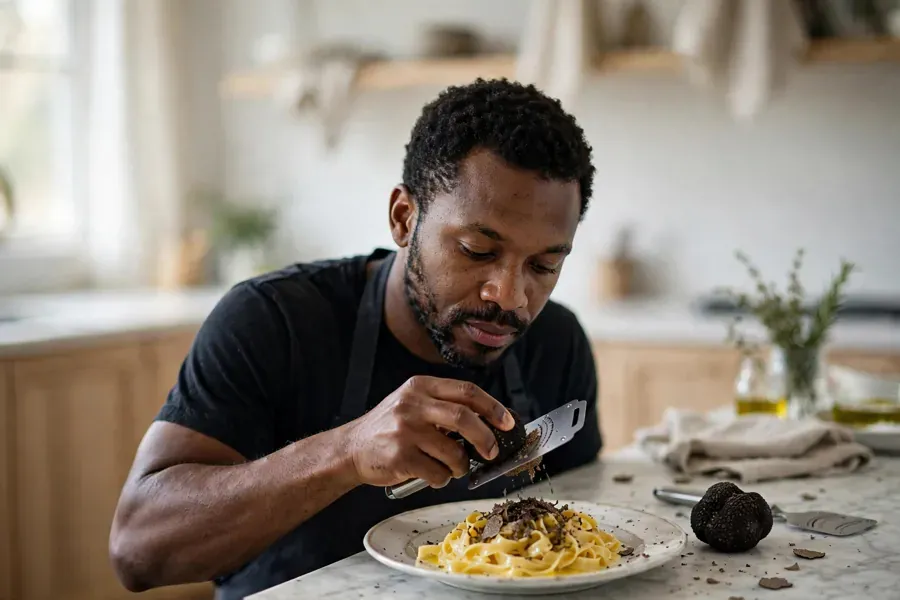
White truffles are never cooked — heat kills their perfume — they are shaved raw, at the table, over warm and simple food: buttered tagliatelle, risotto, eggs. Black truffles tolerate a little warmth and reward it, folded into sauces at the last moment or shaved over the same plain stages. Simplicity is not modesty here; it is acoustics.
A truffle is a quiet instrument, and it is heard best in a quiet room — which is also why the great kitchens shave it in front of you, to order, by weight. Ask your purveyor to do the same, and weigh what you buy.
How Top Kitchens Source — and How You Should Order
Watch how a serious kitchen buys and you will learn how to buy for a house. Chefs order caviar against reservations, not against hope: small tins, ordered often, arriving by overnight cold chain and opened against a booked table — because every day an opened tin waits, it is spending the only currency caviar has.
They taste before they commit, keeping a working relationship with one or two purveyors whose farms they can name, and they return product that arrives warm, dull or strong-smelling without ceremony; the houses that supply great kitchens expect exactly that discipline and respect the customers who practise it. Home hosts should copy the rhythm at household scale.
Order for the occasion, sized to the guest list — a 30-gram tin is a tasting for two, not a course for six — and time delivery for the day before you serve, never the week before.
Buy one tin of something superb rather than three of something adequate; caviar does not keep for a second party, and it does not forgive being bought early “just in case.”
Choosing your first serious tin follows the same logic. Begin with Osetra if you want the flavour connoisseurs describe first — nutty, rounded, generous — or with a fine farmed white sturgeon or Kaluga hybrid if you want Beluga's silken register at a kinder price; keep Sevruga for the table that loves brine and assertion.
Serve the first tin the minimalist way the purveyors recommend — straight from the tin, pearl spoon, nothing between you and the roe but cold — so your palate learns the reference point before the blinis and crème fraîche start arranging it.
After that first clean taste, every accompaniment becomes a choice instead of a habit, and every future tin is judged against a standard you actually hold. That is what buying right really purchases: not a tin, but a palate with a memory.
The Wider Shelf of Extravagances
The same discipline governs the rest of the beautiful shelf. Saffron is sold by the gram because it is picked by hand from crocus flowers — buy whole threads, deep red, never powder you cannot inspect. Vanilla is graded by plumpness and oil, and priced like the orchid it is.
Foie gras, Wagyu, aged balsamic, single-estate olive oil pressed within hours of harvest — each has a provenance chain, a season or a grade, and a counterfeit economy shadowing it. The pattern never changes: the genuine article can always tell you where it came from, when, and by whose hand; the imitation can only tell you a price.
Learn the pattern once and you can shop the entire shelf — and set the results on a table worthy of them, the way the rooms in The Best Tables in America do, or at home beside the cellar you built with Part I of our cellar guide.
Extravagance, bought right, stops being a risk and becomes what it was always supposed to be: a pleasure you can repeat with confidence.
The Best Tables in America: How the Five-Star Room Actually Works
Building the Cellar, Part I: The Drinking Cellar — Bottles You'll Actually Open
Food Owners — Black Excellence Profiles
Le Chef's Wife — “How to Serve Caviar”
Caviar Star — “How to Eat and Serve Caviar Like a Pro”
WNF Caviar Heritage — “How to Buy Caviar Online, According to the Experts”
We Are Aquaculture — “Caviar for Christmas? It Could Be Illegal — or Not Even Caviar, Research Shows”
American Museum of Natural History — “Caviar DNA Barcoding for Conservation”
TasteAtlas — “The Truffle Industry Is a Big Scam”
Truffle & Truffe — “How to Identify Real Truffles and Avoid Scams”
Questions & Answers
Who starts the meal, and when do you put your napkin on your lap?
How to buy caviar with confidence — grades, provenance, serving and storage, plainly explained — and how to buy truffles and the other beautiful extravagances without paying for a story instead of a flavour. It links to 3 stories and articles — open any card to read the full piece.
Who pays when one person invites another to dinner?
How to buy caviar with confidence — grades, provenance, serving and storage, plainly explained — and how to buy truffles and the other beautiful extravagances without paying for a story instead of a flavour.
How do I read the full stories on Caviar, Truffles, and Other Beautiful Extravagances — Buying Them Right?
Choose any card on this page. Each one opens a full page of its own — the complete story or article, with its sources linked.