
The Cigar, Chosen Well: Selection, the Humidor, and Smoking Like a Gentleman of Leisure
How to choose cigars with confidence — a humidor guide covering sizes, strengths, Cuban vs non-Cuban, and the unhurried etiquette of smoking well.
There is a moment, in every good tobacconist’s, when the humidor door opens and the cedar breathes out — and the gentleman who knows how to choose cigars takes his time.
This is a humidor guide for that moment and everything after it: sizes and strengths decoded, Cuban vs non-Cuban assessed honestly (including the law, plainly), the humidor built and kept properly, ageing and rotation, the cut and the light, and the etiquette that lets a man smoke in company the way he does everything else — unhurried, considerate, and entirely at ease.
A cigar is one of the last purchases that cannot be hurried at any stage: not in the growing, the fermenting or the rolling, and certainly not in the smoking. That is precisely its charm for men whose days are scheduled by other people. An hour with a Churchill is an hour nobody can optimise.
Choose it well, keep it well, and it will keep its side of the bargain.
Start With Time, Not Price
The first question a good merchant asks is not your budget. It is your hour. How long do you actually have?
The classic sizes are, in effect, appointments: a Robusto at about 5 inches by a 50 ring gauge gives you roughly 45 to 60 minutes; a Toro stretches the same pleasure to an hour and a quarter; a Churchill, at about 7 inches, asks for 75 to 90 minutes; and a Double Corona is a special-occasion commitment of up to two hours.
A Corona — 5½ to 6 inches, slimmer at a 42 to 44 ring — is the classic 30-to-45-minute smoke, and a Petit Corona is the honest choice when the evening only allows half an hour. Nothing ruins a fine cigar like abandoning its final third to a dinner reservation; nothing flatters it like finishing exactly as the conversation does.
Match the cigar to the time you truly have, and you have already chosen better than most men with larger budgets.
Ring gauge, for the uninitiated, is simply thickness measured in 64ths of an inch — the same scale, as Holt’s likes to note, as your finger when you are fitted for a wedding ring; a cigar’s shape is its vitola, straight-sided parejos on one hand and tapered figurados — torpedoes, belicosos, perfectos — on the other.
Keep two of those wedding-ring numbers in your head — 50 for a Robusto, 38 for a Lancero — and the whole humidor wall becomes legible.
Sizes and Strengths, Decoded
Now unlearn the beginner’s assumption: bigger does not mean stronger. As Mike’s Cigars explains plainly, a larger cigar contains more tobacco, but strength comes primarily from the tobaccos used in the blend — size changes the proportion of wrapper, binder and filler, not the power.
A slim Lancero puts proportionally more wrapper in every draw, so its flavour is precise and wrapper-led; a fat Gordo gives the blender room for more filler, burns cooler, and takes its time. Thinner cigars burn a little hotter and faster; longer cigars deliver cooler smoke early, with flavour building as you go.
This is why the same blend in three sizes is three related but distinct smokes — and why a serious humidor holds one beloved blend in two sizes rather than ten strangers in one.
Strength itself — mild, medium, full — lives in the leaf, particularly the high-priming ligero in the filler. Learn your own palate the way you learned wine: keep brief notes. What you smoked, with what drink, after what meal, and whether the final third pleased you.
Within a season of honest notes, a pattern emerges that no critic can give you — most men discover they prefer medium-bodied cigars in the afternoon and something fuller after dinner, and that the strongest cigar in the box is rarely the one they reach for twice. Your palate, documented, is the only expertise that finally matters.
Cuban vs Non-Cuban, Assessed Honestly
To the great question, then, without romance in either direction. The flavour map drawn by region is genuinely useful.
Notice what that map implies: the New World is not a substitute for Cuba.
It is a library of its own, built largely by Cuban families who carried their seed and their craft to Nicaragua, the Dominican Republic and Honduras — and on a given evening, a great Nicaraguan may simply be the better cigar for your mood and your meal.
And now the law, because a gentleman does not build a collection on a misunderstanding. Cuban cigars cannot legally be imported into or sold within the United States: a trade embargo dating to 1962 bars all Cuban tobacco products, and a 2020 tightening closed the last exception that once let authorised travellers bring back small quantities for personal use.
You may enjoy a Cuban cigar where it is legal to do so — in Havana, in London, in a third country — but bringing one home, however innocently purchased, breaks federal law, and there is no mail-order workaround.
So the American humidor is, lawfully, a New World humidor — and as the flavour map shows, that is no hardship at all. Abroad, buy Cubans only from official houses, sealed and stamped, and enjoy them where you bought them. Discernment includes knowing which pleasures travel and which are enjoyed, properly, on the spot.
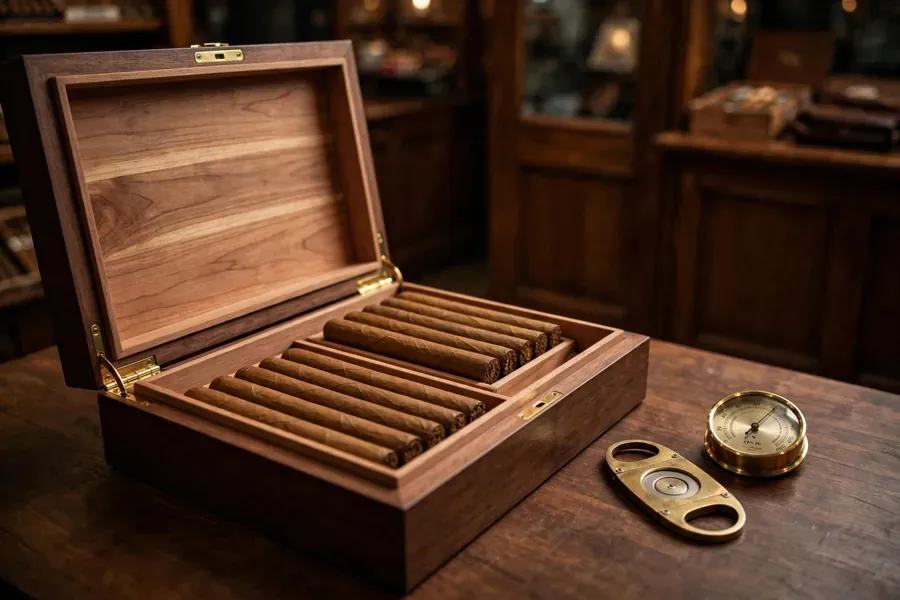
Building the Humidor
A humidor is not furniture; it is a climate you are responsible for. The numbers first.
Collectors’ guidance converges on 65–72% relative humidity covering nearly every cigar, with most collectors targeting about 69% — Cubans, rolled tighter, often happier at 65–67%, Nicaraguan and Dominican cigars content at 68–72%, and temperature held between 65°F and 70°F, because above 72°F the risk of tobacco beetles rises.
A second guide agrees on the working band — most smokers aim for 68% to 70% as the daily target for the most consistent burn and flavour — with Habanos itself specifying 65% to 70% at 16°C to 18°C for Cuban cigars. Every box of Habanos carries the instruction in its own words:
“For fullest enjoyment, these cigars should be stored in a humidor, away from products with strong odour and under correct conditions of temperature (16ºC to 18ºC) and relative humidity (65% to 70%).”— Habanos box insert, via Cuban Cigar Website
Within that climate, buy for the seal, not the shine. A desktop humidor of Spanish cedar that closes true will outperform a beautiful box that leaks; season a new wooden humidor before trusting it with cigars; and use a digital hygrometer you have actually checked, because an uncalibrated gauge is decoration.
Humidification can be admirably simple — the same guide recommends two-way humidity packs, one 60-gram pack per 25 cigars, replaced every two to four months when the packs turn stiff — and for a growing collection, an electric cabinet or a converted wine cooler with Spanish cedar shelves holds conditions steadier than any drawer.
Place the humidor in a cool, dark, stable spot, away from sun, radiators and heat vents. Then practise the discipline that matters most: stability. Cigars forgive a point or two of humidity.
They do not forgive weather.
Ageing Stock and Rotation
Kept at proper temperature and humidity, premium cigars do not merely survive — they improve, and they keep indefinitely. Collectors’ guidance puts the rewarding window at three to ten years of ageing in stable conditions for many premium cigars, with serious collectors holding stock far longer.
Ageing rounds the edges: ammonia and youthful harshness dissipate, flavours marry, and a cigar that was merely good becomes composed.
Build for that future in three tiers — cigars to smoke now, cigars resting for a year or two, and a small prestige tier you are ageing on purpose — and rotate honestly: smoke from the ready tier, replace what you smoke, and let the resting tier rest undisturbed.
Date your boxes when they enter the humidor, in pencil, on the box. The man who knows what he has, and since when, is the man whose humidor is a cellar rather than a drawer of surprises.
Two housekeeping rules protect the whole collection.
Inspect new arrivals before they join the stock — a merchant you trust is the first inspection, your own eyes the second — and keep strongly flavoured or infused cigars, if you keep them at all, in a separate small humidor; cedar shares aroma generously, which is a virtue among classics and a disaster across categories.
And never, whatever a helpful relative suggests, the refrigerator: it is far too dry, and it will desiccate a fine cigar while perfuming it with last night’s leftovers. The humidor, checked weekly and opened with pleasure rather than anxiety, is quite enough.
Cut and Light Like You Mean It
The ritual at the start decides the next hour.
Cut once, cleanly: use a proper cutter, aim just above the cap, and make one clean cut that keeps airflow smooth and stops the wrapper unravelling — a straight guillotine cut for most cigars, a V-cut for a deeper, concentrated draw on large ring gauges, a punch for a tidy, smaller opening.
Never bite, never tear, and never cut a cigar in half to make two smokes; you will ruin both.
Then toast before you light: hold the flame near the foot without letting it lick the wrapper, rotate slowly until the foot glows evenly, take the first gentle puffs while still rotating, and check the burn ring is uniform before you settle back.
Butane or matches or a cedar spill — anything clean-burning; a petrol flame will season your cigar with fuel, which is not a flavour note anyone is seeking.
Smoke it the way it was rolled to be smoked: draw the smoke into your mouth, taste it, let it go — cigar smoke is not inhaled.
Pace is the whole technique, at roughly a puff or two a minute; let the ash build to about an inch before rolling it off gently in the tray, because a cigar tapped like a cigarette burns hot, turns bitter, and announces its smoker’s inexperience to the room.
If it goes out — and on a long evening, it may — knock the ash off, purge with a few short puffs, and relight without ceremony or apology. Relights happen. Composure is the etiquette.
Etiquette in Clubs and on Terraces
In a lounge, you are a guest of the house and of the room. Support the house: buy a cigar or two from the lounge that hosts you — some houses charge a cutting fee for outside cigars, and even then, buying one is the done thing.
Do not handle, smell or — the unforgivable sin — lick cigars that others may buy. Keep your smoke out of faces, your voice at conversation level, your telephone in your pocket, and your ash in the ashtray rather than on the furniture.
When your cigar is finished, do not smash it out: set it in the ashtray and let it go out on its own — a cigar extinguished gently does not punish the room with the smell of a crushed one. Do not dip your cigar in your drink, whatever films have taught you; it enhances nothing and fouls the glass.
And remove the band late, when the heat has loosened its glue and it lifts without tearing the wrapper — or leave it on entirely; both are correct, and arguing about it is not.
On your own terrace, hosting, the duties invert pleasantly.
Offer guests a genuine choice — a mild Dominican for the newcomer, something fuller for the experienced — cut and light for a guest who is unsure, and never press a cigar on a man who declines; offering well and accepting a refusal gracefully are the same courtesy viewed from two sides.
Pair with what is in the glass the way you would pair wine: not by rule, but by weight. A medium cigar meets aged rum, Cognac or a sherried whisky as an equal; a full Nicaraguan wants the darkest spirit on the tray; coffee, earlier in the day, flatters almost everything in the humidor.
Which brings the evening full circle — build the bar to match the box, keep both with the same care, and the last hour of the day becomes what it was in better-organised centuries: yours. For the bottles that belong beside the humidor, our guide to the home bar is the natural next read.
The Home Bar at the Highest Level: Spirits Worth Their Shelf Space
Joining the Club
The House Party Weekend
Food Owners — Black Excellence Profiles
Teach Me Cigars — “12 Best Cigar Humidors Reviewed & Buyer’s Guide”
Swiss Cuban Cigars — “Humidity Matters: How to Find the Right Cigar Hygrometer”
Cuban Cigar Website — “General Cigar Information”
Claille — “Cuban vs Non-Cuban Cigars: Flavor Map by Region”
LegalClarity — “Are Cuban Cigars Banned in the US? Rules & Penalties”
Mike’s Cigars — “Cigar Sizes Explained: Ring Gauge, Shapes & How to Choose the Right Cigar”
Holt’s Cigar Company — “Cigar Basics: How to Look Like You Know What You’re Doing”
Swiss Cuban Cigars — “Cigar Etiquette Guide: Do’s, Don’ts & Social Smoking Rules”
After Action Cigars — “Cigar Etiquette 101”
Questions & Answers
Who starts the meal, and when do you put your napkin on your lap?
How to choose cigars with confidence — a humidor guide covering sizes, strengths, Cuban vs non-Cuban, and the unhurried etiquette of smoking well. It links to 4 stories and articles — open any card to read the full piece.
Who pays when one person invites another to dinner?
How to choose cigars with confidence — a humidor guide covering sizes, strengths, Cuban vs non-Cuban, and the unhurried etiquette of smoking well.
How do I read the full stories on The Cigar, Chosen Well: Selection, the Humidor, and Smoking Like a Gentleman of Leisure?
Choose any card on this page. Each one opens a full page of its own — the complete story or article, with its sources linked.