
The Home Bar at the Highest Level: Spirits Worth Their Shelf Space
How to stock a luxury home bar, spirits first: the brown-spirits canon, the Black-owned distilleries that belong on the top shelf, ice treated as a discipline, and the two cocktails a host should be able to make blindfolded.
If you want to know how to stock a luxury home bar, begin with a truth every great host learns: the bar is not a collection, it is a capability.
Its job is to let you put a proper drink in a guest's hand within minutes of their arrival, without a trip to the shop, without apology, and without a shelf of dusty trophies you never open.
The houses that do this well stock deep rather than wide — a canon of spirits chosen because each one earns its place in a glass, tools that make precision effortless, and ice treated with the same seriousness as the whiskey it chills. Build it once, build it honestly, and the bar will serve your evenings for years.
Start, then, with the architecture. The stocking guides agree on the foundation: five base families — vodka, gin, rum, tequila and whiskey — cover the broad spectrum of the classics.
The survey-based guide at TravelPander — “Essential Spirits for a Home Bar” puts it plainly: vodka for its neutrality, gin for its botanical complexity, rum in light and dark registers, tequila for the Margarita family, and whiskey — bourbon and rye above all — for the Old Fashioned and the Manhattan.
Around those five, the modifiers do the quiet work: sweet and dry vermouth, an orange liqueur such as Cointreau, and bitters, Angostura first. That is the whole skeleton. Everything after it is taste, story and pleasure.
The Brown-Spirits Canon
At the highest level, the heart of the bar is brown.
A serious shelf holds its whiskeys in deliberate layers: a bourbon you pour without thinking — the house pour, generous and reliable; a rye with enough spice to stand up in a Manhattan; a single malt Scotch for the guest who takes it neat; a blended Scotch for the highball; and one Cognac, VSOP or better, because the Sidecar and the after-dinner pour are part of a host's repertoire.
The home-bar authority quoted by The Gentleman's Journal — “This Is Your Guide to Creating the Ultimate Home Bar” builds in exactly this order: most of the great cocktails, he notes, are built around either gin or American whiskey, so begin with a decent bottle of each — he names Tanqueray and Four Roses Small Batch as the pattern — then two vermouths, French and Italian, a decent tequila, an aged rum and a white rum, a blended Scotch, a single malt or two, VSOP Cognac and a clean vodka.
It is a shopping list, but it is also a philosophy: no bottle without a job.
Buy the canon in that order and resist the collector's temptation to skip steps. The prestige bottle — the allocated bourbon, the old malt — belongs at the end of the build, not the beginning, because a bar that can make everything except a Martini is a display case, not a bar.
And store what you buy like you mean it: the stocking guides are unanimous that spirits keep best in a cool, dark place away from sunlight and heat, and that the working bottles — vermouth above all — are perishables. Vermouth is wine.
Once opened it belongs in the refrigerator, and once tired it belongs in the bin, because a Manhattan made with dead vermouth is a bourbon punished for someone else's neglect.
The Top Shelf Is Ours, Too: Black-Owned Distilleries
No top shelf in an American house is complete — or honest — without the Black distillers who helped build American whiskey and are now building its future. The essential name is Uncle Nearest.
The brand honors Nathan “Nearest” Green, described by the distillery as the world's first-known African American master distiller and the first spirits brand in the world named after a Black American; its whiskeys are Tennessee whiskeys, which means they meet every requirement of bourbon and then pass through sugar maple charcoal — the Lincoln County Process — before aging, a mellowing step the tradition credits to Green himself.
The profile at The Whiskey Wash — “Uncle Nearest Whiskey: The Ultimate Guide” confirms the brand remains Black-owned and led by its founder, Fawn Weaver, and the distillery's own account records a portfolio that has gathered awards by the hundreds since its 2017 launch. One bottle of the small batch belongs on every serious shelf; the story pours with it.
It is not alone.
The distillery survey at Wine Enthusiast — “10 Black-Owned Distilleries Making Some of America's Finest Bottles” maps a shelf worth building deliberately: Brough Brothers, the Louisville small-batch bourbon owned by brothers Victor, Christian and Bryson Yarbrough, its bottles designed around Kentucky culture; Du Nord Craft Spirits of Minneapolis, founded by Chris and Shanelle Montana, making vodka, gin, whiskey and liqueurs behind a community mission; Anteel Tequila, co-owned by Nayana Ferguson, blending Highland and Lowland agave; and Black Momma Vodka, helmed by Vanessa Braxton, whom the survey notes was proclaimed the first African American woman master distiller and master blender in the United States.
Add Ten To One's Caribbean rums and a bottle from Victor George Spirits, and your top shelf tells the whole American story — which is to say, it tells the truth beautifully, in the glass.
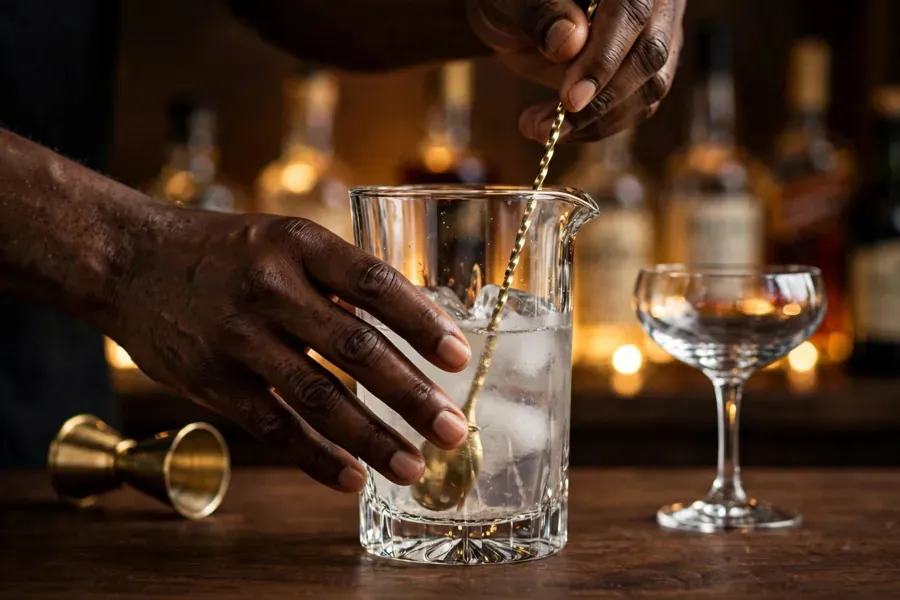
Ice Is a Discipline
Ask a great bartender what separates a home bar from a real one and the answer is rarely a bottle. It is ice.
The clear-ice guide at Liquor Librarian — “Beyond the Cloudy Cube” gives the functional case: clear ice is denser and melts significantly slower than cloudy ice, and large-format ice — the big cube, the sphere — slows melting further because it carries less surface area for its volume.
Cocktails need some dilution; water mellows the burn, marries the flavors and opens the drink. What they cannot survive is uncontrolled dilution, the quick melt that turns a proud Old Fashioned into flavored water by the second conversation. The large clear cube is therefore not decoration.
It is temperature held steady and dilution on a schedule — chilling with control.
The working bar keeps three forms, as the bartenders surveyed by Food Republic — “The 3 Types of Ice Bars Keep on Hand” describe them: small cubes for shaking and building, crushed ice for the drinks that want it — juleps, swizzles, the tropical family — and the large clear cube or sphere for spirit-forward drinks, because, as Chicago bartender Mike Ryan explains in that survey, their size and thickness mean they take a long time to melt, which is why you see them in Old Fashioneds, Manhattans, Negronis and fine whiskeys.
At home the system is simple: a directional-freezing cooler or good molds for the big clear cubes, trays of hard small cubes for the shaker, and a Lewis bag and mallet for crushed.
Freeze with filtered water, turn the stock over — ice left for weeks absorbs the freezer's odors and sublimes away — and never serve a guest ice you would not put in your own glass.
Tools and Glassware: Fewer, Better
The toolkit is short and should be bought once, well. The essentials, as the kit guide at The Bar Collective — “Mixology Made Easy: 6 Essential Tools for Home Bartenders” lays them out, are a shaker, a dual-sided jigger, a long bar spoon, a mixing glass and strainers — a Hawthorne for the shaker, a fine-mesh for the polished pour.
The jigger is the conscience of the bar: eyeballing ruins consistency, and precision is what makes your second Old Fashioned taste like your first. Stirred drinks — the Old Fashioned, the Negroni, the Martini — are built in the mixing glass so they keep their clarity and texture; shaken drinks, the citrus and egg-white family, go in the tins.
Glassware follows the same discipline of fewer and better. The Gentleman's Journal's expert is blunt about it:
“You really don't need that many types of glasses.”— Home-bar expert Jeffreys, via The Gentleman's Journal
His working set is tumblers, Martini glasses and highballs, plus one good all-round wine glass that serves red, white and sparkling alike; coupes and Nick & Nora glasses join only if the bar has room. Take the advice.
Four shapes, well made and well washed, will carry a lifetime of evenings — and they leave the budget where it belongs, in the bottles.
The Two Cocktails to Make Blindfolded
Every host needs two drinks held in the hands, not in a book: one stirred and brown, one stirred and clear. The first is the Old Fashioned, the oldest architecture in the canon — whiskey, sugar, bitters, water, ice.
The International Bartenders Association's official form, as the method guide at HisPotion — “How to Make an Old Fashioned” records it, is a sugar cube soaked with Angostura bitters and a little water, muddled dissolved, then ice and 45 ml of bourbon or rye, stirred in the glass and garnished with orange.
The modern craft form is easier to repeat: two ounces of whiskey, a bar spoon of rich syrup, two or three dashes of Angostura, stirred over ice until the mixing glass frosts, strained over one large cube, and finished with a wide strip of orange peel expressed over the surface and run around the rim.
Learn it with your house bourbon and again with rye, and you will never be caught without a drink for a whiskey guest.
The second is the Martini, the bar's examination in restraint. The reference at MasterClass — “Classic Martini Cocktail Recipe” gives the classic ratio as three parts gin to one part dry vermouth — a starting place from which you find your own house ratio — served ice-cold and garnished with anything from a citrus peel to olives.
Stir it, never shake it, in the mixing glass over hard ice until it is bracingly cold; strain it into the chilled coupe; and know your guests' answers before they arrive — gin or vodka, olive or twist, and how dry.
A host who can produce these two drinks from memory, while holding a conversation and never once looking at a phone, owns the room. That is the whole point of the bar behind you: not the bottles, but the ease.
Build it in order, then: the five families and their modifiers; the brown canon layered from house pour to prestige; the Black-owned bottles given their rightful place on the top shelf, not a segregated corner of it; ice in three forms, treated as an ingredient; tools and glassware bought once and bought well.
Then practice the two drinks until your hands know them. The rest — the amaro shelf, the mezcal, the vintage Chartreuse — arrives over years of evenings, one good bottle at a time, each with a story you can tell while you pour.
And when the shelf is built and the party is coming to your house, our guide to building the drinking cellar stocks the wine to stand beside it.
The House Party Weekend
The Cigar, Chosen Well: Selection, the Humidor, and Smoking Like a Gentleman of Leisure
Food Owners — Black Excellence Profiles
The Gentleman's Journal — “This Is Your Guide to Creating the Ultimate Home Bar”
TravelPander — “Essential Spirits for Home Bar: Must-Have Liquors and Stocking Guide”
Wine Enthusiast — “10 Black-Owned Distilleries Making Some of America's Finest Bottles”
The Whiskey Wash — “Uncle Nearest Whiskey: The Ultimate Guide”
Liquor Librarian — “Beyond the Cloudy Cube: Your Guide to Crystal Clear Ice at Home”
Food Republic — “The 3 Types of Ice Bars Keep on Hand, and How They Use Each”
HisPotion — “How to Make an Old Fashioned: Whiskey, Sugar, Bitters and Good Ice”
MasterClass — “Classic Martini Cocktail Recipe”
The Bar Collective — “Mixology Made Easy: 6 Essential Tools for Home Bartenders”
Questions & Answers
Who starts the meal, and when do you put your napkin on your lap?
How to stock a luxury home bar, spirits first: the brown-spirits canon, the Black-owned distilleries that belong on the top shelf, ice treated as a discipline, and the two cocktails a host should be able to make blindfolded. It links to 4 stories and articles — open any card to read the full piece.
Who pays when one person invites another to dinner?
How to stock a luxury home bar, spirits first: the brown-spirits canon, the Black-owned distilleries that belong on the top shelf, ice treated as a discipline, and the two cocktails a host should be able to make blindfolded.
How do I read the full stories on The Home Bar at the Highest Level: Spirits Worth Their Shelf Space?
Choose any card on this page. Each one opens a full page of its own — the complete story or article, with its sources linked.