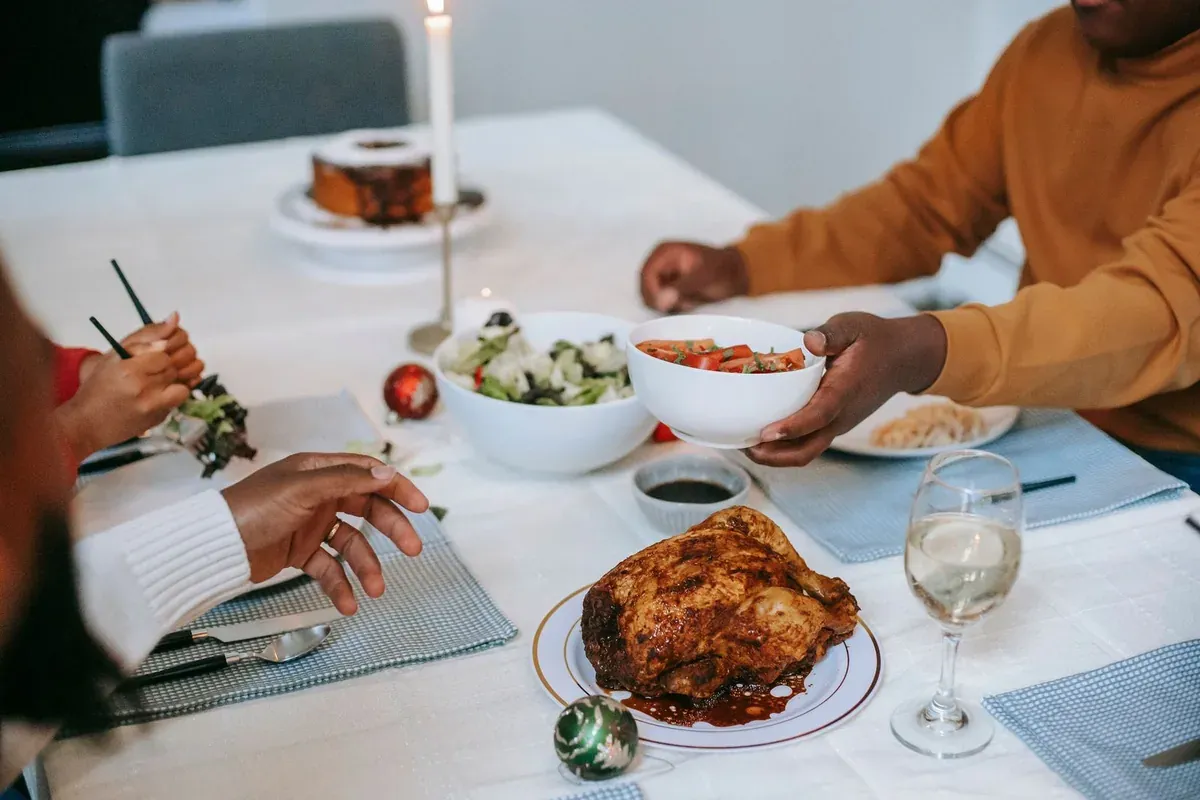
Proper Form, Part II: The Table — Settings, Courses, and Never Reaching
Formal table setting etiquette — courses, glasses and silver laid out as instructions, not a test — and how to read the whole meal before the first plate lands.
Here is the secret nobody tells the newly invited: a formal table is not a test. It is a set of instructions, laid out in silver and crystal, by a host who wants you to succeed.
Once you understand formal table setting etiquette — courses, glasses, forks and all — the most intimidating cover in the finest dining room turns into a menu of what is coming, written in objects.
This instalment of Proper Form teaches you to read it in about ten seconds, handle six courses and four glasses without a single guess, and recover from the one mistake everybody eventually makes.
Begin where every good captain and maître d' begins: with the logic, not the inventory. The table is laid in the order you will eat. Nothing on it is decoration except the flowers, and even the flowers are kept low so you can see the person across from you.
Everything else is information. Learn the five landmarks and the rest is commentary.
Reading the Setting in Ten Seconds
Start from the plate in the centre — your service plate, or charger, the anchor of the cover. Forks sit to the left; knives and spoons sit to the right; glasses are arranged above the knives; the small bread plate is to your upper left; and anything laid horizontally above the plate belongs to dessert.
That single sentence is ninety per cent of table literacy. Knives sit with the blade turned toward the plate, a small old courtesy so the cutting edge never points at your neighbour. Spoons sit to the right of the knives.
Your water glass stands above the tip of your dinner knife, and the wine glasses gather to its right and slightly below it.
The glassware, which frightens people most, is the easiest part once you see the order. Formal settings typically carry a water glass, a red wine glass, a white wine glass and a champagne flute, arranged in the order they will be used.
The water glass is usually the largest and stays all evening — it is yours to drink from freely, at any point, without waiting for a course or a toast.
Wine glasses are filled as their course arrives, and a glass you do not want filled is declined with a quiet word or a fingertip resting lightly on the rim as the bottle approaches. No explanation is ever required.
Two memory tricks will rescue you at a crowded table where eight settings blur together. The first is BMW, read left to right: Bread, Meal, Water — your bread is on your left, your meal in the middle, your water on your right.
The second uses your own hands: touch thumb to forefinger on each hand and your left hand forms a small b, for bread, while your right forms a d, for drink. Everything that is yours lives inside that frame. Everything outside it belongs to your neighbours, and touching it is the only real error the table allows.

Outside In: The One Rule That Runs the Meal
If you remember nothing else from this article, remember this: work outside-in — as each course arrives, use the utensil farthest from the plate and move inward with every course. The outermost fork is for the first course. The fork closest to the plate is for the main.
The table was laid by someone who knew the menu, so the silverware is quite literally a table of contents. You never need to guess, count or watch your neighbour out of the corner of your eye. Start at the edge and walk inward, and you will be right every time.
There are two honest exceptions, and both are gifts once you know them. The oyster or seafood fork is the only fork that ever lives on the right — you may find it resting against or beyond the spoons, because its course comes first and its shape fits nowhere else.
And dessert silver often travels horizontally above the plate: the dessert spoon with its handle to the right, the dessert fork beneath it with its handle to the left, to be drawn down when the sweet course arrives — or, in many fine rooms, brought fresh with the dessert itself. Neither exception breaks the rule.
Both are the rule, applied by people who think in courses.
The napkin is your first act at the table, and it happens the moment you sit: it leaves its place — on the charger, or to the left of the forks — and goes into your lap.
The napkin rests in the lap after everyone is seated, dab rather than wipe with it, and never tuck it into a collar, however good the sauce.
If you leave the table mid-meal, the napkin goes loosely on your chair; when the meal is truly over, it rests loosely to the left of your plate — never refolded, never balled, a quiet signal that needs no announcement.
Six Courses, In the Order They Arrive
Formal menus are variations on one old architecture. Emily Post's recommended formal menu ran to seven courses — cold hors d'oeuvres, soup, fish, entrée, roast, salad and dessert, followed by coffee — and modern fine dining mostly compresses that same progression.
A full contemporary sequence typically moves through an opening amuse-bouche or hors d’oeuvre, a starter, soup, fish, a first main of poultry and a second of red meat, then a palate cleanser, cheese, dessert and small sweets with coffee. You will rarely meet all of them at one table.
You will meet them in this order, or an order very like it, every time.
Each course has its signature, and none requires technique you do not already own. Soup is spooned away from you — dip away, drip away, tip the bowl away if you tip it at all — and the spoon rests on the underplate, never in the bowl, when you pause.
Fish may arrive with a fish knife, a broad, blunter blade made for easing flesh from skin and bone rather than cutting; if it does not, your dinner knife serves perfectly well.
The salad course, in the American formal tradition, often follows the main rather than preceding it — one reason a salad fork's position can shift, placed for the order the host has actually chosen.
A classic formal progression is often taught as appetiser, soup, salad, fish, meat and dessert, but the setting, not the textbook, is your authority on the night: if a fork for salad sits beside the plate, salad is coming late; if it sits at the far left, salad is coming early.
Cheese, when it appears, comes before dessert in the French manner — savoury always before sweet, never after. Dessert clears the stage: everything else leaves, the charger goes, and the sweet course gets the table to itself.
Coffee and small sweets close the meal, and the teaspoon that arrives with the cup is the one piece of silver that was never part of your original cover at all. Notice what has happened across those courses: you never once had to decide anything about equipment.
The table decided, course by course, and all you had to do was eat from the outside in.
Never Reaching, and the Geography of Passing
The second half of this article's title is the half that actually gets judged. Nobody at a serious table is silently scoring your fork selection. Everybody notices reaching.
The rule is absolute and simple: you never reach across the table, across your own setting, or across another person. What you cannot comfortably touch with your fingertips while seated upright is not yours to take — you ask for it to be passed, and you ask the person nearest to it, quietly, by name if you know it.
Passing has its own small liturgy. Pass to the right. Offer a dish to the person beside you before you serve yourself from it.
When a dish with handles is passed, set it down so the handles face the next person's hand. Salt and pepper are married: they travel together, even when only one was requested — pass one, pass both, every time.
Bread is offered to your neighbour first, torn — never cut — one piece at a time over your bread plate, and buttered bite by bite on that plate, never smeared across a whole slice held in the air.
Two smaller disciplines complete the geography.
Keep your elbows and your belongings inside your own cover — a phone, a clutch and a pair of sunglasses have no place on a formal table, not because the table is precious but because the people across it are, and anything between you and them is a small declaration of where your attention lives.
And when something you need sits just beyond your reach beside a neighbour's setting rather than across the table, the same rule applies in miniature: ask, smile, receive it with thanks, and return it. The choreography is never really about objects.
It is about showing, forty small times in one evening, that you noticed the people around you before you noticed what you wanted.
The bread plate deserves its own sentence, because it causes more quiet confusion than any glass. It is the small plate at your upper left, with its own small butter knife resting across it. That knife belongs to the bread plate alone.
It is not for your main course, and your dinner knife is never, under any circumstances, used to butter bread. Keep those two worlds separate and you will look like someone raised at this table, even if you were raised, as most of us were, somewhere entirely more sensible.
When You Use the Wrong Fork
And now the moment of grace this whole series exists to deliver. You look down. The fish has arrived.
The fork in your hand is — unmistakably, archaeologically — the wrong one. Perhaps it is the dinner fork, pressed into early service. Perhaps it is the salad fork, and salad is still two courses away.
Here is the complete, correct, traditional procedure, in full: keep eating.
Do nothing. Do not apologise to the table, do not confess to your neighbour, do not attempt a silent exchange of silverware when the course is cleared, and above all do not put the used fork back into the row as though nothing happened.
Simply continue, finish the course, and rest the fork on the plate at the four-o'clock position, where it will be cleared away with the course like every other used piece. The setting still holds the correct forks for everything yet to come.
No competent host, captain or fellow guest will remark on it, remember it, or think one degree less of you — and the ones who would are telling you something about themselves that has nothing to do with forks.
What the table actually rewards is not perfection. It is pace, attention and appetite: eat at the speed of the table, neither racing to an empty plate nor lingering two courses behind; keep your focus on the people to your left and right, turning your attention between them as the meal turns; and enjoy what is served, visibly.
Where this leaves you hungry for more: the rooms where this standard is set nightly are surveyed in The Best Tables in America, and the glasses themselves get their own education in Building the Cellar: Champagne and Burgundy.
Begin, as always, at the door — Proper Form, Part I — and dress for the table in Part III: Dress Codes, Decoded.
Eat from the outside in!— CuisineNet, “The Secret of the Formal Place Setting”
The Best Tables in America
Building the Cellar: Champagne and Burgundy
Proper Form, Part I: Introductions That Open Doors
Proper Form, Part III: Dress Codes, Decoded Once and for All
Napkin Folding — “The Complete Guide to Table Etiquette”
Wayfair Canada — “Dining Etiquette Training: Proper Place and Table Setting”
KitchPrep / Graceful Basics — “Emily Post: How to Set a Table”
CuisineNet — “The Secret of the Formal Place Setting”
Amazing Food and Drink — “Meal Courses Explained”
Questions & Answers
What is the first thing to do when you enter a room or sit down to a meal?
Formal table setting etiquette — courses, glasses and silver laid out as instructions, not a test — and how to read the whole meal before the first plate lands. It links to 5 stories and articles — open any card to read the full piece.
How should a guest answer an invitation?
Formal table setting etiquette — courses, glasses and silver laid out as instructions, not a test — and how to read the whole meal before the first plate lands.
How do I read the full stories on Proper Form, Part II: The Table — Settings, Courses, and Never Reaching?
Choose any card on this page. Each one opens a full page of its own — the complete story or article, with its sources linked.