
The Debutante Ball and the Scholarship Ball: Where the Season Meets the Mission
Charity debutante ball fundraising traditions, and how it works when presentation meets purpose — the Links, guild and foundation balls where a young woman is presented to society and society, in return, funds her future.
There is a moment, just before the music starts, when a ballroom full of people who have known a girl since she was small goes completely quiet — and a young woman in white comes down the staircase on her father's arm to be presented, formally and forever, as who she now is.
This is an account of charity debutante ball fundraising traditions, and how it works from the inside: the heritage Black families built into the form, the season of service and rehearsal that precedes the single evening, the money — tickets, tables, souvenir programmes, scholarships — and how a family participates with both cheque and character.
The debutante ball is sometimes described from outside as pageantry. From inside, it is better understood as an institution with a ball attached: a machine, built by Black women's organisations over generations, for turning one family's proud evening into a whole community's scholarships. The gown is real.
So is the mission. The season is where they meet.
Heritage, Told Straight
The form itself is old and European: debutante balls and cotillions reach back centuries, to an era when a young woman's presentation marked her formal entrance into society.
The ritual grammar survives recognisably — History's account of the tradition describes a formal entrance ceremony, a sponsor who presents the debutante, a father who bows as his daughter executes her long-practised curtsy, and a highly choreographed father-daughter waltz to follow — with rigorous training behind every apparently effortless gesture.
What Black America did with that inherited form is the story this magazine exists to tell. In Black communities, the ball was never only a marriage market or a society page photograph. Fathers presenting their daughters made a public statement about Black family life and Black womanhood — dignity, cultivation and achievement, displayed on the community's own terms.
Sororities, women's clubs and service organisations took up the form and bent it toward their purposes: Alpha Kappa Alpha chapters were hosting debutante balls by the 1930s, with scholarship programmes attached; The Links, Incorporated — founded in 1946 — made the cotillion a signature of Black social seasons from coast to coast; guilds, foundations and Jack and Jill chapters built their own versions.
The presentation stayed. The purpose widened: education, mentorship, fundraising and community service became the ball's load-bearing walls.
Los Angeles shows the tradition's character in a single history.
The Los Angeles Links chapter's own cotillion history records that the first Los Angeles Cotillion was held at Ciro's nightclub in November 1952, at a time when hotel ballrooms in the city were not available for minority social events — and that the funds raised at that first cotillion went to support the chapter's commitment to purchase an NAACP life membership.
Read that twice. Presented with closed doors, the chapter found a glamorous room by ingenuity and connection, filled it, and sent the evening's proceeds to the civil-rights cause of the hour. That is the Black debutante tradition in miniature: elegance as an instrument, never as the end.
The same history traces how quickly the institution professionalised — eligibility rules, a uniform standard of dress, a souvenir programme as a permanent keepsake, and a volunteer service requirement layered in within a decade. Heritage, in this tradition, is not nostalgia. It is a set of working instructions handed down with the gloves.
The family of balls is wider than any single organisation, and a family entering the season should learn its local map. Sorority balls tend to wear their scholarship purpose in their name and their marking scheme. Links cotillions carry the service requirement and the chapter's year-round programme behind them.
Guild and foundation balls — hospital guilds, museum guilds, education foundations — often present debutantes alongside a broader benefit, with the evening's honorees and its beneficiaries sharing the programme. Church and civic balls root the presentation in a congregation or a neighbourhood institution.
The forms differ in emphasis; the covenant is the same everywhere: the community dresses its daughters in white, presents them with ceremony, and converts the room's admiration into money for education. Choose the ball whose mission your family can serve for years, not merely attend once — the committees notice the difference, and so, eventually, does the daughter.
The Season Before the Night
Outsiders see an evening; families live a season. Entry itself is by sponsorship and selection: the standard account of the form notes that to gain admission to a debutante ball, debutantes must usually be recommended by a distinguished committee or sponsored by an established member of the society presenting them, typically their mothers or other female relatives.
Los Angeles codified the pattern early — its history records that each Cotillionette was required to be sponsored by a member of the Los Angeles chapter of the Links, and to be seventeen years old or a senior in high school.
A Ramsey County Historical Society account of a Links cotillion describes what selection begins: following a competitive application process, the cohort undertakes a multi-month journey of community service projects, etiquette classes, career forums, seminars and fundraising, with the spring formal as its capstone.
Workshops in public speaking, financial literacy and cultural awareness; mentorship from established women; rehearsals until the waltz is in the body — the modern debutante season is, in effect, a finishing curriculum with a ball at graduation.
Service is not decorative in this curriculum; it is quantified. The Los Angeles history records that a Volunteer Service Program was instituted in 1963 requiring each Cotillionette to complete fifteen hours of community service — a requirement that proved so successful it was later raised, through the years, to fifty, seventy-five and eighty hours.
Sit with that trajectory: the institution kept raising the service bar because the young women kept clearing it. For a family considering the season, this is the honest preview to give a daughter. She will rehearse until her feet ache and her curtsy is exact.
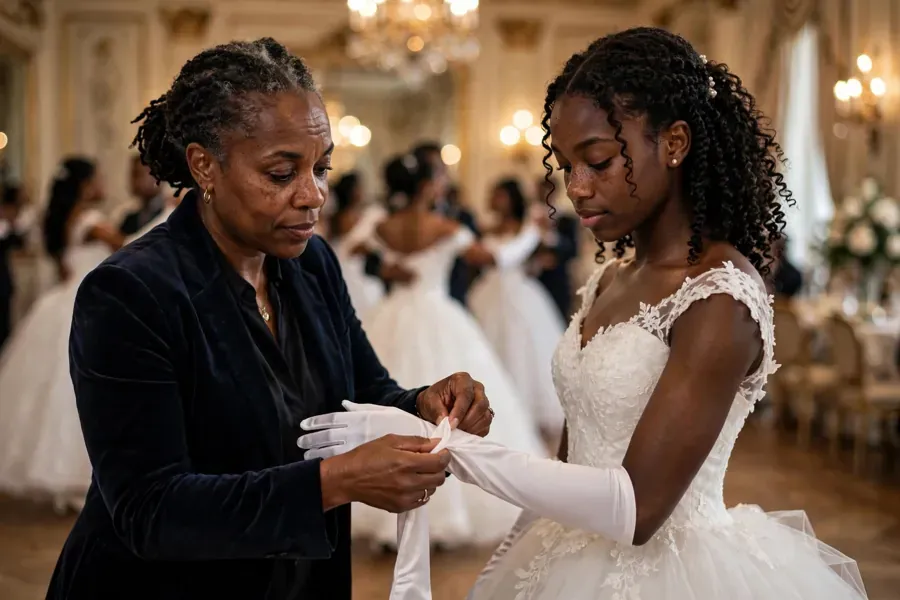
She will also log real hours in her community, sit in rooms with women whose careers she may one day hold, learn to introduce herself, to write the thank-you note, to carry herself under attention. Wenda Moore, a charter member and past cotillion chair quoted in the Ramsey County account, states the committee's whole philosophy in a sentence:
“[These young women] are the future leaders of our community.”— Wenda Moore, Links cotillion chair, via Ramsey County Historical Society
How the Money Works
A scholarship ball is a fundraiser wearing evening dress, and its economics deserve the same respect as its choreography.
Charity-ball guidance is consistent on the foundations: balls take between six and twelve months of planning and careful financial management, tickets are priced against real costs, and local businesses are asked to sponsor the event — featured, in return, on the programmes and tickets the ball prints.
Fundraising-gala practice adds the on-the-night machinery: ticket sales and sponsorships that cover event costs and contribute directly to the mission, silent and live auctions, fund-a-need or paddle raises for direct contributions, and raffles and smaller experiences layered through the evening. The debutante tradition contributes a revenue instrument entirely its own: the souvenir programme.
Los Angeles introduced its Souvenir Program as a permanent keepsake — photographs of the Cotillionettes, the chapter's annual record, and advertisements and messages from family, friends, community groups and businesses — and the same history notes that the souvenir book now supports the chapter's annual fundraising efforts for local charities.
Every proud family's page, every business's advertisement, is scholarship money in formal dress.
And the money lands where the brochures promise.
The Los Angeles Links chapter records that since 1990, its debutantes have received Cotillionette Scholarships in academic achievement, community service hours, entrepreneurship and essay writing — and that grants to community organisations are presented annually following the November debutante ball, to a recipient list running to fifteen to twenty-five organisations a year, alongside educational endowments the chapter has built over decades.
Note the scholarship categories, because they are the mission stated as a marking scheme: achievement, service, enterprise, and the written word. A young woman is not funded for descending a staircase beautifully. She is funded for what the season revealed about her — and the staircase is how her community gathers to say so.
Families buying a table at a scholarship ball should understand their purchase in exactly those terms: the ticket is a donation with dinner attached, and the table is a statement about whose futures the family funds.
The Night Itself
The presentation follows an order refined over generations, and it rewards the rehearsals. The debutantes, in floor-length white gowns and long white gloves — Los Angeles standardised the uniform early: white formal dresses of uniform length, long white gloves and medium-heeled white pumps for every Cotillionette — stand in a receiving line and are then introduced individually to the room.
The standard choreography, as the reference accounts describe it, runs like music: the debutante is announced, walks the room on her father's arm as he presents her, performs her curtsy — the St. James Bow, a full court bow — and is then joined by her young male escort, who escorts her away to make way for the next.
Texas debutantes at New York's International Debutante Ball perform the famous exception, the Texas Dip, a bow so deep the forehead nearly brushes the floor. Escorts — sometimes chosen by the committee to promote good social pairings — wear full evening dress; the choreographed cotillion waltz follows, then the father-daughter dance, then the ball opens to the room.
Every element a guest sees has a committee behind it: the photography finished before the receiving line forms, the order of presentation set like a running order in theatre, the counting and presentation of the evening's funds woven into the programme rather than appended to it.
For the family of a debutante, the night asks for a particular kind of grace. Arrive early and dressed to the stated standard — this is a white-tie room, and underdressing is a discourtesy to the young women. Take your seats for the presentation itself; the descending line is not a drinks interval.
Applaud each debutante as you would your own — the room's warmth is part of what is being presented. And understand the escorts' and fathers' roles as the tradition frames them: the father presents, the escort attends, and the young woman is the occasion.
Photographs from the evening belong in the family archive with the same care we urge for christenings and anniversaries; the souvenir programme, with her photograph and her season recorded in it, is already its first volume.
Participating With Cheque and Character
How, then, does a family take part well? Begin before the season: ask the presenting organisation — Links chapter, sorority, guild, foundation — about its calendar, its sponsorship route and its expectations, and take the answers seriously enough to plan a year around them.
Budget honestly for the whole participation, not the gown alone: the family's table, programme advertisements and messages, attire for parents and escort, photography, and the courtesies owed to sponsors and committee members. None of this is hidden cost; it is the published architecture of a fundraiser, and a family that resents it has misunderstood what it joined.
The cheque, however, is the easier half. The character half is showing up: to every rehearsal, on time, with the shoes broken in; to the service hours as service, not as a box ticked in the final week; to the workshops as a student.
Debutantes are remembered by committees — and committees are the same women who write recommendations, make introductions and open doors for decades. The season is a young woman's first professional reputation, built in public, in white gloves.
And it does not end at the ball. The tradition builds its own alumni: post-debutantes return to assist the next class through rehearsals and presentation, presented women join the organisations that presented them, and mothers who once descended the staircase sponsor daughters, nieces and mentees down it.
That relay — cheque and character, season after season — is why the scholarship ball endures where mere parties fade. A family that participates fully is not buying an evening. It is joining the machinery by which a community announces its daughters and endows its future in the same gesture.
Our companion guides take up the neighbouring rooms of this world: the debutante standard for the young woman herself, and philanthropy with structure for the giving that funds it all.
The Debutante Standard
Buying the Table
Philanthropy With Structure
Women of Distinction — Profile Collection
Wikipedia — “Debutante”
History — “How Debutante Balls Became an Elite Society Tradition”
Los Angeles Cotillion — “History: Los Angeles Cotillion 1952 to Present”
The Links, Inc., Los Angeles Chapter — “Awards & Recognition: Cotillionette Scholarships”
Ramsey County Historical Society — “Celebrating Young Women: The Links Debutante Cotillion”
BiddingOwl — “What Is a Fundraising Gala? (Plus Tips for Hosting One)”
Cystic Fibrosis Trust — “Organise a Ball, Dinner or Dance”
Questions & Answers
How do families pass down wealth and values?
Charity debutante ball fundraising traditions, and how it works when presentation meets purpose — the Links, guild and foundation balls where a young woman is presented to society and society, in return, funds her future. It links to 4 stories and articles — open any card to read the full piece.
How do you involve children in family wealth planning?
Charity debutante ball fundraising traditions, and how it works when presentation meets purpose — the Links, guild and foundation balls where a young woman is presented to society and society, in return, funds her future.
How do I read the full stories on The Debutante Ball and the Scholarship Ball: Where the Season Meets the Mission?
Choose any card on this page. Each one opens a full page of its own — the complete story or article, with its sources linked.