Dressing Well, Part III: Shoes — the Rotation, the Makers, the Care
The best dress shoes every man should own rotation is six pairs deep — the bench that carries a whole wardrobe, the makers who build them to be rebuilt, and the care that doubles their lives.
Ask a well-dressed man about his suit and he will talk for a minute. Ask him about his shoes and watch his whole posture change — because shoes are where a wardrobe confesses its truth.
The best dress shoes every man should own rotation is not a shopping list; it is a system, exactly as Part I taught us the suit is a system: a small bench of pairs, each with a job, none worn two days running, all of them built to be repaired rather than replaced.
The bench in our photograph — Oxfords and loafers in a row, a hand lifting one pair by the heel in the morning light — is the entire philosophy in one frame.
Six pairs, properly chosen and properly rested, will carry a wealthy man’s year from the boardroom to the gala to the Vineyard ferry, and outlast a decade of lesser shoes bought twice as often.
Here is the rotation, the makers, and the care — with the resoling economics that make buying once, properly, the cheapest decision in the whole wardrobe.
The Six Pairs That Cover the Year
The specialist literature builds the rotation the way a tailor builds a wardrobe — one essential at a time.
The Shoe Snob’s essential-dress-shoes guide starts from the summit: if you could own only one pair, make it a black wholecut Oxford — cut from a single piece of leather, it takes you from business meetings to formal dinners and even black tie in a pinch. Pair two adds the brown brogue, the daytime workhorse against navy and grey.
Pair three is the brown suede loafer, the rotation’s diplomat — tailoring on Friday, no socks in July. Pair four, the apron-toe derby, whose open lacing forgives a long day and a high instep alike. Pair five completes the classic bench in that guide: a smart chukka or a sleek Chelsea boot, for weather and travel.
To those five, the Bourgeois Society bench adds a sixth — a black cap-toe Oxford kept polished and rested for the most formal evenings, so the wholecut is never asked to be in two places at once.
Around that core, climate and city make their small adjustments: a rubber-soled derby where winters are wet, a second suede pair where summers are long. But the architecture holds everywhere — two blacks, two browns, one suede, one boot — and a man who owns it is, quite literally, never wrongly shod.
One discipline governs the bench before any purchase does, and the care guides state it as a rule, not a tip:
“Rotate pairs — never wear the same leather shoe two days consecutively.”— Urban Men Style, “Every Man Needs These 5 Pairs of Shoes”
Leather is skin; a day’s wear fills it with moisture and compresses its structure, and it needs a full day — better, two — on trees to dry, recover its shape and be ready to work again.
Rotation is therefore not indulgence but arithmetic: three pairs rotated wear out in far more than three times the life of one pair worn daily, because each pair’s rest days are doing invisible repairs the whole time.
This is why the second pair of dress shoes a man buys is the best-value purchase in his wardrobe, and why cobblers to executives will tell you the client with six pairs is not extravagant — he is the only one being economical.
Reading the Shoe: Oxford, Derby, Loafer, Boot
Before the makers, the grammar — because half of all shoe mistakes are vocabulary mistakes worn in public.
The formality ladder runs on lacing and decoration, and the style guides state its first rule cleanly: Oxfords are the most formal, their closed lacing — the eyelet tabs stitched beneath the vamp — giving the shoe its clean, unbroken line; derbies, with open lacing stitched on top, read more relaxed and allow more room across the instep.
Hence the bench’s logic: black Oxfords own the evening, derbies own the working day and the wider foot, and the plain wholecut — no seams, no broguing, nothing to interrupt the line — sits above even the cap-toe when the invitation is at its most formal.
Broguing, the punched decoration, moves a shoe one step down the ladder with every row of holes, which is why the brown brogue is a daytime shoe and why no brogue has ever belonged at black tie.
The loafer is the ladder’s landing: no laces at all, its formality set by material — polished calf for the city, suede for the season — and the boot, Chelsea or chukka, trades the shoe’s line for coverage and weather, dressing up or down by its last and sole.
Learn to read those four facts on a stranger’s feet and you will know, before he sits down, whether his wardrobe was assembled or merely accumulated.
Soles complete the reading. A heritage-construction guide sets out the working choice: leather soles glide and feel dressiest, ideal for formal wear and smooth floors, while Dainite and similar rubber soles add grip and resilience for city streets, wet steps and cobblestones — with hybrid soles, leather with rubber foreparts, offering the best of both for mixed lives.
The same guide’s counsel on the welt itself is a traveller’s footnote: a sleeker 270-degree welt reads best under tailoring, while a full storm welt suits a mixed-weather, travel-heavy routine.
In practice the bench settles it simply — leather soles on the two black pairs, rubber or hybrid on the derby and the boot — and the man who has made that one decision in advance never again performs the marble-floor skating routine in a hotel lobby.
The Makers: Northampton, and the Summit Above It
The geography of serious shoes is reassuringly small. Northampton, in England’s East Midlands, remains the bench-made capital — home to Crockett & Jones, Church’s, Edward Green and the ready-to-wear arm of John Lobb — with Spain’s Carmina the name every rotation-builder adds from the continent.
The Gentleman’s Journal’s dress-shoe survey captures the summit’s character in a single maker’s numbers: John Lobb have been making shoes since 1849, and their Oxfords are bench-made with over 190 steps before they are good to go, while its Crockett & Jones entry notes the Goodyear-welted construction that will matter in a moment — shoes that will “last a lifetime if looked after correctly.” A head-to-head comparison of the two houses at the very top puts the current ready-to-wear territory plainly: both John Lobb and Edward Green retail in roughly the $1,500 to $2,500 band for ready-to-wear, both Goodyear-welted in the Northampton tradition — the choice between them, that comparison concludes, depends on the foot more than on the brand: Edward Green for the narrower foot and slimmer last, John Lobb for the wider foot or higher instep.
Below that summit, the honest ladder runs from the strong Northampton mid-tier and Carmina — the working rotation of most serious wardrobes — up through the two great houses ready-to-wear, and finally to bespoke, where a last is carved for one pair of feet and the John Lobb bespoke tradition prices accordingly, in the several thousands.
Buy at the rung your rotation needs; a bench of six mid-tier pairs, rested and resoled, will out-serve two summit pairs worn into the ground.
Built to Be Rebuilt: The Resoling Economics
The construction word to learn is Goodyear welt: a strip of leather stitched between upper and sole, which lets a cobbler remove a worn sole and stitch on a new one without disturbing the upper your feet have spent years persuading into shape.
A construction guide drawing on the makers’ own figures reports that Carmina counts around 150 steps for a welted shoe against about 50 for a Blake-stitched one, and that a welted shoe with moderate use can be rebuilt three to four times — with Loake’s factory refurbishment, new soles and heels and welts where needed, listed at £125 in that same guide.
Set that against the alternative: a cemented shoe, glued rather than welted, whose sole’s death is the shoe’s death.
The care literature’s comparison is blunt — a resoleable shoe that can be resoled three or four times will outlast multiple pairs of cheap cemented shoes, making it the better value in the long run despite the steeper first price.
The one rule of timing matters more than any figure: resole when the sole begins to wear thin, before the damage reaches the welt and insole — a good cobbler can restore an excellent pair, but, as one guide puts it, they can’t save a destroyed one.
Inspect your soles the way you inspect your tyres, and the rotation will repay you for decades.
The Other Constructions, Honestly Weighed
Goodyear welting is the rotation’s default, not its religion, and the construction guides are fair to the alternatives.
The Blake stitch — a single seam passing straight through insole, upper and outsole — produces a slimmer, more flexible shoe that can be cut closer to the foot, which is why sleek Italian city shoes so often use it; the same comparison notes its honest trade-offs: water can wick up through the Blake seam, and Blake shoes are rarely resoled because the job takes much more labour — while cemented soles, simply glued, are effectively not resoleable at all.
A Blake loafer bought knowingly, for dry days and dressed-down elegance, is a perfectly honourable member of the bench. What the well-dressed avoid is only the unknowing purchase: the glued shoe at a welted price, bought on shine alone.
The construction check takes ten seconds in the shop — ask the maker’s name for its construction, and turn the shoe over: a real welt’s stitching is a working seam, slightly irregular in its distance from the edge, while a perfectly even decorative line on a glued sole is costume.
Makers who welt their shoes say so, in print, proudly. If the listing will not name the construction, the silence is the answer.
The Care: Trees, Rest, Cream — the Ten-Minute Religion
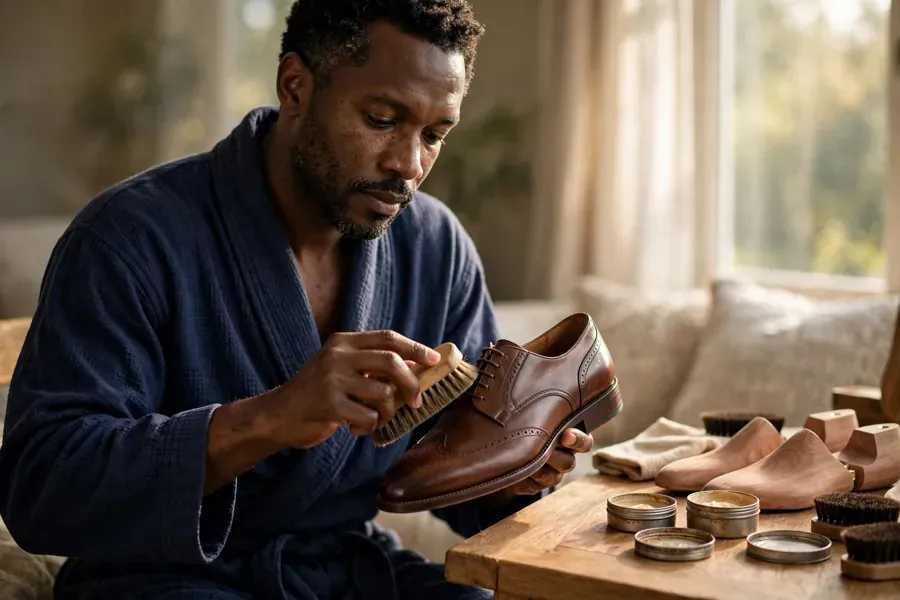
The care ritual, in the photograph above, is deliberately unglamorous — which is why it works. The guides agree on its elements almost word for word.
Cedar trees go in the moment the shoes come off: use cedar shoe trees in leather shoes after every wear, clean and condition the leather every few months, polish before major occasions, and treat suede with protector spray before its first wear.
The fuller care sequence from the dress-shoe guides adds the daily and monthly cadence: wipe the shoes with a soft cloth after each wear, apply a cream polish every four to six weeks and buff with a horsehair brush, and store the pairs in dust bags away from direct heat.
Ten minutes on a Sunday, trees every night, rest every other day — that is the entire religion, and its reward is compound: uppers that deepen into patina instead of cracking, soles replaced on schedule instead of in emergency, and a bench that looks, at year ten, better than it did at year one.
Complete the dressed man with the piece the shoes are pointing up toward — the watch on the wrist, the subject of Part IV — and the system this series has been building stands finished, from the ground up. Literally.
Build the bench once, rest it faithfully, resole it on schedule — and the question of what to put on your feet, on any morning of any year, simply stops being a question.
Dress Like a Gentleman, Part I: The Suit Is a System
Dress Like a Gentleman, Part IV: The Watch on the Wrist
The Shoe Snob — “The 5 Essential Dress Shoes Every Man Should Own”
Urban Men Style — “Every Man Needs These 5 Pairs of Shoes — Here’s Why”
His Potion — “Goodyear Welted Shoes Explained: How the Welt Works and Who Needs It”
The Gentleman’s Journal — “Wardrobe Essential: The Dress Shoe”
Trillionaire Daily — “John Lobb vs Edward Green: English Shoes, Honestly”
Vinthentic — “Men’s Leather Shoes for Formal Settings: Guide”
Herschel — “Goodyear Welt Shoes: Heritage Craft That Outlasts Trends”
Questions & Answers
What makes a gentleman in the modern world?
The best dress shoes every man should own rotation is six pairs deep — the bench that carries a whole wardrobe, the makers who build them to be rebuilt, and the care that doubles their lives. It links to 3 stories and articles — open any card to read the full piece.
How should a gentleman dress and carry himself?
The best dress shoes every man should own rotation is six pairs deep — the bench that carries a whole wardrobe, the makers who build them to be rebuilt, and the care that doubles their lives.
How do I read the full stories on Dressing Well, Part III: Shoes — the Rotation, the Makers, the Care?
Choose any card on this page. Each one opens a full page of its own — the complete story or article, with its sources linked.