
Black Hair for Men: The Cuts, the Care, the Standard
The best haircuts for Black men are never an accident. They are chosen for the head they sit on, kept on a barber's calendar, and carried by a care routine that runs whether anyone is watching or not.
Let us begin where every good cut begins: not with a photograph of somebody else's head, but with your own. The best haircuts for Black men start with three honest facts — the shape of your head and face, the texture your hair actually grows in, and the upkeep your life can honestly sustain.
A cut that honours all three will look like it was designed for you, because it was. A cut borrowed from a man with a different head, a different curl pattern, and a barber on weekly retainer will look borrowed.
This guide is the whole standard: how to choose, what to ask for, how waves are really built, how grey is handled with intent, and which products earn their place on the shelf.
Choose for the Head You Have
Face shape is the first variable, and barbers think about it in terms of balance.
A round face wants height on top and clean, close sides to give it length; a square face, already architectural, carries short structured cuts beautifully and can afford softer texture on top; a longer face wants the opposite prescription — less height, a little more presence at the sides.
An oval face is the lucky geometry: nearly everything works, and the choice becomes a matter of taste and maintenance. Texture is the second variable. Tight coils hold a sculpted shape and show a fade's gradient like velvet; looser curls carry length and movement on top.
The cut should work with the grain of the hair, never against it — every barber worth his chair will tell you the same.
Then there is the fade itself, which is less a haircut than a family of them.
The low fade is the conservative, boardroom choice; the mid fade is the balanced all-rounder; the high fade is maximum contrast; the temple fade keeps curls and natural tops neat at the edges; and the drop and burst fades curve around the ear for the more sculptural styles. None is better than the others in the abstract.
The right one is the one whose contrast level matches the rooms you walk into — and whose maintenance rhythm matches your calendar, because a skin fade is a weekly-to-fortnightly commitment while a low taper forgives a third week.
The Classics, and What Each One Asks of You
Beyond the fade sit the enduring styles, each with its own contract. The Caesar and the short, even cut are the quiet standard — one length, immaculate edges, nothing to hide behind. The high-top, carried down from the golden age of hip-hop and worn now with a modern taper, asks for dense hair and a barber who understands architecture.
Twists and sponge twists give texture with a shorter commitment; cornrows ask for a skilled braider and honesty about tension — a style that hurts is too tight, and tight styles worn relentlessly are unkind to a hairline.
Locs are the long game: a decision measured in years, kept with retwists at intervals of several weeks and a scalp kept clean and moisturised underneath. Style guides that catalogue these cuts note the practical spread plainly: short cuts and waves suit the man happy in the chair every few weeks, while locs suit the man playing the long game.
Choose the contract you will actually keep.
Whatever the style, the finish is the line-up — the shaped edge along the hairline and temples that turns a haircut into a presentation. Keep it crisp but keep it honest: a line-up that respects your natural hairline will age with you, while one carved aggressively forward fights your own geometry and loses.
Ask your barber to keep the hairline natural. It is the difference between sharp and strained.
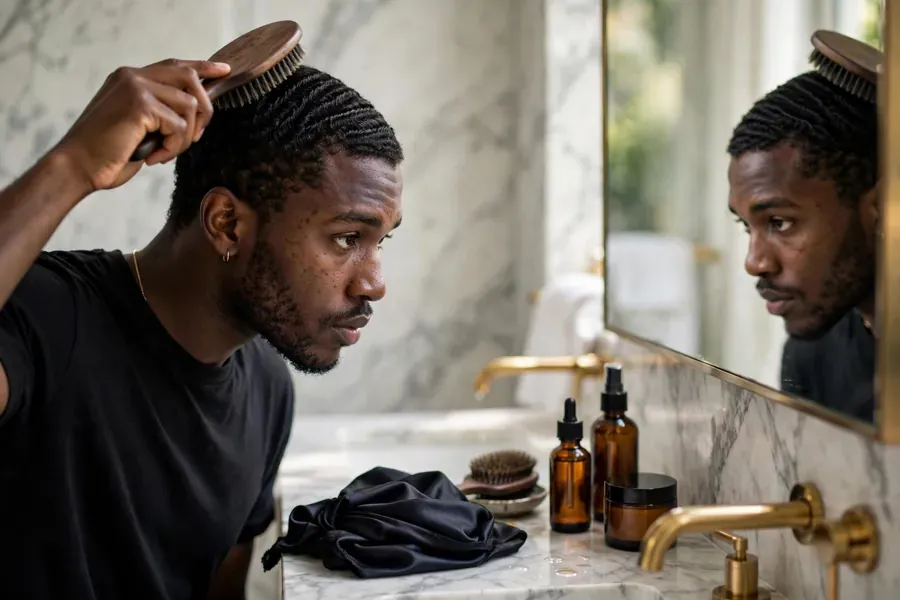
Waves: The Discipline Cut
Waves “have long been a symbol of discipline and care in black male grooming, often signalling a sense of pride in one’s appearance.”— Ape to Gentleman, "The Best Haircuts For Black Men"
Every word of that is earned nightly. Waves are not cut in; they are trained in.
The method, as the wave guides lay it out, is a routine with no shortcuts: start from a low, even cut, moisturise daily, brush in the direction of your natural pattern in consistent daily sessions, and protect the work with a durag or wave cap every night.
Early signs arrive in a few weeks; full, deep definition takes longer, and the men with the deepest waves are simply the men who kept brushing. The cut underneath matters too — a low or drop fade keeps the attention on the pattern while the outline stays clean.
Waves are the one style in this guide whose upkeep is daily rather than weekly, and that is precisely their social function: they announce, silently, that their owner does the small things every day. At our level, that announcement is worth more than the pattern.
The Care Beneath the Cut
A great cut on an uncared-for scalp is a frame around nothing. The care standard for coily hair is moisture, managed deliberately. Hair of this texture loses moisture quickly and drinks it gratefully: a gentle, sulphate-free cleanse on wash day, conditioner every time, and a leave-in or light cream between washes, with oils used to seal rather than to substitute.
Porosity — how readily your hair takes in and holds moisture — is why two men can use the same product to opposite effect; if your hair dries within the hour, it is asking for richer creams and less frequent washing, not more product layered on in frustration.
Keep heavy, waxy products in check: build-up dulls the hair, clogs the scalp, and makes the next cut sit badly. And keep the scalp itself clean and calm — it is skin, and it keeps the same rules as the skin of your face.
General information only, and worth saying plainly: persistent itching, flaking, patchiness, or soreness is not a product problem to shop your way out of. That is a question for a dermatologist who knows Black skin and Black hair, and asking it early is part of the standard, not a failure of it.
Texture, Honestly Read
Two terms from the stylists' vocabulary are worth owning, because they explain most of what your hair does.
The first is shrinkage: coily hair springs back on itself, so the hair you see is considerably shorter than the hair you have — which is why length on top can look modest in the mirror and still be doing real work, and why cutting coily hair dry, in its natural state, is the professional's preference.
The second is the curl pattern itself, catalogued from looser Type 3 curls to the tight coils and zig-zag patterns of Type 4. Neither is a grade; they are descriptions, and each carries its own best cuts — coils hold sculpture and show a fade's gradient beautifully, looser curls carry length and movement.
Know which one grows out of your head before you choose what it becomes, and be suspicious of any product or style that promises to make your hair behave like a different type. The standard is not transformation. It is your own texture, cut by someone who understands it, kept like you mean it.
How to Talk to Your Barber
Most disappointing haircuts are translation failures, not talent failures. The fix is a small vocabulary and a photograph.
Bring two pictures of the cut you want — one from the front, one from the side — on a head whose texture resembles yours, and then speak in the barber's units: the length on top, the guard number on the sides, where the fade or taper begins, and whether you want a line-up and how natural it should stay.
A number one guard leaves an eighth of an inch; from there the numbers climb by eighths, and knowing your own numbers turns every future appointment into a refinement instead of a negotiation. Say, too, what your mornings look like — a cut that needs ten minutes of styling will be betrayed by a man with four.
A good barber would rather build you a slightly simpler cut you will actually maintain than a masterpiece that collapses by Thursday. And say it immediately if something hurts or pulls, in braiding especially: pain is information, and a professional wants it in the chair, not in a review.
The Maintenance Calendar
Hold the standard on a rhythm and it stops feeling like effort. The cut itself: fades and short styles every two to three weeks, skin fades at the tighter end of that window; twists refreshed within about two weeks; locs retwisted at intervals of several weeks, as the style guides catalogue them.
The line-up can be maintained between full cuts with a short edge appointment — many men of standing keep exactly that standing date.
At home the rhythm is daily for waves (brush, moisturise, durag at night), weekly for wash day with its cleanse-and-condition sequence, and nightly for everyone: hair goes to sleep protected or compressed against cotton, it pays for it.
Put the barber on the calendar the way you put the dentist — recurring, unmissable, unembarrassing to reschedule a day but never to abandon. Hair kept this way stops being an event. It becomes what it should be at your level: a constant.
The Beard, Blended
For most men the cut does not end at the sideburn. The beard is the second half of the silhouette, and the standard is the blend: sideburns that flow into the beard with no visible seam, a cheek line that is deliberate without being drawn on, and a neckline kept where the jaw's authority ends.
Condition it as you condition the hair above it — a dry, uncombed beard will undo an immaculate fade in a single glance, and the fade guides say so plainly: a worn beard is part of the cut, and it is kept or the whole presentation is not.
Decide the beard's length as consciously as the cut's guard number, keep its grey to the same policy as the hair's, and let one hand — your barber's — own the architecture of both.
Grey, Handled With Intent
When the silver arrives — at the temples first, usually, as if testing your reaction — you have three honourable options. Keep it, and keep it well: grey strands are coarser and drier than pigmented ones and pick up a yellow cast from the environment, so moisture and an occasional silver-toned shampoo keep them bright rather than dull.
Blend it, with colour kept a shade or two lighter than your original black so it sits naturally against mature skin rather than as a hard, flat cap of dye. Or commit to full colour, knowing it is a standing appointment every few weeks, beard and temples included in the decision.
What the standard forbids is only the fourth option: drift. A man who has decided about his grey looks intentional at any colour. A man who has not looks like the question caught him off guard — and at your level, very little should.
The shelf, finally, should be short enough to memorise: a gentle cleanser, a real conditioner, a leave-in moisturiser matched to your porosity, one styling product with hold and no concrete, a proper wave brush if you wear waves, a durag in silk or satin, and clippers kept clean if you maintain your own edges between visits. Everything else is decoration.
The institution behind all of it — the shop, the standing appointment, the chair itself — is honoured in The Chair, and the masters who built that institution stand in The Great Black Barbers. And for the man whose answer to all of this is the razor, worn with pride: The Bald Standard is his guide.
However you wear it, wear it like you meant it. That is the whole secret, and it was never only about hair.
One last word on photographs, because they are how most cuts are chosen and most cuts are ruined. When you find a style you admire, save pictures of it from the front and the side, on a head shaped like yours, and bring them to the chair — then let your barber translate rather than photocopy.
The translation is where his expertise lives: the same design sits higher on one skull, softer on another, and the professional adjustment is what makes the finished cut look like it grew there. Collect the references over time, not in a panic the morning of the appointment, and retire the ones your texture has voted against.
Taste, like the cut itself, is a thing maintained.
The Grooming Standard: Barber, Skin, and Scent
The Chair: Barbers, Salons, and the Appointments That Run Black Life
The Great Black Barbers: Masters of the Chair
The Bald Standard: Why the Clean Head Is a Crown
Maneva Magazine — "Fade Haircuts For Black Men"
Men's Hairstyles Today — "Fresh Waves Haircuts"
Grooming for Black Men — "How Long Waves Take for Black Men"
Ape to Gentleman — "The Best Haircuts For Black Men"
Luxe Digital — "Black Men Haircuts: Styles, Waves to Locs"
On Point Fresh — "Best Hairstyle for My Face Shape: Men's Haircut Match Guide"
Questions & Answers
What makes a gentleman in the modern world?
The best haircuts for Black men are never an accident. They are chosen for the head they sit on, kept on a barber's calendar, and carried by a care routine that runs whether anyone is watching or not. It links to 5 stories and articles — open any card to read the full piece.
How should a gentleman dress and carry himself?
The best haircuts for Black men are never an accident. They are chosen for the head they sit on, kept on a barber's calendar, and carried by a care routine that runs whether anyone is watching or not.
How do I read the full stories on Black Hair for Men: The Cuts, the Care, the Standard?
Choose any card on this page. Each one opens a full page of its own — the complete story or article, with its sources linked.