
Dressing Well, Part VI: The Grooming Standard — Barbers, Skin, and Scent
A men's grooming routine is not a shelf of products; it is a calendar. Barber on a standing cadence, skincare kept simple and daily, and a fragrance wardrobe of three — that is the whole standard behind the effortless look.
Ask a room of well-kept men how the look is done and each will shrug, because to him it no longer feels like effort. Press him, and a structure emerges — the same structure every time. It is never a miracle product.
It is a men's grooming routine run like a household: the barber booked on a cadence rather than in a crisis, skincare reduced to a few daily acts performed without exception, and scent disciplined to a small wardrobe with a job for every bottle.
The questions men actually ask — barber, how often? skincare, how much? fragrance, how many? — all have the same shape of answer: less than you fear, more regularly than you think, and always on the calendar instead of on impulse.
That is the grooming standard this guide sets out: the appointments behind the effortlessness, the premium care of melanin-rich skin, and the case for three fragrances rather than thirty.
The Barber Cadence — Standing Appointments, Not Emergencies
Everything begins in the chair, because hair is the frame the rest of the face is judged inside. The professional consensus on frequency is a range, not a date, and it is set by the cut you wear.
One barber's guide gives the practical baseline directly: most men can use a 3–5 week schedule as a practical baseline — tight fades and very short styles often need attention every 2–3 weeks, classic or medium-length styles often hold for 4–5 weeks, and longer or textured styles may go 5–6 weeks.
A second barbering guide breaks the same calendar down by style with a working man's precision: skin fades and buzz cuts every 2–3 weeks, taper fades every 3–4 weeks, textured crops every 4–5 weeks, and medium-length styles every 6–8 weeks — with curly and coily hair often able to stretch a little longer, because shrinkage hides growth even while the hairline and outline still need their tidy.
A complete grooming calendar from a men's style authority lands in the same territory, placing the barber visit on a three-to-six-week cycle alongside the weekly and daily tasks. Three independent sources, one conclusion: pick your interval from your cut, then hold it like a board meeting.
Holding it is the actual standard, and it is administrative, not aesthetic. Book the next appointment before you leave the shop — ideally standing, same chair, same day, same hour — so the decision is never remade and never forgotten.
A barber kept on cadence becomes something more valuable than a barber: he becomes the keeper of your silhouette, the man who notices the neckline thicken, the hairline change, the beard's grey arriving, and adjusts the cut before the room notices anything at all.
Treat the appointment as the full service it is at the premium end — consultation, cut, hot-towel finish, neckline and edges perfected, beard shaped if you wear one — and protect its place in the week the way you protect a fitting at your tailor's.
The detail that buys you grace between visits is worth asking for by name: a tapered neckline, which grows out smooth and natural rather than growing out obviously, is the easiest single change for a man stretching toward the longer end of his interval.
And between chairs, the home discipline is ten seconds a day: brush, a light product matched to your texture, and hands off. The cut does the work; you merely keep faith with it.
“The men whose skin looks effortless in the morning are almost always the ones who did the work the night before.”— Mojeh Men, “Men's Grooming Routines: A Step-by-Step Daily Guide”
Skin — Simple Daily, Serious About Melanin
Skincare at the premium level is, paradoxically, a short routine performed forever. The daily architecture, as the grooming calendars agree, is three acts: cleanse, moisturise, and protect.
Cleanse once or twice daily with a gentle, non-stripping wash; moisturise immediately after cleansing, while the skin is still receptive, to lock in hydration; and apply sunscreen every morning — broad-spectrum, SPF 30 or higher — as the non-negotiable final step.
Around that spine, the weekly rhythm: exfoliation two to three times a week to clear dead skin and keep the complexion even, and a targeted treatment step on some evenings — a serum aimed at tone or texture — rather than a cabinet of experiments performed all at once.
Nails trimmed and tidied weekly, nose and ear hair checked fortnightly: the grooming calendar's small print, and the details other men register without knowing they have.
For melanin-rich skin, the premium difference is not more products; it is a clearer understanding of one mechanism.
Darker skin's characteristic concern is hyperpigmentation — dark marks left behind wherever the skin has been irritated — and the chemist-led guidance for Black men's skin puts the governing rule first: irritation is the enemy — cleanse gently, moisturise right after cleansing, wear sunscreen daily, introduce new active ingredients one at a time, and stop anything that keeps burning or stinging, because pushing through irritation is how more dark spots are made.
The treatment ingredients with the strongest support in that guidance are the patient ones: niacinamide and arbutin in an evening treatment step, vitamin C for brightening, azelaic acid and gentle AHAs used carefully — barrier-supportive formulas over aggressive ones, always. Harsh scrubs are doubly discouraged for a man who shaves, because every source of friction is a potential mark.
And sunscreen is not optional decoration on this routine; it is the keystone.
The specialist guidance on dark spots explains why in one causal chain: sunscreen is the most critical step because UV radiation stimulates melanin production, which darkens existing spots and triggers new ones — without daily sunscreen, the work of fading marks is undermined as fast as it is done.
Set expectations like an investor, not a consumer: the same guidance puts initial improvement at six to twelve weeks and significant fading at three to six months. Skin keeps a long ledger. The standard is consistency, measured in seasons.
It is the same skin-first philosophy our companion guide sets out for the other half of the household in The Beauty Standard: Skin First. And when marks persist, deepen, or change, the premium move is the professional one: a dermatologist experienced with skin of colour, consulted early rather than after a year of product roulette.
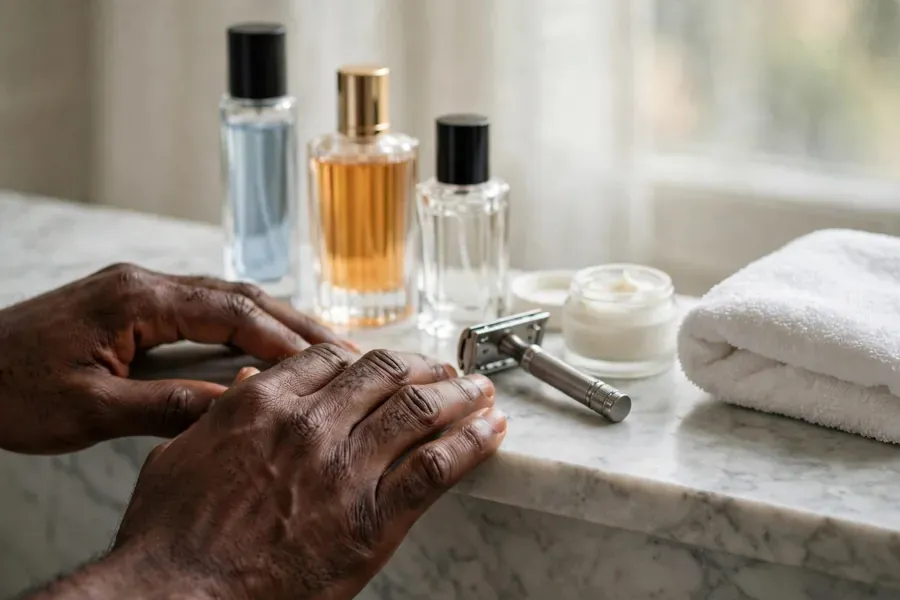
The Shave — Technique as Skin Care
No grooming topic touches Black men more personally than the razor, because no topic is more written on the skin itself.
Razor bumps — pseudofolliculitis barbae — occur when a tightly curled hair, cut short and sharpened by the blade, curves back into the skin and is treated by the body as an intruder; dermatology guidance notes they are especially common among Black men with tightly curled beard hair, that they are not a sign of poor hygiene, and that shaving with the direction of hair growth, without pulling the skin tight, and avoiding a very close shave can help — while picking or digging at a trapped hair only worsens the damage.
The premium technique follows directly: soften the beard first with warm water or the barber's hot towel; use a lubricating gel; shave with the grain in a single unhurried pass; favour a single blade or clippers that leave a whisper of stubble over multi-blade systems that cut below the surface; and soothe afterwards rather than assaulting the skin with alcohol-heavy splashes.
Leaving a fraction of length is not a compromise of the clean look — at the standard this series keeps, a healthy neck in a perfect collar outranks a raw one in a perfect shave. Chronic, painful, or scarring bumps are a dermatologist's brief, full stop; topical retinoids and other prescribed treatments exist, and they belong in professional hands.
Between the barber's chair and the dermatologist's office, technique is the treatment most men have been skipping.
Scent — A Wardrobe of Three, Not Thirty
Fragrance is where the grooming standard meets the wardrobe philosophy of this whole series: a small rotation, each piece with a job, nothing bought twice for the same occasion. The guidance on how many colognes a man should own converges with unusual unanimity.
One fragrance authority's answer is a minimum of three, each with a named role: a signature scent for everyday wear, a special-occasion scent for the moments that ask for a statement, and a casual, light scent for active and relaxed days.
A fragrance house's wardrobe guide agrees to the bottle: two to three fragrances cover most situations comfortably — one fresh for daytime, one deeper for evening, and optionally one for colder weather — and beyond three you are building a collection rather than a wardrobe. Collections are a fine hobby. They are not a grooming standard.
The signature scent is the one colleagues and family will associate with you for a decade; choose it versatile, office-safe, and unmistakably yours. The evening scent is warmer and richer — amber, leather, woods — worn closer and at night. The third is freshness itself, for heat, travel, and daylight ease.
Application is the other half of the discipline, and it is a discipline of less. Fragrance goes on after hygiene, never instead of it — body wash, shampoo, breath, and laundry speak before the cologne does, and no bottle rescues neglected basics.
Apply to pulse points — wrists, neck, the inside of the elbow — where warmth diffuses the scent, and onto moisturised skin, which holds it longer. One or two sprays is the standard dose; the governing ambition, as one grooming essay phrases the etiquette, is to be noticed when people get close, not before you enter the room.
Test before you commit: wear a candidate through a full ordinary day, live with its dry-down — the scent at hour six, not the sparkle at minute one — and only then buy the bottle. Decants and samples are the fitting room of fragrance; use them with the same seriousness you bring to a tailor's chalk.
Keep the three bottles together, away from bathroom steam and sunlight, and the wardrobe will hold its character for years.
The Standard, on One Calendar
Lay it out plainly, as the household would. Daily: cleanse, moisturise, sunscreen in the morning; cleanse and moisturise at night; fragrance, one or two sprays, chosen from three. Two or three times a week: exfoliate; a treatment serum on its evenings.
Weekly: nails and cuticles; a check of brows, nose, and ears. Every two to six weeks, by your cut: the barber, booked standing, next appointment made before you leave the chair. Seasonally: review the fragrance wardrobe's third bottle against the weather, and the skincare's weight against the climate.
Annually, and without drama: a dermatologist who knows melanin-rich skin. Nothing on that calendar is expensive in the way men fear and everything on it is expensive in the way that matters — it costs regularity.
That is the open secret behind every "effortless" man you have ever admired, from the style-forward honorees of our Black Men profiles collection onward: not a shelf, not a secret, but a standard — kept quietly, kept always, and visible in every room precisely because it never has to be thought about in any of them.
Dressing Well, The Lady: The Beauty Standard — Skin First
Dressing Well, Part V: Black Tie, Built Properly
Dressing Well, Part II: Bespoke, Made-to-Measure, or Off the Rack
Black Excellence — Profiles of Black Men
The Ultimate Cave Barber — “How Often Should Men Get a Haircut? Barber Guide”
Brandy Barbers — “How Often Should Men Get a Haircut?”
Strive Skin — “Black Men Skin Care: A Chemist's Guide to Dark Spots and Routines”
Grooming for Black Men — “Dark Spots: Hyperpigmentation in Black Men”
MedEvidence — “Ingrown Hairs and Razor Bumps: Why Bumps Appear After Shaving — and How You Can Prevent Them”
Kingsmen Premium — “How Many Colognes Should a Man Own?”
Mojeh Men — “Men's Grooming Routines: A Step-by-Step Daily Guide”
The Essence Vault — “How to Build a Men's Fragrance Wardrobe”
Havok Journal — “The Modern Man's Standard: Grooming Beyond the Basics”
Cuts by Amber — “How Often Should You Get a Haircut?”
Questions & Answers
What makes a gentleman in the modern world?
A men's grooming routine is not a shelf of products; it is a calendar. Barber on a standing cadence, skincare kept simple and daily, and a fragrance wardrobe of three — that is the whole standard behind the effortless look. It links to 4 stories and articles — open any card to read the full piece.
How should a gentleman dress and carry himself?
A men's grooming routine is not a shelf of products; it is a calendar. Barber on a standing cadence, skincare kept simple and daily, and a fragrance wardrobe of three — that is the whole standard behind the effortless look.
How do I read the full stories on Dressing Well, Part VI: The Grooming Standard — Barbers, Skin, and Scent?
Choose any card on this page. Each one opens a full page of its own — the complete story or article, with its sources linked.