
Dressing Well, Part II: Bespoke, Made-to-Measure, Off-the-Rack — and When Each Is Right
Bespoke vs made to measure vs off the rack cost is the first honest question in menswear — what each tier really charges, how long it takes, and why the second suit matters more than the first.
Every well-dressed man you admire has quietly answered the same question, usually in stages: where, on the ladder from the shop floor to the cutter’s table, does his suit come from?
Bespoke vs made to measure vs off the rack cost is where most men start the arithmetic — and it is the wrong place to end it, because the three tiers are not three prices for one product.
They are three different products that happen to share a silhouette: a standard size adjusted by a tailor’s chalk, a house block recut around your measurements, and a paper pattern that exists for one body on earth — yours. Part I of this series set the order of operations (the suit is a system: fit before fabric before flash).
This part gives you the honest maths — drawn from the tailors, the made-to-measure specialists and the price guides themselves — so that whichever rung you buy from, you buy it like a man who knows exactly what he is paying for.
The Three Tiers, Defined by the Pattern
Strip away the marketing and a single fact separates the tiers: the pattern. A detailed comparison from Nathan Tailors lays the architecture out row by row — bespoke begins from a pattern created from scratch for your body, made-to-measure adjusts a base pattern, and off-the-rack is standard sizing you simply pick.
The numbers that follow from that one fact cascade through everything else: bespoke takes some 25 to 40 or more measurements and two to three fittings at minimum; made-to-measure takes roughly 10 to 20 measurements and at most a fitting or two; off-the-rack takes none, because the fitting is you, a mirror, and a size label.
Construction follows the same gradient — hand-stitched, full-canvas work at the bespoke summit, machine making with some hand finishing in the middle, and frequently fused interlinings on the rack.
Even the old word tells the story: as the same comparison notes, “bespoke” comes from “bespeak” — cloth on Savile Row was said to be spoken for by one customer before a garment was ever cut.
Why does the pattern matter so much? Because a suit’s real fit problems are never the ones a tape measure alone solves. Shoulder slope, posture, one arm carried lower than the other, a chest that leads and a back that follows — a from-scratch pattern is drawn around all of it, while a block pattern is negotiated with it.
That is why the tailoring guides reserve true bespoke for men with specific fit challenges, signature wardrobes to build, or a craftsman’s appreciation of the thing itself — and why nobody with a standard build and a standard week should feel the slightest inadequacy reaching for tier two. The ladder is a tool, not a judgement.
The Honest Maths: What Each Tier Actually Costs
Now the figures, with the sources’ names on them, because prices in tailoring vary by city, cloth and house — and any man who quotes you one number for “a bespoke suit” is selling.
A full price guide from TS Custom Suits sets the working ranges: off-the-rack suits run roughly $300–$2,000, with the alterations they almost always need adding a further $75–$200; made-to-measure runs $800–$2,500; and true bespoke runs $2,500–$15,000 and beyond, with major-city houses at the top of each band and regional makers often delivering equivalent quality without the location premium.
The Nathan Tailors comparison lands in the same territory from the other direction — bespoke from around $2,000 to $8,000 and up, made-to-measure roughly $399–$1,500, off-the-rack $100–$800 at the volume end — and a third comparison, from Andre Emilio, puts the tiers at $200–800 off-the-rack, $800–2,000 made-to-measure, and $3,000 and up bespoke.
Take the overlap as the honest map: a good rack suit costs hundreds, a good made-to-measure suit costs around one to two thousand, and a good bespoke suit costs several thousand. Cloth, it should be said, moves a commission within its band as much as labour does — the legendary mills’ finest bolts are priced like it.
At the summit, one house will stand as the worked example. Huntsman of Savile Row — at 11 Savile Row since the early twentieth century, by its own account — publishes its terms with admirable plainness:
“Each bespoke commission takes over 80 hours of handwork, and requires up to three individual fittings… we aim to deliver your suit within 14-16 weeks from your first appointment.”— Huntsman, Savile Row — Frequently Asked Questions
And its made-to-measure service, from the same house, shows how the middle tier buys most of the craft at a different tempo: garments of enduring quality, delivered within six to eight weeks, starting from £3,500 for a two-piece suit, fitted by trying the house cut and adjusting the block pattern to your proportions.
The Gentleman’s Journal’s Savile Row primer gives the general timetable that most houses recognise: a bespoke suit will require two to three months, a made-to-measure six to eight weeks, and even ready-to-wear a couple of days for finishing. Time, in other words, is the second currency of tailoring — and the one no discount can refund.
A man who needs a suit for a wedding in three weeks is not an off-the-rack failure; he is a man whose calendar made the correct decision for him.
When Each Tier Is the Right Buy
Off-the-rack is right when the body is standard, the need is near, and the maker is good.
Buy the best cloth and construction the rack offers — half-canvas where you can find it — in the size that fits your shoulders and chest, and spend the alteration money without resentment: the $75–$200 the price guides budget for taking in, hemming and adjusting is what converts a stock garment into your garment.
Never let a tailor rebuild shoulders or shorten a jacket’s body; those are the rack’s honest limits, and crossing them costs bespoke money for a rack result.
Made-to-measure is right for most professionals, most of the time: it solves the common fit problems — the long arm, the athletic chest in a slim size, the trouser that never matches the jacket — lets you choose cloth, lining and details, and lands, per the guides, at 85 per cent and upward of optimal fit for a fraction of bespoke’s price and half its wait.
It is also the correct first commission: one good made-to-measure suit teaches you your measurements, your preferences and your tailor’s eye, which is capital you will spend wisely forever after — not least on the grooming standard that completes the picture, in Part V’s companion guide.
Bespoke is right when any of three things is true: your body defeats the blocks (a pronounced posture, a significant drop, an old injury the cloth must be cut around); the suit is a signature — the boardroom uniform of a man whose silhouette is part of his authority, worn weekly for a decade; or the craft itself is part of the purchase, as it is for the men in our pages who commission the way others collect.
Notice what is not on the list: a single gala. A one-night garment is a rental’s job or a rack suit’s finest hour; bespoke repays itself across years of Tuesdays. And a practical word inherited from our piece on the business of being early: commission ahead of need.
The man who orders in a calm season, for no occasion, is the man who is never badly dressed on short notice.
Inside a Bespoke Commission: What the Fittings Actually Do
Men who have never commissioned often imagine the fittings as ceremony.
They are, in fact, engineering, and a trade account of the Huntsman process shows the machinery plainly: a bespoke suit passes through the hands of a cutter, a coat maker, a trouser maker and a finisher, taking upwards of 60 to 80 hours, from more than thirty measurements transposed into a paper pattern.
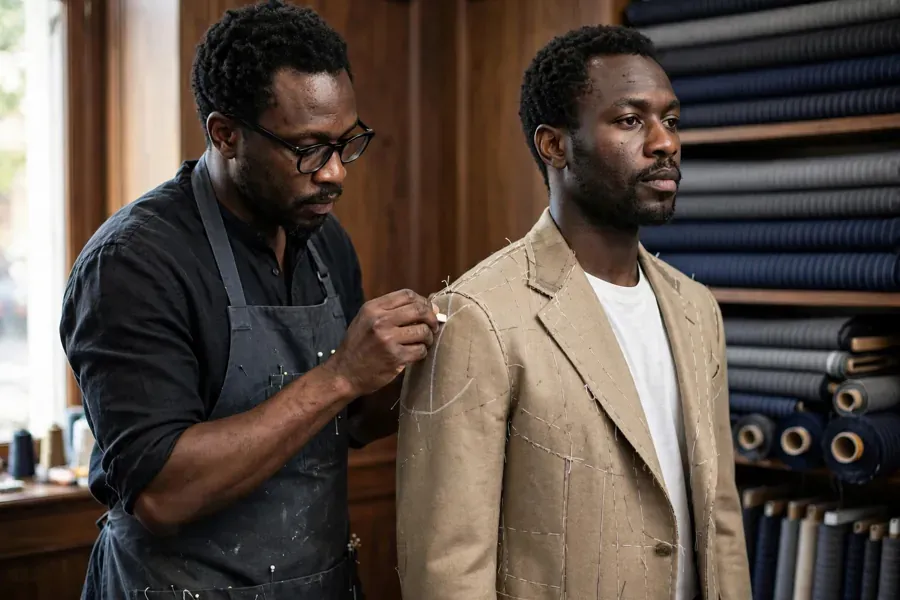
The cloth is cut, trimmed with its canvas, linings and components, and sewn into a baste — the rough, white-stitched skeleton you see our tailor chalking in the photograph above. At the first fitting the baste is assessed on your body, marked, and then ripped down — taken apart entirely — so the pattern itself can be corrected.
The second fitting works on a garment with pockets set and structure in place; the final stage adds hand-made buttonholes and hand finishing inside and out.
Henry Poole’s own account of the same rhythm puts the whole journey at approximately two months for a first commission — and then adds the detail that explains the second-suit doctrine below: for subsequent suits the timescale is much shorter, because the house already holds the pattern and, as Poole’s cutter puts it, posture barely changes in five years.
You are not paying for three fittings. You are paying for a permanent, correctable record of your body, held by people who will consult it for decades.
Made-to-measure borrows the visible parts of that theatre — the measuring, the cloth books, the choosing of lining and buttons — while replacing the pattern-from-blank-page with a block adjusted at its key points, and the baste’s rip-down with at most a final fitting and small corrections.
Off-the-rack borrows only the last act: a finished garment and a tailor’s alterations. None of this makes the lower tiers dishonest. It makes them legible — and a man who can read the process can walk into any showroom, at any rung, and know within five minutes which product he is actually being sold, whatever the signage says.
Cost per Wear: The Only Number That Settles Arguments
Run the guides’ ranges over a working decade and the ladder rearranges itself. A $1,500 made-to-measure suit worn twice a month for eight years is 192 wearings — under eight dollars a wearing, before a single compliment is counted.
A bespoke commission at $5,000, worn weekly across a ten-year signature — the use bespoke is actually for — is 500 wearings at ten dollars each, with two mid-life refurbishments still cheaper than one replacement suit.
The rack suit’s arithmetic is the mirror image: at $600 plus $150 of alterations, worn hard for two seasons until the fused chest bubbles and the cloth shines, it must be bought five times to cover the same decade, and the fifth purchase still fits worse than the first bespoke fitting.
This is why the established do not ask what a suit costs; they ask what it costs per wearing, per year of looking correct.
It is also why a young man building in stages should not apologise for his rack suit: bought well and altered honestly, it is the correct first line of the ledger — provided the ledger is actually leading somewhere.
Why the Second Suit Matters More Than the First
Here is the slate’s quiet thesis, and every working tailor will confirm it over the cutting table. Your first commission — at whichever tier — is tuition. You learn that you like a softer shoulder than you thought, that the cloth you chose pills against your briefcase, that you reach for the blue twice as often as the grey.
The house learns you, too: your pattern is drafted, your posture is on file, your preferences are in the book.
The second suit is where all of that knowledge converts into fit — cut by a tailor who has already watched the first one move through your life, in the cloth your wardrobe actually lacked, with the first suit’s small errors corrected before they are cut rather than after.
This is why the established build slowly and in sequence: one commission a year, each better informed than the last, beats a season’s splurge of three. It is also why, when the wardrobe graduates beyond suiting altogether into the one-of-one commission, the lessons transfer intact — the subject of Couture for Him, the final word in this series’ ladder.
Buy the tier your body, your calendar and your budget honestly indicate. Then buy the next one better. That, in the end, is the whole maths — and it has never once been about the label.
Dress Like a Gentleman, Part I: The Suit Is a System
The Gentleman’s Grooming Standard
The Business of Being Early
Couture for Him: Beyond the Suit
Nathan Tailors — “Bespoke vs Made-to-Measure vs Off-the-Rack: What’s Actually Different”
TS Custom Suits — “How Much Does a Custom Suit Really Cost? Complete Price Guide”
Huntsman, Savile Row — Frequently Asked Questions
Huntsman, Savile Row — Made-to-Measure Suits & Jackets
The Gentleman’s Journal — “10 Things a Gentleman Should Know Before Getting a Savile Row Suit”
Andre Emilio — “Off-the-Rack vs Made-to-Measure vs Bespoke”
FashionUnited — “Bespoke Suiting 101 with Savile Row’s Huntsman”
Questions & Answers
What makes a gentleman in the modern world?
Bespoke vs made to measure vs off the rack cost is the first honest question in menswear — what each tier really charges, how long it takes, and why the second suit matters more than the first. It links to 5 stories and articles — open any card to read the full piece.
How should a gentleman dress and carry himself?
Bespoke vs made to measure vs off the rack cost is the first honest question in menswear — what each tier really charges, how long it takes, and why the second suit matters more than the first.
How do I read the full stories on Dressing Well, Part II: Bespoke, Made-to-Measure, Off-the-Rack — and When Each Is Right?
Choose any card on this page. Each one opens a full page of its own — the complete story or article, with its sources linked.