Couture for Him: The World of Men's Made-to-Order
Men's couture, made to order: the designer commission and the trunk show, explained — what a one-of-one atelier piece buys a man that even the finest bespoke suiting does not.
Every wardrobe in this series has been built, until now, inside the tailor's world — fit, cloth, construction, the honest mathematics of bespoke, made-to-measure and off the rack. This final instalment steps through a different door.
The search that starts it — men's couture made to order designer commission trunk show — describes a world most men have watched from the other side of a velvet rope: the designer's atelier, where a garment begins not with your measurements but with a designer's idea of who you could be.
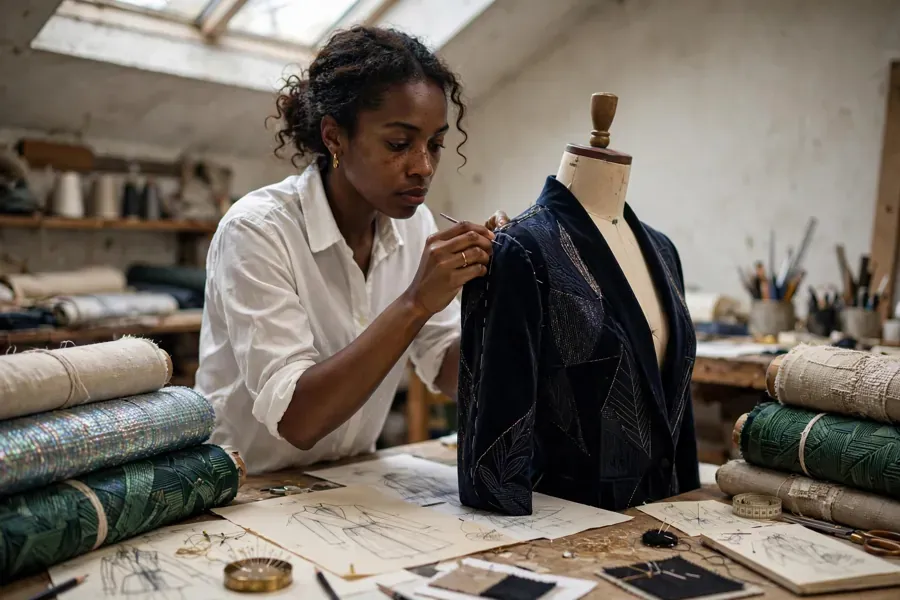
In our hero photograph, an evening coat turns on its stand under a skylight while sketches and swatches wait on the table — that table, that conversation, that coat that will exist exactly once, is the subject of this article. Couture for him is not a more expensive suit.
It is a different transaction entirely: you are no longer commissioning a tailor to perfect a known garment; you are commissioning a designer to invent one, with your name written in the house's ledger as the reason it exists.
First, the Words — Couture, Bespoke, Made-to-Order
Precision matters here, because the industry blurs its own vocabulary and the blur always favours the seller.
A couture reference draws the lines cleanly: bespoke means a garment is made specifically for an individual client, and a tailor or designer can offer bespoke clothing without being an accredited haute couture house — haute couture, by contrast, is a protected French designation, so a garment can be bespoke without being haute couture.
The same reference grounds the institution in history: the Fédération traces its origins to 1868, Charles Frederick Worth is regarded as a founding figure of the modern couture house, and the designation itself became legally controlled in France in 1945.
Below those two summits sits the broad, useful middle: a menswear authority sorting the vocabulary notes that custom, in its widest sense, simply means anything that is not ready-to-wear, and that it encompasses three levels — made-to-order, made-to-measure, and bespoke.
In made-to-order, the level this article inhabits, you choose the material, details and general sizing from a designer's existing design, and the garment is then made for you — the design is the house's; the piece is yours alone.
The pattern question separates the levels more sharply than any other.
A tailoring house's comparison table states it without decoration: made-to-measure adapts a base pattern to the individual wearer, while bespoke creates a new pattern — with bespoke running to three to five collaborative fittings, lead times of twelve weeks or more, and starting prices the house lists from $3,800 against $1,450 for made-to-measure.
Hold that table in mind, because the designer commission rearranges it: in couture-for-him, the pattern is new, the fittings are many, the timeline is long — but the creative authority runs the other way. Your tailor asks what you want and builds it perfectly. Your designer shows you what the house imagines and builds that, fitted to you.
Knowing which conversation you are entering is the difference between a commission and a confusion.
What Couture Buys That Bespoke Does Not
Three things, and a man should be able to name them before he spends on any of them. The first is silhouette. Bespoke tailoring perfects the architecture your body already suggests — shoulder, chest, drape — within the grammar of the suit.
A designer works in a different grammar entirely: proportion as authorship, a longer line, a sculptural shoulder, an evening coat cut like nothing in the tailoring canon because it answers to a collection, a season, a point of view. The second is cloth innovation.
Ateliers develop and reserve fabrics — experimental weaves, embroidered and engineered textiles, materials made for one design in one quantity — that no tailor's bunch book will ever carry, because they were never offered for sale as cloth.
The third is singularity with a record: a one-of-one garment, entered against your name in the house's books, fitted across multiple sittings, and finished by hand in the atelier that imagined it.
A great Savile Row house describes its own summit in terms that show how close the two worlds approach at the top: Huntsman's bespoke commissions start from £7,500 for a two-piece suit, unfold across a minimum of three fittings with access to the house's complete cloth library — and long after the final fitting, your cutter's name remains inside your jacket.
Couture-for-him takes that permanence and adds authorship: not only who made it, but who dreamed it — and the dream was dreamed for you.
Know also what couture does not buy. It does not buy a better business suit: for the boardroom, the tailor's perfected grammar beats the designer's invention every working day of the year.
It does not buy speed, and it does not buy anonymity — a one-of-one evening coat is a statement by design, which is why it pairs so naturally with the previous instalment's discipline: commission boldly for the nights that call for it, and keep the quiet flex for every other room.
The commission earns its place in a wardrobe the way a major painting earns its wall — rarely, deliberately, and for occasions the rest of the collection cannot cover: the gala where you are honoured, the wedding that is yours, the evening your family's history will be photographed. Men who commission well commission seldom.
Men who commission constantly are collecting applause, and the ateliers can tell the difference before the second fitting.
The Trunk Show — How the Atelier Comes to You
The working doorway into this world is the trunk show, and its mechanics are friendlier than its mystique suggests.
A retailer's own explanation of the format is disarmingly plain: exclusive products roll into the store for as little as two days or up to two weeks at most, anyone can attend with no obligation to buy, and if the garments are being made for you, the store takes your measurements and sends them to the design house; after a deposit, the clothes are ordered, and the in-house tailoring team handles any final minor alterations on arrival.
The same guide names the format's real prize: access to brands and styles most people will never know about, and the chance to get ahead of the season and the crowd — order at a pre-season show and your piece is being made while the collection is still a rumour.
At the bespoke end of the travelling trade, the rhythm stretches across seasons: one Savile Row house advises clients plainly that bespoke commissions require multiple fittings, which means suits are fitted across one or two trunk shows unless the client visits London between tours — order in spring, fit in autumn, wear the garment, then let the house check how it has settled on your body at the next visit.
That patience is not a defect of the system. It is the system.
The best modern trunk shows run as private appointments rather than open floors, and a London house's description of its own road programme shows the contemporary standard: each appointment is private and unhurried, typically an hour and often longer, with no obligation to commission; you arrive at a private suite, talk through how you live and dress, work through the season's cloth alongside the ready-to-wear collection, and the tailors take your measurements and establish a personal profile that holds your orders and informs those to come.
Fittings then follow at any future trunk show or at the house itself.
Prepare for that hour as you would for a tailor's first consultation, only more so: wear your best-fitting garment, bring the shoes the piece must live with, know your calendar for the year — the galas, the weddings, the photographed evenings — and be honest about which of the designer's ideas you love and which you merely admire.
A commission succeeds on candour. The atelier can fit a coat to your body in three sittings; it cannot fit one to a politeness.
The Designers — Black Authorship at the Top of the Craft
This magazine's reason for ending the Gentleman series here, rather than at the tailor's door, is that the summit of this craft now carries Black authorship in its own right — as inheritance, not novelty.
The lineage runs through Savile Row itself: Ozwald Boateng, born in London to Ghanaian parents, made history in 1995 when at 28 he became the youngest and first Black tailor to open a store on Savile Row, earning renown for a fresh take on classic menswear silhouettes that drew a younger, more diverse generation to Mayfair.
Boateng's own account of his method is the bridge between this article's two worlds: starting on a traditional base is always the key, he says — taking something traditional and finding a modern language in which to express it. That is exactly what a designer commission offers that pure tailoring does not: a language, authored, with a heritage inside it.
A generation on, the authorship has reached the oldest house of all: Hermès has named Grace Wales Bonner creative director of menswear, succeeding a 37-year tenure — a London designer whose label, founded in 2014, fuses tailoring and sportswear with cultural and spiritual enquiry, and who has said she wants her work to come from a Black cultural perspective considered at the same level as any European luxury house.
When a man of this magazine's world commissions a one-of-one piece today, he is not borrowing someone else's tradition. He is, increasingly, patronising his own — and arriving, as Black Tie, Built Properly taught, in rooms where that patronage is read at a glance.
“Starting on a traditional base is always the key for me. It's about taking something traditional and finding a modern language in which to express it.”— Ozwald Boateng, via Dezeen
Commission, then, the way this whole series has taught you to dress: in order. Master fit before fabric, fabric before flash; own the suit system, the shoes, the watch, the black tie. Then, when the wardrobe's foundations no longer need you, let one garment a year — or one a milestone — be authored rather than merely made.
Choose the house whose language you want to speak. Meet it at the trunk show, or travel to the atelier if the piece deserves the journey. Give the process its seasons.
And when the coat comes off its stand for the last time and onto your shoulders, you will understand what the ledger entry means: somewhere in that house's books, beside a sketch and a list of cloths, is your name — not as a size, but as the reason a beautiful thing exists.
That is couture for him, and it is the proper summit of dressing well.
Dress Like a Gentleman, Part II: Bespoke, Made-to-Measure, or Off the Rack
Dressing Well, Part VIII: The Quiet Flex
Black Excellence Profiles: Black Men
CoutureNotebook — “Haute Couture: Definition, Designers, Clients & Prices”
Gentleman's Gazette — “Myth Or Magic: Does 'Custom' Matter In Menswear?”
Larrimor's — “Everything You Ever Wanted To Know About A Trunk Show”
Thom Sweeney — “Trunk Shows: Bespoke & Made to Measure”
Huntsman — “Our Bespoke Services”
Dezeen — “Ozwald Boateng Redesigns the Chesterfield Sofa with Poltrona Frau”
Esquire Singapore — “What Grace Wales Bonner's Appointment Means for Hermès”
New & Lingwood — “Bespoke vs Made-to-Measure: What's the Difference?”
Questions & Answers
What makes a gentleman in the modern world?
Men's couture, made to order: the designer commission and the trunk show, explained — what a one-of-one atelier piece buys a man that even the finest bespoke suiting does not. It links to 4 stories and articles — open any card to read the full piece.
How should a gentleman dress and carry himself?
Men's couture, made to order: the designer commission and the trunk show, explained — what a one-of-one atelier piece buys a man that even the finest bespoke suiting does not.
How do I read the full stories on Couture for Him: The World of Men's Made-to-Order?
Choose any card on this page. Each one opens a full page of its own — the complete story or article, with its sources linked.