
Dressing Like a Lady, Part V: The Beauty Standard — Skin First, Makeup Second
The best skincare routine for melanin-rich skin is not the longest one in the room — it is the calmest: a facialist who knows your face, a handful of products used with restraint, and makeup that is asked to do very little because the skin has already done the work.
Look closely at the women who are photographed for a living and you will notice something the beauty counters rarely say out loud: their makeup is not doing the heavy lifting. The foundation is sheer because it can afford to be. The powder is a whisper because there is nothing to hide.
What you are actually admiring is the best skincare routine for melanin-rich skin, practised quietly and consistently — a facialist relationship maintained like a standing appointment with a trusted tailor, a routine edited down to what the skin genuinely needs, and a discipline of restraint that treats irritation as the enemy of elegance.
This is Part V of our Dress Like a Lady series, and it begins where every other part quietly ends: with the face itself. Part IV taught your hair to hold a signature; this part teaches your skin to carry a room before a single product touches it.
A note on how we will proceed, because this subject deserves honesty. Everything that follows is general information drawn from named dermatology and clinical sources — the guidance dermatologists publish for skin of colour generally, not advice about your skin specifically. Melanin-rich skin is glorious and it is also individual: what calms one face inflames another.
So read this the way you would read a master tailor's principles — as the standard against which to hold a conversation with a professional who knows your skin by sight and by history, ideally a board-certified dermatologist or licensed facialist experienced in skin of colour.
That relationship, more than any jar, is the beauty standard this article is really about.
Why Wealthy Skin Looks Like Skin
There is a particular quality to skin that is cared for at this level, and it is not perfection — it is evenness. No mask of coverage, no filtered blur; just tone that stays consistent from forehead to jaw, a surface that catches light the same way everywhere, and a calmness that reads as rest even on an ordinary Tuesday.
Dermatologists who specialise in deeper skin tones will tell you that evenness is harder won for melanin-rich skin than for almost any other, for one biological reason worth understanding plainly. When melanin-rich skin is inflamed or injured — a blemish, an ingrown hair, a bug bite, an over-enthusiastic scrub — it often answers by producing extra pigment in that spot.
The result, known clinically as post-inflammatory hyperpigmentation, is a mark that can linger for months after the original blemish is long gone, because deeper skin tones have more active melanocytes — the cells that create pigment — and their response tends to be stronger and longer-lasting.
New Beauty, reporting the Skin of Color Society's figures, puts the scale of it plainly: post-inflammatory hyperpigmentation is very common in skin of colour, with more than 65 percent of African Americans experiencing symptoms.
Hold that one fact and the whole philosophy of this article falls into place. If irritation becomes pigment, then the first rule of melanin-rich skincare is not intensity — it is gentleness. The aggressive routine, the ten-step shelf, the scrub that promises to polish marks away: each risks creating the very marks it claims to cure.
The women whose skin you admire have usually learned this, sometimes the expensive way, and their routines share a family resemblance precisely because they are built around it. Cleanse without stripping. Treat with one or two well-chosen actives, not five.
Moisturise like you mean it. Protect from the sun every single morning. And let a professional — not a product launch — set the pace of anything stronger.
That is not a minimalist fashion statement. It is melanin-aware strategy.
The Facialist Relationship
Every woman in this world has a person for her hair, a person for her tailoring, a person who knows which table she prefers. The facialist belongs on that list, and for the same reason: continuity.
A facialist who sees your face month after month reads it the way a good editor reads a manuscript — she notices the congestion that arrives with travel, the dryness that follows a change of climate, the faint mark forming where a blemish tried to settle, long before any of it becomes a problem you have to solve under deadline.
The appointment is maintenance, yes, but the real luxury is surveillance by someone who knows your normal.
The rhythm is not arbitrary. Dermatology practices that offer professional facials commonly settle on the same cadence: regular facials every four to six weeks, with the schedule adjusted to your skin type and goals after an initial evaluation.
That interval tracks the skin's own renewal cycle, and it gives the treatment its real functions: expert exfoliation that lifts dead cells without violence, deep cleansing home care cannot match, considered extractions performed by trained hands rather than bathroom-mirror impatience, and massage that encourages circulation and eases the puffiness a long flight or a longer week leaves behind.
Just as valuable is what a good facialist will not do — she will talk you out of the fashionable treatment your skin does not need this month, and she will tell you when a concern has crossed the line from cosmetic to medical and belongs in a dermatologist's chair instead.
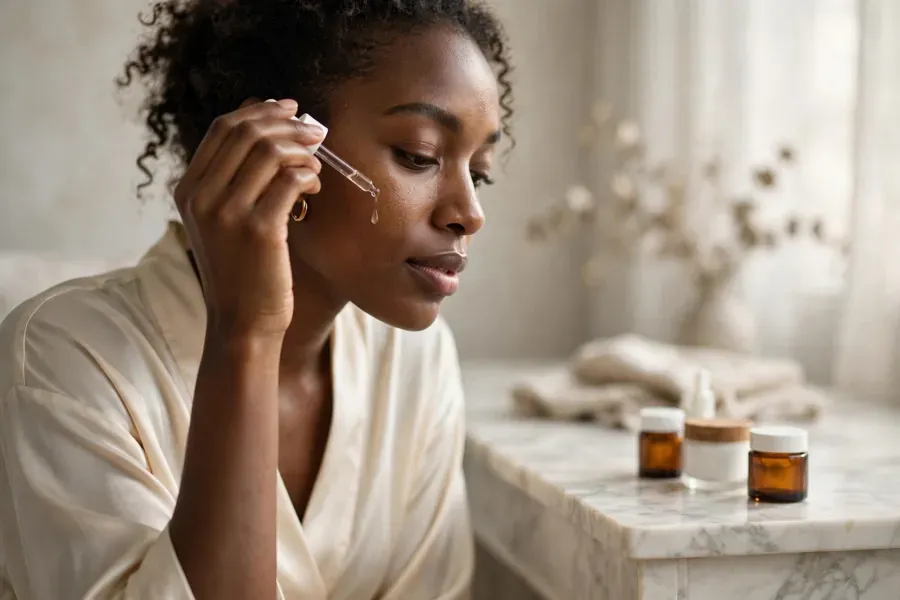
Choose this person the way you would choose any professional of consequence. Look for licensed hands with a documented practice in skin of colour — ask directly, and listen for fluency about hyperpigmentation, melasma, and sensitivity rather than a one-routine-fits-all answer.
Notice whether the first appointment begins with questions and a close look at your skin, or with a product pitch. And notice the room itself: calm, scrupulously clean, unhurried. The facialist relationship, like the one we described with the glam team in Part IV: Hair as Signature, is a standing arrangement between adults who respect each other's expertise.
You bring loyalty and honesty about what you have been putting on your face. She brings judgment. It is an excellent trade.
The Routine, Edited to Its Essentials
Between appointments, the home routine is where the standard is actually kept, and its architecture is refreshingly plain.
Dermatologist-guided routines for melanin-rich skin published by Exquisite Magazine begin exactly where you would hope: cleanse morning and evening with a cream, gel, or oil cleanser free of sulphates, because deeper skin tones tend to run drier at the surface, and a stripped barrier is the fastest route to irritation and, eventually, dark marks. Warm water, fingertips, no washcloth heroics.
The squeaky-clean feeling so many of us were raised to chase is, for this skin, a warning sign — it means the barrier has been robbed, and a robbed barrier lets everything else go wrong more easily.
Treatment comes next, and here restraint becomes a technique.
The same dermatologist guidance advises applying actives to clean, slightly damp skin before moisturiser — a vitamin C serum in the morning, a retinoid at night, with azelaic acid and niacinamide among the ingredients dermatologists reach for to fade dark marks, calm the skin, and even tone over time — and it carries the instruction this whole article could be summarised by: layer one or two actives at most, because melanin-rich skin reacts fastest when it is overwhelmed with too many strong ingredients at once.
Introduce one new active at a time, give it weeks rather than days to declare itself, and treat any routine that stings as information, not as proof that it is working.
Moisturise generously over the top — ceramides and humectants are the barrier's building materials — and remember that a simple routine performed daily will outperform a complicated one performed in bursts of guilt.
As one beginner-friendly dermatology guide concludes, you don't need a ten-step routine: a gentle cleanser, a targeted treatment, moisturiser, and sun protection, followed consistently, is the structure that healthy melanin-rich skin is actually built on.
Yes, people of color should wear sunscreen. Dermatologists recommend that people of color use sunscreen that has broad-spectrum protection, SPF 30 or greater, [and] water resistance.— American Academy of Dermatology, quoted in a peer-reviewed review of sunscreen access, via the linked source
That final morning step deserves its own emphasis, because it is the one most often skipped by women with deeper skin — sometimes from the old myth that melanin is protection enough, more often because older mineral formulas left an ashy cast no elegant woman would tolerate. Both obstacles have answers now.
The American Academy of Dermatology's standard is broad-spectrum, water-resistant sunscreen at SPF 30 or higher for people of colour, as the Academy's guidance is summarised in a peer-reviewed review of photoprotection in melanated skin — and tinted formulas containing iron oxides earn a special mention in the dermatology literature because they add protection against the visible light that can worsen hyperpigmentation, while blending into deeper tones without the grey cast.
Wear it daily, reapply it when you are genuinely outdoors, and understand what it is doing for you cosmetically as much as medically: every dark mark you are patiently fading with your evening actives is being quietly re-darkened by unprotected daylight. Sunscreen is not the last step of the routine.
In a real sense, it is the step that makes the other steps count.
Treatments to Approach With Care
Sooner or later, a woman maintaining her skin at this level will be offered the stronger instruments — lasers, intense pulsed light, deep peels — usually with a promise of speed. Some of these technologies, in expert hands, genuinely serve skin of colour.
But this is the section of the beauty conversation where the lady's restraint matters most, because the margin for error is thinner on melanin-rich skin and the consequences are written in pigment.
Dermatica's dermatologist guidance states the position with welcome bluntness: laser treatments can be safe for darker skin, but only with a practitioner familiar with working with dark skin who makes the necessary adjustments — and intense pulsed light, for instance, is not recommended for hair removal in brown and Black skin because of the high risk of hyperpigmentation.
The same guidance notes that pigment changes after laser treatment in skin of colour can, in some cases, be permanent — which is precisely why the safeguards exist.
Learn the safeguards and insist on every one. A consultation that assesses your skin type and history before any device is switched on.
A test spot in a discreet area, assessed after enough time has passed for delayed pigment changes to declare themselves — specialists in this field describe the test spot, plainly, as the single most informative safety step available.
Skin prepared in advance with a suitable topical regimen, as Washington dermatologist Tina Alster describes in New Beauty's reporting: skin should first be primed with agents such as topical vitamin C, retinol, or tranexamic acid to reduce baseline pigmentation, and any laser used should be low-energy and pursued with caution.
Conservative settings, a series of gentler sessions rather than one dramatic pass, and strict sun discipline before and after. A provider who welcomes these questions is showing you her standard. A provider who waves them away has also shown you hers.
The same caution, scaled down, applies to strong home peels and to any trend that arrives with more marketing than evidence: on melanin-rich skin, slow is not a compromise. Slow is the method.
Makeup Second — and Barely Needed
Now the makeup, which is where this standard pays its visible dividend. When the skin is even, calm, and hydrated, makeup stops being camouflage and becomes jewellery for the face — a decision about emphasis rather than concealment.
The base goes on sheer, placed where it is needed and blended past the jaw, the neck, the hairline, all the places daylight checks. Shade matching becomes an exercise in undertone rather than coverage.
And because there is less product on the face, there is less to fail over the course of a long evening — which is the first secret of makeup that survives a ballroom: start with less of it.
The second secret is setting, done as technique rather than habit. Professional long-wear guidance makes a distinction most home routines blur: translucent setting powder should be pressed gently into the skin — the press-and-roll technique, pressed firmly and rolled away rather than dusted — concentrating on the T-zone and under-eye area where creasing and shine begin.
Setting spray then does a different job than powder: it lays a flexible film over the whole face that holds the layers together, and many makeup artists apply it twice — once after the base, once at the very end — a double-setting habit borrowed from event work.
Eyes and lips, which show wear first, reward the same layering logic: liner set with shadow, lip colour lined, applied, blotted, and applied again. Touch-ups, when they come, stay surgical — blot the oil first rather than piling powder onto it, re-powder only where needed, refresh the lip. The goal at midnight is not a face that looks freshly painted.
It is a face that looks like it was never in danger.
Notice how the philosophy completes itself. Skin first means the routine is gentle, professional, and consistent. Makeup second means it is sheer, set with intention, and almost boring in its reliability.
Neither half works alone — the finest makeup artist in the world cannot make neglected skin look like cared-for skin under ballroom light, and the finest facialist cannot help a face buried nightly under heavy, unremoved product.
The ladies in our Women of Distinction profiles — the founders and executives whose faces carry their companies — tend to run both halves as one system, the same way the gentleman of our acquaintance runs his in The Grooming Standard: professional maintenance on a schedule, a small edited kit at home, and no drama anywhere in it.
That is the beauty standard. Not a face that looks expensive. A face that looks after itself — and lets everything you wear afterwards, beginning with the shoes and bags we take up in Part VI, sit on a foundation that was never really makeup at all.
Dressing Like a Lady, Part IV: Hair as Signature
The Grooming Standard
Women of Distinction — Profiles Collection
Exquisite Magazine — "The Ultimate Skincare Routine for Melanin-Rich Skin, According to Dermatologists"
Caribbean E Magazine — "Best Skincare Routine for Melanin-Rich Skin"
PubMed Central — "An Overlooked Risk for Skin Health: Sunscreen Availability and Cost for People With Melanated Skin" (American Academy of Dermatology guidance)
Dermatica — "Ask a Derm: Can I Get Laser Treatments if I Have Darker Skin?"
New Beauty — "These Are the Best Lasers for Post-Inflammatory Hyperpigmentation"
IYASA Beauty — "Fade Dark Spots on Melanin-Rich Skin Without Bleaching"
Balcones Dermatology & Aesthetics — "Benefits of Getting Regular Facials"
Beauty World News — "How to Build a Makeup Routine With Long Lasting Makeup Tips and Makeup Setting Tips That Hold"
Questions & Answers
How should a lady carry herself in public?
The best skincare routine for melanin-rich skin is not the longest one in the room — it is the calmest: a facialist who knows your face, a handful of products used with restraint, and makeup that is asked to do very little because the skin has already done the work. It links to 3 stories and articles — open any card to read the full piece.
What should a lady wear on the street?
The best skincare routine for melanin-rich skin is not the longest one in the room — it is the calmest: a facialist who knows your face, a handful of products used with restraint, and makeup that is asked to do very little because the skin has already done the work.
How do I read the full stories on Dressing Like a Lady, Part V: The Beauty Standard — Skin First, Makeup Second?
Choose any card on this page. Each one opens a full page of its own — the complete story or article, with its sources linked.