
Razor Bumps, Solved: The Treatment Guide for Black Skin
Razor bumps on Black skin — pseudofolliculitis barbae in the dermatology literature — are not a failure of grooming. They are a predictable meeting of curved hair and a close shave, and the clinical sources treat them that way: as a problem with causes, and therefore with answers.
Every gentleman knows the pattern. The shave looks immaculate at breakfast; by the weekend the jawline and neck carry small, tender bumps, some with a hair visibly trapped inside, and the marks linger long after the bumps settle.
The search for razor bumps treatment for Black skin usually begins in folklore — a grandfather's splash, a barbershop remedy, a product a friend swears by. This article leaves the folklore aside.
What follows is general information drawn from named clinical and dermatological sources — the American Academy of Dermatology, Cleveland Clinic, the MSD Manual, and dermatology journal guidance — reporting what the literature describes, what it says calms a flare, what it says addresses the cause, and where it draws the line and sends the reader to a doctor.
It is not personal medical advice, and it makes no promises for any product. It is a map, so the conversation with a dermatologist starts from knowledge instead of frustration.
What It Actually Is
The clinical name matters because it carries the explanation. Cleveland Clinic describes pseudofolliculitis barbae as a condition of the beard area in which sharply trimmed hairs turn back into the skin, and notes that it occurs more commonly in people with curly hair, particularly Black men.
The word pseudo does quiet work in that name: the bumps resemble infected follicles, but the trigger is the hair itself rather than a germ.
A blade cuts the hair, often at an angle and sometimes below the surface; hair that grows in a tight curl can arc back and pierce the skin beside the follicle, or curl inside the follicle before emerging. The body responds to that hair tip as it responds to a splinter — with inflammation.
The visible results, as the clinical sources list them, are redness, swelling, itching, small papules and sometimes pustules in the shaved area, and, over time, darker marks where the inflammation has been.
That mechanism explains the geography. Bumps track exactly where the razor went and spare skin that was not shaved — the beard, the front of the neck, and other shaved areas.
It also explains why the neck so often suffers most: hair there frequently grows in several directions at once, lying flatter against the skin, so a stroke that follows the grain on the cheek cuts across it on the neck. And it explains why the condition is nobody's hygiene failure.
The sources are consistent on the point: tightly coiled hair is simply more likely to re-enter the skin after cutting, and the closer the cut, the more likely the re-entry.
Three Things That Are Not the Same Thing
Part of solving the problem is naming it correctly, because three different conditions share the same bathroom mirror. Razor burn is the immediate sting and redness after a shave — surface irritation that settles.
Folliculitis, in Cleveland Clinic's account, is inflammation or infection of the follicle itself, with several forms; one severe form in the beard area involves the whole follicle becoming infected, and the Clinic's guidance for that picture is a dermatologist's care rather than home measures.
Pseudofolliculitis barbae sits between them: it looks like folliculitis, it can become secondarily infected, but its engine is mechanical — the hair — which is why the clinical literature keeps returning to hair removal method as the central variable.
Antibacterial products, the sources note, do little for a bump with no infection driving it; they enter the picture when a clinician judges that infection has joined the inflammation.
Razor bumps can create permanent changes to your skin when left untreated, like deep grooves and raised scars.— Dr. Rokhsar, via the American Academy of Dermatology
That sentence, carried in the American Academy of Dermatology's guidance on preventing razor bumps, is the honest reason this subject earns a full article rather than a grooming tip. The stakes are not vanity.
Repeated inflammation in the same ground is associated in the literature with post-inflammatory dark marks, thickened skin, and scarring — changes that outlast any single shave by years. The gentleman who treats razor bumps as a nuisance to be endured is, on the clinical account, accepting a slow accumulation.
The one who treats them as a condition to be managed is protecting the skin he will wear for decades.
What Only Calms, and What Addresses the Cause
The literature separates, with unusual clarity, between measures that soothe a flare and measures that interrupt the mechanism.
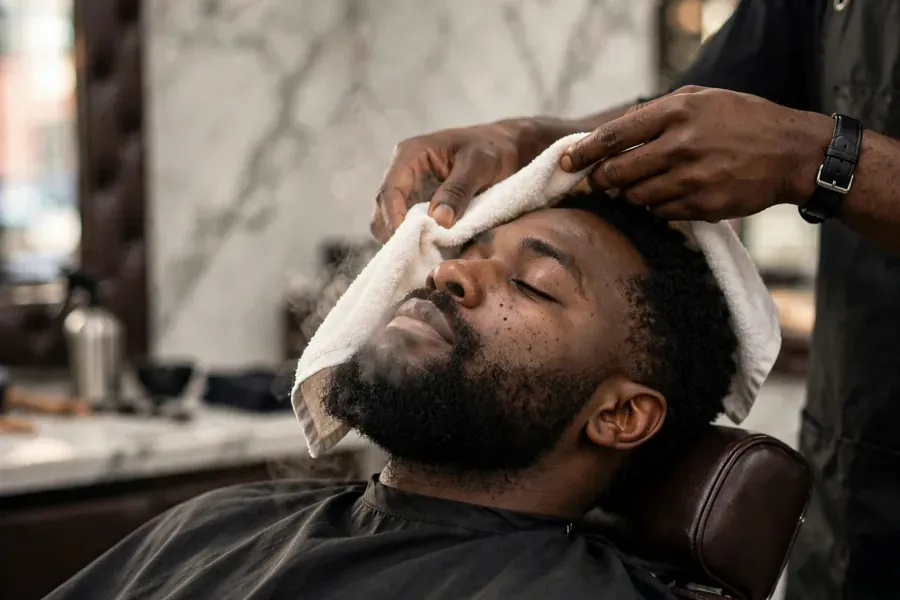
In the soothing column, the sources converge: warm compresses on acute bumps, a cool, damp cloth on freshly shaved skin — the Academy's routine holds a cool compress in place for five minutes — gentle handling, no picking, squeezing, or digging for trapped hairs, and a pause in shaving the affected area while it heals.
The MSD Manual's professional account lists cessation of shaving first among its treatments, with warm compresses and the careful release of embedded hair tips, and describes growing the hair out as the step that removes the trigger entirely: once hairs reach a certain length, they no longer curl back into the skin.
Dermatology guidance aimed at patients makes the same point warmly — for the man who wears a beard gladly, the beard is the simplest resolution the literature knows.
For the man whose work, taste, or uniform keeps the razor in his life, the literature turns to technique, and here the sources are remarkably united.
The Academy's guidance describes softening the hair first — shaving at the end of a shower, or holding a warm, damp washcloth to the area so hairs swell and are less likely to curve into the skin; washing beforehand with a cleanser that does not clog pores; using a moisturising shaving cream; shaving in the direction the hair grows; rinsing, finishing with the cool cloth, and replacing a disposable razor after five to seven shaves, with an electric razor cleaned on the same rhythm.
The Academy also describes mapping the grain — pulling the skin gently in the mirror to see the directions hair actually grows — and even training hair toward one direction with daily gentle brushing. On frequency, its guidance runs against instinct: shaving daily, or at least every two to three days, gives hair less time to grow and curve.
Other clinical summaries frame frequency more flexibly, and recent evidence reviews note that schedules differ between authorities; the shared ground is the avoidance of repeated close injury, not a single calendar for every face.
Technique details recur across sources with the force of a refrain: short, slow, single-pass strokes rather than repeated passes over the same ground; no stretching the skin taut to chase closeness; no pressing; shaving with the grain, particularly on the neck.
Several clinical sources describe the tools in the same terms — a single-blade razor, or clippers and electric trimmers set to leave a whisper of stubble, on the logic that hair cut at or below the surface is the hair most likely to re-enter it.
The dermatology guidance published for clinicians in MDedge describes clipping with a guard, electric razors, and thick shaving gel with a single or twin blade among the options clinicians discuss, and chemical depilatories appear in the same literature as an alternative some men use — with the standing caveat, repeated in the sources, that depilatories can irritate and are a matter of individual tolerance and clinician advice, not a universal answer.
The Product Classes, as the Literature Reports Them
Beyond technique, the clinical sources discuss several classes of topical preparation. They are reported here exactly as the literature reports them — as options clinicians weigh for particular presentations, some available over the counter and some by prescription — and not as recommendations for any reader.
Exfoliating acids appear frequently: salicylic acid and glycolic acid preparations are described in dermatology sources as helping to clear surface cells so hairs emerge more readily, and benzoyl peroxide appears in the literature both on its own and in combination preparations.
Topical retinoids — tretinoin in the MSD Manual's account, which notes such preparations may be effective in mild to moderate cases and may also irritate — are described as thinning the surface layer so hairs pass through more easily.
For inflammation itself, the Manual lists topical hydrocortisone for mild cases and topical or oral antibiotics where moderate to severe inflammation or secondary infection is present, with oral options named in its professional text; it also describes topical eflornithine, a prescription cream that slows hair growth, as a means of reducing how often shaving is needed.
The pattern in every source is the same: the choice among these classes, and their strength and duration, belongs to the examining clinician, because the right match depends on whether the picture is mild bumps, frequent pustules, infection, dark marks, or scarring.
When the Literature Reaches for the Laser
For persistent cases that technique and topicals do not settle, the sources describe one further avenue: reducing the hair itself.
Clinician guidance in MDedge describes laser hair removal as an option in the right candidate, particularly longer-pulsed lasers — the 1,064 nm Nd:YAG and 810 nm wavelengths are named — in darker-skinned individuals, and describes eflornithine used alongside laser in the studies it cites.
The MSD Manual likewise lists electrolysis and laser treatment among the routes by which follicles can be permanently removed, and notes chemical depilatories in the same discussion. The emphasis on wavelength and candidacy is itself the information: laser work on melanin-rich skin is a specialist's judgement, made after examination, with the device and settings chosen for that skin.
It belongs in a consultation room, with a practitioner experienced in skin of colour — never in a bargain hunt.
The Kit, Read Properly
The shelf in our photograph — a single-blade razor, a brush, amber bottles — earns its place not as a shopping list but as a portrait of the literature's logic. The single blade stands for the cut that leaves the hair at the surface rather than below it.
The brush and the warm water it works with stand for softening, the step the Academy places before any blade touches skin. The bottles stand for the two product ideas the sources actually discuss — gentle cleansing before, and soothing, fragrance-cautious care after; the Academy's guidance notes that an aftershave that burns or stings is one to stop using.
Nothing on that shelf is magic, and the sources claim magic for none of it. The kit works, in the literature's account, only as the equipment of a method.
When It Is a Doctor's Visit
The sources draw their lines plainly, and this article reports them without softening. Bumps that persist after shaving habits have genuinely changed are, in the Academy's words as carried in its guidance, a reason to see a board-certified dermatologist.
The clinical sources add their own markers: skin that is very painful, hot, or swollen; spreading redness; pustules that deepen; fever; bumps that scar, thicken, or leave expanding dark areas; and any picture that might be the infected, scarring form of folliculitis Cleveland Clinic describes.
Work rules enter the literature too — evidence reviews note that men whose employers require a clean shave and whose skin cannot sustain one are a recognised case for a dermatologist's documentation and advocacy. None of these are product problems, and the literature does not treat them as such.
Which returns the gentleman to the standing close of every health article in this magazine. Skin like ours deserves a specialist in it: a dermatologist who knows Black skin — its curl pattern, its pigment responses, its scarring tendencies — and who treats pseudofolliculitis barbae as the medical condition the literature says it is, rather than a cosmetic complaint.
Bring the map. Ask what is calming and what is causal in the proposed plan, what belongs on the shelf and what belongs in a prescription, and whether the practice has laser experience with darker skin if that road opens. The jawline in the mirror is not a small thing.
It is the first thing the room sees, and it deserves better than folklore.
The Grooming Standard
Alopecia in Black Men: The Honest Map
The Skin We're In
American Academy of Dermatology — "How to prevent razor bumps"
Cleveland Clinic — "Folliculitis: Appearance, Causes, Symptoms & Treatment"
MSD Manual Professional Edition — "Pseudofolliculitis Barbae"
MDedge — "Pseudofolliculitis barbae – tips for patients"
MedEvidence — "Ingrown Hairs and Razor Bumps: Why Do Bumps Appear After Shaving — and How Can You Prevent Them?"
Questions & Answers
What makes a gentleman in the modern world?
Razor bumps on Black skin — pseudofolliculitis barbae in the dermatology literature — are not a failure of grooming. They are a predictable meeting of curved hair and a close shave, and the clinical sources treat them that way: as a problem with causes, and therefore with answers. It links to 4 stories and articles — open any card to read the full piece.
How should a gentleman dress and carry himself?
Razor bumps on Black skin — pseudofolliculitis barbae in the dermatology literature — are not a failure of grooming. They are a predictable meeting of curved hair and a close shave, and the clinical sources treat them that way: as a problem with causes, and therefore with answers.
How do I read the full stories on Razor Bumps, Solved: The Treatment Guide for Black Skin?
Choose any card on this page. Each one opens a full page of its own — the complete story or article, with its sources linked.