
Dressing Well, Part VII: Summer Weight, Winter Bones — Dressing the Season You're In
How to build a seasonal wardrobe — men, linen, flannel and everything between — comes down to one discipline: dress the season you are actually in, in cloth weighted for it, in the city you are actually standing in.
Ask a well-dressed man how to build a seasonal wardrobe — men, linen, flannel, tropical wool and all — and he will not talk about shopping. He will talk about rotation.
Somewhere in his house there are two rails, or two closets, or two homes, and twice a year the wardrobe changes over the way a good household changes its linens: the cream linen comes forward, the charcoal flannel goes back, and nothing he owns is ever asked to perform in weather it was not built for.
That is the whole secret this instalment exists to teach. A wardrobe is not a pile of good clothes; it is a system organised by season and city, in which every garment has a climate it belongs to, a weight that suits it, and a place it lives when its season ends.
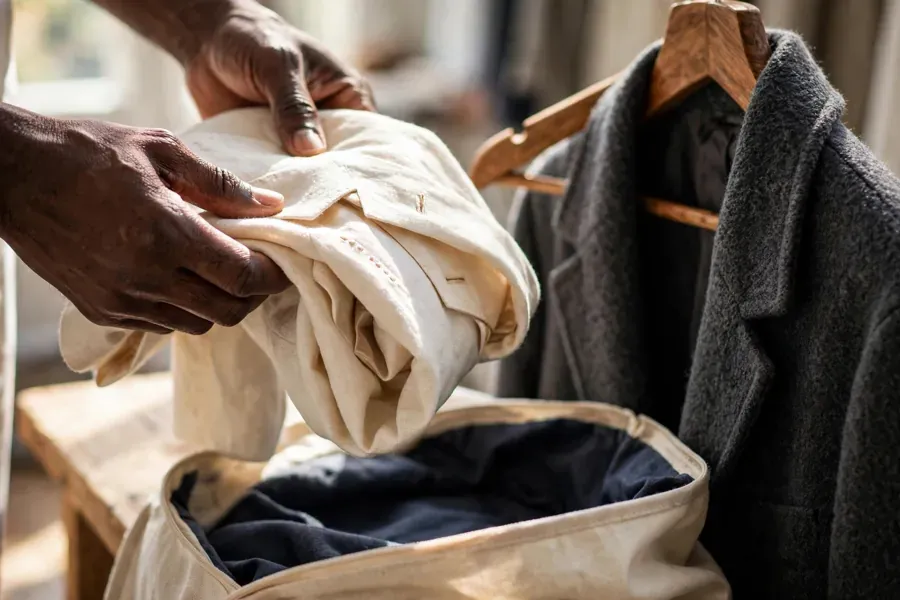
Build the system once — by fabric weight, by weave, by address — and dressing well stops being a daily act of improvisation and becomes what it is for the men in our hero photograph above: a calm, twice-yearly packing of a garment bag, done in sunlight, without a moment's doubt about what goes in it.
First, Learn to Read a Cloth by Weight
Every decision in this article descends from a single number: the weight of the cloth, measured in ounces per square yard. Learn the scale and you can commission, buy and pack with a tailor's confidence.
A New York custom house lays the scale out plainly: fabric weight determines the drape and seasonality of a suit — lighter fabrics of 6 to 9 ounces are ideal for summer, while heavier weights of 10 to 13 ounces suit colder months.
A clothier's seasonal guide fills in the winter end: an ideal fabric weight for autumn temperatures is 12 ounces, while 16 ounces works well for the colder winter days, and the same guide offers the honest compromise for a man building on a budget — a mid-weight wool that works across the year with layers added and removed.
Hold those three bands in mind — roughly 7 to 9 ounces for summer, 10 to 13 for the middle of the year, 14 and above for true cold — and the rest of seasonal dressing is commentary.
Weight is only half the reading, though. The other half is weave. A cloth's weave dictates its texture, breathability and sheen: twill and worsted weaves are smooth and formal, while looser, more open weaves let air move through the garment.
This is why two suits of identical weight can wear ten degrees apart — the open-weave 8-ounce cloth breathes like a screen door, while the tight twill at the same weight holds its heat. When you stand at a tailor's bunch book, then, you are reading two numbers at once: how heavy, and how open. Summer wants light and open.
Winter wants heavy and closed. The shoulder seasons — the months this series' readers actually travel through — want the middle weights in the middle weaves, which is why the year-round wardrobe is built in layers rather than in absolutes, a point we will return to when we talk about cities.
Summer Weight — Linen That Earns Its Wrinkles, Wool That Breathes
Linen is the summer cloth of record, and it deserves both its crown and its caveat.
Woven from flax, it is the most breathable suiting a man can wear: a clothier's guide to spring suiting calls it the most honest of warm-weather fabrics, one that makes no attempt to behave like something it is not — linen wrinkles, and when it does, it looks exactly right in the way that only linen can — there is a particular ease to a well-cut linen suit that no other cloth quite captures.
The linen suit weight scale runs from about 8 to 9 ounces for warm-weather and beach dressing up to 10 or 11 ounces for general summer office wear, where the extra body buys structure and better shape retention through a long day.
Pure linen, then, is for the man who has made peace with the crease — and in the right rooms, the crease is not a flaw at all but a signature: it says the cloth is real, the day is warm, and the wearer is unbothered.
What linen will never be is a boardroom suit at full formality, and a seasonal wardrobe respects that boundary instead of fighting it.
For the days when formality is non-negotiable and the temperature is not cooperating, summer's second cloth is tropical wool — and it surprises every man who meets it properly.
These are tightly woven, very lightweight wools, often in the 7 to 8 ounce range, designed specifically for heat and humidity; the tight weave gives them a smooth surface and a degree of structure looser weaves cannot match, and they breathe exceptionally well, press cleanly, and recover from a long day in a way that recommends them strongly for summer travel and warmer climates.
A menswear layering guide makes the same point from the other direction: you can wear wool in the summer — keep it under 8 ounces in weight and it will be more breathable and cooler than most other fabrics, with seersucker, poplin cotton, madras and chambray completing the warm-weather bench.
The practical summer rail, then, builds like this: linen for ease and daylight, tropical wool and fresco for polish and evening, seersucker and cotton for the weekend — and every jacket half-lined or unlined, because the finest summer cloth in the world cannot breathe through a full lining.
That construction detail matters as much as the cloth: ask for it by name when you commission.
Winter Bones — Flannel, Structure, and the Layering Order
Winter dressing is summer dressing inverted: where summer strips a garment down, winter builds it up — and the bones of the winter wardrobe are flannel, heavier worsteds, and the overcoat that crowns them.
The tailoring guides are consistent on the seasonal exchange: when cooler temperatures settle in, you stow away the lightweight cotton, linen and mohair and opt instead for wool and flannel, which provide the best insulation when the temperature drops and also resist creasing and wrinkling. Flannel earns its place on three counts.
Its brushed surface traps air and therefore warmth without demanding great thickness. Its matte, soft finish reads as richness rather than shine — the winter equivalent of linen's honest texture. And it drapes with a weight that flatters, holding a trouser crease and a jacket line through a long northern day.
Build the winter rail around charcoal and navy flannel suits in the 12 to 14 ounce band, a heavier overcoat above them, and knitwear that can move between them.
Layering, done properly, obeys a simple architecture: the pieces get thicker and heavier as you progress outward — the lighter cloth sits against the skin, where it can breathe, and the heaviest cloth faces the weather, where it can shield. Reverse the order and you cook inside your own coat while looking oddly thin-armed in photographs.
The capsule-wardrobe literature agrees on the winter bench itself: a wool overcoat, rollneck and merino sweaters, flannel trousers, leather boots and a structured bag — texture layered on texture, in tones that deepen as the light fails. One more winter discipline: respect the rest.
Heavy cloth worn daily without rotation breaks down at the seat and the elbow faster than summer cloth ever does, because the fibres are working harder.
Two flannel suits worn in alternation will outlast three worn in sequence — the first principle of our series, that the suit is a system, applies with double force in winter, when the system includes the coat, the boots and the knitwear as load-bearing members.
The Two-City Logic — Vineyard Summers, Manhattan Winters
Now the part of seasonal dressing that belongs specifically to this magazine's readers: the wardrobe that lives in more than one place. The man with a house in the city and a house where summer happens does not have one wardrobe with a suitcase problem; he has two wardrobes with a shared spine.
The spine — the pieces that travel — is small: the tropical wool suit that works in both places, the loafers, the watch, the garment bag itself. The rails at each address hold what belongs to that address's climate and calendar, and they stay there.
A Vineyard packing guide describes the summer-house end of the arrangement exactly: the island's wardrobe is versatile rather than vast — clothes that move easily from sightseeing to lunch to dinner, linen trousers in neutral colours, cotton and linen shirts, and, because evenings near the water cool even in high summer, a lightweight sweater in cashmere or merino and a blazer, with a linen blazer particularly well-suited to the climate.
That sweater is the two-city man's emblematic garment: at the summer house it is not an extra, it is the difference between staying on the porch and going in.
The city end of the system runs on the opposite logic — depth over versatility, structure over ease — and the bridge between the two is the changeover ritual itself.
Wardrobe writers make the same structural point from the foundation up: timeless wardrobes adapt to seasonal changes through fabric weights and colour adjustments rather than complete overhauls — seasonal additions integrate with the existing foundation, so linen shirts coordinate with existing blazers while wool sweaters layer with dress shirts.
Read that carefully, because it is the economics of the whole instalment: you are not buying two wardrobes, you are buying one foundation — the navy, charcoal and cream spine — and two seasonal skins that plug into it.
The summer house itself has its own season and its own social mathematics, which our travel desk takes up in The Summer House Season: the wardrobe logic here is the cloth-side of that same coin.
And for the men whose standing is recorded in our Black Men profile collection, notice how consistently the photographs tell this story — linen where the light is warm, flannel where the business is serious, never the reverse.
Storage — The Half of the Wardrobe Nobody Photographs
A seasonal wardrobe is only as good as its off-season, and storage is where expensive cloth goes to be quietly ruined or quietly preserved. The menswear storage guides converge on a short, non-negotiable protocol.
Clean everything before it goes away — always clean a suit before storing it for a season, to prevent stains setting and fabric damage — and let it dry completely. Store it in a cool, dark place, away from direct sunlight, which fades and weakens cloth.
Keep an inventory as you pack: a stored-wardrobe list noting each piece and its condition is what stands between a system and the out-of-sight, out-of-mind dilemma every large wardrobe eventually meets.
Hang what should hang — suits, trousers and coats on proper hangers, protected in breathable garment bags that keep dust off while sealing out moisture and pests — and fold what should fold, knitwear above all, since hanging sweaters for months stretches and misshapes them.
The seasonal changeover guide adds the natural defences: use cedar or lavender to keep stored clothing fresh and deter pests, and store in a dry place — never the musty basement — with delicate pieces in breathable bags over acid-free tissue.
Treat the changeover as an audit, not a chore, and it pays you twice.
Coming out of storage, every garment gets inspected, aired, steamed and tried against the mirror before it rejoins the rail; going in, every garment gets cleaned, repaired if it needs it, and honestly assessed — the piece you did not wear all season is telling you something, and a wardrobe that listens stays lean.
This is also the moment the travelling spine gets serviced: shoes resoled before the season that will test them, the garment bag's zips checked, the summer house's rail confirmed against the inventory before you fly rather than after you land.
Do this twice a year, in good light, without hurry, and the two rails in our opening photograph stop being an aspiration. They become simply how your house is run — summer weight in front when the year is warm, winter bones holding the structure when it is not, and you dressed, always, for the season you are in.
Dress Like a Gentleman, Part I: The Suit Is a System
The Summer House Season
Black Excellence Profiles: Black Men
FashionBeans — “Men's Fashion Basics – Layering & Fabric Basics”
Samuel Baron Clothiers — “The Art of the Spring Suit: Fabric, Weight, and Why It Matters”
Klein Epstein Parker — “How to Choose the Perfect Fabric for Your Custom Suit in New York”
Embassy Cleaners — “Fall and Winter Tailored Fashion for Men”
Percival Menswear — “How To Properly Store Seasonal Clothing”
Curious Expeditions — “What Do You Wear in Martha's Vineyard?”
Wessi — “Wardrobe Basics: Building a Timeless Men's Closet”
Questions & Answers
What makes a gentleman in the modern world?
How to build a seasonal wardrobe — men, linen, flannel and everything between — comes down to one discipline: dress the season you are actually in, in cloth weighted for it, in the city you are actually standing in. It links to 3 stories and articles — open any card to read the full piece.
How should a gentleman dress and carry himself?
How to build a seasonal wardrobe — men, linen, flannel and everything between — comes down to one discipline: dress the season you are actually in, in cloth weighted for it, in the city you are actually standing in.
How do I read the full stories on Dressing Well, Part VII: Summer Weight, Winter Bones — Dressing the Season You're In?
Choose any card on this page. Each one opens a full page of its own — the complete story or article, with its sources linked.