The Styles, Now and Forever: Classic Black Hairstyles — a History of Iconic Looks, from Braids to the Bob and the Pixie
Classic Black hairstyles are a living canon: a history of iconic looks — braids older than empires, the bob that never left, the pixie that keeps returning — each classic carried by named women, each one worn beautifully now.
Ask a room of our readers to name the styles and the roll call starts before the question finishes: the press, the bob, braids in all their dynasties, the pixie, the silk press, locs, the updo that has closed a thousand evenings. Classic Black hairstyles are not a nostalgia act.
Their history is a record of iconic looks invented, carried, and handed down — braids with roots thousands of years deep, a press perfected at a kitchen stove and industrialised by a genius, cuts that defined whole decades and then simply refused to leave.
This is the roll call, with its history attached: where each style came from, who carried it, and how the classic is worn now. The care that keeps every one of them possible lives in our companion, Black Hair for Women: The Care Beneath the Style, and the craft of keeping a signature lives in Hair as Signature.
Here, we celebrate the canon itself.
Braids: The Oldest Dynasty
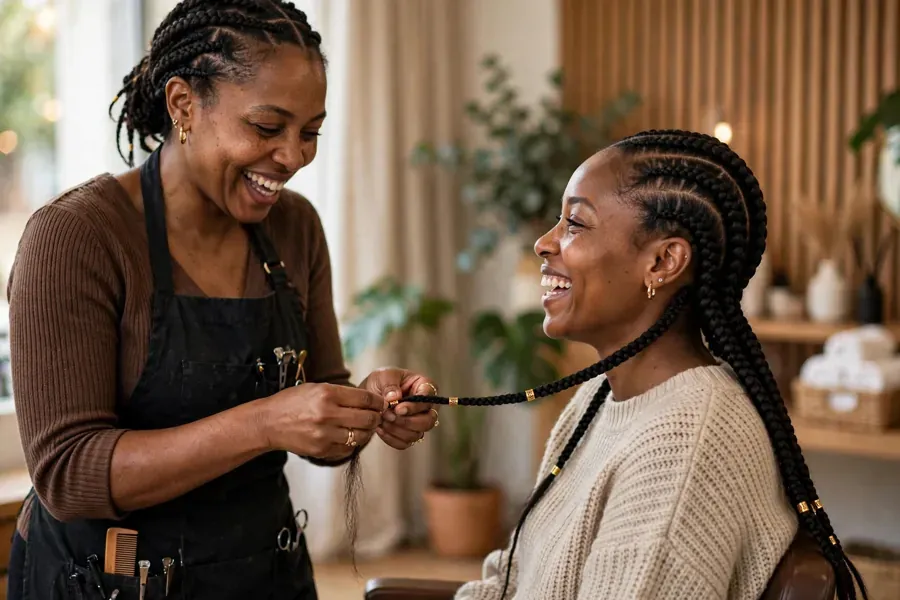
Begin where the record begins. Word In Black's history of Black hair's evolutions traces braiding back some five thousand years, with cornrow variations arising along Africa's Horn and western coasts around 3000 B.C. — styles that were never merely decoration, carrying identity, status, and artistry in their patterns, and surviving the Middle Passage as a kept language.
Joico's celebration of iconic Black-hair looks makes the same sweep in a single line of descent — cornrows to Bantu knots, box braids to flat twists, adorned across the centuries with shells, beads, and feathers, as popular in present-day America as in early Egypt.
Every era since has added a chapter rather than replacing the book: the Fulani pattern with its centre braid and ornaments, carried in the modern era by Alicia Keys and Beyoncé; the box braids a generation claimed as its own when Brandy wore them everywhere; the micro-braided pick-and-drop and feather braids of the early two-thousands.
Worn now, the dynasty is in a golden age of craft.
Luxe Digital's working guide to braids explains the modern booking vocabulary with a braider's precision: box braids begin with a small knot where the added hair enters, while knotless braids feed the hair in gradually so the base lies flat — a gentler beginning our care companion recommends — and the style's own naming moment came in the nineteen-nineties, after Janet Jackson wore box braids in Poetic Justice.
Its companion survey of current styles adds the season's signatures: French curl braids that open into loose curls for their last stretch, and the classic Fulani pattern of flat cornrows in front with loose braids behind.
The braided bob deserves its own sentence: cut to just above the shoulders, it carries less weight on the edges, installs faster than long braids, and reads as polished as any cut in this piece — the dynasty, tailored.
However they are worn, the house rules from our care piece travel with them: loose at the root, rested between installs, and out on schedule.
The Press: From the Hot Comb to the Silk Press
The second dynasty is heat, skilfully applied.
The history of afro-textured hair in America credits the hot comb to the eighteen-seventies and follows what happened next: Madam C. J. Walker built a hair-care line and a company of trained agents around healthier hair and the pressing comb, became the era's celebrated self-made millionaire, and made the press-and-curl legendary — the full story of her empire is told in our history pages at Madam C. J. Walker.
Walker's own framing of her work is the one worth keeping, because it was about health before it was about straightness, as her biographical record preserves it:
I have always held myself out as a hair culturist. I grow hair.— Madam C. J. Walker, via the linked source
The press-and-curl became Sunday best for generations — glossy, bouncy hair achieved with hot combs and marcel irons, as Flawless Hair's survey of nineteen-nineties styles that still hold recalls — and its modern heir, the silk press, keeps the promise with better manners: no chemicals, deep conditioning first, heat protectant always, and the curl pattern waiting intact for wash day.
The bumped ends that closed so many awards-show looks in the two-thousands — Gabrielle Union's among the reference points, with Rihanna, Normani, and Keke Palmer carrying the finish forward — are the press's evening dress, as the era surveys note.
Worn now, the silk press is the canon's most versatile member: boardroom-sleek in the week, silk-wrapped at night, and retired on schedule so the hair beneath it stays the hair Walker would have insisted on — grown, and healthy.
The Bob and the Pixie: The Cuts That Define Decades
If braids are the oldest dynasty and the press the most industrious, the cuts are the canon's punctuation — short sentences that end arguments.
The nineteen-nineties belonged, in large part, to the pixie and the flipped bob: FunTimes Magazine's decade-by-decade survey remembers Toni Braxton's super-chic pixie alongside the era's braids, silk presses, swooped bangs, and flipped bobs — versatility as the decade's whole thesis.
The pixie's defining face was Halle Berry's: closely cropped, all cheekbone and confidence, the cut that the vintage surveys credit with defining short-hair ambition for a generation, with modern versions playing texture and asymmetry against the original's clean lines. The bob, meanwhile, simply never left — it changed lengths and tempers.
Rihanna's asymmetrical bob became the must-have cut of the mid-two-thousands, sharp enough that the era's retrospectives treat it as inseparable from the music it arrived with.
And the bob's softer descendants — the layered pixie bob, shorter at the back and longer around the face — are what salons report clients trading their classic bobs for now, precisely because the shape grows out gracefully and asks less of the flat iron.
Worn now, both cuts reward the same virtues: precision and upkeep. A pixie is architecture — it lives or dies on the cut's geometry and on line-up appointments kept like clockwork, the barbering standard our culture pages celebrate in The Great Black Barbers.
A bob is a frame — chin-length to collarbone, blunt or layered, pressed silk or braided — and its modern genius is range: the same woman can wear it as a silk press in one season and a box-braid bob in the next, and both are the classic, correctly quoted.
Choose the version your hair's health and your calendar can keep immaculate; an impeccable shorter cut will always out-dress a longer one maintained in theory.
Locs, the Afro, and the Updo Canon
Three more members complete the roll call, each carrying a philosophy.
Locs: Word In Black's history describes strands formed into ropes by twisting or by allowing the hair to mat naturally, and traces the style's modern prominence through the Rastafari movement that arose in Jamaica in the nineteen-thirties and the reggae era that carried it worldwide — a style long understood by its wearers as devotion and patience made visible.
The two-thousands saw locs and twists rise again in the mainstream, and worn now — sisterlocks, traditional locs, locs dressed with cuffs and colour — they are the canon's long game: length retained over years, manipulation kept low, a presence that is unmistakably one's own.
The Afro stands opposite in method and equal in meaning: hair grown up and out in its own architecture, which Joico's celebration calls the ultimate symbol of natural hair — seen at every length, shape, and texture, a tribute to embracing what makes the wearer flourish.
Its descendants fill today's salons: the tapered cut, the teeny-weeny Afro with its shaved part, the twist-out and the wash-and-go — the natural canon, tailored.
And the updo — the canon's evening register. It has no single inventor because it belongs to occasion itself: the chignon and the French roll of formal decades, the braided crown, the high bun, the sculpted styles that carry a gown.
Cinema kept the archive: the hair moments that taught generations what elegance looked like on screen are gathered in our Black Cinema Across the Eras, and the updo's grammar survives intact in them — hair lifted so the neck, the earrings, and the dress can speak.
Worn now, the updo is where the dynasties meet: braids swept into a crown, locs coiled into a chignon, a pressed ponytail wrapped to architecture. It asks the most of a stylist and returns the most in a photograph, which is why, a century in, no gala has managed to replace it.
Choosing Your Classic
A canon is only useful if it helps a woman choose, so here is the choosing, honestly done. Start with the hair you have and the life you actually lead, in that order.
The press and the bob ask for a stylist within regular reach and a tolerance for wraps, rollers, and weather planning; they repay it with the most polished silhouette in the canon.
Braids ask for one long, well-chosen appointment and weeks of low daily effort; they repay it with rest for your own hair — provided the install is loose, the parts are sized to your hair's strength, and the takedown date is honoured.
The pixie asks the least product and the most precision, and repays it with a face entirely in charge of the room. Locs ask for patience measured in seasons and repay it for years.
The Afro and its natural descendants ask for moisture discipline and a cut shaped to your own curl pattern, and repay it with the one silhouette no one else in the room can borrow.
Then let the mirror arbitrate the rest. The right classic is the one whose maintenance you will genuinely keep — because every style in this piece fails in exactly the same way, by being worn past its appointment, and succeeds in exactly the same way, by being kept.
Bring your stylist a photograph of the classic as it was worn in its era and one of it worn now, and let the two of you translate between them: that conversation, reference in hand, is how a heritage style becomes a personal signature rather than a costume.
The women whose looks fill the history above were not copying a canon. They were choosing from it — and then wearing the choice so consistently that the canon grew to include them.
Now and Forever, Stated Plainly
Notice what the roll call proves. None of these styles is a trend that happened to survive; each is a technology — for protection, for polish, for devotion, for occasion — perfected by generations of women and the stylists, barbers, and hair culturists who served them.
The classics return because they work, and they work now in their best-ever materials: knotless beginnings kinder to edges, heat protectants Walker could only dream of, braiding hair and units of a quality earlier decades never had.
Wear the canon with its history on — a Fulani pattern placed knowingly, a press kept to Walker's health-first standard, a pixie cut with a master's precision. That is what now and forever actually means: not that the styles never change, but that they are never finished being ours. Choose yours, keep it immaculately, and pass it on.
Black Hair for Women: The Care Beneath the Style
Hair as Signature: The Silk Press, Protective Styles, and the Glam Team Question
Madam C. J. Walker
Women of Distinction — The Profiles Collection
FunTimes Magazine — "From Afro To Braids: The Biggest Black Hair Trends From the '70s To Now"
Flawless Hair — "15 Vintage '90s Hairstyles For Black Women That Still Slay Today"
Word In Black — "Top 5 Evolutions of Black Hair"
WJXT — "From Hot Combs to Hair Grease: The Journey Behind Afro-Textured Hair in America"
ShunSalon — "Black Hair Perm: A Black Woman's Invention?" (Madam C. J. Walker biography and quotations)
Luxe Digital — "Hairstyles for Black Women: 20 Styles"
Luxe Digital — "Braids for Black Women: 24 Styles and Types"
Joico — "The Enduring Celebration of Iconic Black-Hair Looks"
Questions & Answers
How should a lady carry herself in public?
Classic Black hairstyles are a living canon: a history of iconic looks — braids older than empires, the bob that never left, the pixie that keeps returning — each classic carried by named women, each one worn beautifully now. It links to 6 stories and articles — open any card to read the full piece.
What should a lady wear on the street?
Classic Black hairstyles are a living canon: a history of iconic looks — braids older than empires, the bob that never left, the pixie that keeps returning — each classic carried by named women, each one worn beautifully now.
How do I read the full stories on The Styles, Now and Forever: Classic Black Hairstyles — a History of Iconic Looks, from…?
Choose any card on this page. Each one opens a full page of its own — the complete story or article, with its sources linked.