
Madam C.J. Walker: The First Self-Made Female Millionaire, Built From the Washtub Up
Madam C.J. Walker, the first self-made female millionaire in America's documented record — born Sarah Breedlove, a washerwoman's daughter who built a hair-care empire, trained an army of agents, built Villa Lewaro, and gave like a founder-philanthropist. Her claim is handled here exactly as historians support it.
If you want to understand what this magazine means by inheritance, stand for a moment in the doorway of Madam C.J. Walker's story.
The first self-made female millionaire in America's documented record began life as Sarah Breedlove, born on December 23, 1867, near Delta, Louisiana — the first child in her family born free, to parents who had been enslaved on a Madison Parish plantation. She was orphaned at seven.
She married at fourteen, in part to escape a harsh household, and was widowed at twenty with a small daughter, Lelia, to raise alone. For years she worked as a laundress and cook in St. Louis for about a dollar and a half a day.
That is the whole of the starting capital the legend is built on: a washtub, a daughter, and a refusal.
Everything after it — the factory, the agents, the mansion, the philanthropy — she built herself, and the building is documented well enough that we can tell it the way historians tell it, with the famous claim examined rather than merely repeated.
The Louisiana encyclopedia 64 Parishes tells her early life in the same plain sequence: the Delta birth, the parents lost by age seven, the move to a sister's home in Vicksburg, the marriage at fourteen, widowhood, and the removal to St. Louis, where her brothers worked as barbers and where she joined the African Methodist Episcopal Church and fell in with an ambitious, self-improving circle of Black St. Louis.
It matters that the record starts this low. Walker's story is often polished into a fable, but the documented version is better than the fable, because nothing in it was given and everything in it can be checked.
The Problem She Solved First
Walker's empire began, as the best businesses do, with a problem she had herself. Like many Black women of her time, she suffered from a scalp condition and severe hair loss — worsened by harsh products, infrequent washing, and the simple fact that mainstream brands did not make anything for Black women's hair at all.
She experimented with home remedies, worked for a time as a sales agent for hair-care entrepreneur Annie Turnbo Malone, and learned the trade from the inside: the formulas, the door-to-door method, and the size of the unmet need.
In 1905 she moved to Denver and began selling her own first product, Madam Walker's Wonderful Hair Grower, aimed squarely at the customers the big brands overlooked.
She soon married Charles Joseph Walker, a newspaper advertising man, and took the name that would go on the tins: Madam C.J. Walker — a version, as the record notes, of "Mrs. Charles Joseph Walker."
What she sold was never just a pomade. The National Hair & Beauty Federation's account describes the breakthrough as the "Walker System" — a regimen of scalp care, shampooing, preparation and styling, taught to the customer along with the product.
She did not invent the hot comb, as the Jim Crow Museum's scholarly account is careful to note; she improved a version of it, with wider-spaced teeth suited to Black hair, and made it one step in a system of care rather than the whole idea.
The distinction is the business in miniature: Walker was selling health, dignity and instruction, in a tin, delivered by women who looked like their customers and could teach as they sold. She said it in her own grammar, in the most quoted passage of her life, carried in full in Storyboard That's Walker biography:
I am a woman who came from the cotton fields of the South. From there I got promoted to the washtub. From there I was promoted to the cook kitchen. And from there I promoted myself into the business of manufacturing hair goods and preparations. I have built my own factory on my own ground.— Madam C.J. Walker, via Storyboard That
Notice the verb she chooses for the last step. Nobody promoted her into manufacturing. She promoted herself.
It is the whole philosophy of the company in one sentence, and she built the company to run on it — not for her alone, but for thousands of women behind her.
The Army of Agents
The growth, once it started, was systematic. Pittsburgh came in 1908, with the company's first beauty school, Lelia College, named for her daughter. In 1910 Walker moved the operation to Indianapolis — then a great rail and manufacturing hub — and built the headquarters and factory of the Madam C.J. Walker Manufacturing Company there.
By 1917, the Jim Crow Museum's account records, she had the largest business in the country owned by an African American. Her 1917 convention in Philadelphia, gathering her sales force, is described in Parade's recent account as among the first national meetings of businesswomen in the country.
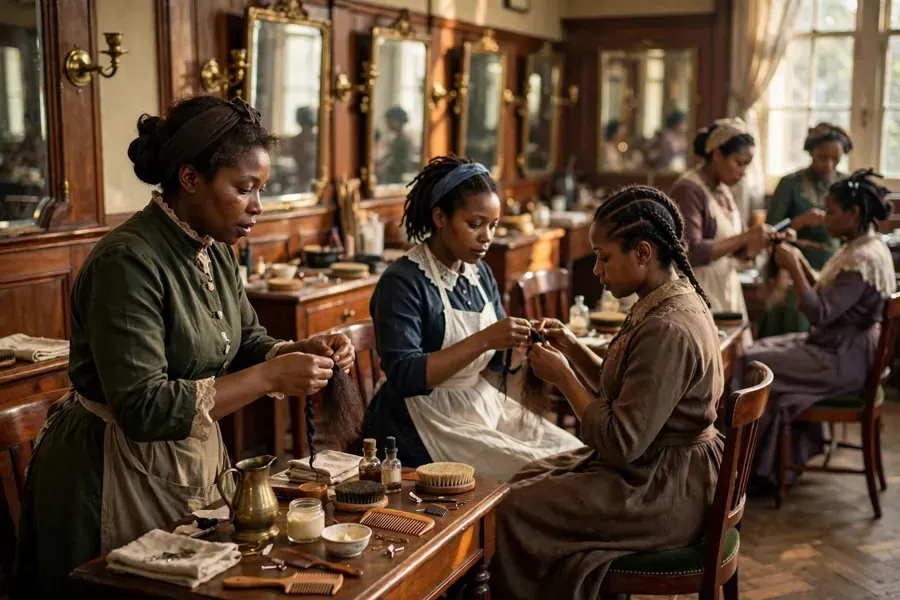
And the sales force itself is the statistic every telling returns to: thousands upon thousands of "Walker Agents" and "beauty culturalists," trained women who sold the system door to door.
Guinness puts the army at around 25,000 agents; Britannica, as quoted by Parade, claims about 25,000 active agents by 1919; other accounts, counting everyone trained across the company's life, give figures in the same large neighbourhood, from roughly 20,000 upward.
The honest summary is that the sources agree on the scale even where they differ on the count: she employed, trained and fielded tens of thousands of women.
Pause on what that employment meant. The standard options for a Black woman of that era were domestic work, laundry, cooking and the field. Walker offered a fourth: a kit, a training, a territory and a commission — work with a title, a uniform standard, and a ladder.
Her agents were instructed, organised and convened like a movement, because in economic terms that is what they were.
The company brought in more than $500,000 in its final year, per the Guinness and Parade accounts — a revenue figure from a business that had begun, fourteen years earlier, in a Denver kitchen with home remedies and about a dollar fifty in savings.
She travelled constantly herself, lecturing to churches, lodges and business leagues, and every stage appearance was also an advertisement: here is the product, here is the proof, here is the job.
The Millionaire Question, Handled Honestly
Now the famous claim, handled exactly as the evidence supports it.
Guinness World Records records Walker as the first woman to earn a personal fortune of more than $1,000,000 — "the first self-made millionairess" — with her net worth estimated to have exceeded $1 million at her death in 1919, counting a large and diverse real-estate portfolio alongside a business earning over $500,000 a year.
That is the strong form of the claim, and it carries an official record-keeper's name. But the careful accounts add the texture, and this magazine prints the texture with the claim.
Parade, drawing on her biographer, reports that A'Lelia Bundles — Walker's great-great-granddaughter and the scholar of her life — values the estate itself at $600,000 to $700,000 at her death, with the company worth $1 million to $2 million on top of it, while Guinness itself acknowledges her exact wealth is hard to pin down.
Other accounts note that women such as Mary Ellen Pleasant may have reached a fortune earlier, with wealth far less well documented. And on the other side of the ledger stand facts nobody disputes: at her death she was considered the wealthiest African-American businesswoman and the wealthiest self-made Black woman in America.
So the claim resolves, cleanly, into this: Walker is the first self-made female millionaire in America whose fortune is documented to the standard a record book requires — attested by Guinness, grounded in a real factory, a real payroll, real property deeds and a probated estate.
Whether one counts the estate alone or the estate plus the company she wholly built, the woman who had earned $1.50 a day at a washtub died controlling wealth in the neighbourhood of a million dollars and an enterprise worth more. In an inheritance series, precision is a form of respect. She does not need the embroidery.
The documents are the monument.
Villa Lewaro: The House as an Argument
In 1916 Walker moved to New York, and she proceeded to make the statement in architecture.
Villa Lewaro, her estate in Irvington-on-Hudson, was designed by Vertner Woodson Tandy — the first registered Black architect in New York State — and built at a cost the accounts put between about $100,000 and $250,000, a genuine mansion by any measure of the day.
She was explicit about its purpose: the house was to stand as an example to her people of what could be accomplished, no matter the background. Its very name was a family signature — "Lewaro," coined, tradition holds, by the tenor Enrico Caruso from the first letters of her daughter's married name, Lelia Walker Robinson.
Atlas Obscura's account of the house records its afterlife: designated a National Historic Landmark in 1976, later named a National Treasure, and serving in its day as a gathering place for the African-American community — a salon as much as a residence. She also kept a palatial Harlem townhouse.
Read the real estate as she intended it: not consumption, but demonstration. A woman born on a plantation had built, with a Black architect, one of the great houses of the Hudson — and left the gate open behind her.
She Gave Like a Founder
The philanthropy was not an afterthought; it was a second career run in parallel with the first.
The documented record, gathered in the 64 Parishes and Jim Crow Museum accounts, includes: a $1,000 gift to Indianapolis's Black YMCA building fund, when that was serious money; tuition paid for students at Tuskegee Institute; donations to restore Frederick Douglass's home; support for the schools of Charlotte Hawkins Brown and Mary McLeod Bethune; gifts to homes for the elderly, to the NAACP and to scholarship funds for African-American women.
In 1919, just before her death, she gave $5,000 to the NAACP's anti-lynching fund — described in Atlas Obscura's account as the equivalent of about $65,000 in later terms and the largest gift the fund had received at the time. In 1917 she had gone further than giving: she petitioned President Woodrow Wilson directly to make lynching a federal crime.
And she rewrote her will so that two-thirds of her estate flowed onward to charity and to individuals and organisations she named. The pattern is unmistakable and consistent with everything else she did: money was a tool, and the tool was for building — businesses, houses, schools, and defences for her community.
The institution outlived its founder, which was precisely her design.
Her daughter Lelia — A'Lelia Walker — had run the Pittsburgh school and mail-order side, inherited Villa Lewaro, and carried the family's name into Harlem's cultural life, while the company she left behind kept building: the timeline recorded on the Madam C.J. Walker historical marker in Indianapolis notes the great Walker Building completed and opened in 1927, eight years after her death, on the ground her enterprise had made valuable — a headquarters with a theatre at its heart, later designated a National Historic Landmark in its own right.
Founders are usually measured by what they start. Walker can also be measured by what continued: a company, a building, a landmark house, and a trained generation of women for whom "agent" had been the first rung of a ladder she built and left standing.
Sarah Breedlove Walker died on May 25, 1919, at Villa Lewaro, aged fifty-one. Fourteen years separated the Denver kitchen from the Hudson mansion.
In between stands one of the most complete entrepreneurial records in American history: a problem identified in her own mirror, a system built around it, a factory raised on her own ground, tens of thousands of women trained into income, a landmark house raised as an argument, and a fortune documented carefully enough that a record book still carries her name at the head of its category.
That is why she is Part II of this series, standing between a medieval emperor and a whole avenue of builders. Musa shows the scale of the inheritance. Walker shows its method: promote yourself, train others to rise with you, build on your own ground, and give like you mean it to continue.
The Inheritance, Part III: Black Wall Street — What Greenwood Built
The Inheritance, Part I: Mansa Musa and the Empire of Gold
Women of Black Excellence — Profiles Collection
Guinness World Records — "First Self-Made Millionairess"
Parade — "In 1905, Sarah Breedlove Mixed Sulfur Remedies for Her Severe Hair Loss"
64 Parishes — "Madam C.J. Walker"
National Hair & Beauty Federation — "Madam C.J. Walker: An Inspiration for Black History Month"
Atlas Obscura — "The Mansion of America's First Black Female Self-Made Millionaire Gets a New Life"
Jim Crow Museum, Ferris State University — "Life and Work of Madam Walker"
Storyboard That — "Madam CJ Walker Bio"
Historical Marker Database — "Madame C.J. Walker Timeline Historical Marker"
Questions & Answers
Why does Black cultural history matter today?
Madam C.J. Walker, the first self-made female millionaire in America's documented record — born Sarah Breedlove, a washerwoman's daughter who built a hair-care empire, trained an army of agents, built Villa Lewaro, and gave like a founder-philanthropist. It links to 3 stories and articles — open any card to read the full piece.
What should every house know about this history?
Madam C.J. Walker, the first self-made female millionaire in America's documented record — born Sarah Breedlove, a washerwoman's daughter who built a hair-care empire, trained an army of agents, built Villa Lewaro, and gave like a founder-philanthropist.
How do I read the full stories on Madam C.J. Walker: The First Self-Made Female Millionaire, Built From the Washtub Up?
Choose any card on this page. Each one opens a full page of its own — the complete story or article, with its sources linked.