
Black Wall Street: What Greenwood Built — and What 1921 Could Not Erase
Black Wall Street — Greenwood, Tulsa, in the documented record: the businesses, the professionals, the dollar that circulated, and the families who built a complete world in thirty-five blocks. What happened in 1921 is told here factually and without spectacle — and the rebuilding is given its full weight, because Greenwood is the inheritance story this magazine's readers carry closest.
Of all the stories in this series, Black Wall Street — Greenwood, Tulsa, and its history of businesses before 1921 — is the one our readers already carry in the family. Somebody's grandmother mentioned it. Somebody's grandfather used it as the standard: this is what we built when we were left to build.
This article tells it from the documented record — the counts, the names, the institutions — because Greenwood deserves better than mythology in either direction. It was not a miracle, and it was not a fable.
It was a functioning, prosperous, self-built Black city within a city, assembled in about fifteen years by identifiable people, and what was done to it, and what its survivors did next, are both matters of record.
Forty Acres and a Rooming House
The founding is specific. In 1906, O.W. Gurley — a prosperous Black landowner from Arkansas — bought forty acres of land in Tulsa, Oklahoma, land that was, in the phrase of the time preserved in the Clio entry on Gurley's rooming house, "only to be sold to colored."
He named the district Greenwood, opened a rooming house on the avenue that took the district's name, and — this is the detail that built a city — loaned money to other Black entrepreneurs who wanted to start businesses. A founder who lends is not building a property. He is building a population of owners.
They came: migrants from the South seeking exactly what Greenwood offered, professionals, tradespeople, families. J.B. Stradford, Gurley's great counterpart, built the Stradford Hotel — fifty-five rooms, the largest Black-owned hotel of its kind in the country at the time — along with rental houses, pool halls and bathhouses.
John and Loula Williams built a confectionery and one of the district's crown jewels, the Williams Dreamland Theatre. A.J. Smitherman founded the Tulsa Star, one of two Black newspapers, and used it to argue for his readers' legal rights and political weight.
Simon Berry built a private transport network — jitneys through Greenwood, and chartered planes for wealthy oilmen on the side.
Stand back and look at the shape of it. A founder with land and credit. A hotelier.
A theatre family. A newspaper. A transport man.
That is not a neighbourhood forming by accident; that is a business community being deliberately assembled, trade by trade, the way you would assemble it on purpose — because it was on purpose.
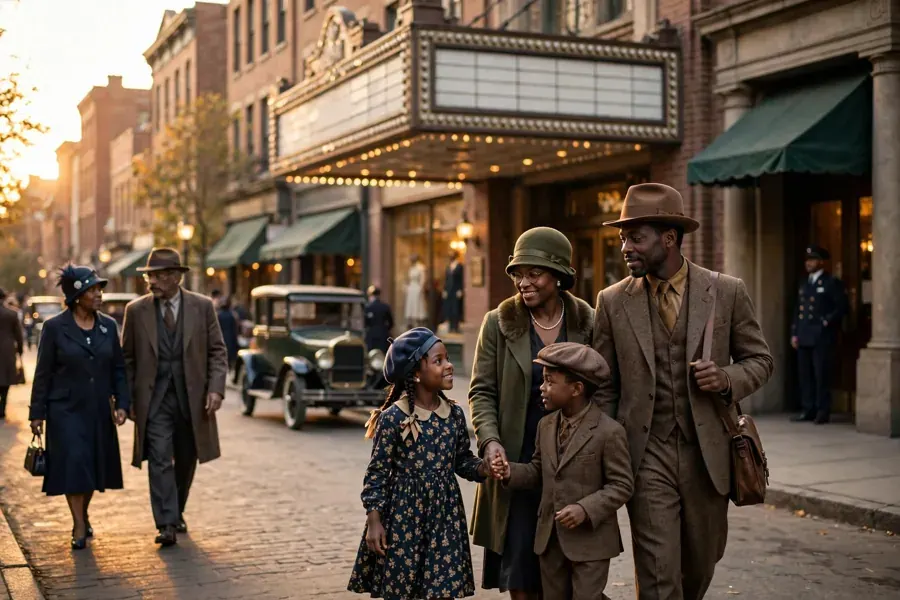
Thirty-Five Blocks, Complete
By 1921, the inventory reads like a city directory, because it was one.
The Public Domain Review's account, drawn from the photographic and documentary record, counts a district of thirty-five blocks, home to nearly eleven thousand Black people — a tenth of Tulsa's population — with close to two hundred businesses: thirty-one restaurants, more than two dozen grocery stores, five hotels, four drugstores and two theatres.
Around the commerce stood the institutions: a dozen churches, two schools, two hospitals, two newspapers and a public library. Most of the businesses and homes were owned by the Black Tulsans who ran and lived in them.
The professional class was deep — clergy and teachers, three lawyers including the pioneering Buck Colbert Franklin, and fifteen doctors, among them Dr. A.C. Jackson, a nationally acclaimed surgeon.
Britannica's account of Black Wall Street dates the land purchases to 1905–1906 and makes the same essential point: this was a self-sufficient, prosperous business district created by African Americans, in the age of segregation, on their own capital.
I have never seen a colored community so highly organised as that of Tulsa.— W.E.B. Du Bois, via The Oklahoma Eagle
Du Bois said it after a visit, and the quote is carried in The Oklahoma Eagle's account of Greenwood — the Eagle itself one of the papers of Black Tulsa. He went on to note that Tulsa's Black residents had accumulated property, established stores and business organisations, and made money in oil.
Booker T. Washington, in the naming that stuck, dubbed Greenwood the "Negro Wall Street of America" — the phrase later generations shortened to Black Wall Street. It was not a compliment about a street.
It was a recognition that Greenwood had reproduced, entire, the functions of a financial district: capital, credit, commerce, professions, press and property, circulating among its own people.
The Families on the Avenue
Walk the avenue in its prime, in the mind's eye, using only what the accounts record.
Greenwood Avenue was lined, in the words of the Southern Poverty Law Center's anniversary account, with luxury shops, restaurants, grocery stores, hotels, jewellery and clothing stores, movie theatres, barbershops and salons — and, just as important, with the ordinary dignities: a library, pool halls and nightclubs, and offices for doctors, lawyers and dentists.
Gurley himself had founded a church that stands in the district's memory as Vernon AME. The Williams family's Dreamland Theatre was the evening's destination; the Stradford was where a travelling salesman or a visiting dignitary stayed in the style the district expected of itself. Nor was this prosperity sealed off at the top.
The same account makes the point our series would make: working-class Black Tulsans were not excluded from Greenwood's economy but woven through it — the janitors, dishwashers, porters and domestic workers who earned in other parts of Tulsa spent at home, and their spending was load-bearing. Lawyers and laundresses were customers of the same grocers.
That is what a complete community looks like from street level: not a row of monuments, but a working ecology of ambition at every income, each tier feeding the next.
It is worth pausing, too, on who held the pen and the ledger. Greenwood's two newspapers did not merely report the district; they organised it — Smitherman's Tulsa Star argued voting strategy and legal self-defence to readers who owned the presses' building.
Its fifteen doctors and its surgeons treated the community in its own hospitals rather than at the mercy of distant wards. Its teachers taught in its own schools. Every function that a people might otherwise have to beg from an indifferent city, Greenwood supplied from its own ranks, at a professional standard its visitors remarked on.
When Du Bois praised the community's organisation, this is the organisation he meant: not tidiness, but completeness under one's own management.
The Dollar That Stayed Home
Every telling of Greenwood returns to the circulating dollar, and the record supports the idea even where the retellings inflate the arithmetic.
The tradition, preserved in the Clio entry and in the recollection of Tulsa Historical Society director Michelle Place quoted in local histories, holds that a dollar spent in Greenwood would change hands many times — nineteen times, in Place's often-quoted version — before it left the community. Other retellings give higher multiples still.
Carry it the way this magazine carries contested numbers: the exact multiple is a tradition, not an audited figure, but the mechanism underneath it is a documented fact.
Greenwood's residents, including the porters, janitors and domestic workers who earned wages across the tracks in white Tulsa, spent those wages at home — in Black-owned groceries, theatres, drugstores and hotels, paying Black landlords, doctors, lawyers and teachers, whose own spending stayed in the same circuit.
Segregation had fenced the money in; Greenwood's achievement was to make the fence into a flywheel. A dollar that changes hands nineteen times does the work of nineteen dollars. That, more than any single fortune, is what Black Wall Street actually was: velocity, ownership and completeness, in thirty-five blocks.
1921: The Record, Without Spectacle
What happened next is told here plainly, because the documented record needs no embellishment and the dead deserve no theatre.
On May 31 and June 1, 1921, following the arrest of a young Black man, Dick Rowland, and a confrontation at the courthouse, a white mob invaded Greenwood through the night and the following morning, killing residents and burning and looting the district.
The figures that follow are the findings of the state's own later investigation, the 1921 Tulsa Race Riot Commission, whose conclusions are carried in Oklahoma's legislative findings: an estimated 100 to 300 people killed, the vast majority of them African American; 1,256 homes destroyed; virtually every school, church and business, and the library and hospital, destroyed with them; property losses estimated at roughly $2 million in 1921 dollars.
The National Archives' account, in the Text Message blog, gives the same commission range — deaths as high as 300, some 191 Black-owned business properties damaged to the value of about $1.5 million, personal property losses around $750,000, and approximately 10,000 people left homeless, per the Red Cross relief report.
The commission further found that some local officials failed to contain the violence and in cases joined or armed it; that no one was convicted for the violence against Greenwood; that no insurance was paid to Black owners who lost everything; and that the city then amended its building code in a way that would have made rebuilding prohibitively expensive.
Those are the state's own findings, entered into its own record. We state them once, factually, and move — as Greenwood itself did — to what was built next.
What the Survivors Did
The rebuilding is the half of the story this magazine insists on weighing at full value. The survivors did not wait for permission or compensation — none came. Buck Colbert Franklin, the lawyer, set up his practice in a tent among the ruins and began taking the claims of the dispossessed.
The fire-proof building ordinance, designed to price Black owners off their own land, was fought and defeated in court.
Families rebuilt their homes on their own lots, with their own money, and the business district rose again: by the end of 1922, most residents' homes had been rebuilt, per the standard accounts, and Greenwood Avenue filled in once more with shops, offices, theatres and churches — a second Greenwood, built by the same hands that had built the first, now carrying the additional knowledge of exactly what the world could do and what they could do anyway.
The district prospered again for decades. Its later decline, as Britannica notes, came by the late 1950s with desegregation's dispersal of its captive customer base — an irony the record states without flinching: the wall that had fenced the dollar in came down, and the flywheel slowed. What did not slow was the telling.
Survivors kept the story when official Tulsa would not: for roughly seventy-five years the massacre was largely omitted from local, state and national histories — the commission itself called it a "conspiracy of silence" — while Greenwood's families handed the account down, kitchen table to kitchen table, until the state finally convened its commission in the late 1990s and told, in 2001, substantially the story the survivors had been telling all along.
Greenwood Today, and Why It Is Ours
The ground itself now carries the memory in institutions: the Greenwood Cultural Center, the John Hope Franklin Reconciliation Park — named for the great historian whose father was the tent-office lawyer of the rebuilding — opened in 2010, and Greenwood Rising, the history centre established by the centennial commission, telling the district's story on the avenue itself.
Visitors walk the restored blocks the way our hero image shows: quietly, reading the markers, in the presence of brick that remembers. That posture — reverent, factual, unspectacular — is the right one, and it is the posture of this whole series.
Why does Greenwood sit at the centre of The Inheritance? Because it is the proof at community scale of everything the other installments show at individual scale. Mansa Musa showed what a sovereign treasury could build.
Madam Walker showed what one founder could build.
Greenwood shows what a whole people, given nothing but their own wages, skills and each other, built together: land bought and held, credit extended neighbour to neighbour, a dollar kept working at home, professions staffed, children schooled, news printed, the sick treated, the dead buried with dignity — an entire civilisation's functions, in thirty-five blocks, in fifteen years.
And when it was burned, they built it again. If you are a reader of this magazine — an owner, a founder, a family building on purpose — Greenwood is not a story about the past. It is the blueprint with your name left blank at the top.
What was built once, completely, from almost nothing, can be studied, honoured and built on. That is what inheritance means here: not only what was handed down, but what the record proves is in our hands to do.
The Inheritance, Part V: The Fortune Builders — Lewis, Johnson, and Gaston
Jack and Jill, The Links: The Institutions That Raise the Next Generation
The Storied Enclaves
The Inheritance, Part II: Madam C.J. Walker
Public Domain Review — "Photographing the Tulsa Massacre of 1921"
Encyclopaedia Britannica — "Black Wall Street"
National Archives, Text Message Blog — "The 1921 Tulsa Race Massacre"
The Oklahoma Eagle — "Tulsa's Black Wall Street"
Oklahoma Statutes — "Findings of the 1921 Tulsa Race Riot Commission"
Clio — "Gurley's Rooming House"
Southern Poverty Law Center — Anniversary Account of Black Wall Street
Questions & Answers
Why does Black cultural history matter today?
Black Wall Street — Greenwood, Tulsa, in the documented record: the businesses, the professionals, the dollar that circulated, and the families who built a complete world in thirty-five blocks. It links to 5 stories and articles — open any card to read the full piece.
What should every house know about this history?
Black Wall Street — Greenwood, Tulsa, in the documented record: the businesses, the professionals, the dollar that circulated, and the families who built a complete world in thirty-five blocks.
How do I read the full stories on Black Wall Street: What Greenwood Built — and What 1921 Could Not Erase?
Choose any card on this page. Each one opens a full page of its own — the complete story or article, with its sources linked.