Mansa Musa, the Richest Man in History: Inside the Mali Empire of Gold and the Pilgrimage That Shook Cairo
Mansa Musa, the richest man in history by the telling of the chroniclers who watched him pass — ruler of the Mali empire of gold, whose pilgrimage in 1324 shook the price of gold in Cairo and put a West African kingdom on the world's maps. This is the documented record, told solidly, with the legends labelled as legends.
Every family that builds something lasting eventually asks where the story starts. For this magazine, it starts here — with Mansa Musa, the richest man in history as the phrase is usually attached to him, sovereign of the Mali empire of gold, whose pilgrimage of 1324 remains the most famous journey any African ruler ever made.
You have probably heard a version of the tale: a king so wealthy that his spending bent the economy of Egypt. What you may not have heard is how historians actually know what they know about him — which witnesses wrote it down, which numbers come from awed chroniclers, and which parts are legend wearing the clothes of fact.
Both halves matter. The documented record is grand enough on its own, and it is the record — not the embroidery — that makes Musa the right opening chapter of an inheritance series.
Begin with the ground he stood on. Musa ruled Mali from about 1312 to about 1337, the ninth mansa, or emperor, of a state that reached its territorial peak under him.
At its greatest extent his empire covered all or parts of what are now Mauritania, Senegal, Gambia, Guinea, Burkina Faso, Mali, Niger, Nigeria and Chad — a realm larger than Western Europe, governed, taxed and defended from West Africa itself.
The World History Encyclopedia's account of Musa notes the sources of that power plainly: Mali's wealth came principally from controlling and taxing the trade in salt from the north and, above all, gold panned and mined in Bambuk and Bure to the south. Over generations, the empire had amassed a large reserve of gold.
This was not treasure found by luck. It was a system — mines, routes, tolls, markets and administration — and the man at the top of the system understood exactly what he held.
An Empire Built on Gold and Salt
To understand Musa, you have to understand the two commodities his world ran on. Gold was West Africa's gift to the medieval world: in an age when Europe's own deposits were limited, the goldfields under Mali's control fed mints and treasuries far beyond the Sahara.
Salt was its mirror — scarce in the south, essential everywhere, traded across the desert from northern mines such as Taghaza, where, travellers reported, buildings were made from blocks of the stuff.
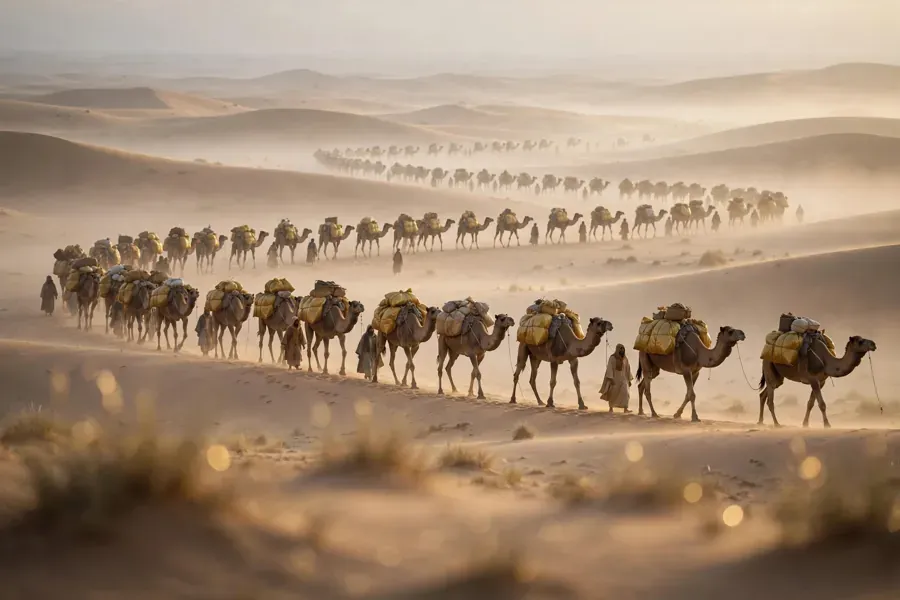
Camel caravans stitched the two together, crossing the Sahara in trains that carried gold north and salt south, and Mali sat astride the junction, taxing the flow in both directions. An empire that controls the junction of two necessities does not need to boast. The caravans did the boasting for it, season after season.
Musa also expanded the realm he inherited, bringing the great trading cities of Gao and Timbuktu firmly into his territory. Timbuktu sat where the Niger River bends toward the desert — the point where river trade and camel trade shook hands — and under Musa it became far more than a port.
It became an argument: that a West African city could hold wealth and learning in the same hand. Hold that thought. It is where the story returns, because Musa's deepest ambition was never merely to be rich.
It was to be known — by Cairo, by Mecca, and by the republic of scholars — as a sovereign of substance.
1324: The Pilgrimage That Moved a Market
In 1324, Musa set out on the hajj — the pilgrimage to Mecca required of a devout Muslim ruler — and turned a religious duty into the most effective act of statecraft of the medieval age. The caravan that crossed the Sahara with him was, by every account, enormous.
Northwestern Magazine's account of his reign, drawn from the Smithsonian's Caravans of Gold scholarship, describes an entourage of 8,000 courtiers and 12,000 servants with 100 camel loads of pure gold; other chroniclers put the whole company in the tens of thousands.
The honest way to carry those figures is the way careful historians carry them: as the reported scale of a procession designed to be reported. Nobody in 1324 was counting heads with a clipboard. What is not in doubt is the effect.
When the caravan halted for the night, one scholar quoted in that account observed, it was like a whole town decamping in the desert — mosque, markets and all, erected and struck daily in the sand.
Then came Cairo, in July 1324, and the moment the legend was minted. Musa gave gold away with both hands — to the Sultan, to courtiers, to officials, to the poor — and his vast retinue spent freely in the city's markets.
The fourteenth-century Arab historian Shihab al-Umari, our most important contemporary witness, recorded what happened next, in words Northwestern's account quotes directly:
He flooded Cairo with his benefactions. He left no court emir nor holder of a royal office without the gift of a load of gold. … They spent gold until they depressed its value in Egypt and caused its price to fall.— Shihab al-Umari, via Northwestern Magazine
Other accounts put the fall at around a fifth of gold's value against silver, and say the market took years — al-Umari's own telling suggests as long as twelve — to absorb the flood and recover. Think about what that means, in plain terms.
A visiting sovereign, passing through a foreign capital on his way to prayer, spent and gave so much of one commodity that he single-handedly moved its price across an entire economy, for years. There is no tidy modern parallel. Central banks move markets with signals and interest rates; Musa did it with generosity, in person, in a matter of weeks.
The African History Online account adds the detail that completes the portrait: so freely did the caravan spend that Musa eventually had to borrow for the journey home — and Egyptian merchants, who had happily raised their prices for the visitors, ended up extending the credit. Even the aftermath was grand.
How Rich Was He, Really?
Here is where this magazine parts company with the internet's favourite headline. You will find Musa assigned precise modern fortunes — figures in the hundreds of billions, presented as if an auditor had closed his books. The careful sources do not support any such number, and the honest ones say so.
A recent scholarly-minded survey in Black History in Real Time puts it plainly: wealth across centuries cannot be converted cleanly into today's dollars, the often-repeated estimates are speculative and can mislead, and what can be said with confidence is that Musa was one of the most spectacularly wealthy rulers known to medieval observers.
Time magazine, quoted in several accounts, reaches the same place from the other direction: there is really no way to put an accurate number on his wealth.
Why is the number so slippery? Because the evidence itself is literary. Our knowledge rests chiefly on Arabic texts — al-Umari and Ibn Khaldun, writing after the pilgrimage — and on Timbuktu's own later chronicles, the Tarikh as-Sudan and the Tarikh al-fattash, composed in the seventeenth century.
Al-Umari never watched the caravan himself; he recorded what Cairo's officials told him, in a genre of writing that prized wonders.
The gold totals attributed to the journey vary by source — one later tradition, discussed in a detailed study of the pilgrimage at African History Extra, speaks of some eight to twelve tonnes of gold carried, with the travelling company counted anywhere between 8,000 and 60,000 people. A range that wide is not a measurement.
It is a chorus of astonishment, written down. The right conclusion is not that the wealth was invented — too many independent witnesses, in too many places, reacted the same way — but that its size exceeded the vocabulary of everyone who tried to describe it. Musa was not rich the way a rich man is rich.
He was rich the way a goldfield with a government is rich. That is the attributed, defensible claim, and it loses nothing by being stated carefully.
What the Gold Built: Timbuktu
If the pilgrimage was the announcement, the return was the investment. Musa came home with scholars, and with an Andalusian architect and poet, Abu Ishaq al-Sahili, whom he persuaded to accompany him back across the desert.
In Timbuktu, al-Sahili is credited with the great Djinguereber Mosque — an architectural masterpiece in the Sudanese mud-brick tradition and, as Northwestern's account notes, one of the most iconic buildings in Africa. Musa endowed mosques and schools, recruited learned men from across the Islamic world, and turned his capital cities into magnets for study.
At its peak, the scholarship around Timbuktu could accommodate — by the Smithsonian account quoted in Northwestern — some 25,000 students, and its archives held more than 800,000 manuscripts. Sit with that second figure for a moment.
Eight hundred thousand manuscripts, in a city on the edge of the Sahara, in an age when most of the world's books lived in a handful of libraries. Timbuktu was not a trading post with a school attached. It was a university city whose libraries the whole Islamic world knew by name.
This is the part of the inheritance that matters most to the reader of this magazine. Musa's gold is the headline, but his judgement is the story. He converted a commodity into institutions — mosques that still stand, a scholarly quarter that outlived his dynasty, a reputation that drew students across a desert.
Wealth that is only spent is a story about a season. Wealth that is built into walls, books and schools becomes a story about centuries.
Every fortune profiled later in this series, from the Walker empire to Greenwood's avenue, runs on the same principle, and Musa ran it first and largest: take what the ground and the trade give you, and build the things that keep giving after you are gone.
The King on the Map
The world got the message.
In 1375, decades after Musa's death around 1337, the Majorcan cartographer Abraham Cresques completed the Catalan Atlas — the finest map of the known world of its age — and there, seated over West Africa, sits a crowned Black king holding a golden orb and sceptre: Mansa Musa, placed by European mapmakers at the centre of the richest realm they knew.
The image is sometimes reproduced so casually that its weight gets lost. Consider what it certifies. A workshop in Majorca, working from travellers' reports, concluded that the most legible symbol of wealth on the entire map of the world was an African emperor most Europeans would never see, ruling a city most could not pronounce.
The pilgrimage had done its work. Mali had been announced — not as a rumour at the edge of the map, but as a throne at its centre.
Musa died around 1337 and was succeeded by his sons. The empire he left was well administered and wealthy, but no succession is a sunrise: later centuries brought internal struggles, pressure from neighbours, and the rise of Songhai, and Mali slowly contracted toward its heartland.
Empires built on a junction of trade routes last exactly as long as they can hold the junction. What did not contract was the memory. In Europe, Musa remained the gold-crowned figure on the map.
In West Africa, he remained the measure of what a mansa could be. And in the sources — Arabic chronicles, Timbuktu manuscripts, a Catalan atlas — he remained documented, which is rarer and more valuable than being merely remembered.
Why He Opens This Series
The Inheritance is this magazine's history series, and it is framed deliberately: these are the foundations under the reader you are. Musa belongs at the front of it because his story corrects the scale of everything that follows.
Before there was a Walker factory or a Greenwood bank, there was a Black sovereign whose treasury moved foreign markets, whose capital held one of the great libraries of the medieval world, and whose name European mapmakers wrote in gold — literally.
To know that record, accurately, with its sources named and its legends labelled, is to know that Black excellence in wealth and learning is not a modern achievement or a recent claim. It is an inheritance, seven centuries deep, documented by the very people who watched it happen.
Carry the numbers the way this article has carried them — attributed, ranged, and honest — and the story needs no exaggeration at all. A king crossed the desert with a city at his back, gave until a great capital's gold price fell, came home with architects and scholars, and built a city of books.
The chroniclers reached for superlatives because the facts had already outrun their adjectives. Ours have the same problem, and we are content to leave the last word to them.
The Inheritance, Part II: Madam C.J. Walker — The First Self-Made Millionairess
The Inheritance, Part IV: The Kingdoms of Gold — Zimbabwe, Benin, Ashanti
The Vault: Art — The Black Masters
Black Cinema Across the Eras
Northwestern Magazine — "A Golden Age: King Mansa Musa's Reign"
World History Encyclopedia — "Mansa Musa I"
African History Online — "Mansa Musa (Musa I of Mali)"
Black History in Real Time — "Mansa Musa"
African History Extra — "Mansa Musa and the Royal Pilgrimage Tradition of West Africa"
Questions & Answers
Why does Black cultural history matter today?
Mansa Musa, the richest man in history by the telling of the chroniclers who watched him pass — ruler of the Mali empire of gold, whose pilgrimage in 1324 shook the price of gold in Cairo and put a West African kingdom on the world's maps. This is the documented record, told solidly, with the legends labelled as legends. It links to 5 stories and articles — open any card to read the full piece.
What should every house know about this history?
Mansa Musa, the richest man in history by the telling of the chroniclers who watched him pass — ruler of the Mali empire of gold, whose pilgrimage in 1324 shook the price of gold in Cairo and put a West African kingdom on the world's maps. This is the documented record, told solidly, with the legends labelled as legends.
How do I read the full stories on Mansa Musa, the Richest Man in History: Inside the Mali Empire of Gold and the Pilgrimage…?
Choose any card on this page. Each one opens a full page of its own — the complete story or article, with its sources linked.