
The Kingdoms of Gold — Great Zimbabwe, the Benin Bronzes and Ashanti Gold
This is Part IV of The Inheritance. Beyond Mansa Musa, the historic African kingdoms of wealth built in stone, cast in brass and weighed in gold dust — Great Zimbabwe, Benin and Ashanti, and what their treasures still prove.
If you have followed this series from Mansa Musa and the Empire of Gold, you already know the first lesson: African wealth did not begin with a single famous king. It was a system — mines, markets, courts and craftsmen, held together over centuries.
In this installment we follow that system south and west, to three kingdoms every reader of this magazine should be able to speak about with confidence: Great Zimbabwe and its stone city, the Kingdom of Benin and its bronzes, and Ashanti — the Asante kingdom — and its gold.
The search that brings most readers here, for Great Zimbabwe, Benin bronzes and Ashanti gold as historic African kingdoms of wealth, is really one search. These were three different answers to the same question: how does a people turn what the land gives them into lasting power?
We will tell each story from the documented record, name what the objects themselves prove, and end where the objects sit today — because the question of where the treasures belong is now part of their history, told factually and without heat. Bring a good light and a little time. This is heritage you can stand inside.
Great Zimbabwe: A City Built Without Mortar
Start with the stones, because the stones are the argument. Britannica describes Great Zimbabwe as the heart of a thriving trading empire from the 11th to the 15th centuries, built by ancestors of the Shona people, with a population estimated in its sources at 10,000 to 20,000.
The word itself tells you what mattered: in the Shona language, as Britannica explains, zimbabwe means “stone houses.” The modern country took its name from this place, and when you stand in the Great Enclosure at first light, you understand why.
The site divides, as archaeologists describe it, into three great parts. There is the Hill Complex, the oldest and most sacred ground, where stone walls grow directly out of granite boulders. There is the Valley, where the life of the city — homes, workshops, markets — spread out below.
And there is the Great Enclosure itself, described in heritage coverage as an elliptical wall roughly 250 metres in circumference and up to about 11 metres high, built from carefully fitted granite blocks with no mortar at all. Inside it stands the Conical Tower, solid stone from base to top, whose precise purpose scholars still debate.
Some read it, in the accounts gathered in our sources, as a symbol of a royal granary — stored abundance made permanent. What is not debated is the labour. Walls of that height, fitted that precisely, without cement, require quarrying, transport, skilled masons and an authority able to organise all of it season after season.
Architecture, here, is paperwork in stone: it proves administration.
What paid for it? Cattle, crops — and gold. Heritage and reference coverage is consistent on the economy: Great Zimbabwe controlled trade from the interior goldfields toward the coast, exporting gold and ivory through the Swahili port of Sofala into the Indian Ocean network.
The proof travels in both directions. The same coverage notes that archaeologists have found Chinese porcelain and Persian ceramics in the ruins — luxury goods that could only have arrived through that ocean trade. Think about what that means in plain terms.
A court in southern Africa was not at the edge of the medieval world. It was a customer of it, and a supplier to it, important enough that the finest tableware of Asia ended up in its houses. If you collect, you will recognise the pattern from our own Vault series on art: provenance is not decoration.
Provenance is evidence.
And then there are the birds. Eight carved soapstone birds were recovered from the site, stylised figures that blend bird and human features. Heritage coverage records that the Zimbabwe Bird became the country’s national symbol, appearing on its flag.
A sculpture small enough to hold in two hands now carries the identity of a nation — which is exactly the kind of inheritance this series exists to trace.
Great Zimbabwe was inscribed as a UNESCO World Heritage site in 1986, a recognition the coverage presents as affirming the site’s African authorship and its connection to the Shona and Ndebele peoples of modern Zimbabwe.
The city was already falling quiet by the 15th century — the reasons, our sources say, are still argued: shifting trade routes, pressure on land and resources, and the rise of successor powers all have their historians. Empires end. What they built, when they built it in stone, testifies anyway.
Benin: The Court That Cast Its History in Brass
Travel west now, to the forest kingdom of Benin, in what is today southern Nigeria — a different landscape, a different material, the same seriousness about record-keeping. Where Zimbabwe wrote in granite, Benin wrote in brass.
The British Museum’s own account of the Benin Bronzes describes them as sculptures — elaborately decorated cast relief plaques, commemorative heads, animal and human figures, items of royal regalia and personal ornaments — created from at least the 1500s onwards by a specialist guild working for the royal court of the Oba, the king, in Benin City. Read that slowly.
This was not folk decoration. It was a court workshop, hereditary and specialised, producing the official visual record of a kingdom: who ruled, who fought, who traded, who mattered.
Many pieces, the Museum notes, were commissioned for the ancestral altars of past Obas and Queen Mothers, and used in rituals to honour the ancestors and to validate the accession of a new Oba.
The plaques are the heart of it.
Hundreds of them once clad the pillars of the royal palace, and as Britannica’s Benin Bronzes entry puts it in the coverage we reviewed, they depicted significant events and ceremonial life in the Oba’s court — battles, rituals, processions, the king larger than those around him, because in this art, scale itself is a statement of rank.
Britannica dates the kingdom’s flourishing from the 13th to the 19th century and notes that by the 15th century the Oba held supreme authority over the Edo-speaking people in political, judicial, economic and spiritual matters. Under rulers such as Ewuare the Great, the kingdom expanded, and its capital stood in present-day Benin City.
Benin’s wealth, like Zimbabwe’s, was trade — but trade of a particular, documented kind. The British Museum records that trade, diplomatic and missionary contacts between Benin and Portugal developed from the late 1400s, including exchange visits between the two courts.
The brass itself carries the evidence: much of the metal, the coverage explains, arrived as brass bracelets — manillas — traded by Europeans, then melted and recast by Benin’s casters using the lost-wax process into plaques, heads and regalia. Pause on that exchange, because it flatters nobody’s simple story and honours the real one.
European raw material went in one end of the workshop. West African genius came out the other. The resulting objects are among the most accomplished castings of their era anywhere in the world, and European visitors of the period, whose accounts survive in the scholarship, described a court as organised as any they knew at home.
Ashanti: Gold You Could Wear, Weigh and Swear By
Our third kingdom takes us to the forest of what is now Ghana, and to the metal in its most concentrated cultural form. If Zimbabwe built gold’s profits into walls and Benin cast trade brass into history, Ashanti — Asante — made gold into a language everybody was expected to read.
The African Studies Centre Leiden dossier on the Asante kingdom records that the separate Asante chiefdoms were united by Osei Tutu in the 1670s, that he took the title Asantehene in the years that followed, built his capital at Kumasi, and that by 1750 the Asante Empire was, in the dossier’s words, the largest and most powerful state in the region — its wealth and prosperity based on mining and trading in gold.
Britannica’s Ashanti Empire entry tells the same founding story: Osei Tutu, a military leader of the Oyoko clan, united the Akan peoples around Kumasi in the 1670s and took the title of Asantehene.
At the centre of that union stands an object no treasury can price.
Tradition holds — and both the Leiden dossier and Britannica present it explicitly as tradition, which is how we present it to you — that the kingdom’s high priest, Okomfo Anokye, called down a Golden Stool from the heavens, and that it landed on Osei Tutu’s knees, sanctifying the union of the Asante states.
The Sika Dwa Kofi, as it is named in the cultural coverage we reviewed, is understood to embody the soul of the Asante nation — the living, the dead and those yet to be born. It is never allowed to touch the ground.
No one sits on it — not even the Asantehene, whose authority comes from his custodianship of it. Consider the political intelligence of that arrangement. Kings succeed one another; the Stool remains.
Power, in Asante thought, belongs finally to the people across time, and the king holds it in trust. Every family in this magazine’s readership that has ever written a trust document will recognise the structure instantly.
Around that sacred centre, gold did the daily work of state.
Asante controlled major gold-producing country — the reason Europeans named this coastline the Gold Coast — and its goldsmiths produced regalia of famous refinement: crowns, swords, sandals and jewellery worn by the king and the queen mother, each piece displaying, as the cultural coverage puts it, the wealth and spiritual power of the state.
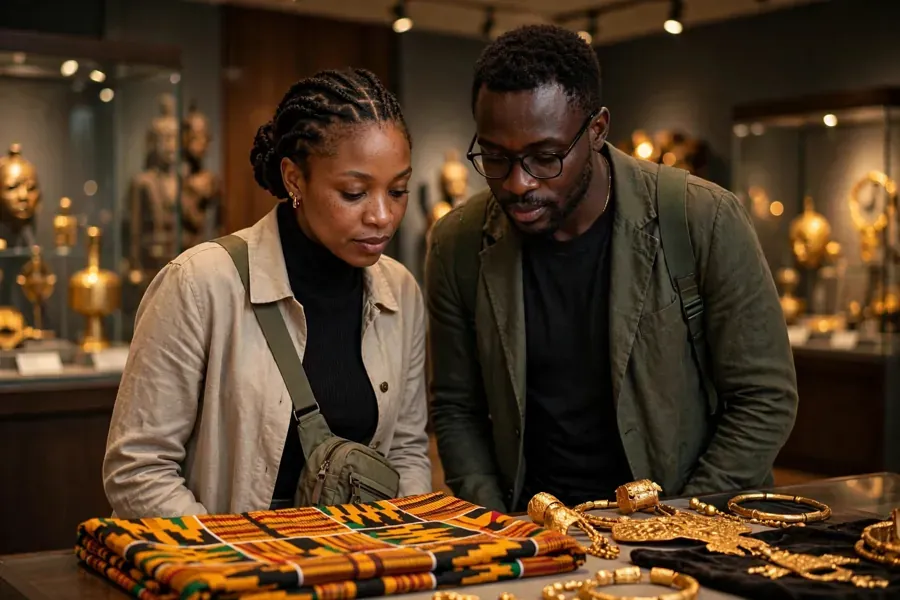
Gold dust itself circulated as currency, weighed out with small brass goldweights cast as figures, animals and proverb-objects — a pocket archive of Asante wisdom that also happened to be the money.
And woven into the same court culture was kente, the brilliant strip-woven cloth the coverage identifies as Asante’s most globally recognised artistic contribution, originally a fabric of profound status. When you see kente at a graduation or a wedding in your own family, you are looking at a court technology of honour that survived the journey across the Atlantic intact.
That is not a metaphor. That is inheritance, worn.
Where the Treasures Sit Today
An honest inheritance story has to say where the property is. In 1897, a British punitive expedition sacked Benin City, and thousands of the palace’s bronzes were taken and dispersed to museums and dealers across Europe and America.
The Digital Benin research project, as summarised in the restitution coverage we reviewed, has recorded more than 5,000 Benin objects in more than 130 institutions in 20 countries, with the largest single holding — about 900 objects — in the British Museum.
In 1900, Asante rose in the war that bears the Golden Stool’s name after a British demand connected to the Stool itself; the Stool was not surrendered, and it is still treasured, in the cultural coverage we reviewed, in the stool house of the Asantehene at Kumasi.
Asante gold regalia, by contrast, left Kumasi in quantity during the wars of the 19th century.
The present chapter is one of returns, loans and negotiation, and it moves year by year. Germany transferred ownership of more than a thousand Benin objects to Nigeria under a 2022 agreement, according to the restitution timelines in our sources. The Horniman Museum in London transferred its 72 Benin objects the same year, and the Smithsonian returned 29.
In June 2025, the Netherlands returned 119 Benin Bronzes to Nigeria — described in the reporting of that handover as the largest single restitution to that date — at a ceremony in Lagos attended by Nigerian officials and the Benin Royal Court.
“Heritage is essential for telling and experiencing the history of a country and community. The Benin Bronzes are therefore indispensable for Nigeria, it is good that they are returning.”— Eppo Bruins, Dutch Minister of Culture, via the linked reporting of the Netherlands handover
For Asante gold, the mechanism so far has been the long-term loan.
In 2024, as coverage of the Manhyia Palace arrangements records, the British Museum and the V&A agreed to lend pieces of Asante gold regalia to the Manhyia Palace Museum in Kumasi — 15 objects from the British Museum and 17 from the V&A — for display in the Asantehene’s own palace, in the city from which they were taken in the 19th century.
Whether loan or return, the direction of travel in the coverage is consistent, and Nigeria’s government has, since 2023 in the accounts we reviewed, recognised the Oba of Benin as owner of the bronzes returned to him.
We report the state of play as our sources give it; where institutions and governments still disagree, we say so, and we will update this page as the record changes.
What should a reader of this magazine do with all of this? Three things.
First, go and see the work where it can be seen well — at Great Zimbabwe itself if your travels take you to southern Africa (pair it with the journey in The Grand Tour, Our Way), at the Manhyia Palace Museum in Kumasi, and in the great museum galleries while the bronzes remain on view there, reading the labels with the history you now hold.
Second, teach it at home. A child who knows that the Zimbabwe Bird flies on a national flag, that Benin’s casters ran a court guild five centuries ago, and that the Golden Stool has never touched the ground, carries a different posture into every room. Third, notice what these kingdoms are really telling you.
None of this wealth was an accident, and none of it was only wealth. It was organisation, craft, record-keeping and trust — the same four things, if we are honest, that build every fortune in the pages that follow this series.
In Part V, we come home to America, to three men who built fortunes in living memory of slavery’s end — a dealmaker, a publisher and a banker of Birmingham — and to the lessons their roads still hold for owners today.
The Fortune Builders — Lewis, Johnson, and Gaston
Mansa Musa and the Empire of Gold
The Vault: Art — Building a Collection That Starts With Black Masters
The Grand Tour, Our Way
The Art Season
Britannica — “Great Zimbabwe”
Cultural Heritage Online — “Great Zimbabwe UNESCO World Heritage Site”
British Museum — “Benin Bronzes”
Britannica — “Benin Bronzes”
African Studies Centre Leiden — “Asante Kingdom”
Britannica Kids — “Ashanti Empire”
News Rangers — “Netherlands To Repatriate 119 Looted Benin Bronzes To Nigeria”
Jam Radio — Chatham House reparative justice coverage, incl. the Asante gold loan
Questions & Answers
Why does Black cultural history matter today?
This is Part IV of The Inheritance. Beyond Mansa Musa, the historic African kingdoms of wealth built in stone, cast in brass and weighed in gold dust — Great Zimbabwe, Benin and Ashanti, and what their treasures still prove. It links to 6 stories and articles — open any card to read the full piece.
What should every house know about this history?
This is Part IV of The Inheritance. Beyond Mansa Musa, the historic African kingdoms of wealth built in stone, cast in brass and weighed in gold dust — Great Zimbabwe, Benin and Ashanti, and what their treasures still prove.
How do I read the full stories on The Kingdoms of Gold — Great Zimbabwe, the Benin Bronzes and Ashanti Gold?
Choose any card on this page. Each one opens a full page of its own — the complete story or article, with its sources linked.