
Polo, Racing, and the Sporting Season in Good Company: What to Wear to a Polo Match — A Racing Etiquette Guide
What to wear to a polo match, how a racing etiquette guide reads the enclosures, and how to stomp a divot, hold a glass, and sponsor a day without ever showing off.
Ask a room of well-dressed people what to wear to a polo match and you will hear about dresses and linen within the minute.
Ask them what a racing etiquette guide would tell them about the day itself — when to walk onto the field, which enclosure their ticket actually enters, how an owner behaves in the parade ring, why the hat is practical before it is pretty — and the room goes quieter, because that is the knowledge that separates a guest from a regular.
This article is for the regular you intend to become. The sporting season — polo Sundays, racing meets, golf invitationals — is the social season outdoors: the same generosity and polish as the ballroom, translated into grass, sunlight, and thundering hooves.
Learn its manners once and you will be at home on every rail, in every enclosure, for the rest of your summers.
Begin with the pleasant truth that these days are built for pleasure. A polo match, as one menswear guide cheerfully admits, is often viewed as more of a social occasion than a sporting event, with guests enjoying a bright, warm day as much as the final score. That is not a criticism of the sport.
It is the sport's social genius: four players a side, ponies at full stretch, a ball moving faster than your eye first follows — and around the field, a village of friends with blankets, baskets, and all afternoon to become better friends. Come for the company, by all means. But watch at least some of the match.
The hosts notice who does, and so do the players.
What to Wear to a Polo Match
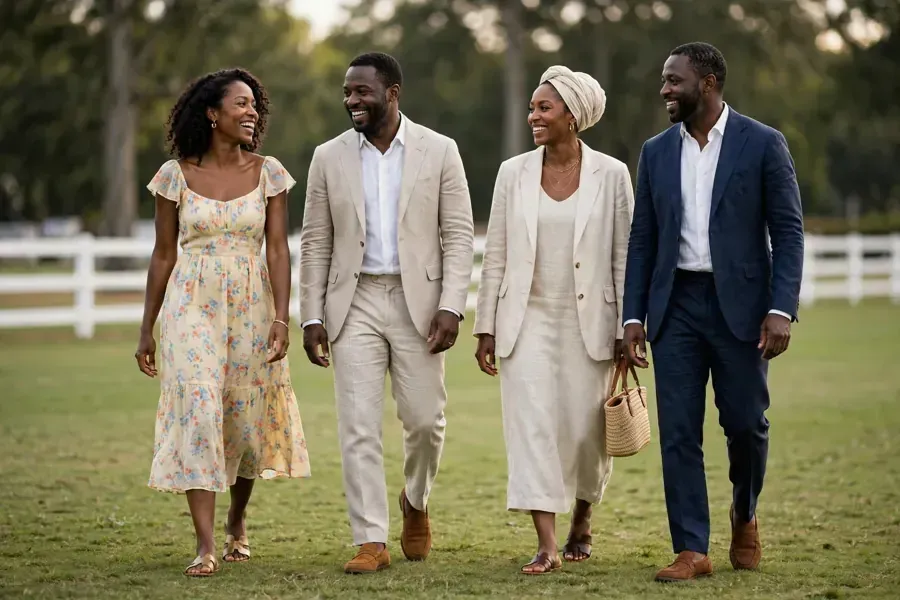
The polo rail has a look, and it is summer itself: colour, linen, and ease, pitched a clear step above garden-party casual and a clear step below a wedding.
Palmera Polo's guide to the day sets the women's register well: a favourite sundress, maxi dress, or jumpsuit in colourful patterns or pastels suits a daytime match, while a gown is too formal for the occasion.
Fashion Quarterly's polo etiquette guide agrees on the spirit, advising guests to choose sophisticated, elegant attire in cotton or linen, embrace colour and prints in pastel or muted tones, and avoid denim, jersey, and anything too revealing. For men, the Jos.
A. Bank guide offers the two registers plainly: a bright oxford shirt and khakis serve the general lawn, while a hospitality invitation calls for a linen or seersucker suit without a tie and slip-on loafers. Morning and early-afternoon matches, the same guide notes, run more relaxed than evening fixtures, which ask a little more polish.
Now the detail that decides whether you enjoy the day or merely survive it: your shoes. Polo is watched from grass, and at halftime the field itself becomes the social floor. Choose, as Fashion Quarterly directs, flats, sandals, wedges, or block heels — never stilettos, which sink into the field — and leave sneakers and flip-flops at home.
Your hat earns its place the same practical way. Palmera advises a sunhat, Panama, or fedora with refined sunglasses, because a match day is a sunny day, while Fashion Quarterly adds the courtesy that completes the thought: a hat should complement the outfit and never be so oversized or elaborate that it blocks the view of the guest behind you.
Jewellery, both guides suggest, stays understated and elegant — one considered piece over a chorus of them. For the full translation of invitation language into outfits across every code, our standing reference is Dress Codes, Decoded; the sporting season is simply that same ladder, worn in daylight.
The Divot Stomp, and Other Field Manners
At halftime comes the tradition every guest secretly came for. Palmera explains it with care: during halftime, spectators walk out onto the field and carefully stomp grass back into the divots torn up by galloping hooves, which helps maintain the field and keeps a flying ball from bouncing off a divot and changing trajectory.
It is real work, cheerfully shared — and it is also the best ten minutes of conversation in the sporting calendar, a promenade disguised as groundskeeping, where introductions happen at walking pace and nobody is looking at a phone.
Spectators will walk out onto the field and carefully stomp grass back into their divots which have been torn up by galloping hooves.— Palmera Polo, "What to Wear to a Polo Match"
The manners around it are simple and absolute. Wait to be invited onto the field; the invitation will come, clearly, over the loudspeaker or from your host. Stomp the divots you find, not just the photogenic ones in the middle.
Watch for the signal that play is about to resume and come off the field promptly, glass in hand, without being asked twice. And never, during play, step onto the field, wave at a player in mid-stroke, or let a child or a dog drift toward the boards.
Spectator guides put the watching etiquette plainly: binoculars are a genuine help on a field this large, and the lawn offers the social view while the stands offer the comfortable seat — choose either, and then actually watch. Applaud good play on both sides.
Polo crowds are partisan in the friendliest way, but the day's grace note is the guest who can admire an opponent's impossible angle shot out loud.
Racing: Read the Enclosure, Then Dress for It
Racing takes polo's daylight polish and gives it architecture. A racecourse is a set of nested rooms — general admission, grandstand, members' and owners' enclosures, private boxes — and each room carries its own dress expectation, rising as you move inward.
The first skill of the racing guest is therefore not fashion but reading: know which enclosure your invitation enters, and dress for that room, not for the photograph you saw of a different one.
A guide to dressing by enclosure makes the principle explicit for Royal Ascot, the most exacting meet of all: the Royal Enclosure asks ladies for a day dress of modest length with straps of at least an inch and a proper hat, and gentlemen for a morning suit with waistcoat, tie, and top hat, while the outer enclosures relax step by step toward smart day dress and a jacket and tie.
Most American meets ask considerably less than Ascot's Royal Enclosure — a suit or blazer for the clubhouse, a beautiful dress and hat where hats are the custom — but the structure is the same everywhere: the closer to the horses and the hosts, the more considered the dress.
The Gentleman's Journal guide to the racing season captures the mood of the great summer meets: linen and navy suits, summery ties, and the crisp Panama hat define the elegant-relaxed register of a festival like Goodwood, with traditional tailoring returning as the season turns to autumn. Take from that the two habits that travel to any course.
First, dress for the weather that is actually forecast, with a layer you can add — enclosures are windy places, and elegance that shivers is not elegance. Second, let one element carry the day: the hat, the colour, the beautiful shoe.
Race-day dressing fails in both directions — the guest who arrives as if for a nightclub, and the guest who arrives as if for a costume party. The regulars in between, tailored and at ease, are the ones the photographers actually find.
In the owners' enclosure and around the parade ring, the manners tighten again, for the best of reasons: you are in a workplace. Horses are being led, trainers are giving instructions, jockeys are weighing in and out, and an owner's guests are expected to be a calm presence in a charged space.
Keep voices low near the horses, never reach for a horse uninvited, keep clear of the unsaddling area unless you are genuinely part of the party, and take your photographs from where spectators belong.
If your host's horse wins — and may you know that joy — the winners' circle photograph is a ceremony: take your place, smile for the frame, and save the celebration for the champagne, not the horse's ear.
If the horse loses, congratulate the effort, thank the trainer by name, and be exactly as gracious at the bar afterward as you would have been in the photograph. Owners are remembered, season after season, by how they behave on the losing days.
Golf Invitationals and the Sponsoring Guest
The third stage of the sporting season is the golf invitational — charity classics, club invitationals, and the long, sociable Saturdays where business and friendship share a cart.
The dress foundation is set by the host club, and a standard tournament guide states it cleanly: charity tournaments typically require collared shirts and dress pants or khaki shorts, with golf shoes, and ask players to display good sportsmanship, respect the course's local rules, repair their marks, and keep pace so no group behind is kept waiting.
As a guest, your extra duties are social: arrive early enough to be unhurried, learn the names of your foursome before the first tee, be ready when it is your turn, and let your score matter exactly as much as the least competitive player in the group wants it to.
The dinner afterward is part of the event — many a guest plans, sensibly, a change of clothes for it — and the guest who stays, applauds the cause, and bids in the auction with a smile has understood the invitational's true sport.
The Picnic, the Tailgate, and Hosting at the Rail
Between the chukkers and the races, the sporting day is fed as well as watched, and hosting at the rail is its own small art.
The experienced host thinks in shade, seating, and sequence: a blanket or chairs that claim enough ground for the party without annexing the neighbours', a basket that opens in courses rather than all at once, cold drinks in genuine quantity, and something warm or substantial held back for the middle of the afternoon, when every other party's provisions are running low and yours become legendary.
Keep the food hand-friendly and forgiving in heat — this is a day of linen, and a host who serves a dripping sauce to a guest in cream trousers has failed a test that has nothing to do with cooking.
Offer generously to the parties on either side of you; the rail is a neighbourhood for the day, and the exchange of a taste of your basket for a taste of theirs is how sporting friendships, and occasionally sporting romances, begin. And when the day ends, leave the grass as you found it.
The divots you stomped at halftime repaired the field for the players. The ground your party leaves clean repairs it for everyone who comes next week — which, if the season has done its work, will include you.
Which brings us to sponsoring, the sporting season's generous art.
A foursome bought, a hole sponsored, a polo team supported, a race named for a foundation — these are the season's quiet engines, and they run on a single manner: give visibly enough to encourage others, and never so theatrically that the gift becomes the story. Put your name on the programme the size the organisers suggest, not larger. Let the charity's own people make the speeches. If you host a rail-side table or a box, host it properly — enough food, enough shade, a welcome for the guest who knows nobody — and then let the day, not your logo, be what people remember. The owners and hosts among our own sporting profiles, collected in the Sports collection, model exactly this register: competitive in the contest, generous around it, and understated about both.So here is the sporting season, whole. Wear linen and colour to the polo, flats for the field you will help repair, and a hat that shades you without shading your neighbour.
Dress for the enclosure you are actually entering at the races, behave in the parade ring as the honoured guest of a working stable, and lose — when you lose — like someone who will be invited back for a decade. Play the invitational at the group's pace and stay for its dinner.
Sponsor with a light hand and an open one. The grass will be green again next season, the ponies fast, the hats improbable, and the company — if you keep these manners — very, very good.
Dress Codes, Decoded Once and for All
Sports — Profile Collection
Palmera Polo — "What to Wear to a Polo Match"
Fashion Quarterly — "Polo Etiquette: The Dos and Don'ts and What to Wear"
Jos. A. Bank — "What to Wear to a Polo Match"
Prestige Corporate Events — "Royal Ascot Dress Code & Etiquette Guide"
The Gentleman's Journal — "What to Wear to the Horse Races This Season"
Golf Registrations — "Mastering Charity Golf Tournament Rules and Etiquette"
Questions & Answers
Who will you meet on this page?
What to wear to a polo match, how a racing etiquette guide reads the enclosures, and how to stomp a divot, hold a glass, and sponsor a day without ever showing off.
What should you know about what to Wear to a Polo Match?
The polo rail has a look, and it is summer itself: colour, linen, and ease, pitched a clear step above garden-party casual and a clear step below a wedding.
What does this article say about the Divot Stomp, and Other Field Manners?
At halftime comes the tradition every guest secretly came for. Palmera explains it with care: during halftime, spectators walk out onto the field and carefully stomp grass back into the divots torn up by galloping hooves, which helps maintain the field and keeps a flying ball from bouncing off a divot and changing trajectory .