
The Hosts With the Rooms: Famous Black Society Hosts, Salons and Dinner Parties
Famous Black society hosts, salons and dinner parties have always been where our world quietly gets decided — meet the hosts whose tables move Black society, and learn what makes a host worth an invitation.
Every world has an address where it actually happens, and in ours it has rarely been an office. It is a room — candlelit, well set, with a host at the door who knows exactly why each guest was asked.
Famous Black society hosts, salons and dinner parties are not decoration on Black life at altitude; they are one of its oldest working institutions. Careers have been introduced across those tables. Marriages have begun as a seating plan.
Books, companies, scholarships and second chances have all started as a conversation a good host arranged on purpose and then had the grace to let look accidental.
This is a tribute to the keepers of those rooms — the women and men, past and present, whose gift is not simply entertaining but assembling — and a practical account of what they do that the rest of us can learn.
The best modern map of this world remains Lawrence Otis Graham's Our Kind of People: Inside America's Black Upper Class, built, its publisher notes, through six years of interviews with more than three hundred prominent families and individuals.
Graham wrote as an insider about a conservative network of families dating back to the first Black millionaires of the 1880s — a world of debutante cotillions, summer houses, and dinners hosted by the families everyone else quietly took their cues from.
Read it today and the technology has changed, but the grammar has not: the invitation is still the currency, and the host is still the bank.
The Originals: Two Women Who Built Rooms That Built a Renaissance
Begin in Harlem, with A'Lelia Walker. The National Trust for Historic Preservation's account describes how, in 1920s Harlem, everyone clamored for an invitation to her townhouse on West 136th Street — the Walker Studio, later the Dark Tower — where she threw lavish parties attended by the poets, writers, artists, musicians and activists of the Harlem Renaissance.
The guest lists in that account read like a syllabus: Countee Cullen, Langston Hughes, Zora Neale Hurston, W.E.B. Du Bois, James Weldon Johnson and Alberta Hunter among them.
Walker was the only child of Madam C. J. Walker, and she understood something her mother's generation had paid dearly to learn: money buys the house, but only the host makes it a capital.
“the joy goddess of Harlem's 1920s”— Langston Hughes on A'Lelia Walker, via the National Trust for Historic Preservation
Hughes remembered rooms so full that latecomers simply could not get in — and everybody, he wrote, seemed to enjoy the crowding. That is the first lesson of the great hosts: abundance is a feeling before it is a budget. Walker issued far more invitations than her apartment could hold because she understood that desire is part of hospitality.
A room people long to enter is already halfway to being a room people remember.
Travel south to Washington and the register changes from spectacle to sustenance. At 1461 S Street NW, the poet Georgia Douglas Johnson hosted the Saturday-evening gatherings known as the S Street Salon, or the Saturday Nighters.
The New Georgia Encyclopedia records that she named her home the Half-Way House — a nod to her habit of taking in anyone who needed a bed — and that her Saturday open houses drew writers including Langston Hughes, Jean Toomer, Jessie Redmon Fauset, Anne Spencer, Angelina Weld Grimké, Zora Neale Hurston and Alain Locke, with new work often debuted at the gatherings.
Johnson was no heiress presiding over a fortune; after her husband's death she supported her sons through government work while keeping that door open for decades. Her salon proves the second lesson: the great host is not the richest person in the room. She is the most reliable one.
The Saturday Nighters knew the table would be there, the welcome would be warm, and the company would make them better at their work.
What the Great Hosts Actually Do
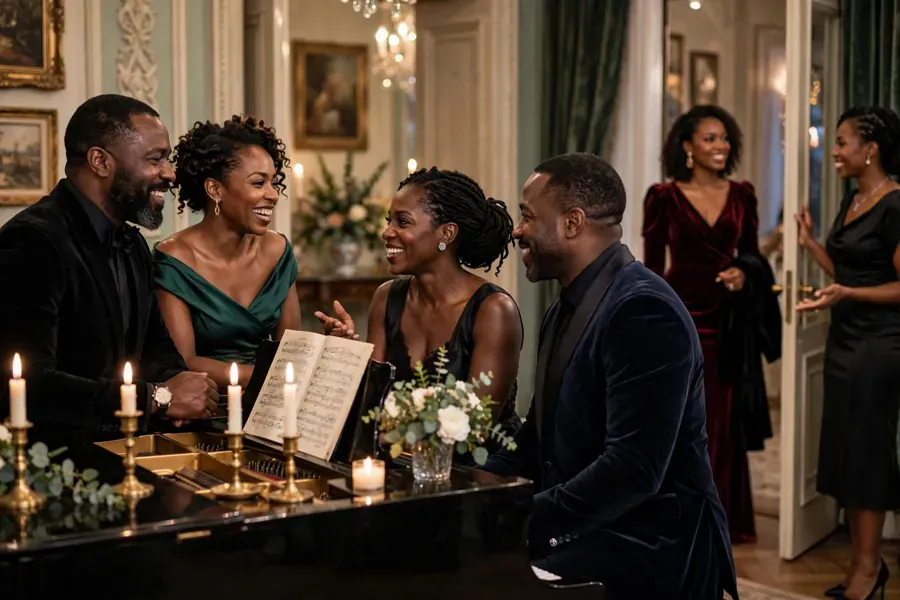
Strip away the eras and the great hosts — Walker with her hundreds of invitations, Johnson with her open Saturday door, and their modern heirs at gala tables and summer-house weekends — share a working method. First, they curate people the way editors curate pages: every guest is there for a reason another guest will be grateful for.
The young founder is seated near the elder who remembers her industry's last three cycles. The newcomer to the city is placed beside the woman who knows everyone and enjoys making introductions that stick. Nothing about it looks engineered, and all of it is.
Second, they protect the room's temperature. A great host watches a conversation the way a conductor watches an orchestra — moving toward the wilting corner, rescuing the guest trapped in a monologue, drawing the quiet brilliant person in with one well-aimed question.
Third, they feed people properly and on time; more reputations have been saved by a dinner served when promised than by any menu. Fourth — and this is the one that separates the salon from the party — they give the evening a reason beyond pleasure. A reading.
A cause introduced in ninety seconds, never nine minutes. A young artist presented properly, so the room receives her as a person and not a pitch. Columbia University's account of A'Lelia Bundles's biography of Walker makes the same point about the original: Bundles found a hostess whose generosity nourished the Harlem Renaissance — nourished, note, not merely amused.
The salon at its best is a feeding, of people and of work.
The Modern Rooms
Today's rooms wear different clothes. There is the gala chair whose table — bought, filled and worked with intention — anchors a museum's or a hospital's year; we take up that craft in Buying the Table.
There is the summer-house host on the Vineyard or in Sag Harbor, whose porch performs in August what Johnson's S Street performed every Saturday: continuity. There is the dinner-party brigade of couples who rotate houses monthly and have quietly become one another's board of directors, godparents and first call.
And there is the deliberate salon, revived in our time by hosts who set a topic, invite twelve people who would not otherwise meet, and let the evening run long. The forms change; the function — a trusted room, a curated company, a host who takes responsibility for both — does not.
It helps to say plainly what these rooms are for, because from outside they can look like mere pleasure. They are where trust is manufactured. Business between strangers is negotiation; business between people who have eaten at the same table for years is a phone call.
The introduction economy we describe in The Introduction Economy runs on collateral built in exactly these rooms, and the children's version of the same architecture — mothers building a world of peers for their sons and daughters — is the story of Jack and Jill and The Links.
When you are invited into a great room, you are not being entertained. You are being underwritten.
Earning the Invitation — and Keeping It
Which brings us to the guest's half of the craft, because a room is only as good as the people trusted to behave in it. The rules are old and they are not complicated. Arrive as the person your host described when she vouched for you.
Bring something to the conversation that is not yourself — a book, a name, a piece of news the table will use. Never conduct visible business; the room is for planting, and harvesting in public is the fastest way to stop being planted near anything valuable.
Protect what you hear: the salon's whole economy rests on the certainty that what is said at the table stays at the table, and one forwarded anecdote can end a decade of invitations.
And reciprocate in kind, not necessarily in scale — Johnson's guests repaid her in work debuted, loyalty shown and rent quietly helped with in lean years; a thoughtful, smaller hospitality of your own, offered sincerely, counts for more than a grand gesture performed for credit.
Encyclopedia.com's entry on Walker calls her an African-American hostess and literary patron whose gatherings brought together the most colorful figures of her age — and that pairing, hostess and patron, is the whole job description in two words. The hosts with the rooms are patrons of people.
They spend their houses, their tables and their introductions the way other patrons spend money, and the return — a culture fed, a generation introduced to itself, a community with a living room — compounds for decades. If you keep such a room, this magazine salutes you.
If you are building one, start the way Johnson did: one regular evening, one open door, and company chosen like you mean it. Our companion guide, Hosting the Salon, takes the craft step by step.
The Host's Ledger: What a Room Costs and What It Pays
Let us talk about the unromantic half, because the great hosts do. A serious salon or dinner series costs real money — food and drink for people with educated palates, flowers, help in the kitchen and at the door, the occasional car sent for an elder who no longer drives at night.
The keepers of great rooms treat that spending the way they treat a foundation budget: planned annually, spent without visible strain, and never, ever discussed in front of guests. The amateur host counts costs at the table; the professional counts them in January, decides what her rooms will do that year, and then lets every evening feel effortless.
There is a matching discipline on the return side. A wise host keeps a private ledger of a different kind — who was introduced to whom, which young person was presented and how she landed, which two elders should not be seated within trading distance of the same story. None of it is written for anyone else's eyes.
All of it is why, three years later, her introductions still work: she remembers what the room did, and she builds the next room on it.
The return on a great room, properly kept, is not applause. It is durability. Walker's Dark Tower lasted only a few years as a formal salon, yet a century later we still organize our understanding of a whole renaissance around her address — the room became the era's return address.
Johnson's Saturday nights ran for decades on a clerk's salary and changed no one's tax bracket, yet the work debuted around her table, and the writers steadied by her welcome, carried her hospitality into American literature permanently.
That is the exchange rate of the salon at its best: a host spends a house, a table and a lifetime of attention, and is repaid in a culture that knows where to gather.
Modern hosts working at gala scale see the same arithmetic in contemporary dress — the chair whose dinner quietly aligns a museum board, a hospital campaign and a scholarship fund in one evening has not thrown a party. She has done a year of institutional work in four hours, at a table she set herself.
Starting Your Own Room
If this portrait leaves you wanting a room of your own, begin smaller than your ambition and more regularly than your calendar prefers. Johnson's example is the honest template: a fixed evening, a modest table, and a company chosen for what they give one another.
Invite eight people the first month and ten the third; let the room acquire a reputation for two things only — that the conversation is worth dressing for, and that what is said there stays there. Feed people early and well.
Introduce every guest to every other guest as if both were doing you a favor, because in a working salon, they are. Keep the guest list in motion: a room that never admits a newcomer becomes a museum of its own first year, while a room that admits everyone becomes a lobby.
The great hosts hold the line at roughly a quarter new blood — enough to keep the talk honest, never so much that the regulars stop recognizing the place.
And when the evening runs long and the last guest is telling the story the whole night was secretly arranged to produce, do the hardest thing in hosting: pour the coffee, sit down, and let your room belong to the people in it.
The hosts with the rooms are remembered less for their tables than for that final grace — knowing the moment the room no longer needs them, and enjoying it anyway.
Hosting the Salon
Jack and Jill and The Links
The Introduction Economy
Women — Society Profiles Collection
Empire Makers — Society Profiles Collection
AALBC — "Our Kind of People: Inside America's Black Upper Class" by Lawrence Otis Graham
National Trust for Historic Preservation — "How A'Lelia Walker and the Dark Tower Shaped the Harlem Renaissance"
New Georgia Encyclopedia — "Georgia Douglas Johnson"
Columbia Magazine — "How Writer A'Lelia Bundles, Descendant of Madam C. J. Walker, Found Her Subject"
Encyclopedia.com — "Walker, A'Lelia (1885–1931)"
Questions & Answers
Who will you meet on this page?
Famous Black society hosts, salons and dinner parties have always been where our world quietly gets decided — meet the hosts whose tables move Black society, and learn what makes a host worth an invitation. It links to 5 stories and articles — open any card to read the full piece.
What makes these stories worth reading?
Famous Black society hosts, salons and dinner parties have always been where our world quietly gets decided — meet the hosts whose tables move Black society, and learn what makes a host worth an invitation.
How do I read the full stories on The Hosts With the Rooms: Famous Black Society Hosts, Salons and Dinner Parties?
Choose any card on this page. Each one opens a full page of its own — the complete story or article, with its sources linked.