
Strong at Every Age: Longevity Habits to Live to 100, With Strength After 50
The longevity habits of people who plan to live to 100 are unglamorous and repeatable — strength after 50, protein at the table, balance, hearing, and a calendar full of people.
There is a particular kind of elder everyone in our world knows. She is eighty-four and still the best-dressed person at the luncheon. He is ninety-one and still opens his own jars, climbs his own stairs, and tells the story better than anyone else at the table.
We call them blessed, and they are — but watch them closely for a week and a pattern emerges that has very little to do with luck. They move, on purpose, every day. They lift things.
They eat like people who intend to be fed by their own hands for decades. They keep their appointments — medical, social, all of them.
The longevity habits that show up again and again in people who thrive into their nineties, and in those quietly planning to live to 100 with strength after 50 as a deliberate practice, are not secrets. They are habits. And habits, unlike genes, can be adopted on a Tuesday.
What follows is general information from public-health and medical sources — the Centers for Disease Control and Prevention, peer-reviewed research on aging muscle, and the U.S. Surgeon General's advisory on social connection — checked against the way our longest-lived readers actually live.
It is not personal medical advice, and it does not replace your own physician, who knows your joints, your medications and your history. Think of it instead as the well-kept syllabus: the subjects that keep appearing on the examination of a long, strong life.
The Muscle You Do Not Spend, You Lose
The science has a name for the central fact of aging strength: sarcopenia, the progressive loss of skeletal muscle mass and strength that comes with biological aging.
A peer-reviewed review in PubMed Central describes it as one of the most important causes of functional decline and loss of independence in older adults, with a 5–10% loss of muscle mass per decade after 50 years estimated. Read that number the way you would read a financial statement.
Five to ten percent a decade, compounding quietly, taken not from your savings but from your ability to rise from a chair, catch yourself on a stair, carry a suitcase, get up off the floor after playing with a grandchild. Muscle is not vanity tissue. Muscle is independence, held in reserve.
The same review connects the loss to the life around it: reduced strength in the lower limbs is linked to longer sitting and lying time, and to a lower capacity for the daily tasks — getting up from a chair, picking something up from the floor, walking, climbing stairs — that together constitute a free life.
And it names the counterweight in the plainest possible terms: the literature is unanimous that disuse and inactivity are determinant causes of the decline. Which is the hopeful reading of the whole subject. The largest single driver of the loss is the one you control completely.
You cannot negotiate with your birth year. You can absolutely negotiate with your chair.
“Being able to carry groceries, get up off the floor, climb stairs and travel comfortably depends on strength and mobility, both of which are improved by resistance training.”— via Parade, on strength training after 50
Strength Training After 50: The Actual Prescription of Habit
Strip away the gym-culture noise and the public-health guidance is brief enough to fit on an index card.
The CDC recommends muscle-strengthening activity at least two days a week for adults, working all the major muscle groups — and for adults 65 and older, its guidance, as summarized in current reporting, is a mix of aerobic, muscle-strengthening, and balance activities each week, with major muscle groups strengthened at least twice weekly and balance activities performed regularly.
Parade's reporting on trainers who work with adults over 50 lands in the same place from the practice side: the CDC advises that adults get at least two days a week of muscle-strengthening activities that include all major muscle groups — legs, hips, back, abdomen, chest, shoulders and arms.
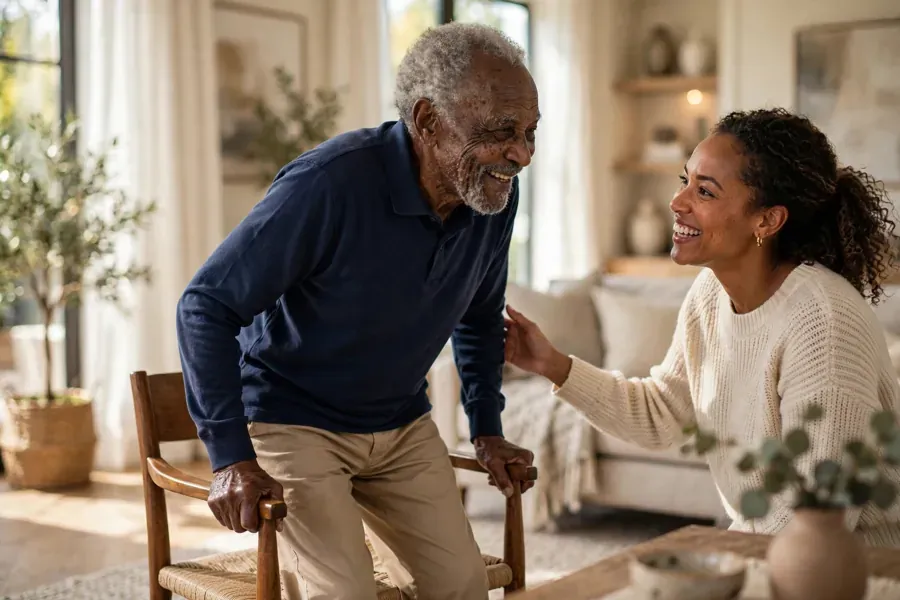
What should those two days actually contain? The movements that translate — the ones current guidance keeps returning to because they rehearse the motions of a life. Chair stands: rising from a sturdy chair, without using your hands if you can, building exactly the leg strength that getting up will demand for the next forty years.
Step-ups onto a low, stable platform, which is stair-climbing in training form. Loaded carries — walking while holding manageable weights at your sides — which is groceries, luggage and grandchildren rendered as exercise. And supported balance work: standing on one leg near a counter, walking heel-to-toe with support at hand.
Notice what is absent from that list: machinery, mirrors, and any requirement to enjoy it in public. A pair of dumbbells in a bright room at home, a trainer who respects the project, and a standing appointment will carry the whole program.
Two principles govern progress, and both are merciful. The first is progressive overload, described in CNN's reporting on strength and longevity as gradually increasing the difficulty over time — adding repetitions, slowing the tempo, or eventually incorporating resistance bands or weights.
The second is that the dose is smaller than people fear: the same reporting notes that ten to thirty minutes of focused resistance exercise can produce meaningful results, because muscle responds to stimulus, and even modest strength training, done consistently and with effort, works against age-related decline.
Ten to thirty minutes, twice a week, against five to ten percent a decade. There is no better trade available in the whole catalogue of self-care.
(And the standing caveat, which the well-kept reader treats as etiquette rather than obstacle: check with your doctor or physical therapist before beginning a new program, especially with any balance or mobility limitation — and let a professional set your starting point.)
Protein, and the Table as Training Partner
Muscle is built from two inputs: the signal to build, which is the training, and the material to build with, which is protein.
The research summarized in CNN's longevity reporting suggests older adults need more protein than younger people for effective muscle protein synthesis, with research suggesting roughly 1.2 to 1.6 grams per kilogram of body weight daily, spread across meals — about 80 to 110 grams for a 150-pound person.
Treat those figures as what they are: research-reported ranges to discuss with your own clinician or dietitian, not a personal target handed down by a magazine. The practical translation, though, needs no prescription at all.
Protein stops being a garnish and becomes a course: eggs or Greek yogurt at breakfast rather than pastry alone, fish or chicken anchoring lunch, beans, lentils and lean cuts doing real work at dinner. The table in a well-kept house already runs on beautiful food.
The longevity edit is simply to make sure every plate carries its building material — and that the protein is spread across the day, as the research describes, rather than saved for one heroic steak at night.
Food quality rides along with quantity. The same body of reporting notes that chronic inflammation interferes with muscle maintenance, and that whole foods — lean proteins, fruits, vegetables, whole grains, healthy fats — support the project while heavily ultra-processed food undermines it. Our readers do not need this translated into austerity.
It is the difference between a table built on things a grandmother would recognize and a diet assembled from packets. The elders who thrive tend to eat recognizably, joyfully, and in company — which brings us to the habit no gym sells.
People: The Social Calendar as Medicine
Ask researchers what predicts a long life and, alongside movement, one answer keeps arriving with unusual force: connection.
The U.S. Surgeon General's advisory on social connection, summarized by the CDC, concludes from multidisciplinary evidence that social connection is a significant predictor of longevity and better physical, cognitive, and mental health, while social isolation and loneliness are significant predictors of premature death and poor health.
That is the Surgeon General of the United States placing your dinner table, your church row, your standing Thursday game and your sister's Sunday call on the same ledger as exercise. The documented centenarians of magazine legend are almost never hermits.
They are people with somewhere to be and somebody expecting them — and the expectation itself is a form of training, because it gets them up, dressed, out and moving on days when nothing else would.
So keep the calendar the way you keep the dumbbells: loaded, on purpose. The club membership used weekly rather than admired annually. The volunteer shift that requires you at a set hour.
The grandchildren's recitals, the alumni committee, the choir — chosen not for résumé but for rhythm. A full social calendar is not the reward for staying strong. In the evidence, it is one of the mechanisms by which people stay strong.
Schedule people the way you schedule training, and let each appointment pull the other one along.
Hearing, Balance, and the Senses That Keep You Upright
The final habit is the one almost nobody connects to strength: hearing.
The American Speech-Language-Hearing Association's reporting on falls lays out the stakes from CDC data — more than one out of four older adults falls each year, and even a mild degree of hearing loss triples the risk of an accidental fall, with the risk rising further as hearing loss increases.
The mechanisms researchers propose are intuitive once stated: hearing feeds your awareness of the environment around you, the inner ear houses balance itself, and a brain working hard just to decipher speech has fewer resources left for posture.
However the pathways divide, the well-kept response is singular: hearing belongs on the annual checklist, tested rather than guessed at, and addressed without vanity if it has changed.
The same is true of vision, of the balance drills already in your training days, and of the house itself — light on the stairs, rails where rails belong, cords out of the walking path. Strength is a system. The strong protect every part of it.
Put the whole syllabus together and it is, you will notice, a description of a well-run household rather than a medical regimen. Two strength sessions a week, built on chair stands, step-ups, carries and balance work, progressed gradually. Protein at every meal, on a table of real food, discussed with your own clinician.
Sleep defended, as our companion piece argues, like the luxury it is. Hearing and vision tested on schedule. And a calendar dense with people who expect you.
None of it is exotic. All of it compounds. The people who plan to see 100 are not doing something different from the rest of us in kind — they are doing the ordinary things, on schedule, for decades, which is the most bourgeois secret of all: longevity is not an event.
It is a standard, kept.
The Executive Physical, Black Edition: The Checkups That Catch What Matters
Sleep Is the Last Luxury: The Well-Kept Bedroom
Related Profiles Collection — Pastors
PubMed Central — “A Review on Aging, Sarcopenia, Falls, and Resistance Training in Community-Dwelling Older Adults”
Men's Journal — “Lifting Weights After 50? Scientists Say There's Another Way to Stay Strong”
Parade — “How Many Minutes of Strength Training Do Adults 50+ Need?”
CNN — “Even modest strength training can counter age-related decline”
CDC / NIOSH — “Social Connection and Worker Well-being” (Surgeon General's Advisory summary)
ASHA Leader — “Hearing Loss and the Increased Risk of Falls”
Questions & Answers
Who will you meet on this page?
The longevity habits of people who plan to live to 100 are unglamorous and repeatable — strength after 50, protein at the table, balance, hearing, and a calendar full of people. It links to 3 stories and articles — open any card to read the full piece.
What makes these stories worth reading?
The longevity habits of people who plan to live to 100 are unglamorous and repeatable — strength after 50, protein at the table, balance, hearing, and a calendar full of people.
How do I read the full stories on Strong at Every Age: Longevity Habits to Live to 100, With Strength After 50?
Choose any card on this page. Each one opens a full page of its own — the complete story or article, with its sources linked.