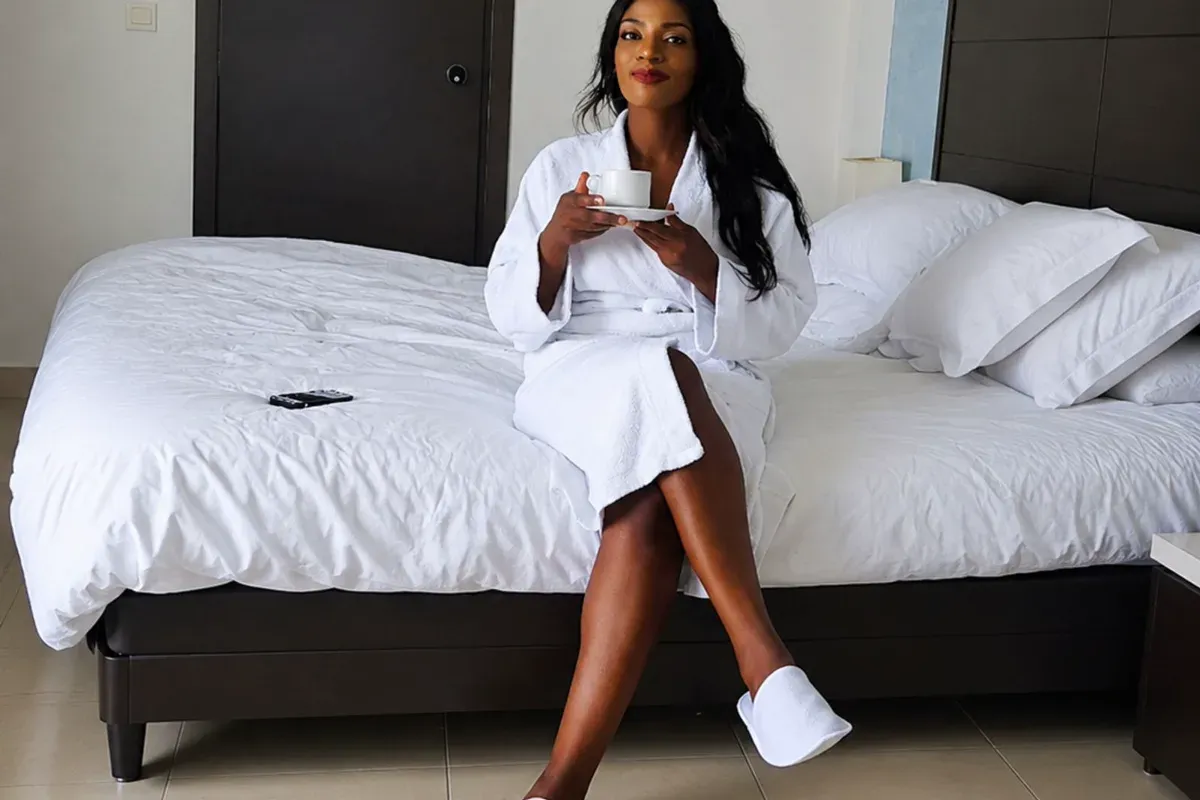
Sleep Is the Last Luxury: How to Sleep Better With a Luxury Bedroom Sleep Routine
How to sleep better starts with a luxury bedroom sleep routine — a room engineered for darkness and quiet, an hour that winds down on purpose, and the calm of knowing the science is simple.
Ask a room full of accomplished people what they would buy if money were no object, and you will hear about houses, cars, watches and trips. Ask the same people a year later what they actually treasure, and a quieter answer surfaces, again and again: sleep. Real sleep.
The unbroken, unhurried kind that leaves a face rested and a mind clear. That is why learning how to sleep better, with a luxury bedroom sleep routine you keep the way you keep any other standard in the house, may be the most bourgeois project of all. The car sits in the garage.
The watch sits in its box. Sleep goes with you into every boardroom, every photograph, every negotiation and every morning of your life.
This is general information, gathered from sleep-medicine and public-health sources — the Centers for Disease Control and Prevention, the American Academy of Sleep Medicine, the Sleep Foundation and Mayo Clinic — not personal medical advice. If sleep stays broken for you, the well-kept answer is a sleep physician who knows your history, not a magazine.
But for most of us, most nights, the gap between the sleep we get and the sleep we could get is not medical. It is environmental, habitual, and entirely within our power to close, beautifully.
How Much Sleep, Honestly?
Begin with the number, because our culture loves to bargain with it.
The CDC's guidance, drawn from sleep research, is that most adults need about 7 to 8 hours of good-quality sleep per night, and good quality has a definition worth noting: the major sleep episode should not be broken by frequent arousals, and it should be long enough for the individual.
The CDC's adult sleep statistics put the floor plainly — the recommended amount of sleep for adults is at least 7 hours each day, and adults reporting less than 7 hours are counted as getting insufficient sleep. Seven is not the aspiration. Seven is the minimum below which the body starts sending invoices.
There is a charming myth, beloved of busy people, that some rare few are built to thrive on five or six hours.
The CDC's own teaching module addresses it directly: researchers have identified gene mutations in some people who naturally sleep six or fewer hours and appear healthy, but the percentage of the population with these mutations is estimated to be small, and most people who say they do not need much sleep are pushing themselves to sleep less — and, over time, carrying the consequences in weight and in risk for several chronic illnesses.
In other words: you are almost certainly not the exception, and neither is the colleague who brags that he is. The truly rested do not brag about sleeping less. They protect sleeping enough the way they protect any other asset — quietly, and without apology.
The CDC module also offers the most elegant self-test in sleep medicine, and it costs nothing but a holiday. Observe how long you sleep toward the end of a relaxing two-week vacation, when you are under no time pressure and sleeping freely — waking spontaneously, without an alarm, and going to bed when you are tired.
Record bedtimes and wake times during the second week; the average across five to seven days is an estimate of your personal sleep-length need. That number, not a magazine's and not a guru's, is the one your bedroom should be built to deliver.
The Room Itself: Cool, Dark, Quiet
Luxury, in a bedroom, is not thread count alone. It is control — over light, over sound, over temperature — exercised so completely that the room disappears and only rest remains. The American Academy of Sleep Medicine's guidance for a good night's sleep ends with an instruction so simple it sounds like a design brief:
“Make your bedroom quiet, dark and a little bit cool.”— American Academy of Sleep Medicine, via AASM.org
The Sleep Foundation's bedtime-routine guidance says the same thing in the language of the well-kept bedroom: your routine can include transforming your bedroom into a sleep oasis, making things as cool, dark, and quiet as possible — setting the thermostat somewhere between 65 and 68 degrees Fahrenheit, turning off noisy electronics, dimming the lights and pulling down the blackout curtains.
Hold those three adjectives up against your current bedroom and audit honestly. Cool: is the room actually at sleeping temperature before you get in, or does it drift warm at midnight? Dark: can you see the glow of a charger, a television standby light, a hallway spilling under the door?
Quiet: what reaches you — a vent, a street, a house settling — and have you softened it with the unglamorous, effective tools: a solid door, sealed drapes, a fan or sound machine for a steady floor of quiet?

Then the bed itself, treated as furniture with a job. The Sleep Foundation's counsel is that the bed should be a soothing place used specifically for rest — getting into it is the final step of the routine, and once your head is on the pillow, you do nothing else but try to fall asleep.
That single discipline rearranges a room. The laptop works in the study. The phone charges in the kitchen or the dressing room, in a drawer, out of reach and out of glow.
Reading — real reading, paper in hand — is welcome; it has been part of the wind-down in good houses for centuries. Scrolling is not reading. One of them lowers the heart rate.
The other raises it while telling you it is relaxing you.
The Wind-Down: An Hour, Kept Like an Appointment
Nobody falls asleep the way a light goes out. The body descends, and the descent can be choreographed.
Mayo Clinic Health System's sleep-medicine guidance collects the classic habits in one place: avoid alcohol at least three hours before bedtime, avoid caffeine within six hours of bedtime, establish relaxing presleep rituals such as a warm bath or ten minutes of reading, and keep a regular schedule to help your inner clock run smoothly.
Read that list again and notice what it really is: a schedule for the last hours of the day, which is to say, an act of household management. Dinner ends at a civilized distance from bed. The last coffee has a curfew.
The evening drink, if there is one, is early enough to be finished with its mischief before the lights go down.
The AASM's hygiene guidance, summarized in its sleep-education materials, adds the pieces our readers most often resist: go to bed and wake up at the same time every day, even on weekends; limit screen time at least an hour before bed to reduce blue-light exposure; and engage in relaxation practices — meditation, deep breathing, gentle stretching — before bed.
The weekend clause is the one that separates a routine from a wish. A body clock does not know it is Saturday. The houses that sleep well tend to keep one rising time the way they keep one standard for everything else: not rigidly, not joylessly, but as the default that exceptions must argue with — and usually lose.
Build your own hour, then, the way you would build any ritual worth keeping. Ours, offered as a pattern and not a prescription: lights lowered throughout the house at a set time, so the whole home exhales at once.
A warm shower or bath — the subsequent gentle fall in body temperature is part of why it works with the cool room, not against it. Tomorrow written down: the three things that matter, on paper, in another room, so the mind is not asked to hold them overnight. A book, a real one, chosen for pleasure rather than improvement.
And the bed entered only when sleepy, in a room already cool, already dark, already quiet. Do it for two weeks without negotiating with yourself, and then judge it. Rituals earn their keep in the keeping.
The Mattress, the Linen, and the Honest Splurge
Where, in all this, does money actually help? In three places, in this order. First, darkness and quiet: proper blackout drapes, well fitted, and a door that closes like it means it will repay you more than any scented candle ever made.
Second, temperature: a thermostat you can program to cool the room before bed and warm it before rising, and bedding that breathes — natural fibres that let heat leave rather than trapping it against the skin. Third, the bed itself: a mattress and pillows fitted to your body and your sleeping position by trial, not by advertising.
Every sleep source in this article converges on the same unglamorous point — a comfortable mattress and pillows are part of hygiene, not indulgence — and the well-kept twist is simply this: replace them on schedule, the way you replace anything else in the house that has quietly worn out beneath you. A sagging mattress is not a character trait.
It is deferred maintenance, and you are paying for the deferral nightly.
What money cannot do is buy its way past the habits. The most expensive bedroom in the world will not rescue a midnight phone habit, a 10 p.m. espresso, or a rising time that swings three hours between Tuesday and Sunday. That is, in its way, wonderful news.
It means the last luxury is not really for sale. It is a standard — and standards, as our readers know better than anyone, are set by the people who live in the house, not by the people who furnish it.
Travel and Time Zones: What the Truly Rested Do Differently
Our readers cross time zones the way other people cross town, and sleep is usually the first casualty of the itinerary.
The CDC's guidance for aircrew — people whose profession is circadian disruption — passes along the National Institutes of Health and National Sleep Foundation approach, and it translates beautifully to the private traveller: keep the same times for sleep and waking where you can, use ear plugs and eye masks to reduce noise and light, sleep in a cool room with a comfortable mattress and pillows, avoid alcohol two to three hours before bedtime, limit caffeine, and avoid heavy meals two to three hours before bed.
And for the hotel room itself, the advice is pure housekeeping, and it works: set up a quiet, dark, comfortable, cool room on arrival — block the light coming under the door and through the windows, cover the lighted clock dial, and pack the eye mask, the ear plugs, and even clothes pins to pin the drapes together.
Research on athletes crossing time zones — a population whose performance is measured to the decimal — adds the light strategy: a consensus review in the sleep literature describes combined interventions built around timed light exposure or avoidance to help the body clock shift toward the destination, with eastward travel generally the harder direction.
The traveller's translation is simple and requires no equipment: get outside into daylight at the destination, at the destination's morning, and let the sun do what it has done for every traveller before you. Build the first day around light and movement, keep the first evening short and dim, and resist the heroic nap that steals the first night.
(Anything pharmacological — melatonin included — belongs in a conversation with your own clinician, who knows your medications and your history. A magazine does not prescribe, and a well-kept traveller does not improvise.)
There is one more travel habit the truly rested share, and it is social rather than scientific: they defend the night before and the night after. No red-eye taken to prove toughness when a morning flight exists. No gala scheduled for the evening of a long-haul arrival when it can be gracefully declined or moved.
The itinerary, like the bedroom, is a design problem — and the people who arrive rested are rarely the ones who got lucky. They are the ones who designed for it.
When to Call the Sleep Physician
A standard has limits, and honesty about them is part of the standard.
If you snore heavily, wake gasping, are told you stop breathing in the night, or remain unrefreshed despite enough hours in a good room on a good routine, that is no longer a bedding question — it is a medical one, and the right move is an evaluation by a sleep-medicine clinician.
The same is true for insomnia that persists for weeks, or sleepiness that makes driving feel unsafe. Mayo Clinic's sleep services exist precisely for this: formal sleep studies track breathing, brain waves, heart rate and more across a night, because some disorders can only be seen, not guessed at. Seeking that evaluation is not a failure of the routine.
It is the routine, completed — the well-kept self does not white-knuckle a health question that professionals can answer.
For everyone else, the path is the one this article began with, and it is almost disappointingly attainable: seven to eight hours, in a room that is cool, dark and quiet, behind an hour that winds down on purpose, on a schedule the weekends respect, in beds and across time zones arranged with the same care we give everything else we value.
Sleep is the last luxury because it cannot be displayed, delegated or bought outright. It can only be kept. Keep it well.
Strong at Every Age: The Longevity Habits of People Who Plan to See 100
The Most Exquisite Hotels
The Sanctuary at Home
Related Profiles Collection — Women
CDC / NIOSH — “Module 2. How Much Sleep Do You Need?”
CDC — “FastStats: Sleep in Adults”
Sleep Foundation — “How to Build a Better Bedtime Routine for Adults”
Mayo Clinic Health System — “Sleep Medicine”
CDC / NIOSH — “Aircrew and Jet Lag”
PubMed Central — “Managing Travel Fatigue and Jet Lag in Athletes: A Review and Consensus Statement”
American Academy of Sleep Medicine — AASM.org sleep guidance
Questions & Answers
Who will you meet on this page?
How to sleep better starts with a luxury bedroom sleep routine — a room engineered for darkness and quiet, an hour that winds down on purpose, and the calm of knowing the science is simple. It links to 4 stories and articles — open any card to read the full piece.
What makes these stories worth reading?
How to sleep better starts with a luxury bedroom sleep routine — a room engineered for darkness and quiet, an hour that winds down on purpose, and the calm of knowing the science is simple.
How do I read the full stories on Sleep Is the Last Luxury: How to Sleep Better With a Luxury Bedroom Sleep Routine?
Choose any card on this page. Each one opens a full page of its own — the complete story or article, with its sources linked.