
Travelling With Art, Jewellery, and Other Precious Cargo
Wondering how to travel with expensive jewelry — and the art, watches and heirlooms that travel with it — with real insurance and real safety? Move your valuables the way institutions do.
Every collector eventually faces the same quiet question at the door: how to travel with expensive jewelry, a serious watch, or a painting that matters — safely, and with insurance that actually responds if the worst happens on the road. The necklace is going to the gala in another city.
The painting is going to the second home, or to a fair, or to a daughter. The watch on your wrist is worth more than the car that took you to the airport.
Institutions solve this problem every day — museums, galleries and auction houses move irreplaceable things across the world as a matter of routine — and their methods are not secrets.
They are simply disciplines: document everything, insure for the journey specifically, hand the object to professionals when it outgrows your carry-on, use the paper that borders respect, and never, ever mistake a hotel room safe for a vault. Here is the institutional method, translated for the private traveller.
First, the Paper: Appraisals, Photographs, Inventory
Nothing moves until it is documented.
Chubb's guidance on travelling with fine jewellery and watches starts where the museums start: have your jewellery appraised, and keep the appraisal current — Chubb advises reappraising every three to five years, and more frequently for high-value and sought-after pieces, including luxury steel sport watches and jewels with rare fancy-coloured diamonds, because market prices move and an old valuation quietly under-insures you.
Before you pack, the same guidance says, check each piece properly: that it fits, that no stones are loose, no clasps broken, no prongs damaged — a piece already weakened is a piece the journey will finish.
Build the file a registrar would build: a photograph of each item, its description, materials, gemstone grading and condition, stored securely and separate from the objects themselves. If anything is ever lost, stolen or damaged in transit, that file is the difference between a claim and an argument.
Our companion guide to choosing pieces that deserve this treatment is Jewellery With Intent; this piece is about what happens when those pieces leave the house.
Insurance That Actually Responds
Here is the uncomfortable truth the institutions know: a standard homeowner's policy is a thin shield for valuables in motion. The coverage built for the purpose is a specialised valuable articles policy.
Chubb's collector guidance advises travellers to look for a Valuable Articles Coverage policy offering worldwide, all-risk protection, including theft and mysterious disappearance — that last phrase matters more than any other in the contract, because most travel losses are not witnessed thefts but pieces that simply vanish, and a policy that excludes mysterious disappearance excludes the likeliest claim you will ever file.
The same guidance pairs the policy with regular appraisals from a qualified appraiser, so coverage keeps pace with value. For art, the equivalent concept has a name every registrar knows: nail-to-nail, or wall-to-wall.
Flaster Greenberg's primer on fine art transit insurance explains that coverage is available for art in transit from origin to destination, nail-to-nail, for newly acquired pieces, for pieces stored while in transit, and for pieces on tour at exhibitions and art fairs — and warns against relying on a carrier's own full-value protection, which demands strict adherence to the carrier's terms and often costs more than insuring separately.
Two questions to put to your broker before any journey, drawn straight from that guidance: does my policy carry a clearly defined transit limit high enough for this piece, and is the value tied to a recent appraisal or bill of sale? If either answer hesitates, the piece does not travel yet.
The wider architecture of protecting a built life is covered in Insuring the Life You've Built.
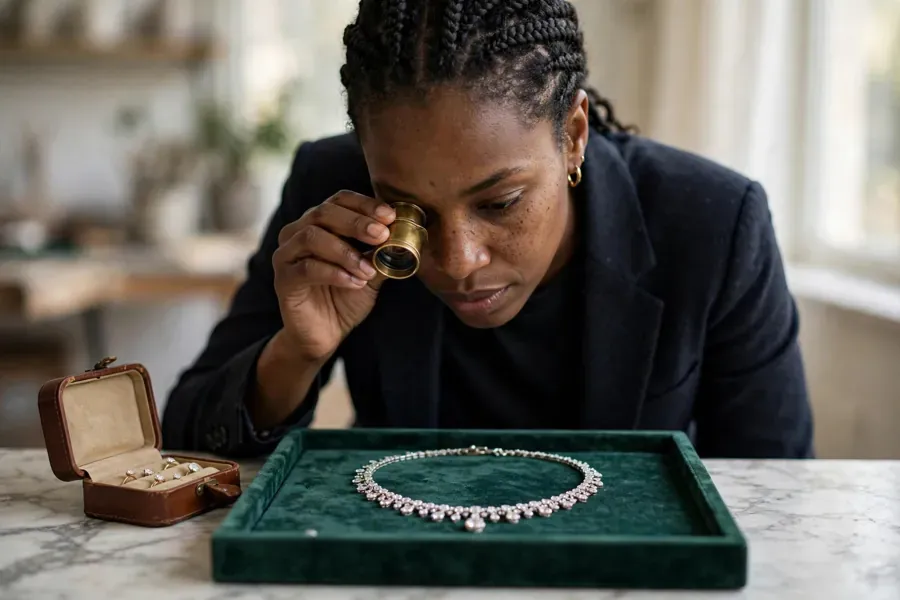
Carry It Like You Mean It: Jewellery and Watches in Transit
For pieces that travel on your person, the rules from the trade are consistent. Chubb's travel guidance is blunt: when travelling, keep expensive items with you at all times or use the hotel vault — not a room safe — and never pack jewellery in checked luggage or wear it in less secure areas like the pool or beach.
National Jeweler's eight tips, drawn from Jewelers Mutual and Jewelers Unblocked, add the working details: keep jewellery on your body going through airport security rather than setting it aside to be scanned where strangers can reach it; be discreet outside the hotel, with rings turned inward and pendants tucked under clothing; take pieces off and lock them away before chlorinated pools, hot tubs or the ocean, since chlorine and saltwater can damage precious metals and some gemstones; and check insurance coverage whether the pieces travel with you or stay home.
Chubb adds one elegant, time-tested option for the truly carefree trip: travel jewellery — a faithful replica worn in place of the original, the trick Elizabeth Taylor used with a replica of her renowned diamond made for a small fraction of the real stone's cost. There is no shame in it. There is only risk management, worn beautifully.
The Hotel Safe That Isn't
Let us settle this one properly, because it is the single most expensive misunderstanding in luxury travel. The safe in your hotel room is a convenience with a master override: the hotel can open it, by design, which means it is a deterrent to the casual opportunist and nothing more.
National Jeweler's guidance directs high-value pieces instead to a two-key control safety deposit box or a secured vault where the hotel offers one — more secure than the in-room safe, which it reserves for semi-valuable belongings.
Chubb says the same from the insurer's side of the desk: avoid storing high-value items in the in-room hotel safe, keep them in the hotel's main vault, and consider calling ahead to review the property's secure storage options before you arrive. Do that calling.
A grande dame with a proper vault, a signed receipt system and a security director who knows your name is part of the precious-cargo infrastructure; a beautiful room with a wardrobe safe is not. And whichever you use, photograph what goes in. Documentation is a habit, not an event.
When the Piece Outgrows Your Carry-On: Couriers and Crates
Art changes the method entirely. A painting does not ride in a tote; it rides in a custom crate, in a climate-stable vehicle or cargo hold, handled by technicians who do nothing else.
Specialist firms such as Atelier 4 describe the professional standard: in-house, licensed customs brokerage, air and sea freight coordination, ATA Carnet and temporary-import processing, and hand-carry courier options with no third-party handoffs.
For the most valuable or sensitive works, a courier travels with the piece — Constantine's touring-exhibition logistics checklist sets out when a courier is sensible: when the work is high-value or highly sensitive, when installation is complex, when a tour has many venues and repeated repacking risk, or when the lender requires direct oversight — with the courier's duties defined in writing: what they check and sign for condition, packing quality and installation positioning, and who they report to.
Private collectors borrow this wholesale. If a work matters enough to insure nail-to-nail, it matters enough to crate properly, condition-report at both ends, and put a named human being in charge of it door to door.
The collection itself — and the Black masters who anchor so many of ours — is the subject of The Vault: Art and the Black Masters.
Choosing the Hands: How to Vet a Fine-Art Shipper
When you hire the professionals, hire them the way a gallery would.
Globex Courier's guide to secure fine-art shipping sets out the criteria plainly: judge a carrier on genuine fine-art expertise, on tailored capability — on-site custom crating and white-glove, door-to-door execution — on customs competency with a dedicated brokerage pipeline, and on operational transparency, with insurance conditions, delivery timelines and liability limitations stated explicitly.
Its warning deserves framing: the common mistake is opting for the cheapest generic shipping service, and cutting corners on packaging or choosing an unvetted carrier can end in the irreversible loss of an irreplaceable asset.
The same guide underlines the insurance point from the shipper's side: in global transport, zero risk does not exist, which is why all-risk transit insurance with an accurately declared valuation is treated as an absolute necessity rather than an upsell.
Ask every candidate the registrar's questions — who packs it, who carries it, who clears it, who signs for it at each handoff, and what exactly responds if it is damaged: restoration costs, agreed value, and the diminution in value that remains even after a repair. A shipper who answers all five without blinking is the shipper.
And if, despite everything, something goes missing on the road, the protocol is short and immediate. Cumberland Diamond Exchange's expert guide to travelling with jewellery advises: report the loss at once to security, the police or the relevant authorities, so an official record exists; then notify your insurer as soon as possible, with your documentation behind the claim.
Its preventive counsel matches the rest of this piece — a detailed inventory with photographs, descriptions and appraisals; pieces kept separated in a proper travel case inside your carry-on so nothing scratches or tangles; and, for multiple pieces, a deliberate split between bags rather than every treasure in one place. Loss is rare when the disciplines hold.
When it happens anyway, speed and paper are what remain — and both are arranged long before the journey begins.
Borders: The Carnet, the Paper the Customs Officer Respects
Cross a border with valuables and a second discipline begins: proving, on paper, what the object is, what it is worth, and that it will leave again. For art travelling temporarily — to an exhibition, a fair, a second home abroad — the instrument is the ATA Carnet.
Flight Logistics Group's collector's guide to international shipping describes the carnet as an international customs document that simplifies the temporary importation and re-exportation of goods, purchased through a Chamber of Commerce, serving as a customs declaration and carrying detailed information about each artwork, including descriptions and values — with strict rules: it works only in countries on the ATA system, and only when every item shipped is also being returned on the same carnet.
Boomerang Carnets' guide to using carnets for artwork adds the financial logic:
A lender would compare the cost and benefits of a permanent (consumption) entry, ATA Carnet and TIB to determine which is most economical.— Leslie Levy August, Vice Chair and COO of Boomerang Carnets, via ATA Carnet's guide to carnets for artwork
The same guide notes the point collectors miss: even into the United States, where most fine art is not subject to duty, the carnet serves as registration of goods — evidence of where the items originated, so they are not assessed duty or tax on the way back in.
Jewellery crosses borders on the same principle, at personal scale: carry your appraisals and purchase records, declare honestly where declaration is required, and keep the paperwork with you, not with the pieces.
Precious cargo travels best in daylight, with its papers in order and its story consistent at every border: what it is, whose it is, where it has been, and when it goes home.
None of this is fuss. It is how the things a family has gathered — the necklace from a grandmother, the painting bought the year the business turned, the watch that marks a life — arrive in the next city, and the next generation, intact. Document it.
Insure the journey, not just the object. Use the vault, hire the courier, respect the carnet. Then put the necklace on, and go dancing.
Insuring the Life You've Built
The Vault: Art and the Black Masters
Jewellery With Intent
Chubb — "Traveling with Luxury Jewelry & Watches: Stay Safe"
Chubb — "Tips for traveling with fine jewelry and watches"
National Jeweler — "For customers, 8 tips for traveling with jewelry"
Flight Logistics Group — "A Collector's Guide to International Shipping"
Atelier 4 — "International Art Shippers: Fine Art Customs Brokerage & Freight"
Flaster Greenberg — "What You Should Know About Fine Art Transit Insurance"
Constantine — "Touring Exhibition Logistics Checklist for Art Loans"
ATA Carnet (Boomerang Carnets) — "How To Use Carnets for Artwork"
Globex Courier — "Secure Fine Art Shipping & Logistics"
Cumberland Diamond Exchange — "Traveling with Jewelry: Expert Tips to Keep Your Treasures Safe"
Questions & Answers
How do seasoned travelers plan a trip that feels effortless?
Wondering how to travel with expensive jewelry — and the art, watches and heirlooms that travel with it — with real insurance and real safety? Move your valuables the way institutions do. It links to 4 stories and articles — open any card to read the full piece.
What separates a good trip from a great one?
Wondering how to travel with expensive jewelry — and the art, watches and heirlooms that travel with it — with real insurance and real safety? Move your valuables the way institutions do.
How do I read the full stories on Travelling With Art, Jewellery, and Other Precious Cargo?
Choose any card on this page. Each one opens a full page of its own — the complete story or article, with its sources linked.