The Big Table: Hosting Thanksgiving for a Large Family — Tips and a Timeline Without the Meltdown
Hosting Thanksgiving for a large family is a production, and productions run on tips, a timeline and assigned roles — not on hope. Here is the file for houses that seat twenty-four.
If your house is where the family lands for the holidays, you already know the truth about hosting Thanksgiving for a large family: the tips that save you are boring, the timeline is everything, and the meltdown everybody jokes about is simply what happens when twenty-four people's dinner depends on one person's memory. The big table is a joy.
It is also a logistics exercise wearing a beautiful dress. Treat it as both, and you get to be in the photographs this year — seated, smiling, with a plate of your own food still warm.
The planning guides agree on where it starts, and it is not the menu. It is the count. One hosting checklist puts the guest number first for a reason — the number of people affects the menu, the seating and the serving plan all at once.
Lock the list early, confirm it once, and plan for the two extra chairs every big family magically produces. Everything else in this article hangs off that number.
Split the Menu Across Households
No single kitchen should carry twenty-four people's Thanksgiving, and at our level, none has to. The menu split is the big table's founding document: the host house keeps the bird, the gravy, the dressing and the honour dishes that define the family's table. Sister houses carry assigned sides — assigned, not volunteered into a pile of four identical macaroni casseroles.
The same hosting checklist advises making requests specific: not “a side dish,” but the exact casserole a person is known for, and for guests who do not cook, a named pie or bread from a named bakery. Specificity is kindness. It tells every contributor their dish has a place on the table before it leaves their kitchen.
Write the split down where everyone can see it. A shared sign-up, as one planning guide recommends, lets guests claim a course and name their exact dish, so duplicates are avoided before anyone starts cooking.
Keep the family's sacred dishes sacred — the guides are blunt that the holiday is the wrong day to retire a beloved stuffing for a trendy alternative — and let adventure live in one new side and one new dessert, clearly marked as the experiment. Tradition carries the table; novelty gets a tasting spoon.
Do the bird arithmetic early and in writing.
Planning guides put the allowance at roughly one to one and a half pounds of bone-in turkey per guest, toward the top of the range when leftovers are part of the family's religion — and for a table of twenty-four, that arithmetic points many houses toward two birds rather than one heroic one, which also solves the oven problem below.
A frozen bird, the same guides note, needs about a day of refrigerator thawing for every four to five pounds, so the calendar, not the Wednesday panic, decides the shopping day.
The Timeline Is the Host
The single most useful sentence in the hosting literature is borrowed from Ina Garten's practice, relayed by the checklist above: build a detailed day-of plan — what dish is prepared at what time, what goes into the oven at a specific time and what comes out when. At twenty-four covers, the oven is not an appliance; it is a constituency.
Two dishes cannot both bake at different temperatures in the same box at the same hour, and four burners cannot pretend to be six. The timeline is where those collisions get resolved on paper, a week early, instead of at the stove, an hour late.
Work backwards in bands.
A two-week countdown from one event-services guide runs the order cleanly: guest list, menu and dish assignments settled first; non-perishables and wine bought next; freezable dishes and cranberry sauce made a week out; the table set completely two days before; casseroles assembled and cold sides made the day before; and on the day itself, a short list — the bird, the gravy, fresh rolls and reheating.
That guide states its principle as a ratio worth framing: only about thirty percent of Thanksgiving needs to happen on the day. The other seventy is done by a calmer person — you, earlier.
Label everything. The guides' most charmingly practical tip is to mark serving dishes in advance with what they will hold, so helpers never have to interrupt the cook with questions — and to label incoming dishes with their reheating temperature and time. At a big table, labels are a staff.
They let a nephew run the warming drawer like he was born to it, and they let the host answer “where does this go?” with a gesture instead of a sentence, forty times an afternoon.
Elders' Plates First, Always
Order at the big table is not formality; it is the family's constitution read aloud. The etiquette sources phrase the general rule as older people before younger people, and guests before family, and Thanksgiving etiquette collections add that the eldest adult is seated first.
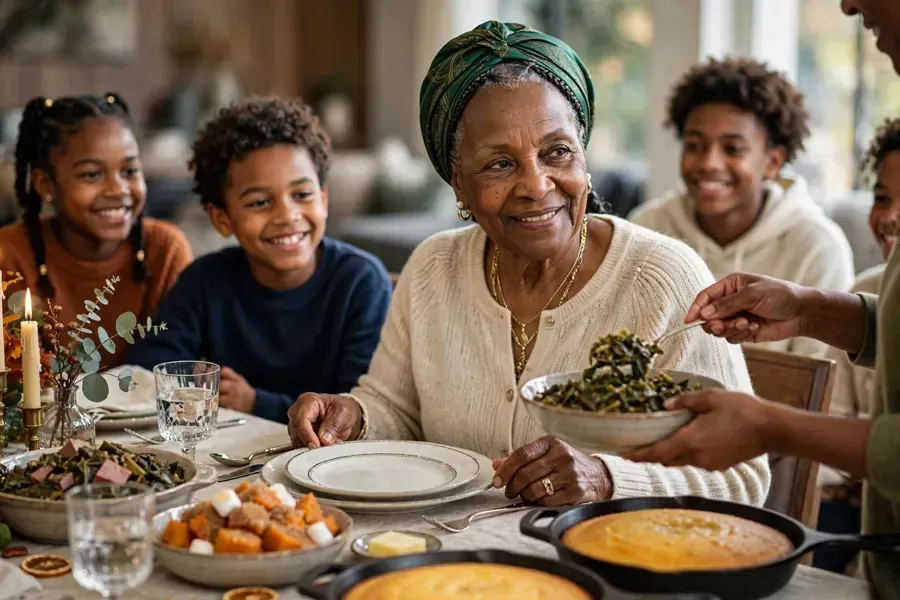
In our houses, that becomes a simple ceremony: the elders are seated at the places of honour, their plates are built first — by a designated server, not by a queue — and nobody's fork moves until the blessing has been said over a table where the people who made the family possible are already served. It takes four minutes.
It teaches the children more about who we are than any speech.
Seat with intention, too. Place cards at a family table are not stiffness; they are how a host protects a shy teenager from a loud corner, puts the hard-of-hearing grandfather where he can follow the table, and keeps the two beloved uncles whose football opinions require distance at a peaceable range.
The etiquette guidance on place cards is firm — a guest does not switch a card; the host arranged the seating on purpose — and at the big table, that purpose is love with a seating chart.
The Kids' Table That Isn't a Punishment
Handled badly, the children's table is exile. Handled well, it is the best seat in the house — and the difference is entirely in the dressing.
Give it the same linen, the same flowers in a lower arrangement, the same good glasses in a sturdier form, and food served at the same moment the elders are served, in the same order, by the same servers.
Put a young adult captain at its head — an older cousin with genuine authority and a sense of occasion — rather than leaving supervision to chance; etiquette writers on holiday gatherings suggest exactly that, whether by seating children beside parents or appointing a trusted older cousin to preside over a separate children's table.
Teach the table before the day, lightly. One family-etiquette guide describes rehearsing the manners that matter — letting others be served first as a way of honouring age, carrying a plate carefully, please and thank you as reflexes — through cheerful practice rather than day-of correction.
Children rise to a table that treats them as apprentices in the family's art, not as a problem to be parked. And the graduates remember it: ask any adult who once presided over the kids' table in state, and watch them sit up straighter at the memory.
For the full architecture of a seated house party at this scale, hosting at home: dinner for twenty-four is the companion file, and the table settings, course by course settles every fork question in advance.
The Buffet Question, Answered Honestly
At twenty-four, family-style service at one table asks a great deal of elbows and passing arms, and the guides know it.
Their logistics counsel is to decide early whether the meal is served at the table or from a buffet — and if a buffet, to fix its location before the day, along with a separate drinks station so the kitchen stays a kitchen.
Our register splits the difference with a clear conscience: the elders are served at the table, always; the main table passes the honour dishes family-style; and a dressed sideboard carries the abundance — second helpings, the extra casseroles, the rolls — so the table itself never drowns. Flow is a form of courtesy.
A guest should never have to choose between holding a plate and greeting a cousin.
Keep the zones clean. Drinks in one place, away from the cooking traffic, with water and children's options beside the wine and cider, and coffee staged for the end of the night before it is needed.
Desserts get their own moment and their own surface — pies arriving on a cleared sideboard read as a second act; pies wedged between the gravy and the rolls read as an afterthought, and our grandmothers did not raise afterthoughts.
What the Family Owes the House
A big table runs on reciprocity, and the guest side of the contract deserves printing beside the host's. Answer the invitation promptly and completely — how many of you, truly — because the host's every calculation hangs off that number.
Bring exactly what was assigned, in the quantity assigned, in a dish it can be served from, with its serving spoon: a contribution that needs the host's oven, bowls and utensils on arrival is a task wearing a bow.
If a dish in your party's life has changed — a new allergy at your table, a child who has become a vegetarian since last year — that news travels a week early, offered with its own solution attached, as the etiquette guidance suggests: an open offer, following the host's direction, with a dish in hand that quietly covers the need.
On the day, arrive at the hour on the invitation, neither early enough to find the host in her robe nor late enough to hold twenty-three people's blessing hostage. Greet the elders first.
Keep one cocktail's discipline before dinner, keep phones off the table entirely, and take the seat your place card gives you with visible pleasure — somebody who loves you and knows this family chose it.
When the meal ends, the guests' brigade forms without being asked: plates carried, leftovers packed under direction, the children's table folded back into childhood for another year. And the thank-you that follows within days — written, specific, naming a dish and a moment — is not decoration.
It is how a guest gets prayed for, in the hosts' own phrase, when next year's list is made.
The Host's Exit Strategy
Every big-table plan fails at the same point if it is not designed against: the host, still in an apron at dessert, having eaten standing up.
The two-week guide's day-of schedule contains the antidote in a single instruction — cooking stops well before guests sit, so the host can wash, change, breathe and arrive at her own table as a participant. Build your exit the same way. The last hot task ends thirty minutes before the blessing.
A designated closer — spouse, sibling, the brigade of older grandchildren — owns the kitchen from that moment: gravy kept warm, seconds ferried, coffee started. Your only remaining jobs are the welcome, the blessing's introduction, and being visibly, unhurriedly glad that these people are in your house.
Hosting isn't about performing — it's about being present.— Sterling Event Services, Thanksgiving hosting guide
And when it is over, end like a house that does this often. Leftovers are packed for elders first, then for the households that cooked, in containers you bought for the purpose and never want back.
The goodbyes happen at the door with both hands free — which means the dishes have a plan that does not include you performing industry while your family watches. Tomorrow-you can run the crystal through its bath.
Tonight-you sits down, at last, with the slice of pie that was cut and set aside before service — because the final rule of the big table is the first one, restated: the host eats too.
The family that does this in the backyard all summer — see the cookout, elevated — and orders its feast from the masters when the season calls for it — see the soul food circuit — has nothing left to prove at Thanksgiving except gratitude, which was the assignment all along.
The Cookout, Elevated: Backyard Season Without Lowering the Standard
The Soul Food Circuit: The Best Plates Around the Country
Hosting at Home: Dinner for 24
Profiles: The Women Collection
Chief Family Officer — "Get Ready for the Holidays: Have a Hosting Plan"
Sterling Event Services — "Stress-Free Thanksgiving Hosting Guide"
SignUpGenius — "Thanksgiving Planning Timeline and Hosting Guide"
Celebrations at Home — "How to Host Thanksgiving"
Clise Etiquette — "Avoiding Thanksgiving Manners Mishaps and Misunderstandings"
The Parks Image Group — "Thanksgiving Etiquette: When Parents Don't Watch Their Kids"
Beep — "Who Serves First at a Table?"
Questions & Answers
Who starts the meal, and when do you put your napkin on your lap?
Hosting Thanksgiving for a large family is a production, and productions run on tips, a timeline and assigned roles — not on hope. Here is the file for houses that seat twenty-four. It links to 5 stories and articles — open any card to read the full piece.
Who pays when one person invites another to dinner?
Hosting Thanksgiving for a large family is a production, and productions run on tips, a timeline and assigned roles — not on hope. Here is the file for houses that seat twenty-four.
How do I read the full stories on The Big Table: Hosting Thanksgiving for a Large Family — Tips and a Timeline Without the…?
Choose any card on this page. Each one opens a full page of its own — the complete story or article, with its sources linked.