
Wine Service at Home: Decanters, Glasses, and the Pour That Honours the Bottle
Wine service at home is a small ceremony with real rules — the decanter chosen for the bottle's age, the glass shaped for its grape, the temperature respected, and a pour that leaves room for the wine to speak.
There is a moment, just before a dinner party finds its rhythm, when the host either honours the bottle or merely opens it. The wine may have cost a great deal or very little; that is not the moment's measure.
The measure is whether somebody thought — about the decanter, about the glass, about whether the bottle is too warm from the kitchen or too cold from the cellar, about how full to pour. Wine service at home is not restaurant theatre transplanted to a dining room.
It is something better: the quiet craft of giving a good bottle its best chance in front of the people you most want to please. The good news is that the craft is learnable, and its rules are few.
Master the decanter, the glass, the temperature and the pour, and every bottle you own — from the Tuesday claret to the anniversary Burgundy you have been saving — will taste like the best version of itself.
The Decanter: Two Jobs, and Only Two
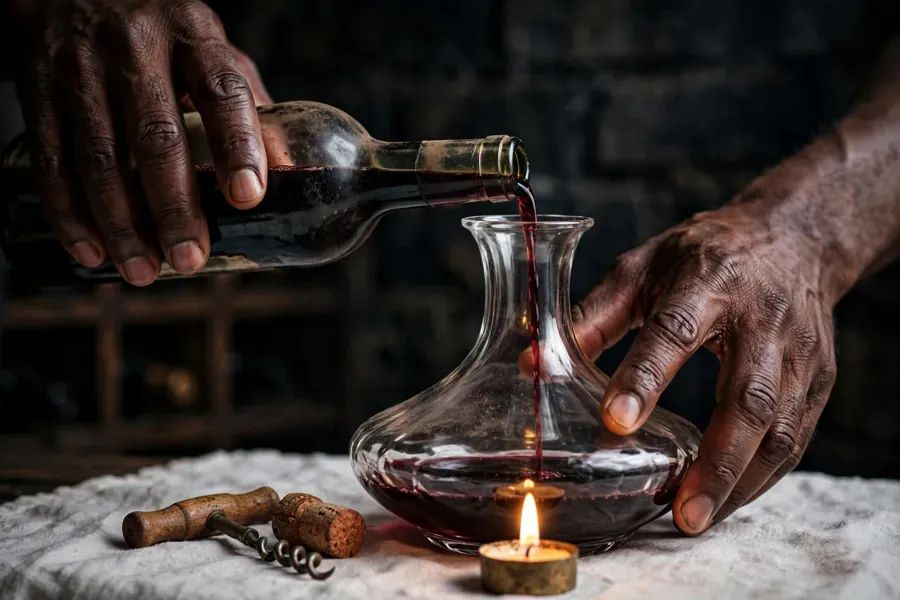
Everything about decanting becomes simple once you know it does two jobs and no more. The first is separation: old red wines throw a sediment — a harmless, bitter sludge of pigment and tannin that gathers over years — and decanting pours the clear wine off it.
The second is aeration: young, tight, tannic wines soften and open when they meet air, their fruit waking and their edges rounding. Which job you need decides everything else: the decanter's shape, the timing, even whether to decant at all.
SommSelect's decanting and serving guide lays out the preparation for the separation job with a sommelier's patience: store the bottle on its side until the day, then stand it upright for 24 to 48 hours in a cool place so the sediment settles to the bottom — especially important for wines of fifteen to twenty years and older — and open it with care, ideally with an Ah-So pronged opener if you open old bottles often, since it grips a fragile cork from the sides instead of crumbling it into the wine.
Then pour slowly, in one steady movement, watching the shoulder of the bottle against a light, and stop the instant the first cloud of sediment reaches the neck. What remains in the bottle is an inch of sacrifice. Pay it gladly; it is the price of a clean glass.
For the aeration job, shape is speed. Flight Wine Bar's decanting guide explains that a wide-based decanter exposes three to four times more of the wine's surface to air, cutting the effective aeration time roughly in half, while a narrow carafe slows the exchange and stretches the wait.
Its timing table is a sensible household rule: a red under five years old wants 60 to 120 minutes; five to fifteen years, 30 to 60; fifteen to twenty-five, just 15 to 30; and a bottle past twenty-five years should get a splash and no more, because its aromatics are fragile and oxidation can take them faster than dinner can start.
SommSelect's counsel rhymes with it — most young reds up to ten or fifteen years benefit from 30 to 60 minutes, robust Bordeaux and Napa Cabernet from great vintages can stand as exceptions among old wines, and vintage Port should always be decanted away from its sediment — while delicate older Burgundy and Pinot Noir may need no decanting at all, fading if you insist.
Learn your own cellar's habits, bottle by bottle; but begin from these numbers, not from bravado.
The Glass: Shaped for the Grape, Not the Shelf
Red wines generally need to breathe, so a fuller, rounder bowl with a wide opening suits them best.— Geller, quoted in The Drinks Business glassware guide
Glassware inspires more snobbery per square inch than any other subject in wine, so it is a relief that the authorities keep the faith simple.
Berry Bros. & Rudd's guide to glassware reduces a serious home set to three basic shapes: a tall flute for sparkling wine, to show the bubbles at their best; a larger glass with a pronounced bowl for reds, giving the wine room to release its aromas; and a moderate glass for whites, which can be smaller because we serve whites in smaller servings to keep them cool and are less often chasing mature aromas with a swirl.
The one essential, the guide insists, is a slightly in-turned rim — the detail that funnels aroma to the nose when you swirl, which is the entire mechanical point of the exercise. Within the red family, the two classic shapes earn their cupboard space.
As The Drinks Business's glassware guide explains, the tall Bordeaux glass — broad-bowled, built for full-bodied reds like Cabernet Sauvignon and Syrah — directs wine toward the back of the mouth, while the bigger-bowled Burgundy glass gathers the aromas of delicate reds such as Pinot Noir and directs the wine to the tip of the tongue.
Berry Bros. maps the same logic by grape: Cabernet and Rhône reds in the Bordeaux glass; Pinot Noir and Italian reds in the Burgundy glass, designed to accentuate aroma; young and aromatic whites in the white Bordeaux shape; and Chardonnay-based and other rich whites in the wider white Burgundy bowl.
Two household corollaries. First, stems matter: hold the glass by the stem, always, so your hand's warmth stays out of the wine and the bowl stays clear of fingerprints — a rule of temperature before it is a rule of manners.
Second, one superb universal glass, used with intelligence, beats a cupboard of neglected specialists; buy the Bordeaux and Burgundy pair first, add flutes, and let the collection grow at the speed of your table. The cellar these glasses serve deserves its own architecture, which is the subject of building the drinking cellar and its companion on Champagne, Burgundy and Bordeaux.
Restraint: What Not to Decant, and the Double Decant
The mark of a host who understands the decanter is knowing when to leave it in the cupboard.
Delicate, aromatic reds can be diminished by the very air that flatters a young Cabernet: SommSelect cautions that some wines in the fifteen-to-thirty-year band — Red Burgundy and other Pinot Noirs among them — may not need decanting at all, and that older wines in general can decay rapidly once decanted, their remaining perfume spent in the decanter instead of the glass.
White wines, as a class, ask for no decanting; their freshness is the point, and the glass and the temperature do the work. When in doubt with an old bottle, decant for sediment only, taste immediately, and let the wine develop in the glass where you can follow it.
And learn the host's elegant compromise, which Flight's guide names: double decanting — pouring the wine into the decanter for its air, then pouring it back into its rinsed bottle for service.
It preserves the aromatics the aeration won, restores the pleasure of pouring from the bottle with its label at the table, and keeps a fragile wine from sitting exposed in a wide bowl through a long dinner.
Rinse the decanter with warm water only, never soap, dry it upside down, and store it empty and odour-free; crystal remembers everything it has held, and your next great bottle should not have to argue with the last one's ghost.
Temperature: The Cheapest Improvement in Wine
If decanting is the craft's ceremony, temperature is its accounting — unglamorous, exact, and worth more than any accessory you can buy.
The standard references agree on the ranges. 8Wines' serving guide puts most reds at about 60 to 65°F, most whites chilled to about 50 to 60°F, and Champagne and sparkling wines cooler still, at 40 to 50°F — noting that the typical cellar sits at 55°F while a refrigerator runs near 37°F, cold enough to mute a white wine's aroma if it waits there too long.
Flight's guide adds the why: wine served above 70°F volatilises its alcohol and mutes its fruit, while wine below 55°F suppresses aromatics — which is why "room temperature," in a warm modern house, is a trap for reds.
Give a red half an hour of chilling rather than serving it soupy, and rescue an over-chilled white by leaving the bottle on the table rather than back in the ice.
The same guide's ice-bucket method is the host's fast lane: a bucket filled half with ice and half with cold water, the bottle submerged to the neck, brings reds down in about five minutes, whites in fifteen to twenty-five, and Champagne in about thirty.
A small thermometer, or simply a practised hand on the bottle, turns all of this from theory into habit within a month of dinners.
The Pour: Five Ounces of Respect
And so to the pour itself — the ten seconds in which everything else is either delivered or squandered. The professional standard is five ounces, about 150 millilitres, for a still wine.
Tasting Table's serving guide works the arithmetic every host should know by heart: the standard serving is five ounces, a typical bottle holds about twenty-five, and so one bottle pours five glasses — the number around which you plan a dinner's bottles per course.
The technique is as codified as the measure: present the bottle with its label facing your guest, pour without letting the bottle touch the glass, and fill to the widest part of the bowl — in a large modern glass, roughly the one-third mark — which leaves the headspace in which aroma gathers and room to swirl without sloshing.
Finish each pour with a quick twist and lift of the wrist, so the last drop stays in the bottle rather than on your linen.
Pour for the table in a steady round, the host's own glass last and never fullest; top up before glasses are empty rather than after; and when a bottle is finished, say so with pleasure and open the next without apology. None of this is fussiness.
The one-third fill is what lets the wine you decanted, in the glass you chose, at the temperature you set, actually smell like itself.
Sequence the evening the way a good room does — the discipline our guide to the best tables in America describes from the other side of the pass.
Sparkling first, while palates are fresh; whites before reds; light before heavy; young before old; and the great bottle not last but at the moment the table is warmest and the food can carry it, which is usually with the main course, not after it.
Keep water glasses filled as faithfully as wine glasses — hospitality is measured in both — and keep a clean glass ready for the guest who arrives late to a bottle already open.
When the evening turns from wine to what follows it, the shelf behind the bar takes over; that handover is the subject of the spirit shelf, this piece's companion.
Wine service at home, done this way, stops being a performance and becomes a form of attention — to the bottle, which travelled and waited; to the wine, which needed air, shape and cool to become itself; and above all to your guests, who will rarely be able to name what you did right.
They will only know that the wine tasted wonderful, that their glass was never empty and never drowned, and that your table is a place where good bottles are safe. That reputation, once earned, pours itself.
The Spirit Shelf: Cognac, Armagnac, and the Bottles Behind the Bar
Building the Cellar, Part I: The Drinking Cellar — Bottles You'll Actually Open
Building the Cellar, Part II: Champagne, Burgundy, Bordeaux
Food Owners — Black Excellence Profiles
SommSelect — "Decanting and Serving Recommendations"
Flight Wine Bar — "How Long Should Red Wine Decant"
Berry Bros. & Rudd — "A Guide to Glassware"
The Drinks Business — "Wine Glasses to Use for Different Types of Wine, Explained"
Tasting Table — "How Many Glasses of Wine Are in a Typical Bottle?"
8Wines — "Serving Temperature and Decanting"
Questions & Answers
Who starts the meal, and when do you put your napkin on your lap?
Wine service at home is a small ceremony with real rules — the decanter chosen for the bottle's age, the glass shaped for its grape, the temperature respected, and a pour that leaves room for the wine to speak. It links to 5 stories and articles — open any card to read the full piece.
Who pays when one person invites another to dinner?
Wine service at home is a small ceremony with real rules — the decanter chosen for the bottle's age, the glass shaped for its grape, the temperature respected, and a pour that leaves room for the wine to speak.
How do I read the full stories on Wine Service at Home: Decanters, Glasses, and the Pour That Honours the Bottle?
Choose any card on this page. Each one opens a full page of its own — the complete story or article, with its sources linked.