The Spirit Shelf: Cognac, Armagnac, and the Bottles Behind the Bar
Behind every great home bar stand two French brothers — cognac and Armagnac, one polished, one soulful — and a shelf built around them with intent: the right grades, the right supporting bottles, and the right glass.
Every serious house eventually builds the shelf. It begins innocently — a good bourbon, a bottle of gin — and then one evening a guest of taste asks, after dinner, whether you keep a cognac, and the honest answer rearranges your priorities.
The spirit shelf is where a home bar grows up: the bottles kept not for mixing into oblivion but for pouring with intention, at the end of meals and the start of long conversations. At its head stand the two great French grape brandies, cognac and Armagnac — brothers from neighbouring country, raised by different methods into different temperaments.
Understand those two, and the letters on their labels, and the shelf builds itself around them: the supporting cast, the ice, the glassware, the storage. This is that understanding, assembled for the host who wants the shelf behind the bar to be as considered as the cellar beneath the house.
Cognac and Armagnac: The Tailored Suit and the Leather Jacket
Think of Cognac as a tailored suit and Armagnac as a well-worn leather jacket.— The Riedel Shop, "Brandy vs Cognac vs Armagnac"
The comparison, from The Riedel Shop's guide to the three brandies, survives because it is exactly right, and the technical facts underneath it explain why. Both spirits are brandy — distilled wine, aged in oak — and both are protected French appellations, but there the family resemblance divides.
Cognac comes from the Charente, north of Bordeaux, and is made overwhelmingly from one grape, Ugni Blanc; Armagnac comes from Gascony, further south, and blends several grapes, including Baco and Folle Blanche alongside Ugni Blanc and Colombard. Cognac is distilled twice in copper pot stills, a process that polishes the spirit toward elegance.
Armagnac is traditionally distilled once, in a continuous column still, at a lower strength — and that single pass keeps more of the grape's oils and character in the glass.
Premium Grands Crus' side-by-side comparison sets the two out in full: cognac's crus run from Grande and Petite Champagne through Borderies to the Bois, its palate refined, silky, floral and fruity with vanilla and subtle oak; Armagnac's three districts are Bas-Armagnac, Ténarèze and Haut-Armagnac, and its palate runs to character and depth — plum, dried fruit, spice and the dark, savoury note tasters call rancio.
Bottle Barn's comparison lands in the same place from the ageing side — cognac in Limousin oak for smoothness, Armagnac in Gascon black oak for a deeper, earthier essence — and from the glass: cognac refined and velvety, Armagnac bolder and more rustic, with prunes, dried apricots, baking spice, leather and oak.
One more difference shapes how you buy: cognac is largely a blender's art, great houses marrying hundreds of eaux-de-vie into a consistent house style, while Armagnac is vintage-led and estate-driven, so the year on an Armagnac label is a real harvest, not a marketing flourish. The shelf needs both: cognac for polish, Armagnac for soul.
VS, VSOP, XO: The Letters, Decoded Once and For All
The letters on a brandy label are not grades of quality; they are guarantees of age, and they refer — this is the part nobody tells you — to the youngest spirit in the blend. For cognac, the ladder is fixed by law. VS, Very Special, means the youngest eau-de-vie has aged at least two years in oak.
VSOP, Very Superior Old Pale, raises the floor to four years. XO, Extra Old, has since 2018 required a minimum of ten years — raised from six, as The Riedel Shop notes, so an XO bought today is genuinely older than the XO of a decade ago — and XXO stands at fourteen.
In practice the great houses blend far above the floor: the same guide observes that most VSOPs actually contain spirits of five to ten years, and most XOs average fifteen to twenty-five.
Armagnac climbs a parallel ladder with its own rungs: VS at a minimum of one year, VSOP at four, Napoléon at six, and XO and Hors d'Âge at ten, per the Premium Grands Crus comparison. Buying with the ladder in mind turns the shelf into a curriculum.
Keep a VS or VSOP for cocktails and highballs, where youth and brightness are virtues. Keep a VSOP you love for drinking neat on ordinary evenings — the value sweet spot, complex enough to savour, priced for pouring. And keep one XO, chosen slowly and personally, for the pour that ends important dinners.
Two cognacs and one Armagnac across those rungs will teach a household more than a dozen bottles bought by label envy.
Serving: The Tulip, the Temperature, and the End of the Warmed Snifter
Fine brandy is served the way fine wine is served — with the glass and the temperature treated as part of the drink.
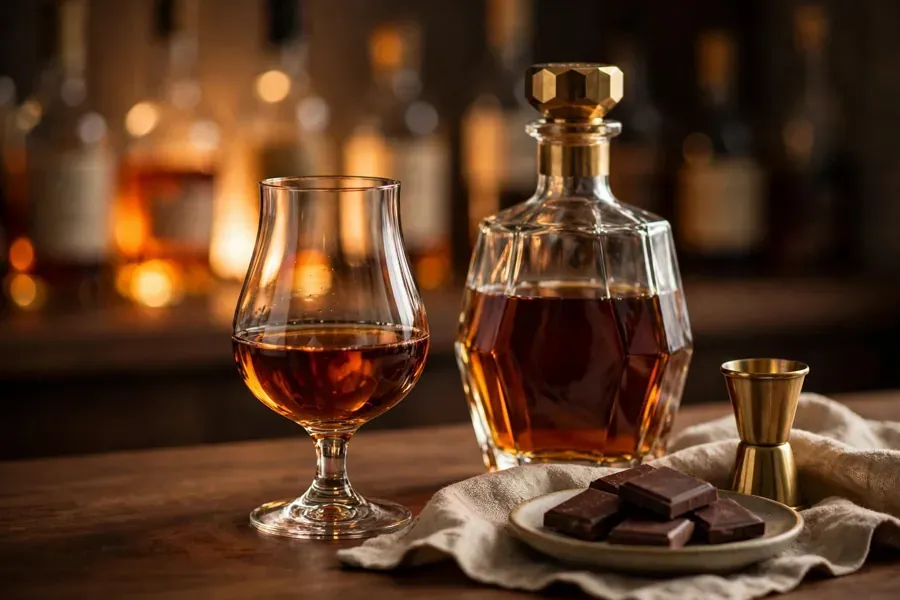
Chateau de las Fonds' cognac guide makes the modern case plainly: the traditional balloon snifter's wide bowl and big surface can let alcohol vapours overpower the delicate notes, and experts increasingly prefer the tulip glass — a smaller bowl with a gently flared lip that channels the aromas upward in balance.
A tulip or a small wine glass, the guide concludes, gives the most balanced experience of the three classic shapes.
Temperature follows the same philosophy of restraint: the ideal range sits between about 18 and 22 degrees — room temperature, honestly measured — and the old ritual of warming the glass over a flame, or cupping it to heat the spirit, is now discouraged by the same authorities, because excess warmth inflates the alcohol and masks the subtleties you paid for.
Ice belongs to youth: a VS or VSOP over a single large cube is a pleasure and no crime, but an XO or Hors d'Âge deserves to be poured neat and given time, warming gradually in the glass and releasing its layers in its own order.
Storage, mercifully, is simple, and both brandies agree on it: bottles stand upright, so the spirit does not sit against the cork, in a cool, dark place — and since brandy stops ageing the moment it is bottled, an opened bottle kept upright and away from light will hold its character for a long, civilised while.
The wine that precedes the brandy at your table deserves the same discipline of glass and pour; our companion piece on wine service at home covers it in full.
The Supporting Cast: Building the Rest of the Shelf
A spirit shelf is an ensemble, and the brandies — for all their seniority — should not stand alone. The most useful building advice in print is also the most modest.
Wine Enthusiast's home-bar essentials starts the whole bar with three bottles — a bourbon or rye, a gin or vodka, and a red bitter amaro such as Campari — because those three build a wide range of cocktails, then adds vermouth, kept in the refrigerator once opened, and an orange liqueur as the budget allows, finishing with the working extras: soda, tonic and ginger beer for highballs; lemons and limes without fail; simple syrup; and bitters, with Angostura the one bottle to own if you own only one.
The Splendid Table's twelve-bottle bar, drawn from David and Lesley Solmonson's book of that name, builds the same architecture a shelf higher: twelve bottles — seven spirits, a liqueur, vermouths and bitters — from which the combinations are, in their phrase, practically limitless, assembled gradually rather than in one expensive gesture.
Around the brandies, then, the mature shelf arranges itself: a bourbon and a rye; a gin and a vodka; a rum with character and a tequila worth sipping; vermouths sweet and dry; one orange liqueur; one bitter; bitters proper; and the tools — shaker, jigger, bar spoon, strainer — kept as faithfully as the bottles.
Add a single malt if your household loves it, an amaro for the end of the evening, and stop. A shelf is finished not when nothing more can be added, but when everything on it is opened, known and loved.
The Two Cocktails the Shelf Must Answer For
A shelf built on brandy owes its guests two cocktails, and both belong to the cognac side of the family.
The Sidecar — cognac, orange liqueur and fresh lemon, shaken and served up, its rim sugared or not as your house prefers — is the great test of a VSOP: bright, structured and unforgiving of a tired bottle, which is precisely why it belongs in the repertoire.
The French 75, in its cognac form, marries the same spirit to lemon, a whisper of sugar and a crown of Champagne, and turns an after-dinner shelf into an aperitif one whenever the evening calls for it earlier than expected.
Oui Cognac's serving guide sets out both, alongside the Vieux Carré — cognac with rye, vermouth and bitters — for the stirred-and-serious drinker, and confirms the division of labour the whole shelf observes: younger cognacs, VS and VSOP, shine on the rocks and in cocktails, while the aged expressions, XO and Hors d'Âge, are kept for slow sipping as digestifs.
Armagnac, for its part, is poured neat and left alone; its character is the cocktail. Master the two drinks, keep the citrus fresh and the Champagne cold, and the shelf behind your bar will never be caught unprepared by a guest's request or a change of mood.
Our Own on the Shelf: The Black Distillers
No shelf in our houses is complete without the bottles that carry our own history in the glass, and the last decade has made that shelf a distinguished one.
Wine Enthusiast's survey of Black-owned distilleries is the standing map: Uncle Nearest, the Tennessee whiskey founded by Fawn Weaver and named for Nathan "Nearest" Green, the enslaved distiller who taught a young Jack Daniel the craft — its 1856 bottling praised there as spicy and well-structured; Ten to One, Marc Farrell's Caribbean rum, built to be, in his phrase, elevated but not exclusive; Fresh Bourbon, Sean Edwards's Kentucky label, which the state recognises for a genuine first — no African American had made Kentucky bourbon there since the days of slavery; and Loft + Bear, Paul Ryan Elliot's Los Angeles distillery, pouring artisanal vodkas from organic wheat and California spring water.
Stock them the way you stock the French brothers — by taste first, and with the pleasure of knowing exactly whose hands and whose story are behind the bar with you. For the guest who takes the evening outdoors with a cigar, the pairing continues in the cigar, chosen well.
Build the shelf slowly, pour from it generously, and keep its two French brothers at the centre — the tailored suit for the evenings that call for polish, the leather jacket for the ones that call for soul. A house is known by what it offers after dinner. Let yours be known for getting it right.
Wine Service at Home: Decanters, Glasses, and the Pour That Honours the Bottle
The Cigar, Chosen Well: Selection, the Humidor, and Smoking Like a Gentleman of Leisure
Building the Cellar, Part I: The Drinking Cellar — Bottles You'll Actually Open
Food Owners — Black Excellence Profiles
The Riedel Shop — "Brandy vs Cognac vs Armagnac"
Premium Grands Crus — "Cognac vs. Armagnac: What Are the Differences?"
Bottle Barn — "Cognac vs. Armagnac: What's the Difference?"
Chateau de las Fonds — "How to Drink Cognac: A Beginner-to-Luxury Guide"
Wine Enthusiast — "You Don't Need to Spend a Fortune to Stock Your Home Bar"
Wine Enthusiast — "10 Black-Owned Distilleries Making Some of America's Finest Bottles"
The Splendid Table — "The 12 Bottles You Need to Stock Your Home Bar"
Oui Cognac — "How to Drink Cognac: Glasses, Cocktails & Serving Guide"
Questions & Answers
Who starts the meal, and when do you put your napkin on your lap?
Behind every great home bar stand two French brothers — cognac and Armagnac, one polished, one soulful — and a shelf built around them with intent: the right grades, the right supporting bottles, and the right glass. It links to 4 stories and articles — open any card to read the full piece.
Who pays when one person invites another to dinner?
Behind every great home bar stand two French brothers — cognac and Armagnac, one polished, one soulful — and a shelf built around them with intent: the right grades, the right supporting bottles, and the right glass.
How do I read the full stories on The Spirit Shelf: Cognac, Armagnac, and the Bottles Behind the Bar?
Choose any card on this page. Each one opens a full page of its own — the complete story or article, with its sources linked.