
Coffee, Tea, and the Morning Rituals of People Who Savour
Luxury tea service etiquette and a rare coffee guide, in one morning: estate teas poured properly, great coffees brewed to the standard, and the quiet ritual that starts the day in houses that do mornings properly.
Before the house wakes, before the first call and the first headline, there is a cup. In houses that do mornings properly, that cup is not an accident of a machine's mood — it is a small, deliberate ceremony, repeated until it becomes the calmest quarter-hour of the day.
This is our guide to building it: luxury tea service etiquette and a rare coffee guide woven together, because the morning ritual of people who savour is rarely about choosing between tea and coffee. It is about refusing to rush either.
Estate leaves and single-origin beans, water at the right temperature, porcelain warmed, a tray carried to the light — the ingredients are simple. The luxury is in the attention.
The Tea Shelf: Estates, Flushes and Seasons
A serious tea shelf is built like a cellar: a few great estates, bought in season, stored with respect.
The cornerstone for many is Darjeeling, the high Himalayan tea that Millennium Hotels' guide to high tea introduces as the "Champagne of Teas" — light, floral and muscatel, pairing, it notes, perfectly with savoury sandwiches, while a rich, malty Assam stands up to scones and clotted cream and an Earl Grey brings its citrus-floral lift to lemon tarts.
Darjeeling's year turns on its flushes — the pickings that mark its seasons — and the first flush, gathered in spring, is the connoisseur's prize: bright, fresh and fleeting.
Rare Tea Company's first flush Darjeeling is plucked, its listing notes, during the April Buddha Jayanti full moon and grown by a Small Growers Cooperative of sixty families — provenance of exactly the kind a morning shelf should be able to recite.
Around the Darjeeling, build outward: a roasted oolong for depth, a delicate white tea for quiet afternoons, a fine green for clarity. Buy loose leaf, always — the leaf needs room to unfurl, and you need to see what you are drinking.
Brewing Tea Properly: Water, Temperature, Time
Tea forgives much, but it does not forgive boiling water on a delicate leaf. Delighted Tea's brewing guide opens with the truth every tea master repeats:
Tea is 99% water, so quality matters.— Delighted Tea, brewing guide
Use fresh, filtered water — never distilled, which brews flat, and never heavily chlorinated tap water. Preheat the pot and the cups so the brew holds its temperature. Then match water to leaf.
Delighted Tea's reference chart and Tea & Peace's master steeping chart agree on the shape of the discipline: white teas at roughly 160–185°F for four to five minutes; green teas cooler still, around 160–180°F for two to three minutes — Japanese greens at the coolest, briefest extreme; oolongs at 185–205°F for three to five minutes; black teas at a full 200–212°F for three to five minutes.
The pattern, as Tea & Peace puts it, is that the more delicate and less oxidised the leaf, the cooler and shorter the brew. If a cup tastes bitter, the water was too hot or the steep too long — and the correction is more leaf, not more time, when you want strength.
Finally, do not throw good leaves away after one steep: quality loose leaf resteeps — whites and greens two or three times, oolongs three to five, each round softer and sweeter than the last. The second cup of the morning, drawn from the same leaves as the first, is one of the ritual's quiet pleasures.
The Service Ritual: Pouring for Someone Else
Morning tea at home is intimate, but the etiquette of tea service scales gracefully from a tray for two to a full afternoon — and its manners are worth learning properly, because they are the manners of care itself. Millennium's etiquette notes begin with the stir: never in circles, never clinking the spoon, but in a gentle six-to-twelve o'clock motion.
Hold the cup by pinching its handle between thumb and index finger — and let the old myth go: the extended pinky, the guide notes, is considered a bit common rather than refined. Break a scone with your fingers rather than cutting it, and dress each small piece with cream and jam as you eat it.
Older etiquette tradition adds the honour at the centre of the ritual: in the classic account preserved by Etiquipedia's etiquette for tea, a hostess may ask a friend "to pour" — to serve the tea for the room while she moves among her guests — and being asked to pour is described as an honour just short of knighthood.
That is the spirit to carry into your own mornings, even at a tray for one: the pouring is the point. Warm the pot, pour with attention, hand the cup across properly, and let the small formality slow everyone down. It is the same grace that governs conversation at altitude — ceremony, used lightly, as a form of respect.
Coffee, Taken Seriously: The Golden Cup
If tea is the morning's meditation, coffee is its craft — and coffee, happily, has a published standard to aim at.
The Specialty Coffee Association's Golden Cup targets, set out in Coffee Brews Hub's guide to the science of extraction, describe a well-extracted cup precisely: an extraction yield of 18 to 22 percent, a strength of 1.15 to 1.35 percent total dissolved solids, brew water at 195–205°F, and a coffee-to-water ratio of about 1:16 to 1:17 for drip and pour-over.
Below that window the cup turns sour and weak; above it, bitter and dry.
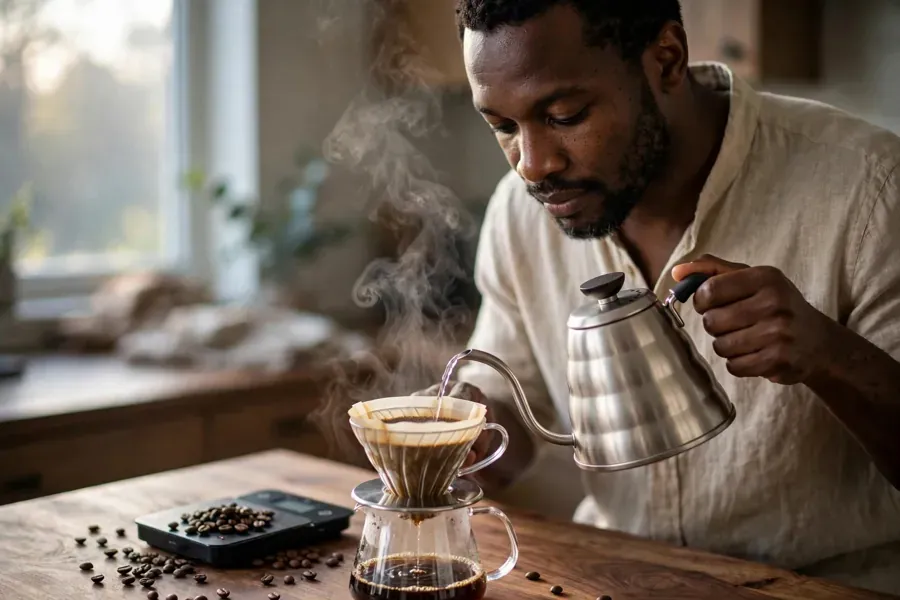
In kitchen language: weigh your coffee and your water — roughly 55 grams of coffee to a litre of water is the classic Golden Cup dose — grind fresh, bloom the grounds with a first small pour and thirty to forty-five seconds of patience so the coffee can release its gas, then pour slowly and evenly.
None of this requires a laboratory. It requires a scale, a kettle that holds a temperature, and the decision that the first cup of the day deserves the same precision you would bring to anything else that matters. Households that master it once find the ritual self-reinforcing: a measured morning tastes like one.
Rare Coffees Worth the Ceremony
At the top of the coffee shelf sit two names every savouring household should know. The first is Gesha — often written Geisha — the variety whose auction lots and tiny harvests have made it the most storied coffee of the modern era.
Its character, as a specialty-coffee guide to Gesha beans describes it, is exceptional aroma and flavour: jasmine, black tea and tropical fruit, with profound sweetness and clarity, a bright acidity, and notes of berries, mango, papaya and mandarin finishing in something like bergamot.
Its price is a function of its difficulty: grown at high altitude — 1,800 to 2,200 metres in that guide's account — with limited yield and precision farming, it is scarcity you can taste. Serve it as a pour-over, black, in a warmed cup, and give it the room its aromatics ask for.
The second name is Jamaica Blue Mountain, the smooth, sweet, meticulously graded coffee of Jamaica's high peaks — listed by a UK specialty-coffee comparison at £40 for 250 grams of green beans from one roaster, a figure that tells you plainly this is a coffee for occasions and for guests who will notice.
Neither coffee is an everyday bean, and neither pretends to be. They are the morning shelf's equivalent of the prestige bottles in a drinking cellar: opened deliberately, shared generously, remembered.
The Roasters on Our Shelf: Black-Owned and Excellent
A Bourgeois Society morning shelf makes room, deliberately, for the Black-owned roasters now setting the specialty standard.
Black America Web's survey of Black-owned coffee brands profiles BLK & Bold, the Des Moines specialty coffee and tea company founded by Pernell Cezar and Rod Johnson — joined as co-owner by Deion Sanders — which pledges 5 percent of its gross revenue to organisations supporting youth.
The same survey introduces Kahawa 1893, founded by third-generation Kenyan coffee farmer Margaret Nyamumbo, built around supporting the women who grow the coffee: customers can tip those farmers through a QR code on the packaging, and Kahawa matches the tips. These are not gestures to stock once and photograph.
They are roasters with real range — blends and single origins across both coffee and tea — that earn a permanent place in the rotation on quality first, with the satisfaction that the money travels well.
Build the shelf as you build any collection in this magazine: the classics, the rarities, and the makers whose work you are proud to serve — then pour, slowly, and let the day begin the way it should. For the evening counterpart to this shelf, see the home bar at the highest level.
Small Disciplines That Change the Cup
Between the great leaves and the great ritual sits a handful of small disciplines, and the brewing guides are unanimous about them. Do not squeeze the leaves when you lift the infuser — Delighted Tea's guide warns that squeezing releases bitter compounds into a cup you have just taken such care over; let it drip, naturally and briefly.
Keep notes when a brew delights you — the leaf, the weight, the temperature, the time — because a ritual you can repeat is worth ten you stumbled into once. Store leaf and bean as the valuables they are: sealed, cool, dark and dry, away from the spice shelf's perfumes.
And widen the morning repertoire beyond the pot and the dripper. Tea & Peace's chart gives matcha its own line — whisked, never steeped, at 165–175°F — and a small bowl of properly whisked matcha, vivid and calming, belongs in the savouring household's rotation beside the Darjeeling and the Gesha: three mornings, three tempers, one unhurried standard.
The same survey of roasters that brought BLK & Bold and Kahawa 1893 to this page points to a wider bench — mindbodygreen's guide to Black-owned coffee brands profiles Red Bay Coffee in the Bay Area, whose tagline is "beautiful coffee to the people," and Memphis's Cxffee Black, whose signature Guji Mane comes from Ethiopia's Sidamo Guji region — while Sunday Morning Coffee, the Black woman-owned roaster founded by Savannah Mitchell, sources from Ethiopia, Kenya, Vietnam, Colombia and Brazil and roasts to order.
A shelf built this way is never finished, and that is rather the joy of it: there is always a new estate, a new flush, a new roaster worth a morning.
The Tray Itself: Composing the Morning
Finally, compose the tray the way you would compose any table in this magazine — because the morning ritual is hospitality, even when the only guest is you. A pot for the table rather than a mug at the counter, so the second cup is a pouring and not a chore.
Porcelain warmed, so the tea keeps its temperature and the coffee its aromatics. Linen under the cup, something green or flowering within sight, the book or the newspaper already chosen, the phone in another room entirely.
Serve a guest the way the high-tea guides describe the room being served — cup pinched properly by the handle, saucer as its landing place between sips, the pour offered before it is asked for — and an ordinary Tuesday acquires the manners of an occasion.
That, in the end, is what people who savour understand about mornings: the day does not become luxurious later, at the gala or the great restaurant. It becomes luxurious here, at the first tray, in the first quiet light, one properly poured cup at a time.
Build the shelf slowly, brew it carefully, pour it for someone you love as often as you pour it for yourself — and the smallest hour of the day becomes the one the whole house is quietly built around.
Conversation at Altitude: Talking Well at Any Table
The Home Bar at the Highest Level: Spirits Worth Their Shelf Space
Building the Cellar, Part I: The Drinking Cellar
The Best Tables in America: How the Five-Star Room Actually Works
Black Excellence Profiles — The Women
Delighted Tea — "Ultimate Tea Brewing Guide: Perfect Temperature & Time for Every Tea Type"
Tea & Peace — "Tea Steeping Times & Temperature Chart"
Coffee Brews Hub — "The Science of Coffee Extraction: A Complete Brewing Guide"
Rare Tea Company — "First Flush Darjeeling, Loose Leaf"
Millennium Hotels — "The Ultimate Guide to High Tea: Tradition, Menus, and Etiquette"
Black America Web — "Black-Owned & Celebrity Coffee Brands to Try"
Etiquipedia — "Etiquette for Tea"
Accio — "Geisha Coffee Beans: Rare, Floral & Premium"
Coffee Diff — "Jamaica Blue Mountain Raw Green Coffee Beans"
mindbodygreen — "Black-Owned Coffee Brands To Shop Online"
Sunday Morning Coffee — "Black-Owned Coffee Brands"
Questions & Answers
Who starts the meal, and when do you put your napkin on your lap?
Luxury tea service etiquette and a rare coffee guide, in one morning: estate teas poured properly, great coffees brewed to the standard, and the quiet ritual that starts the day in houses that do mornings properly. It links to 5 stories and articles — open any card to read the full piece.
Who pays when one person invites another to dinner?
Luxury tea service etiquette and a rare coffee guide, in one morning: estate teas poured properly, great coffees brewed to the standard, and the quiet ritual that starts the day in houses that do mornings properly.
How do I read the full stories on Coffee, Tea, and the Morning Rituals of People Who Savour?
Choose any card on this page. Each one opens a full page of its own — the complete story or article, with its sources linked.