
The In-Law Summit: In-Law Etiquette for Merging Families, Cultures and Holidays
Good in-law etiquette for merging families, cultures and holidays is not about winning the calendar. It is about building one table where both houses can recognize themselves — and be glad they came.
Let us start with the sentence nobody says at the wedding and everybody learns by the second holiday season: you did not only marry a person.
You married a whole way of doing things — how loud a kitchen gets, how long grace lasts, whether gifts are opened in front of everyone or saved for later, and who believes a holiday is ruined if one particular dish is missing.
Sound in-law etiquette for merging families, cultures and holidays begins there, with respect for the fact that the other house is not doing it wrong. They are doing it the way their house has always done it, which is exactly how your house feels about yours.
That is why we call it a summit. A summit is not a surrender and it is not a takeover. It is a meeting between two established powers who intend to remain on good terms for a very long time.
The couple in the middle are the translators, the hosts in training, and — whether they planned it or not — the founders of a third house with customs of its own. Run the summit well and the merged family becomes larger, warmer and more interesting than either side was alone.
Run it carelessly and every November becomes a negotiation nobody enjoys.
every marriage is a cross-cultural experience regardless of whether people are from different or the same cultures. They come from different families and the family they create is a brand new culture that has never existed before.— Dr. John Gottman, via The Gottman Institute
That line, quoted in the Gottman Institute's own guidance on navigating the holidays with in-laws, is the most useful frame we know. If every marriage creates a new culture, then the work is not choosing whose culture survives.
The work is founding the new one deliberately — with a few beloved imports from each side, chosen openly, instead of a quiet contest over whose imports count as normal.
First, the Couple Meets Alone
Every successful summit starts with a private session, and that session is just the two of you. Before either set of parents hears a plan, the couple decides what they actually want: which gatherings matter most to each of you, what a good holiday feels like in your own home, and where your limits honestly sit.
Intercultural-marriage guidance makes the same point in practical terms — partners should talk through expectations about family closeness rather than discovering, in front of an audience, that one of you assumed weekly visits and the other assumed a warm phone call would do.
Notice what that conversation protects. When a husband criticizes his wife's mother to her face, or a wife rolls her eyes at her husband's father's stories, the argument that follows is rarely about the parent. It is about loyalty.
So agree on the house rule early: each spouse speaks to their own parents about difficult things, each spouse defends the other's dignity in every room, and disagreements about the merged calendar happen behind a closed door, never across a dinner table. Your partner's family will forgive a firm boundary delivered by their own child.
The same words from an in-law can echo for years.
It also helps to name the difference honestly when one appears. A spouse who wants to call home daily and a spouse who calls on Sundays are not a devoted child and a cold one. They are two people raised in houses with different temperatures.
Naming it as a house difference — not a character flaw — is the move experienced guides return to again and again, and it lowers the temperature of almost every in-law disagreement we have ever watched.
The Calendar Is Diplomacy
Holidays are where merged families feel the merge, because holidays arrive with assignments attached: this house does the big dinner, that house does the morning, somebody's grandmother expects everybody, always, no exceptions. The established solutions are unglamorous and they work.
You can divide a single day when geography allows it, alternate the major dates from year to year, or mark a nearby day as your own second celebration with the family you did not see on the day itself.
One widely shared guide to splitting the holidays between two families lays out those same three patterns — sharing the day, taking turns across years, and choosing a different date entirely — because couples keep arriving at them independently. They endure because they are fair in a way everyone can see.
Fair, visible and early. Those are the three qualities that matter. Decide the plan while the leaves are still green, communicate it once, kindly and completely, and then do not reopen it under pressure in the final week.
A plan announced early gives the disappointed house time to adjust its own table. A plan announced late feels like a verdict.
And when you deliver it, deliver the whole picture: not only where you will be, but when you will see them next, what you will bring, and what part of their tradition you are carrying into your own home. People can accept missing you at one meal far more easily when they can see themselves honored somewhere in the season.
Our favorite upgrade, when the houses get along, is the one that guide also suggests: stop traveling between the families and bring the families to you. Host, and invite both. Yes, it is more work.
It is also the moment the merge stops being theoretical — two grandmothers in one kitchen, two grandfathers discovering they agree about football and almost nothing else, grandchildren who stop code-switching between houses because there is only one house that day. If you host the summit, you set its tone, and tone is most of the battle.
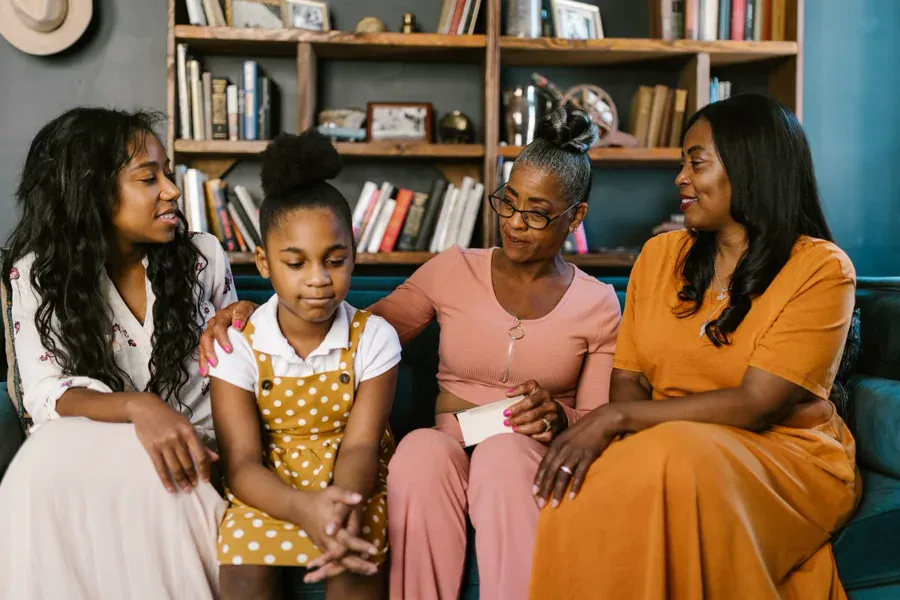
Hosting Both Mothers
Let us speak plainly about the kitchen, because that is where the summit is actually held. Two women who have each run a holiday kitchen for thirty years do not need to be managed. They need to be honored — specifically, publicly and in advance.
The hostess who does this well assigns glory, not chores. One mother is asked for the dish only she can make, and it is named when it is served. The other is given the recipe conversation, the tasting spoon, the first look at the table.
What you must not do is let two proud cooks discover, in real time, that they both believed they were making the centerpiece.
Ask before the day. A short call — “We would love your greens this year, and Mama Rosa is bringing her tamales, so the table will have both” — turns a potential rivalry into a menu. Food is never only food in a merged family.
A dish is a flag planted by love, and the wise host flies both flags. If a tradition involves an ingredient, a fast, a blessing or a preparation rule that is new to you, learn it properly and follow it in your kitchen without commentary. Respect that is visible on the plate is believed.
Respect that is only spoken is audited.
The same courtesy extends beyond food. Faith practices, languages, music, the volume of a toast, whether shoes come off at the door — these are the small surfaces where a guest decides whether your home considers them normal. You do not have to adopt every custom of the other house.
You do have to avoid treating any of them as a curiosity. Ask the question a good host asks — “Show me how your family does this” — and then actually watch. Grandchildren, by the way, are watching too, and what they absorb at these tables becomes their definition of family: wide, fluent and unbothered.
The Seating Chart Is a Peace Treaty
Experienced hosts know that a dinner succeeds or fails on paper, days before it happens, in the seating plan. The merged-family table has one iron rule: never seat the two houses as two houses. A table with one family's end and the other family's end is a border, and borders invite incidents.
Interleave them. Put the uncle who tells stories beside the aunt who loves hearing them, whatever their surnames. Seat the two grandmothers within talking distance — you will be amazed how often the senior generation settles matters the middle generation was still rehearsing.
Place cards earn their keep here. They remove the anxious hovering, the saved seats, the cousin stranded beside the one relative they cannot abide.
They also let you do quiet kindnesses nobody notices: the shy spouse of a sibling gets the warm conversationalist, the elder with hearing loss gets the quieter end and a neighbor who faces her when speaking, the teenager gets an adult who will actually talk to them.
Extension-service guidance on holiday gatherings makes a companion point worth stealing — decide with your partner beforehand how you will handle a tense moment, including a simple signal that means a break is needed. A seating chart prevents most fires. A shared plan handles the rest without a scene.
And give the table something to do together. A question asked by the host — where did your family celebrate when you were ten, what dish traveled with your family from the old place to this one — turns two audiences into one company. Traditions translate beautifully when somebody narrates them with pride.
Half the friction at merged tables is simple ignorance wearing the mask of disapproval; a thirty-second story dissolves it.
Gifts That Honor Both Houses
Gift-giving is the other quiet referendum. The standard is reciprocity of thought, not sameness of price. Learn what each house values: one family prizes the elaborate wrapped present, another prizes food made by hand, another still prizes a contribution in their name or simply your reliable presence with the good rolls.
Give each house its own love language, and never — this is the summit rule — compare the houses' generosity in front of anyone. Children repeat ledgers they overhear. Adults remember them.
For the couple's own giving, one elegant practice is the paired gift: something from each tradition, given together. A cookbook from her family's cuisine beside one from his. A framed photograph of the merged table, sent to both houses after the holiday, identical copies, identical note.
Small symmetries like these are read, correctly, as statecraft. They say the new house keeps its accounts of gratitude evenly, and intends to go on doing so.
Bringing something of your own house into the other house matters just as much. Lifestyle guidance on joining a partner's family celebration returns to this simple gesture — contribute a family recipe or tradition of your own rather than arriving as a spectator at somebody else's holiday.
Offer it lightly, accept graciously if the menu is already set, and serve it next time. The offer itself is the diplomacy.
When the Summit Gets Hard
Some years will test the structure: a new baby both grandmothers want on the same morning, a divorce that doubles the number of tables, a parent whose health changes what is possible. The summit rules still hold. The couple decides together first.
Each spouse carries the news to their own house. The plan is fair in a way that can be explained in one sentence. And nobody litigates old holidays — the year somebody left early, the comment made three seasons ago — because a merged family, like a country, cannot govern itself out of its grievances.
It can only govern itself out of its principles.
Where a real boundary is needed, set it the way the intercultural guides advise: together, briefly, with the alternative included.
“We can't visit weekly, but we can visit monthly and call weekly” — that construction, offered as an example in the intercultural in-law boundaries guide, works because it gives the family a yes inside the no. People defend themselves against refusals. They rarely defend themselves against a different, genuine offer.
Here is the secret the old families know, and it is a happy one: the summit gets easier. Traditions that had to be negotiated the first year become simply “how we do it” by the third. The dish from the other house becomes the dish the grandchildren request by name.
The seating chart stops being a treaty and becomes a habit. What you are building, holiday by holiday, is a family that is fluent in more than one way of loving people — and there is no inheritance you can hand a child that is worth more than watching that fluency practiced, calmly, at a full table.
For the wedding that starts it all, see The Wedding at Full Scale, and for the big merged table itself, The Big Table.
The Wedding Guest Standard: What to Give, Wear, and Never Do
The Quiet Exit: Leaving Boards, Clubs and Circles Well
The Wedding at Full Scale
The Big Table
Society Profiles — Women
The Gottman Institute — “Holidays With In-Laws: A Survival Guide”
Mixed2Match — “The Complete Guide to In-Laws & Family Boundaries in Intercultural Marriage”
Brides of Long Island — “How to Split the Holidays Between Your Family and Your In-Laws”
University of Arkansas Extension — “Navigating the Holidays with your In-laws”
Brit + Co — “6 Ways to Survive the Holidays With Your SO (and Their Family)”
Questions & Answers
What is the first thing to do when you enter a room or sit down to a meal?
Good in-law etiquette for merging families, cultures and holidays is not about winning the calendar. It is about building one table where both houses can recognize themselves — and be glad they came. It links to 5 stories and articles — open any card to read the full piece.
How should a guest answer an invitation?
Good in-law etiquette for merging families, cultures and holidays is not about winning the calendar. It is about building one table where both houses can recognize themselves — and be glad they came.
How do I read the full stories on The In-Law Summit: In-Law Etiquette for Merging Families, Cultures and Holidays?
Choose any card on this page. Each one opens a full page of its own — the complete story or article, with its sources linked.