
Home for the Holidays, Their House: Visiting Parents for the Holidays as a Grown Child
Visiting parents for the holidays as adult children — with a spouse, a baby, and a whole life of your own in the suitcase — is its own etiquette: arrive as family, behave as a guest, and leave the house, and the people in it, better than the season found them.
There is a particular door many of us walk through in the holiday season, and it opens both ways. On one side of it, we are the people we have become — partners, parents, professionals, heads of our own households, keepers of our own standards. On the other side, we are somebody's child, and the house knows it.
The smell of the kitchen reaches parts of us no boardroom ever will. Visiting parents for the holidays is not a trip, exactly, and it is not quite coming home, either.
It is a visit to the house that raised you, made by the adult you turned out to be — and the etiquette of it lives in holding both of those truths at once, gracefully, for the whole stay.
The grown child's advantage is that the rules are not new. They are the same rules that govern any gracious stay, the ones this magazine sets out in Being a Guest: The Weekend Rules — warmed, in this house, by love and history. What changes is the cast.
You may arrive with a spouse who is still learning the family's shorthand. You may arrive with a baby whose schedule answers to no one's tradition. And you arrive at a table where your seat was assigned long before you had opinions about seating.
Here is how the visit goes well — the standing practice, season after season, in houses that do this beautifully.
The Arrival Is the First Gift
A good visit begins before the car is unpacked. The dates are agreed in advance — the day you come and the day you go, said out loud and kept — because a host plans a house around a visit the way a conductor plans around a score.
Professional Courtesy's holiday houseguest guidance puts the plain version first: guests arrive on the day that was settled, and no extra people appear unannounced. In a family house, that courtesy doubles. Your parents are not running a hotel with flexible inventory; they are making up beds, counting chairs, and buying for a number.
Be the number you said you would be.
Then, arrive carrying something. In the houses that raised us, you do not walk in empty-handed — not because your mother keeps score, but because the gesture says the visit is an occasion, not an assumption.
A pie is the classic instrument, and a good one: it travels, it serves the table, it asks nothing of the kitchen before its moment.
A host gift that can be used during the stay or saved after it carries the same thought, and for a longer stay, the gift grows up — a dinner out, a grocery run, something scaled to the welcome. The point is proportion.
What you bring should say, quietly, that you know what a visit costs the people who host it, in groceries and linens and happy exhaustion, and that you came prepared to carry your share of it from the very first hour.
Contribute Without Taking Over
Here is the grown child's central discipline, and it is a finer line than it looks: help, and do not seize. The kitchen you grew up in has a system, and it is not yours anymore. The gravy is made the way it is made.
The good platter lives where it has always lived. Your job is to be gloriously useful inside that system — not to renovate it.
The etiquette authorities are warm and unanimous on the shape of it.
Miss Manners' long-standing counsel to family guests is that considerate guests — children included — clean up after themselves, pitch in on the extra work a full house creates, bring treats, and, on longer stays, take one whole meal off the hosts' hands, either by cooking and shopping for it or by taking everybody out.
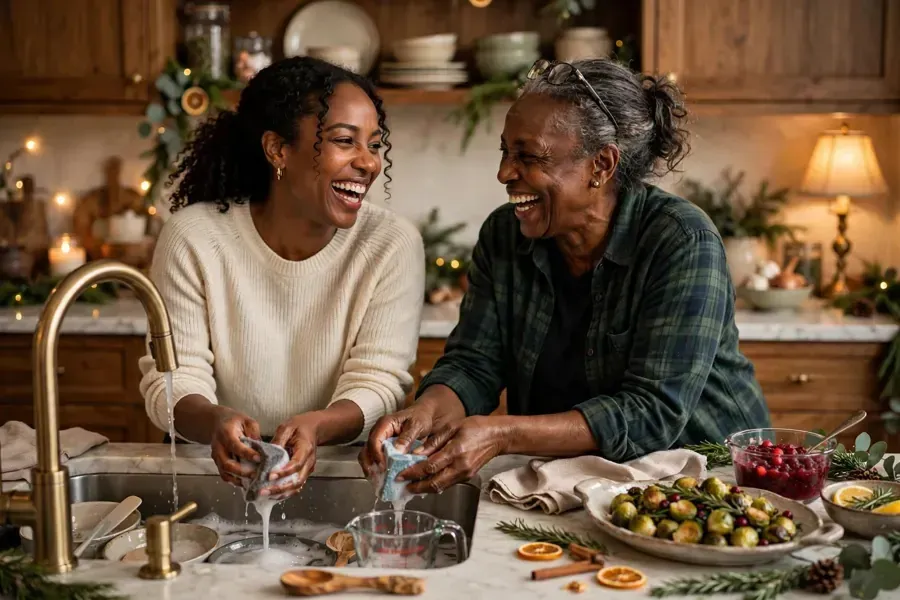
Notice what that list never does: it never hands the guest the house. You offer, you ask where you're wanted, you take the assignment you're given, and you do it completely. Washing up beside your mother while the house settles is not labor; it is one of the great conversations of the year, and it happens at the sink.
TulsaKids' five tips for grown children at their parents' table make the same point from the family's side of the stove: communicate honestly about who is hosting and how, bring a real contribution rather than a token, come early enough to set the table and stay late enough to clear it — and, in time, put your own offer to host on the table, because the generation that has carried the holiday for decades has earned a year as the guests.
That last move, made sincerely and made early, is one of the kindest sentences a grown child can say out loud.
And accept the return courtesy.
Writing on what makes adult children feel genuinely welcome at home, Hackspirit describes parents who let their grown child contribute — accepting the offered dish, the grocery run, the small repair — because being allowed to give something back is part of feeling like a capable member of the household, not a child home from school.
When your mother waves off your help for the third time, that is the moment for gentle insistence, once, with a smile: this is quality time, and the dishes are where it happens. Contribution offered and contribution accepted — that is the whole exchange, and both sides have a part in it.
The Childhood Bedroom, Grown-Up Rules
You will sleep, in all likelihood, in a room that remembers you. Sleep there like a guest anyway. The Emily Post Institute's golden rules for houseguests — published by the house that has taught American manners for a century — begin with a reminder aimed squarely at relatives: guest manners apply even in a family home.
Make the bed. Keep the bathroom clean, down to the ring in the tub and the shaving cream in the basin. Bring your own toiletries.
Keep the visit short and sweet — the Institute's classic ceiling is three nights — and be adaptable, ready for anything the house has planned, or for nothing at all. None of this is cold formality.
It is how a grown person tells the house: I see the work my being here creates, and I refuse to be careless with it.
Two more of the Institute's rules earn their keep in a family house. Do not accept an invitation elsewhere during the visit without checking with your hosts first — the cousin's open house may be lovely, but your parents planned their days around your presence, and disappearing mid-visit without a word is a small wound.
And show that you are enjoying yourself. It sounds simple; it is, in fact, the entire emotional product your hosts are producing. A house full of people performing contentment is a chore.
A house where the grown children are plainly, vocally glad to be there is a holiday.
Bringing Your Partner Into the House's Language
If you arrive with a spouse or a partner, you are their translator, and translation is a duty of love. Your family speaks a dialect built over decades — nicknames, old jokes, references to people your partner has never met, a way of teasing that is pure affection inside the family and pure bewilderment outside it.
Brief your partner before you arrive: who is who, which stories will be told, which uncle holds court, where the land mines of old family business are politely buried. Then, at the table, translate in real time. Explain the joke.
Supply the backstory. Never let the person you brought sit smiling through a conversation conducted entirely in a language they don't yet speak.
Protect their footing in smaller ways, too. Give them a role — a dish they make well, a game they're good at, a walk with your father — because a role is how a newcomer becomes a participant instead of an audience.
Keep some unstructured time in the visit that belongs to the two of you: a morning drive, a walk around the old neighborhood. Hackspirit's account of welcoming houses notes that unplanned hours are often where a visit breathes — nobody needs to be entertained every minute to know they matter.
A partner who gets a little air, a little context, and a job at the table will not merely survive your family's holiday. They will start, slowly, to have a place in it — which is the whole point of bringing them home at all.
Children, Babies, and the Rhythm of the House
Grandchildren change the physics of a visit. The house reorganizes around the smallest person in it, and mostly, that is joy. The etiquette is in the edges.
Your children are yours to supervise — grandparents are a blessing, not a staffing plan — and the household's rhythm still deserves respect: the quiet hour your father keeps, the stairs that are not a playground, the good room that exists.
Beaumont Etiquette's holiday guest guidance adds the modern particulars: belongings kept tidy and contained, the thermostat asked about before it is touched, towels gathered in one place, groceries and morning coffee offered as a matter of course.
With children in tow, add one more: leave every room you borrowed closer to its original condition than childhood nostalgia wants you to bother with. The standard is not perfection. The standard is that your parents should not need a recovery day from the evidence of your stay.
And notice, while you are there — gently, and without turning the holiday into an inspection. A longer visit shows you how your parents are actually doing in their house: the routines holding, the stairs managed, the refrigerator honest. The grown child's job in the season itself is simply to see it, with love.
Anything that wants a conversation can have one later, calmly, at a table that is not set for a feast. The holiday is for being their child and their guest. The watching-over part of love keeps its own calendar.
Money, Handled Like Family
Sooner or later, a generous grown child wonders whether to leave money — for the groceries, the utilities, the sheer scale of the feeding. Miss Manners answered the question directly, and her answer still stands as the house rule: hospitality does not carry a price tag, and paying your mother for your visit mistakes the nature of the gift.
What a guest owes is not reimbursement. It is reciprocity — the treats brought, the meal taken over, the hosts taken out, and, in time, the invitation returned from your own table. If your parents genuinely need support, that is a separate, dignified conversation about family duty, held on its own day and never stapled to a visit.
Keep the two things apart and both stay clean: the holiday remains a gift exchanged, and the help, when it comes, arrives as love rather than as a bill being settled.
The Departure, and the Note That Follows You Home
Leave the way you came: on the day you said, with the house thanked at every stage. Before you go, ask the departure question — would it help to strip the bed and gather the towels, or leave them?
Every host has a preference, and asking is the courtesy; Professional Courtesy's guidance notes the offer itself is always appreciated, whether or not it is taken up. Check the room twice for chargers and children's strays.
Then say the thank-you in person, specifically — not "thanks for everything," but thanks for the meal that mattered, the bed made up, the story at the table you'll be retelling all year.
And when you are home, close the visit the way this magazine believes all hospitality should be closed: on paper. The Emily Post Institute's rule for an overnight stay is a handwritten note of thanks after it — family included.
Yours will land in a mailbox that has received your handwriting since you were small, and it will be kept the way those things are kept in houses like the one you just left.
That is the visit, complete: you arrived as family, you behaved as the finest kind of guest, and you left behind a rested house, a full table's worth of new memories, and proof — in your own hand — that the grown child they raised knows exactly what their welcome is worth.
For the bigger table the season builds around all of it, keep reading The Big Table and The Holiday Season — and when the visit merges two families at once, The In-Law Summit is the companion piece.
The Group Chat Is a Room Too
Being a Guest: The Weekend Rules
The In-Law Summit: Merging Two Families Without Losing Either
The Big Table
The Holiday Season
The Emily Post Institute — "How to Be a Good Houseguest"
Miss Manners, via UExpress — "Hospitality Doesn't Come With a Price Tag"
TulsaKids — "Five Tips For Being a Good Guest at Your Parents' House"
Hackspirit — "8 things parents do that make their adult children feel genuinely welcome at home"
Professional Courtesy, LLC — House Guest Etiquette
Beaumont Etiquette — "How to Be the Perfect Guest This Holiday Season"
Questions & Answers
What is the first thing to do when you enter a room or sit down to a meal?
Visiting parents for the holidays as adult children — with a spouse, a baby, and a whole life of your own in the suitcase — is its own etiquette: arrive as family, behave as a guest, and leave the house, and the people in it, better than the season found them. It links to 7 stories and articles — open any card to read the full piece.
How should a guest answer an invitation?
Visiting parents for the holidays as adult children — with a spouse, a baby, and a whole life of your own in the suitcase — is its own etiquette: arrive as family, behave as a guest, and leave the house, and the people in it, better than the season found them.
How do I read the full stories on Home for the Holidays, Their House: Visiting Parents for the Holidays as a Grown Child?
Choose any card on this page. Each one opens a full page of its own — the complete story or article, with its sources linked.